Plot Explained Spoilers guaranteed!
Plot Explained

Browse by genre

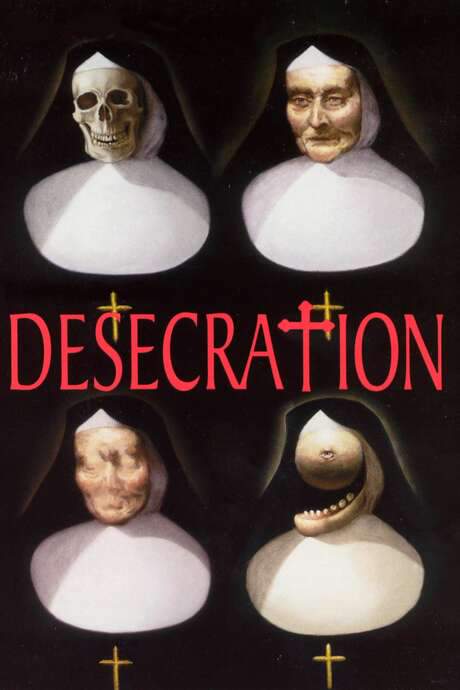
Desecration (1999) movie poster

Plot Summary

Desecration (1999) Plot Summary Explained

Release, runtime and language
1999 · 88 mins · English
Directed by
Dante Tomaselli
Starring
Danny Lopes, Irma St. Paule, Christie Sanford, Vincent Lamberti, Salvatore Paul Piro, Maureen Tomaselli

Sixteen‑year‑old Bobby, still reeling from his mother’s early death, inadvertently kills a nun. The tragedy awakens a series of supernatural forces that pull him deeper into a nightmarish journey toward the very pits of Hell, where a terrifying fate awaits.

On this page (5)
  1. 1 What happens: full plot
  2. 2 Plot questions answered
  3. 3 Movie threads
  4. 4 Movies like Desecration
  5. 5 Every angle

Full plot summary · contains spoilers

What Happens in Desecration: Full Plot Summary

The whole story of Desecration (1999) explained, from the opening scene to the final frame: every key event, every twist and what it all adds up to. Read it as a quick recap before the sequel, to check a scene you missed, or to finally understand what really happened.

A 16-year-old Bobby Rullo is emotionally scarred by the tragic early death of his mother, a wound that leaves him withdrawn, angry, and haunted by grief. Raised in a strict Catholic household, he lives under the watch of his devout grandmother, Grandma Matilda, and a religious father whose rigid beliefs fold into every corner of daily life. The weight of guilt, the pressure to conform, and the sense that every feeling must be measured against an unseen moral code push Bobby toward a fragile edge where adolescence collides with a world of judgment, sin, and eternal consequences. The home environment feels suffocating, and the religious doctrine surrounding him amplifies his confusion as he tries to make sense of his mother’s absence and his own emerging sexuality.

Within the Catholic school he attends, the atmosphere grows even tenser. Surrounded by nuns and priests who emphasize punishment, moral clarity, and the afterlife, Bobby’s mental state becomes increasingly unstable. The daily reminders of sin and consequence—paired with the intimate knowledge that he’s navigating personal loss—push him toward erratic and defiant behavior. The intense scrutiny and the looming specter of divine judgment become constant pressures as he grapples with frightening dreams and waking visions that blur the line between reality and nightmare. The classroom becomes a theater of anxiety where authority figures, even when acting with care, stand as traces of a system that seems designed to test his limits.

The pivotal moment arrives when Bobby, overwhelmed by anger and a breaking point, accidentally causes the death of a stern nun, Sister Madeline. This tragedy is presented not merely as a consequence of misbehavior but as a catalyst that tears open the boundary between the physical world and something far more sinister. In the wake of that incident, a chill runs through the story as Bobby’s surroundings begin to respond to a shift he cannot control. The nun’s death marks a turning point that signals the intrusion of a supernatural dimension into Bobby’s already fractured psyche.

From that moment, Bobby is haunted by increasingly disturbing phenomena that seem aimed at him alone. Grotesque religious imagery comes to life, statues bleed, crucifixes invert, and the walls of his Catholic environment throb with an unsettling, malignant energy. The once-familiar spaces—churches, classrooms, and homes—morph into spaces where fear and the supernatural press in from every corner. The world begins to feel like a dream from which there is no waking, as he slips into a nightmarish limbo that exists somewhere between the living and a hellish realm.

As the boundaries between dream and reality blur, Bobby encounters visions of Hell: landscapes of fire, torment, and the perpetual suffering of the damned. The weight of his mother’s absence, the guilt he carries for the nun’s death, and the rigid, repressive backdrop of his upbringing converge into a single, overwhelming struggle. The oppressive atmosphere of his religious upbringing intensifies his internal battles, turning guilt into a driving force that seems to push him toward an abyss rather than toward redemption. The film depicts his psyche tearing at the seams as he confronts not only external demonic entities and terrifying sights but also the deep, unresolved grief that has taken up residence inside him.

In the climactic arc, Bobby is pulled deeper into the infernal realm as the fighting within him intensifies. He must face a combination of supernatural forces and the internal demons spawned by his traumatic experiences and oppressive environment. The story traces his gradual descent and the moment-by-moment test of his will as he wrestles with guilt, fear, and the enduring ache of loss. It is a journey that asks what it means to confront one’s own past, to stand up to the guilt that clings to the soul, and to seek some form of resolution in a landscape where faith, fear, and the human heart collide. The ending lingers on the tension between punishment and forgiveness, the pull of darkness and the possibility of light, leaving viewers to reflect on how a young life can be shaped—or shattered—by memory, faith, and the shadows that dwell within.
Last updated: October 05, 2025 at 12:21

Was this helpful?

Plot questions answered

Desecration Plot Explained: Your Questions Answered

The questions people ask most about Desecration (1999): what happens in the confusing scenes, why the characters do what they do, the twists, hidden details and what the ending means. Each answer contains spoilers.

Q1

Why does Bobby accidentally kill Sister Madeline?

Bobby kills Sister Madeline during a moment of explosive anger while at Catholic school. Overwhelmed by grief over his mother's death, guilt about his emerging sexuality, and the intense pressure from the rigid religious environment, Bobby reaches a breaking point. The incident is described as potentially reflecting a psychotic break, where his emotional turmoil finally erupts into violence. He didn't intend to kill her, it was an accidental death triggered by his inability to control his emotions in that moment.

Foreshadowing: Earlier scenes establish Bobby's escalating distress through frightening dreams, waking visions, and defiance toward authority figures, hinting at his fragile mental state.

  • bobby
  • sister madeline
  • accidental death
  • catholic school
  • psychotic break
Q2

How does Sister Madeline's death trigger the supernatural events?

Sister Madeline's death acts as a supernatural catalyst that tears open the boundary between the physical world and a hellish spiritual realm. The moment she dies, the veil between worlds is shattered, allowing malignant forces to enter Bobby's reality. This isn't just psychological guilt, it's presented as a literal metaphysical event where the tragedy opens a portal that supernatural entities use to reach Bobby.

  • supernatural
  • veil
  • hell
  • portal
  • spiritual realm
Q3

Why do statues bleed and crucifixes invert around Bobby?

The hostile religious imagery is a manifestation of the supernatural forces that have entered Bobby's world after Sister Madeline's death. Bleeding statues, inverting crucifixes, and pulsing walls represent the demonic entities making the sacred hostile. This hostile environment specifically targets Bobby, intensifying his paranoia and terror. The religious symbols that once represented safety now embody the threat pursuing him.

Foreshadowing: The inverted crucifixes and bleeding statues appear after the veil is torn following Sister Madeline's death.

  • statues
  • crucifixes
  • bleeding
  • inverted
  • demonic
  • religious imagery
Q4

Why is Bobby so haunted by his mother's death?

Bobby's mother's death left him emotionally scarred, withdrawn, and filled with unresolved grief. Growing up in a strict Catholic household where death is framed as sin, punishment, and eternal consequence, Bobby has no healthy outlet for his grief. The religious doctrine teaches him that death carries moral weight, and his mother's absence becomes intertwined with feelings of guilt and abandonment. This trauma is the foundational wound that makes him vulnerable to the supernatural forces.

  • mother
  • death
  • grief
  • trauma
  • childhood
Q5

What does Bobby see when he visions of Hell?

When Bobby descends into the hellish realm, he sees landscapes of fire, torment, and perpetual suffering of the damned. These visions depict the classic imagery of Hell as a place of punishment and damnation. The film uses these sequences to visualize the internal demons Bobby carries, the guilt, grief, and fear of divine punishment that have consumed his psyche. The boundary between dream and waking dissolves, making these hellish visions feel dangerously close to spilling into reality.

  • hell
  • fire
  • torment
  • visions
  • damnation
  • dream
Q6

Why is Bobby pulled deeper into the infernal realm?

Bobby is pulled deeper into the infernal realm because the supernatural forces unleashed by Sister Madeline's death continue to draw him in, but he is also compelled by his own guilt and unresolved trauma. The film presents this descent as both external, demons pulling him into Hell, and internal, his own psyche dragging him toward damnation. The weight of his mother's death, his sexual guilt, and the oppressive religious environment create an internal pull matching the external supernatural pressure.

  • infernal realm
  • descent
  • guilt
  • demons
  • pull
Q7

What happens to Bobby at the end, is he saved or damned?

The ending leaves Bobby at the edge of the infernal realm with his fate unresolved. He remains caught between memories of his mother, the weight of religious law, and the encroaching supernatural forces. The film emphasizes the lasting impact of trauma and oppression on his psyche rather than providing a clear resolution. Whether he is redeemed, trapped in Hell, or transformed is deliberately left ambiguous, forcing viewers to consider themes of punishment versus forgiveness.

  • ending
  • fate
  • redemption
  • damnation
  • ambiguous
Q8

Why does Bobby's Catholic environment become so hostile and nightmarish?

Bobby's Catholic environment turns hostile because the supernatural forces that entered through Sister Madeline's death begin manifesting within the spaces most associated with his guilt and fear. The school, church, and home, places already filled with reminders of sin, punishment, and judgment, become theaters of dread. The religious atmosphere that once constrained him now reflects his internal terror outward, making every sacred space feel cursed and threatening.

  • catholic environment
  • school
  • church
  • hostile
  • nightmarish
Q9

How does Bobby's guilt manifest as supernatural phenomena?

Bobby's guilt manifests as supernatural phenomena because the guilt itself is so overwhelming that it becomes reality-warping. The film presents his guilt over killing Sister Madeline, combined with pre-existing guilt about his mother's death and his sexuality, as a psychological force powerful enough to tear open the veil between worlds. His internal demons literally become external demons, the guilt takes physical form and pursues him through increasingly horrifying manifestations.

  • guilt
  • supernatural
  • manifestation
  • psychological
  • demons
Q10

Why does the oppressive Catholic upbringing affect Bobby so deeply?

The oppressive Catholic upbringing affects Bobby deeply because he has no framework to process grief, sexuality, or anger outside of sin and punishment. Every natural adolescent feeling is framed as sinful, every loss as potential divine retribution. The constant reminders of sin, divine judgment, and eternal consequences create unbearable psychological pressure. Grandma Matilda's unwavering piety and his father's rigid expectations suffocate him, leaving no space for healthy emotional development.

  • catholic upbringing
  • oppression
  • guilt
  • religion
  • pressure

Movie threads

More Movies Like Desecration, by Mood & Story

Curated lists built around what makes Desecration tick: the same mood, the same kind of story or the same emotional payoff. Each list explains why these movies belong together.

Movies about religious horror like Desecration

Stories where oppressive religious guilt manifests as supernatural terror. If you liked the oppressive atmosphere of guilt and supernatural punishment in Desecration, explore these films. This list features movies like Desecration where religion and grief collide, creating stories of psychological breakdown and demonic forces in a rigid moral world.

  • oppressive
  • guilt-ridden
  • macabre
  • supernatural
  • psychological
  • religious
  • Tone: dark, oppressive
  • Pacing: steady, methodical
Why these movies?

The story pattern: These narratives typically follow a protagonist grappling with a profound loss within a rigid religious framework. Their grief and guilt become a doorway for supernatural forces, leading to a linear descent into a nightmarish reality where their faith is tested by literal or psychological demons.

Why they belong together: Movies in this thread are grouped by their shared atmosphere of oppressive religious guilt, the use of supernatural horror as a manifestation of internal trauma, and a heavy emotional weight focused on grief and psychological unraveling.

Movies about a descent into hell like Desecration

Character-driven journeys into surreal and nightmarish psychological landscapes. For viewers who enjoyed the steady, nightmarish journey in Desecration, this list finds similar movies about a descent into hell. Discover films like Desecration that follow a character's psychological or supernatural collapse into a bleak and ambiguous fate.

  • nightmarish
  • surreal
  • anxious
  • claustrophobic
  • psychological
  • bleak
  • Tone: dark, nightmarish
  • Pacing: steady, linear
Why these movies?

The story pattern: The narrative pattern is a steady, downward spiral. A single traumatic event triggers a chain reaction, pulling the protagonist deeper into a claustrophobic and surreal nightmare. The line between reality and psychological breakdown blurs as they move toward an ambiguous, often terrifying, conclusion.

Why they belong together: These films share a core structure of a linear descent, a dark and heavy tone, surreal or nightmarish imagery, and a focus on the protagonist's psychological unraveling amidst overwhelming external and internal forces.

If you liked this

Movies Like Desecration

Similar movies to Desecration: the same genre, themes or kind of story. Each one comes with its own plot summary, timeline and ending explained.

Browse all movie summaries

Every angle

Desecration (1999) Explained: Plot, Timeline & Characters

Everything about Desecration in one place: what happens in the plot summary, the timeline in chronological order, the characters and meaning and a spoiler-free summary. What's After the Movie adds the cast, box office and post-credit scenes.

Coming soon on iOS and Android

The Plot Explained Movie Summary App

Plot summaries, endings explained and timelines on your phone. Catch up on any movie in minutes, save your favorites and never miss a twist again.

Be the first to know when we launch. Your email stays private, always.

Learn more about the app