Plot Explained Spoilers guaranteed!
Plot Explained

Browse by genre

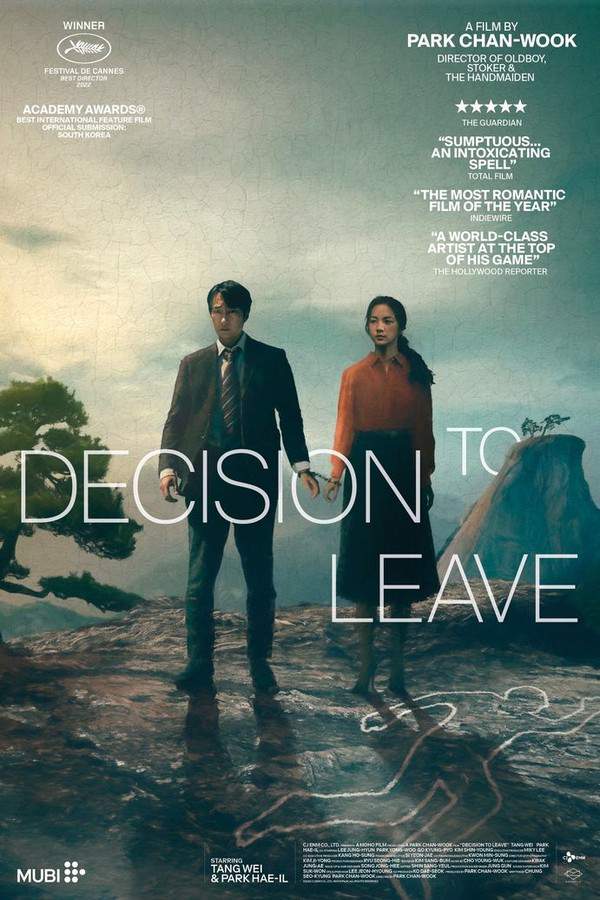
Decision to Leave (2022) movie poster

Plot Summary

Decision to Leave (2022) Plot Summary & Ending Explained

Release, runtime and language
2022 · 138 min · Korean
Echo score 80
JustWatch #4,411 28
Directed by
Chan-wook Park
Starring
Teo Yoo, Wei Tang, Hae-il Park, Hak-joo Lee, Jeong Esuz, Jung-hyun Lee
Budget
$10M

A detective investigates a man's death after he falls from a mountain in South Korea. As he delves deeper into the case, he becomes increasingly drawn to the deceased's mysterious widow, Seo-rae. His pursuit of the truth becomes dangerously intertwined with his own emotions, blurring the lines between professional duty and personal obsession, and leading him down a path where discerning fact from deception proves increasingly difficult.

On this page (7)
  1. 1 Where to watch
  2. 2 What happens: full plot
  3. 3 Plot questions answered
  4. 4 How it ends
  5. 5 Movie threads
  6. 6 Movies like Decision to Leave
  7. 7 Every angle

Where to watch

Where to Watch Decision to Leave (2022)

Where can you watch Decision to Leave? Stream, rent or buy it in the US, including on MUBI, Amazon Video and Apple TV Store: current JustWatch availability with up-to-date prices.

Streaming availability powered by JustWatch

Full plot summary · contains spoilers

What Happens in Decision to Leave: Full Plot Summary

The whole story of Decision to Leave (2022) explained, from the opening scene to the final frame: every key event, every twist and what it all adds up to. Read it as a quick recap before the sequel, to check a scene you missed, or to finally understand what really happened.

An insomniac detective named [Hae-Jun](teo-yoo) is stationed in the thriving city of Busan, where he sees his wife, [Jung-An](junghyun-lee), a diligent nuclear power plant employee, only once a week due to his grueling work schedule. Together with his partner [Soo-Wan](hakjoo-lee), Hae-Jun delves into the peculiar case of a retired immigration officer, [Ki Do Soo](seungmok-yoo), whose lifeless body is discovered at the base of a mountain he frequently ascended. As they investigate, they question the victim's significantly younger wife, [Seo-Rae](wei-tang), who immigrated from China and works as a caregiver for the elderly. Suspicion falls upon her due to her oddly muted reaction to the tragedy, the visible injuries on her body, and a tattoo bearing Ki's initials, reminiscent of how he marked his possessions.

Driven by an unsettling fixation, Hae-Jun conducts nightly surveillance outside Seo-Rae’s residence, consumed by thoughts of her and imagining life within her apartment. Seo-Rae, not oblivious to his presence, begins to follow his other cases. A client of Seo-Rae's provides an alibi, claiming she was with her during Ki's fatal incident. In a moment of dark revelation, Seo-Rae interviews her troubled past, confessing to having hastened her mother's death with fentanyl, fulfilling her terminal wishes. Her mother instructed her to venture to Korea to claim the mountain left to her by her grandfather, a heroic figure from the independence movement in Manchuria.

Hae-Jun and Soo-Wan unearth incriminating letters from Ki, revealing his corruption as an immigration official and hinting at his impending suicide. As Hae-Jun concludes that Ki’s death was self-inflicted, he informs Seo-Rae that she is no longer under suspicion. The two then embark on a heartfelt connection, visiting a Buddhist temple and sharing moments in each other's homes. Seo-Rae meticulously destroys evidence from her husband's case, believing it to be a source of Hae-Jun's insomnia, burdened by unresolved cases.

However, when Hae-Jun substitutes for her client, an unsettling discovery unfolds; both Seo-Rae and her client possess identical smartphones, raising red flags in Hae-Jun's mind. He learns the elderly woman had purportedly conquered 138 flights of stairs on the day of Ki's demise, leading him to surmise that Seo-Rae swapped their phones on that fateful day. Soon, the depth of Seo-Rae's deception becomes painfully clear—she had plotted Ki's murder and crafted a phony suicide note to shield her actions. Hae-Jun tells her she has shattered his professional integrity and feels "broken" since their paths intertwined. He implores her to discard the damning phone into the ocean.

Thirteen months later, Hae-Jun relocates to Ipo, where he lives with [Jung-An](junghyun-lee), wrestling with depression and crippling insomnia. While visiting a fish market, he unexpectedly encounters Seo-Rae, now married to [Im Ho-Shin](yongwoo-park), a business tycoon. Soon after, Ho-Shin's body is found in the mansion's swimming pool, and Hae-Jun can't help but suspect Seo-Rae's involvement. She nonchalantly claims that she drained the pool so Hae-Jun wouldn’t be disturbed by the mess. A Chinese immigrant, [Sa Cheol-Seong](seo-hyunwoo), confesses to killing Ho-Shin, allegedly avenging his mother's financial ruin at Ho-Shin's hands. Despite Sa's claims of Seo-Rae's innocence, Hae-Jun discovers she had visited Sa's dying mother, leading him to believe she injected the final dose of fentanyl into her.

The strain of suspicion takes a toll on Hae-Jun's marriage, prompting [Jung-An](junghyun-lee) to leave, suspecting an affair with Seo-Rae. Hae-Jun confronts her at the mountain left to her by her grandfather, where she unveils a shocking truth—Ho-Shin had threatened to reveal their hidden relationship after discovering a recording of Hae-Jun professing love to Seo-Rae. Although Hae-Jun fails to recall his words, their emotions escalate, culminating in a passionate kiss at the mountain's peak.

As Seo-Rae drives to the sea, Hae-Jun uncovers the phone containing the questionable recording, in which he urged her to destroy evidence from Ki's case. At the beach, Seo-Rae digs a trench in the sand and willingly submits herself to the rising tide, choosing to become an eternal enigma for Hae-Jun. When he finally arrives, he is unable to perceive her presence, standing unknowingly on her unmarked grave. In a desperate search, he calls out for her, overwhelmed by despair.
Last updated: November 16, 2024 at 11:33

Was this helpful?

Plot questions answered

Decision to Leave Plot Explained: Your Questions Answered

The questions people ask most about Decision to Leave (2022): what happens in the confusing scenes, why the characters do what they do, the twists, hidden details and what the ending means. Each answer contains spoilers.

Q1

Why did Seo-Rae kill her husband Ki Do Soo?

Seo-Rae killed Ki Do Soo because she wanted to escape her unhappy marriage to an abusive and corrupt man. Ki was a retired immigration officer who had brought her to Korea as a mail-order bride, and she was essentially trapped. Additionally, the mountain she inherited from her grandfather represented her only path to freedom and a new life in Korea, which Ki threatened to take away from her.

Foreshadowing: Earlier in the film, Seo-Rae mentions her grandfather was a hero from the independence movement in Manchuria, establishing why the mountain carries deep personal significance.

  • seo-rae
  • ki do soo
  • murder
  • motivation
  • abuse
Q2

How did Hae-Jun discover Seo-Rae murdered her husband?

Hae-Jun discovered the truth when he substituted for one of Seo-Rae's elderly clients and noticed that both women had identical smartphones. Realizing the client claimed to have climbed 138 flights of stairs on the day of Ki's death, Hae-Jun deduced that Seo-Rae had swapped phones with her client to create a false alibi, proving she was present at the mountain when Ki died.

Foreshadowing: The investigation initially concluded Ki's death was suicide based on letters revealing his corruption and suicidal thoughts, which Seo-Rae strategically allowed to surface.

  • seo-rae
  • hae-jun
  • discovery
  • murder
  • phone swap
  • alibi
Q3

Why did Seo-Rae drown herself at the end of the movie?

Seo-Rae chose to drown herself because she wanted to remain an eternal mystery for Hae-Jun, preserving their tragic love in an idealized, unattainable form. Having already taken two lives (her terminally ill mother and Ki), and facing exposure of her relationship with Hae-Jun through the recording Ho-Shin possessed, she saw no way forward. Her final act was a deliberate sacrifice that would forever haunt him.

Foreshadowing: The recurring themes of water throughout the film, including the swimming pool scene and Hae-Jun's fear of drowning, foreshadow this tragic conclusion.

  • seo-rae
  • death
  • drowning
  • mystery
  • tragic ending
  • sacrifice
Q4

Did Seo-Rae kill Im Ho-Shin?

While Sa Cheol-Seong confesses to killing Ho-Shin, Hae-Jun believes Seo-Rae was involved. He discovers she had visited Sa's dying mother and concludes she injected the final dose of fentanyl to speed her death, likely as part of a arrangement where Sa would kill Ho-Shin in exchange. This mirrors her earlier act of helping her own mother die peacefully.

Foreshadowing: Seo-Rae's confession about killing her mother with fentanyl establishes her willingness to use the drug for assisted death, which connects to Ho-Shin's death.

  • seo-rae
  • ho-shin
  • murder
  • fentanyl
  • sa cheol-seong
Q5

What was on the recording that Ho-Shin threatened Seo-Rae with?

The recording contained Hae-Jun confessing his love to Seo-Rae and urging her to destroy evidence from Ki's case. Ho-Shin discovered this recording and used it to threaten Seo-Rae, demanding she stay in their marriage or expose their affair. This threat prompted Seo-Rae to arrange Ho-Shin's death.

Foreshadowing: Earlier scenes show Hae-Jun telling Seo-Rae to discard the damning phone into the ocean, demonstrating how invested he was in protecting her.

  • recording
  • ho-shin
  • threat
  • exposure
  • affair
Q6

Why did Hae-Jun tell Seo-Rae to throw away the phone?

Hae-Jun told Seo-Rae to discard the phone containing evidence from Ki's case because he was suffering from severe insomnia caused by unresolved cases. He believed destroying the evidence would free him from his obsession and allow him to move on with his life. This moment marks the beginning of his moral corruption and personal entanglement with Seo-Rae.

Foreshadowing: Hae-Jun's insomnia is established early in the film as his defining psychological struggle, making this request feel like a desperate attempt at relief.

  • hae-jun
  • phone
  • evidence
  • insomnia
  • corruption
Q7

What happened to Hae-Jun's marriage after his encounter with Seo-Rae?

Hae-Jun's marriage to Jung-An collapsed under the weight of his obsession with Seo-Rae. When they relocated to Ipo to start fresh, Hae-Jun remained consumed by depression and insomnia. Jung-An eventually left him, suspecting he was having an affair with Seo-Rae, which his continued obsession with the case seemed to confirm.

Foreshadowing: The film establishes early on that Hae-Jun only sees his wife once a week due to work, showing the fragility of their relationship from the start.

  • hae-jun
  • jung-an
  • marriage
  • divorce
  • depression
Q8

Why was Seo-Rae's reaction to Ki Do Soo's death so muted?

Seo-Rae displayed an unusually subdued reaction to her husband's death because she had planned and executed his murder. Her lack of grief was genuine, as she viewed Ki as an abusive captor who had trapped her in Korea. The tattoo of his initials on her body, which she got to maintain her cover, added to her unsettling demeanor.

Foreshadowing: The investigation notes her physical injuries early on, hinting at the abusive dynamic in her marriage.

  • seo-rae
  • reaction
  • ki do soo
  • murder
  • abuse
Q9

What is the significance of the mountain left to Seo-Rae by her grandfather?

The mountain represents Seo-Rae's only true inheritance and path to freedom in Korea. Her grandfather was a hero from the independence movement in Manchuria, and the mountain was his legacy to her. Ki Do Soo threatened to take this land from her, which became her primary motivation for killing him and reclaiming her autonomy.

Foreshadowing: Seo-Rae reveals her mother instructed her to go to Korea to claim the mountain left by her grandfather, establishing its importance early in the investigation.

  • mountain
  • grandfather
  • independence movement
  • manchuria
  • inheritance
Q10

Did Sa Cheol-Seong really kill Ho-Shin, or was Seo-Rae responsible?

Sa Cheol-Seong confessed to killing Ho-Shin, claiming revenge for the financial ruin his mother suffered due to Ho-Shin's business practices. However, Hae-Jun believes Seo-Rae orchestrated the murder by facilitating Sa's mother's death with fentanyl, creating a situation where Sa would be willing to kill Ho-Shin. The film leaves the exact level of Seo-Rae's direct involvement ambiguous, reflecting the film's theme of uncertain truth.

Foreshadowing: Seo-Rae's pattern of using fentanyl to help people die peacefully, established through her mother's death, connects her to this killing.

  • sa cheol-seong
  • ho-shin
  • confession
  • revenge
  • financial ruin
Q11

Why did Seo-Rae confess to killing her mother with fentanyl?

Seo-Rae confessed to killing her mother because her mother was terminally ill and suffering unbearable pain. Her mother explicitly requested that Seo-Rae help her die peacefully by administering fentanyl. This act reveals Seo-Rae's complicated relationship with death and mercy killing, which becomes a recurring theme in her character arc.

Foreshadowing: This confession establishes Seo-Rae's willingness to use fentanyl for assisted death, foreshadowing similar actions in later killings.

  • seo-rae
  • mother
  • fentanyl
  • mercy killing
  • terminal illness

Ending explained

What Happens at the End of Decision to Leave?

How Decision to Leave (2022) ends, in short: the final scene, the last twist and what it means for the characters. The full ending explained, with every spoiler, lives on its own page.

Read the full ending explained

Hae-joon’s love for Seo-rae drives him to forgive her, understanding that she acted out of a complex mix of despair and self-preservation rather than malice. After discovering that Seo-rae hadn’t directly killed her second husband, but instead orchestrated his death by causing her mother’s, Hae-joon realizes that her actions were driven by her desire to protect herself and those she loved, rather than intent to murder. This deeper understanding of her character ultimately intensifies his feelings and his internal conflict.

At the film’s climax, Seo-rae’s willingness to sacrifice herself reflects her love for Hae-joon. She chooses to disappear into the sea, digging her own grave and waiting for the tide to drown her, as an act of ultimate devotion—believing that by doing so, she can protect him from scandal and free him from the burden of her truth. Hae-joon, arriving too late to save her, searches desperately for her in the rising waters but finds only the spot where she has committed her final act. Her death is ambiguous—it’s left to the audience to interpret whether she truly drowned or simply disappeared into the sea, embodying the tragic and poetic nature of their love story.

Continue reading the ending (1 more paragraphs)

In the end, the film leaves you contemplating the blurred line between duty and love, the moral complexities of their actions, and how far one is willing to go for love. Hae-joon’s unwavering love and Seo-rae’s ultimate sacrifice highlight a love that is as beautiful as it is tragic, ending with a profound reminder of the costs of devotion, the limits of justice, and the sacrifices made in the name of love.

Decision to Leave ending explained in full

Movie threads

More Movies Like Decision to Leave, by Mood & Story

Curated lists built around what makes Decision to Leave tick: the same mood, the same kind of story or the same emotional payoff. Each list explains why these movies belong together.

Obsessive and Melancholic Thrillers like Decision to Leave

Thrillers where professional obsession blurs dangerously into personal ruin. Movies like Decision to Leave that explore the dangerous overlap between professional duty and personal obsession. If you enjoyed the film's moody atmosphere and the slow-burn psychological tension of a detective falling for a suspect, you'll find similar stories of fatal attraction and moral collapse here.

  • obsessive
  • melancholic
  • atmospheric
  • psychological
  • lonely
  • slow burn
  • Tone: melancholic, tense
  • Pacing: steady, slow burn
Why these movies?

The story pattern: The narrative follows a protagonist, often a detective or investigator, who becomes emotionally entangled with their subject. The investigation becomes a conduit for their own loneliness or desires, leading to a blurring of reality and deception, and ultimately, a tragic outcome born from this inextricable bond.

Why they belong together: They are grouped by their shared focus on psychological obsession over physical action, a consistently melancholic tone, and a narrative structure that prioritizes emotional decay over simple mystery resolution. The experience is defined by a heavy, atmospheric sense of dread and doomed romance.

Fatal Attraction Crime Dramas like Decision to Leave

Stories where a criminal investigation becomes a web of desire and deception. Similar crime dramas to Decision to Leave centered on a dangerous romantic entanglement within an investigation. These films feature charismatic but ambiguous suspects, detectives grappling with moral ambiguity, and a pervasive sense of deception that makes the pursuit of truth a deeply personal and devastating endeavor.

  • fatal attraction
  • moral ambiguity
  • deception
  • anxious
  • dreamlike
  • crime
  • Tone: anxious, melancholic
  • Pacing: steady, deliberate
Why these movies?

The story pattern: The plot is driven by a charismatic and enigmatic suspect who captivates the investigator. The traditional 'whodunit' framework is used to explore themes of trust, betrayal, and fatal attraction. The resolution often leaves the protagonist emotionally shattered, having lost their objective footing and often the person they became obsessed with.

Why they belong together: They share a core narrative device: using a crime investigation as the setting for a destructive romance. The mood is consistently anxious and dreamlike, with a focus on moral ambiguity and the emotional fallout of crossing professional lines. The pacing is deliberate, building the central relationship with exquisite tension.

If you liked this

Movies Like Decision to Leave

Similar movies to Decision to Leave: the same genre, themes or kind of story. Each one comes with its own plot summary, timeline and ending explained.

Browse all movie summaries

Every angle

Decision to Leave (2022) Explained: Plot, Ending, Timeline & Characters

Everything about Decision to Leave in one place: what happens in the plot summary, the timeline in chronological order, the characters and meaning, the ending explained and a spoiler-free summary. What's After the Movie adds the cast, box office and post-credit scenes.

Coming soon on iOS and Android

The Plot Explained Movie Summary App

Plot summaries, endings explained and timelines on your phone. Catch up on any movie in minutes, save your favorites and never miss a twist again.

Be the first to know when we launch. Your email stays private, always.

Learn more about the app