Plot Explained Spoilers guaranteed!
Plot Explained

Browse by genre

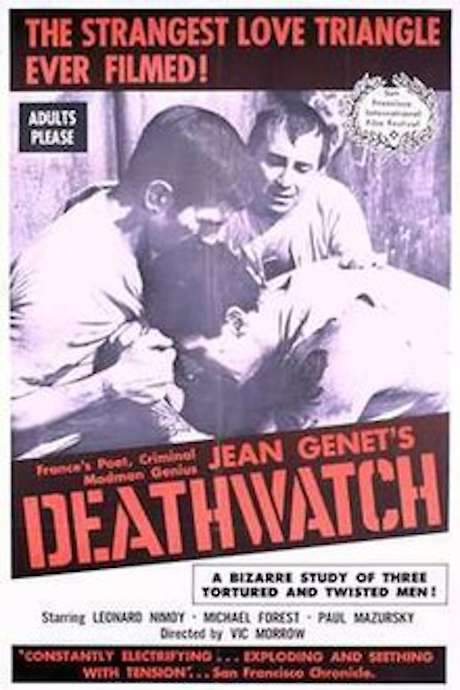
Deathwatch (1966) movie poster

Timeline

Deathwatch (1966) Timeline Explained – Every Event in Order

Release, runtime and language
1966 · 88 mins · English
Loading streaming availability…
Directed by
Vic Morrow
Starring
Leonard Nimoy, Paul Mazursky, Gavin MacLeod, Robert Ellenstein, Michael Forest, Andre Tayir

Homosexual outlaws on a rampage! Based on a play by Jean Genet, a small-time thief battles with his gay cellmate over a third illiterate, muscular convict.

On this page (6)
  1. 1 Where to watch
  2. 2 Events in order (12)
  3. 3 Timeline questions answered
  4. 4 Movie threads
  5. 5 Movies like Deathwatch
  6. 6 Every angle
Loading streaming availability…

12 events in order · contains spoilers

Deathwatch Timeline: Events in Chronological Order

Every key event of Deathwatch (1966) in order, scene by scene, with when and where it takes place. Use it to untangle flashbacks, time jumps and parallel storylines, to refresh your memory before the sequel or to find the exact scene you are thinking of.

  1. Greeneyes' illiteracy and Lefranc reading aid

    Greeneyes cannot read or write, so Lefranc reads his wife’s letters aloud and translates his thoughts into replies. Lefranc's skill makes him indispensable to Greeneyes, and their bond forms in the claustrophobic prison environment. The living arrangement is tense as life sentences loom.

    Where
    Prison cell
  2. Wife learns the letters weren't written by Greeneyes

    Lefranc relays letters to Greeneyes' wife; she discovers Greeneyes didn't actually write them. This revelation shatters his romantic image and triggers anger. Greeneyes plots to have her killed after release, wanting either cellmate to carry it out.

    Where
    Cell block
  3. Greeneyes' rage and murderous plan against his wife

    Upon learning the deception, Greeneyes erupts in rage and resents the life he cannot escape. He explicitly wants his wife dead and instructs his cellmates to kill her after their release. The threat sets a chilling tone for the prison’s power dynamics.

    Where
    Cell block
  4. Greeneyes breaks down in confinement

    Greeneyes later collapses under the weight of his confinement and unchangeable fate. He laments being trapped in a prison of his thoughts and actions, realizing he cannot pivot his life. The moment hints at his inner dissolution before a mandated prison visit.

    Where
    Cell
  5. Visitation day: Greeneyes visits his wife

    Greeneyes is taken away from the cell for a visit with his wife. The visit briefly softens him and shifts his perspective on his own plan. The encounter also signals evolving loyalties among the inmates.

    Where
    Visiting area
  6. Maurice and Lefranc seek Greeneyes' favor

    While Greeneyes is away, Maurice and Lefranc compete to prove themselves as the most capable inmate. Each believes that winning Greeneyes’ favor will secure a better place in the rough social hierarchy of the cellblock. Their rivalry foreshadows the tensions to come.

    Where
    Prison yard / common area
  7. Greeneyes returns and spares his wife

    Upon returning, Greeneyes no longer wants his wife dead and instead offers her to a guard. This gesture indicates a shift away from murder toward survival within the prison’s power structure. The guard-friendly arrangement introduces a new chain of influence.

    Where
    Prison corridor / visiting area
  8. Guard connection and Snowball's contraband

    The guard, who has ties to Greeneyes, supplies contraband that originates from Snowball, a powerful inmate. This exchange strengthens Greeneyes’ tenuous grip on safety inside the prison. Lefranc remains suspicious of who truly controls the prison’s favors.

    Where
    Guard station
  9. Lefranc grows disillusioned with Greeneyes and Snowball

    Lefranc begins to see that Greeneyes and Snowball are aligned with the guards, undermining any real sense of loyalty. Despite this, he still craves Greeneyes’ respect and the power that might come with it. The realization deepens his isolation from both men.

    Where
    Cell block
  10. Tattoo reveal and Maurice’s taunt

    Maurice exposes Lefranc’s tattoo, which turns out to be painted on. The moment deflates Lefranc’s confidence and invites a new round of taunting. The illusion of equal standing among the inmates fractures further.

    Where
    Prison yard
  11. Lefranc strikes: the murder of Maurice

    Overwhelmed by jealousy and the fragile power dynamic, Lefranc strangles Maurice to death. He expects Greeneyes to praise him, but Greeneyes is repulsed and alerts the guards. The act marks a brutal turn toward irreversible consequences.

    Where
    Cell block / yard
  12. The outcome: Greeneyes condemns the path to murder

    Greeneyes expresses disgust at Lefranc’s violent act and reinforces his own moral distance from Lefranc’s methods. Lefranc is left realizing he will never become the kind of man Greeneyes is. The incident underscores the brutal reality of prison power and the fragility of criminal hierarchy.

    Where
    Prison yard / guards’ area

Last updated: October 05, 2025 at 11:27

Was this helpful?

Timeline questions answered

Deathwatch Timeline Explained: Your Questions Answered

When does it happen, and why in that order? The questions people ask about the chronology of Deathwatch (1966): time jumps, flashbacks, cause and effect between scenes and the correct order of events, each answered with spoilers.

Q1

Why does Greeneyes want his wife killed after she stops writing?

When Greeneyes' wife learns that he never actually wrote the letters, she discovers Lefranc was writing them for him, she stops writing to him. Greeneyes sees this as losing control over his own fate and responds with rage, instructing his cellmates to kill her after they're released. This stems from his illiteracy making him feel powerless and his desire to reclaim some control over his life, even through violence.

Foreshadowing: Earlier, Greeneyes relies entirely on Lefranc to communicate with his wife, establishing his dependency and the fragility of their connection.

  • greeneyes wife
  • letter writing
  • illiteracy
  • control
  • murder plot
Q2

Why does Lefranc read and write letters for Greeneyes?

Greeneyes is illiterate, he cannot read or write. Lefranc, a jewel thief, serves as his interface with the outside world by reading his wife's letters aloud and translating Greeneyes' responses into written replies. This makes Lefranc indispensable to Greeneyes and forms the basis of their cellmate bond.

  • lefranc
  • greeneyes
  • illiteracy
  • letters
  • prison bond
Q3

What happens when Greeneyes' wife finds out he didn't write the letters?

Greeneyes' wife gradually realizes that the letters she received were not actually written by her husband. Upon discovering the deception, she loses interest in corresponding with Greeneyes and stops writing. This betrayal of the romantic image she held shatters Greeneyes and triggers his violent rage.

Foreshadowing: The entire communication system is built on Lefranc's deception from the start, making discovery inevitable.

  • wife letters
  • deception
  • greeneyes wife
  • prison letters
Q4

Why does Greeneyes give his wife to a guard instead of having her killed?

After his prison visit with his wife, something shifts in Greeneyes. Rather than having her killed as he previously planned, he gives her away to a guard who is friendly with him. This represents a pivot from seeking violent revenge to accepting survival within the prison's existing power structure. The guard reciprocates by supplying contraband from Snowball, strengthening Greeneyes' position.

Foreshadowing: The visit with his wife softens him and causes him to reconsider his murderous plan.

  • greeneyes wife
  • guard
  • prison visit
  • survival
Q5

Why does Lefranc murder Maurice in Deathwatch?

Lefranc kills Maurice out of jealousy and a desperate attempt to prove himself. After Maurice exposes Lefranc's fake tattoo and taunts him, Lefranc snaps and strangles Maurice to death. He expects Greeneyes to praise him for demonstrating the same ruthless capability that defines Greeneyes' status among inmates.

Foreshadowing: The rivalry between Maurice and Lefranc for Greeneyes' favor builds throughout, with both men competing to prove their worth.

  • lefranc
  • maurice
  • murder
  • strangling
  • rivalry
Q6

What is the significance of the fake tattoo reveal?

Lefranc paints a tattoo on himself to appear tougher and more established in the prison hierarchy, hoping to gain Greeneyes' respect and favoritism. When Maurice exposes the tattoo as fake, it deflates Lefranc's claim to status and exposes him as a fraud. This humiliation triggers his violent response and murder of Maurice.

Foreshadowing: The tattoo represents Lefranc's desperation to elevate his status among the inmates.

  • tattoo
  • fake
  • maurice
  • lefranc
  • status
Q7

Why does Greeneyes react with disgust when Lefranc kills Maurice?

Greeneyes is disgusted because murder represents a line he won't cross, even in prison. Despite his violent reputation, he maintains a moral distance from such acts. When Lefranc kills Maurice expecting praise, Greeneyes instead alerts the guards, condemning Lefranc's method. This reveals that Greeneyes operates by his own code of survival that doesn't include unnecessary murder.

Foreshadowing: Earlier, Greeneyes shifts from wanting his wife dead to giving her away, showing his preference for survival over violence.

  • greeneyes
  • lefranc
  • maurice
  • murder
  • disgust
  • guards
Q8

How do Greeneyes and Snowball work with the guards?

Greeneyes maintains a friendship with a guard who supplies him with contraband. This contraband actually comes from Snowball, another powerful inmate. Lefranc realizes that both Greeneyes and Snowball are aligned with the guards, creating an internal prison economy and power structure that favors certain inmates. This connection explains how Greeneyes maintains his status despite being on death row.

Foreshadowing: The guard's friendly relationship with Greeneyes is established early when he facilitates the visit with Greeneyes' wife.

  • snowball
  • guards
  • contraband
  • greeneyes
  • prison power
Q9

Why does Lefranc become disillusioned with Greeneyes?

Lefranc realizes that Greeneyes and Snowball are both working with the guards, not operating outside the system as he initially believed. This discovery undermines his romanticized view of Greeneyes as a true outlaw. However, despite this disillusionment, Lefranc still craves Greeneyes' respect and the power that comes with it, driving his later desperate actions.

  • lefranc
  • disillusionment
  • greeneyes
  • snowball
  • guards
Q10

What does Lefranc realize at the end of Deathwatch?

After killing Maurice and expecting Greeneyes to embrace him as an equal, Lefranc is horrified when Greeneyes betrays him by alerting the guards. Lefranc realizes he will never be the kind of man Greeneyes is, someone who can maintain status without resorting to unnecessary violence. The ending underscores the brutal reality of prison hierarchy and the futility of trying to prove oneself through murder.

Foreshadowing: Greeneyes' earlier shift from murder to survival foreshadows his rejection of Lefranc's violent approach.

  • ending
  • lefranc
  • greeneyes
  • realization
  • betrayal
  • tragic

Movie threads

More Movies Like Deathwatch, by Mood & Story

Curated lists built around what makes Deathwatch tick: the same mood, the same kind of story or the same emotional payoff. Each list explains why these movies belong together.

Confinement power plays like in Deathwatch

Stories where volatile relationships unravel in tight, oppressive spaces. If you liked the tense psychological battles and oppressive setting of Deathwatch, explore more movies about volatile power dynamics in confined worlds. These films capture the desperate struggle for control in places like prisons, submarines, and isolated institutions where alliances are fragile and survival is a brutal game.

  • claustrophobic
  • oppressive
  • volatile
  • desperate
  • brutal
  • psychological tension
  • Tone: dark, oppressive
  • Pacing: steady, building tension
Why these movies?

The story pattern: A narrative pattern where characters are physically or socially trapped, leading to escalating conflicts over dominance and submission. The plot is driven by shifting alliances, betrayals, and the psychological toll of living under constant threat, typically culminating in a devastating outcome for the characters.

Why they belong together: These films are grouped together because they share a core focus on the intense psychological and emotional effects of confinement, creating a consistent mood of claustrophobia, desperation, and high-stakes interpersonal conflict. They often feature a bleak or tragic tone and a steady pacing that builds dread.

Bleak stories of masculinity like Deathwatch

Raw portrayals of men confronting their own futility and fragile identities. For viewers who appreciated Deathwatch's exploration of male identity, power, and despair, this collection features similar movies about men in crisis. These dramatic films examine volatile masculinity, homoerotic tensions, and existential dread, often ending on a bleak note without redemption.

  • desperate
  • melancholic
  • brutal
  • existential
  • volatile
  • psychological
  • Tone: dark, melancholic
  • Pacing: steady, character-driven
Why these movies?

The story pattern: The narrative follows a male protagonist or group of men as their constructed identities and relationships are tested to the breaking point. The journey typically involves a confrontation with desire, violence, and the futility of their struggle, leading to a conclusion that offers no solace or redemption, only a deeper sense of despair.

Why they belong together: Movies in this thread are connected by their profound and critical look at masculine identity in states of crisis. They share a heavy emotional weight, a dark or bleak tone, and a focus on complex, often destructive relationships between men, resulting in a consistently somber and thought-provoking viewing experience.

If you liked this

Movies Like Deathwatch

Similar movies to Deathwatch: the same genre, themes or kind of story. Each one comes with its own plot summary, timeline and ending explained.

Browse all movie summaries

Every angle

Deathwatch (1966) Explained: Plot, Timeline & Characters

Everything about Deathwatch in one place: what happens in the plot summary, the timeline in chronological order, the characters and meaning and a spoiler-free summary. What's After the Movie adds the cast, box office and post-credit scenes.

Coming soon on iOS and Android

The Plot Explained Movie Summary App

Plot summaries, endings explained and timelines on your phone. Catch up on any movie in minutes, save your favorites and never miss a twist again.

Be the first to know when we launch. Your email stays private, always.

Learn more about the app