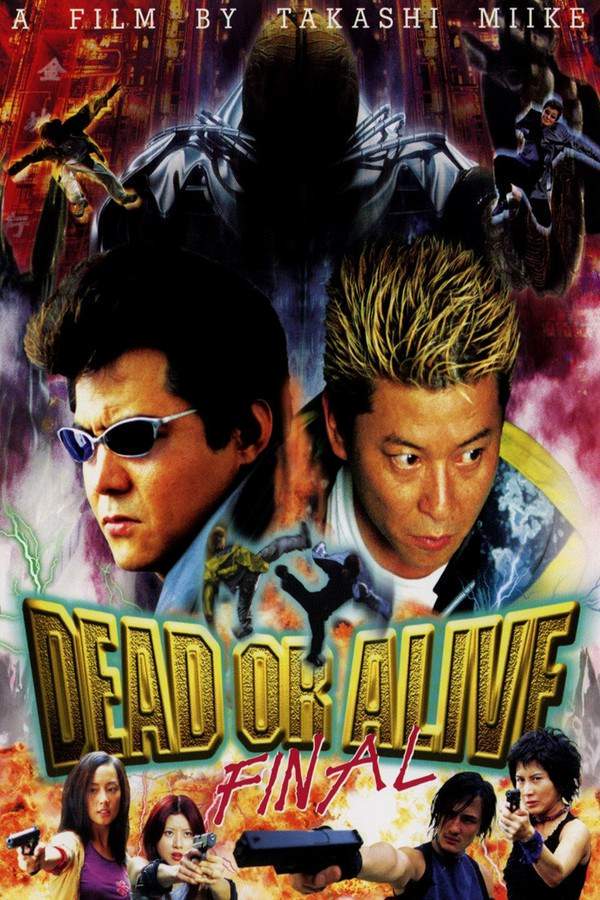
Mizuki, Show Aikawa, is an assassin caught in a murky clash between rival gangs as a yakuza-triad turf war rages around him. He’s hired to take out an officer from the opposing side, but just as he’s lining up his shot, someone else reaches the target first. The mystery killer’s presence jolts Mizuki—he recognizes the person but cannot recall who they are in his own memory. Back at his base, he lies about a successful hit, pocketing the contractor’s money and moving on with a dangerous, self-preserving calm.
As he digs deeper, Mizuki discovers that the other assassin has adopted the name Mizuki Kohei, and the pursuit escalates into a personal hunt across city shadows and ferry rides. When he phones to arrange a booking, a violent encounter with his own contractors forces him to vanish for a time. He chooses to retreat to his childhood home, a remote island off the coast of Japan, hoping distance will dull the flare of danger that keeps burning at his heels. The other killer, now fearing the heat of the chase, also disappears into hiding. Both men seek solace in small, ordinary rituals—buying noodles as they recall trips to the mainland as children.
On the ferry to the island, Mizuki spots his counterpart again and follows him ashore, where the two finally confront one another. The meeting dissolves into a confession: the other fighter’s given name is Shuuichi. Instead of violence, they decide to pause their killings and reconnect with memories from their past. What unfolds is a long flashback that paints a shared history: a beach, a lifelike routine at a Catholic-oriented orphanage, and a bond forged amid the ordinary rhythms of childhood.
The younger years are shown in vivid vignettes. Mizuki, Shuuichi, and their friend Kohei inhabit a world that feels safe and almost sacred, despite the harshness of the orphanage. The head of the orphanage, Yūichi Minato, presides over their days with a stern but caring hand, even as the family unit fractures when Mizuki is adopted into life on the mainland. Letters from home arrive—some real, some fabricated—to keep a tether that slowly unravels as Mizuki’s adoptive family life ends in tragedy. In the years that follow, the trio grows up apart but remains tied to the island’s schoolyard and to the old film reels that capture their past adventures.
Back in the present, Kohei’s wife, Noriko Aota, enters the narrative as a stabilizing link to the children they once were. The grown men accompany Kohei to his home, where he and his wife host them and encourage visits to the orphanage’s burned, immobile guardian. They watch a trove of Super 8 clips that record their shared innocence, while a traveling theater troupe arrives on the island and, through an accident, still manages to light up the island’s children with a small, improvised performance. Meanwhile, the violence on the mainland intensifies and becomes increasingly unsustainable for all involved.
As the island memories deepen, Kohei’s wife spots a newspaper clipping that reveals Shuu’s connection to the initial killings, and someone else witnesses the old guardian watching a news item identifying them as assassins. The two men, moved by their revisited past and a desire to make amends, decide to team up against their former employers. They pool their money into water supplies and medicines for African children, transforming their seemingly senseless violence into a mission with a humanitarian edge. Their earnings soar, the plan seems to work, and Shuu reveals that he is living with a deteriorating medical condition.
The two assassins press on, defeating the last guard sent by the gangs, but their bodies bear the scars of the struggle. They choose to return to the island for a final, quiet reckoning. They eat noodles together one last time, and Mizuki dies in Shuu’s arms, the two of them sharing a final moment before the harbor’s horizon swallows them. They carry Mizuki’s body up a hillside, overlooking the sea, and the scene cuts to childhood images that bind their fates together even in death. The film closes with a stark insert, a question pressed into the air: > WHERE ARE YOU GOING? Then Kohei and Chi return from the hospital with their newborn baby, underscoring a fragile thread of life that persists beyond violence and memory.
In this restrained, contemplative arc, the film blends intimate memory with brutal reality, turning two old friends—now bitterly worn—into unlikely allies who fight not just enemies but the despair that lingers after violence. The story lingers on choice, memory, and the quiet dignity of trying to heal a world threaded with pain.