Plot Explained Spoilers guaranteed!
Plot Explained

Browse by genre

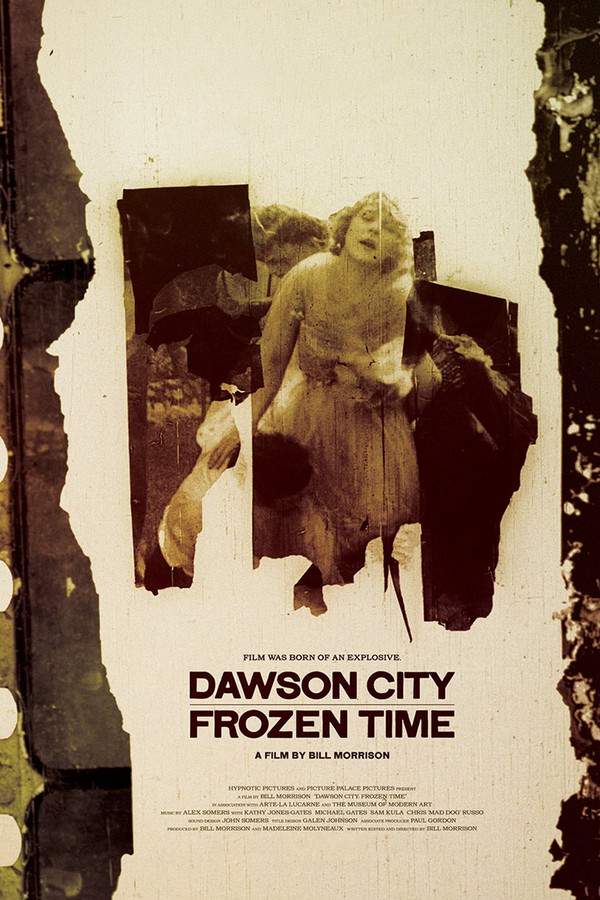
Dawson City: Frozen Time (2017) movie poster

Timeline

Dawson City: Frozen Time (2017) Timeline Explained – Every Event in Order

Release, runtime and language
2017 · 120 min · English
Echo score 78
Loading streaming availability…
Starring
Bill Morrison, Bill O'Farrell, Chris 'Mad Dog' Russo, Kathy Jones-Gates, Michael Gates, Sam Kula

In the Yukon's unforgiving past, a remarkable discovery was made: 533 forgotten film prints from the early 1900s, preserved in the permafrost of Dawson City, a town once bustling with the Canadian Gold Rush. Directed by Bill Morrison, this unique documentary explores the history of this lost film collection, using rare silent films, newsreels, and archival footage to tell the story of their exile, accidental burial, and eventual rediscovery and restoration. It’s a poignant reflection on the fragility of film and the power of preservation.

On this page (6)
  1. 1 Where to watch
  2. 2 Events in order (15)
  3. 3 Timeline questions answered
  4. 4 Movie threads
  5. 5 Movies like Dawson City: Frozen Time
  6. 6 Every angle
Loading streaming availability…

15 events in order · contains spoilers

Dawson City: Frozen Time Timeline: Events in Chronological Order

Every key event of Dawson City: Frozen Time (2017) in order, scene by scene, with when and where it takes place. Use it to untangle flashbacks, time jumps and parallel storylines, to refresh your memory before the sequel or to find the exact scene you are thinking of.

  1. Trʼondëk Hwëchʼin Homeland

    Long before fortune seekers arrived, the lands at the confluence of the Yukon and Klondike rivers were home to the Trʼondëk Hwëchʼin people. The film portrays how these native lands stood on the threshold of a transformation that would change them forever. Their traditional way of life was about to collide with one of history's great gold rushes.

    When
    Late 19th century
    Where
    Dawson City, Yukon, Canada
  2. The Klondike Gold Rush

    The discovery of gold in the Klondike triggered a stampede of prospectors into one of the most remote corners of North America. The influx of gold seekers turned the native lands into a rough and lawless frontier. This flood of newcomers set the stage for the birth of Dawson City.

    When
    1896–1899
    Where
    Klondike region, Yukon
  3. A Boomtown Is Born

    Dawson City grew rapidly from a small settlement into a booming frontier town. Saloons, theaters, and businesses sprang up almost overnight to serve the thousands of fortune seekers. The town became the vibrant heart of the Klondike Gold Rush.

    When
    Late 1890s
    Where
    Dawson City, Yukon
  4. An Entertainment Hub of the North

    Amid the gold fever, Dawson City flourished as a major entertainment hub. Performances and amusements connected the isolated frontier to the culture of the wider continent. The boomtown offered miners a taste of civilization at the edge of the wilderness.

    Where
    Dawson City, Yukon
  5. Silent Era Hollywood Reaches the Frontier

    During the silent era, Hollywood films made their way north and screened in Dawson City's venues. The reels captured the dawn of 20th century America and became part of the town's entertainment life. Unknowingly, the remote town was accumulating what would later become a priceless cinematic time capsule.

    When
    Early 20th century
    Where
    Dawson City, Yukon
  6. Industrial Monopolies Take Hold

    As the gold rush waned, industrial monopolies moved in and reshaped Dawson City. Large corporate interests came to dominate the local economy, squeezing out independent prospectors and small businesses. The freewheeling spirit of the boomtown gradually gave way to corporate control.

    Where
    Dawson City, Yukon
  7. Decline and Poverty of Resources

    With the gold exhausted, Dawson City entered a long period of decline. A poverty of resources set in, and the once-thriving entertainment hub began to fade. The town slowly became a shadow of its former glory.

    Where
    Dawson City, Yukon
  8. The Films Are Buried in Permafrost

    Over time, thousands of film reels ended up buried beneath the permafrost of a decommissioned swimming pool in Dawson City. The frozen ground ironically preserved the highly flammable nitrate film that would otherwise have decayed or burned. For decades, the reels lay frozen and forgotten.

    Where
    Dawson City, Yukon
  9. City of Gold Captures the Faded Town

    The 1957 documentary City of Gold captured Dawson City in the shadow of its former glory. The film brought attention to the ghostly remnants of the great boomtown. It immortalized the town's faded splendor just two decades before an extraordinary discovery would be made there.

    When
    1957
    Where
    Dawson City, Yukon
  10. The Dawson Film Find

    In 1978, crews unearthed 533 reels of nitrate film beneath the permafrost of the decommissioned swimming pool. The discovery, later known as the Dawson Film Find, revealed an astonishing trove of silent-era cinema. The frozen reels contained rare fragments of the dawn of the 20th century.

    When
    1978
    Where
    Dawson City, Yukon
  11. Saving the Chemically Volatile Reels

    The unearthed nitrate film was chemically volatile and dangerously unstable, posing serious preservation challenges. Brief interviews with those who saved the reels recount the careful handling required to keep them from deteriorating. Their quick action rescued an irreplaceable piece of film history.

    When
    1978
    Where
    Dawson City, Yukon
  12. Commercial Delivery Services Refuse the Job

    Transporting the unstable nitrate reels proved to be a major obstacle. Commercial delivery services refused to carry the volatile cargo because of the risks involved in moving such dangerous objects. The precious find appeared stranded in the north with no way to reach preservation experts.

    Where
    Dawson City, Yukon
  13. The Canadian Armed Forces Step In

    With commercial options exhausted, the Canadian Armed Forces were assigned to transport the fragile film reels. The military took on the delicate task of moving the chemically volatile cargo out of the Yukon. Their involvement ensured the reels would finally reach professional hands.

    Where
    Dawson City, Yukon
  14. The Reels Reach Ottawa and Washington D.C.

    The recovered reels were delivered to their final destinations in Ottawa and Washington D.C. There, film archives could properly preserve and study the rare silent-era footage. The journey from a frozen swimming pool to national archives completed one of cinema's most remarkable rescue stories.

    Where
    Ottawa and Washington D.C.
  15. The Reels Tell Dawson's Story

    The contents of the unearthed reels help portray the full story of Dawson City, from native lands to boomtown to entertainment hub. Silent film techniques such as intertitles, archival sound, and a prominent musical score bring the town's history to life. The find ultimately preserved a vivid window onto the Klondike Gold Rush, silent-era Hollywood, and the dawn of 20th century America.

Last updated: October 15, 2026 at 23:42

Was this helpful?

Timeline questions answered

Dawson City: Frozen Time Timeline Explained: Your Questions Answered

When does it happen, and why in that order? The questions people ask about the chronology of Dawson City: Frozen Time (2017): time jumps, flashbacks, cause and effect between scenes and the correct order of events, each answered with spoilers.

Q1

Why were hundreds of film reels buried under a swimming pool in Dawson City?

Dawson City's theaters and entertainment venues had been receiving silent-era film reels for distribution across North America, and over time the town accumulated thousands of these nitrate prints. Because nitrate film is highly flammable, the reels could not be stored safely above ground, so they were buried in a decommissioned swimming pool to keep them away from the town's wooden buildings. The frozen ground then preserved them accidentally for decades until their 1978 rediscovery, the central event that Dawson City: Frozen Time explores.

Foreshadowing: The documentary hints at this when showing the constant flow of new silent-era reels arriving in the remote boomtown during its entertainment heyday.

  • film reels buried
  • swimming pool
  • dawson city
  • nitrate film storage
  • silent era
Q2

How did the permafrost preserve the chemically unstable nitrate film?

Nitrate film normally deteriorates over time and is prone to spontaneous combustion, but the cold, stable temperatures of the Yukon permafrost kept the buried reels chemically dormant. This ironic preservation halted the natural breakdown process, allowing 533 reels that would have been destroyed elsewhere to survive nearly a century underground. Dawson City: Frozen Time emphasizes how the harsh northern climate accidentally rescued an irreplaceable piece of cinema history.

Foreshadowing: Earlier footage of the reels arriving in Dawson City hints at how many prints had been accumulating, setting up the magnitude of the eventual discovery.

  • permafrost preservation
  • nitrate film
  • yukon climate
  • frozen reels
  • dawson film find
Q3

What is the Dawson Film Find?

The Dawson Film Find refers to the 1978 discovery of 533 reels of nitrate film buried beneath the permafrost of a decommissioned swimming pool in Dawson City, Yukon. The find was extraordinary because it preserved rare silent-era footage that documented the early 20th century, including films that had been lost or destroyed everywhere else in the world. Dawson City: Frozen Time is structured around this pivotal rediscovery, using the recovered reels as both subject matter and narrative thread.

  • dawson film find
  • 533 reels
  • 1978 discovery
  • silent era cinema
  • nitrate film find
Q4

Why is nitrate film considered so dangerous?

Nitrate film is made from cellulose nitrate, which is chemically unstable and prone to spontaneous combustion, especially as it ages. The base breaks down over time and releases heat and flammable gases, meaning deteriorating nitrate stock can ignite without warning. Dawson City: Frozen Time highlights this danger as the central reason the recovery required such extreme caution at every stage.

Foreshadowing: Early references to fires that destroyed film archives elsewhere foreshadow the urgency of rescuing the Dawson City cache.

  • nitrate film danger
  • cellulose nitrate
  • flammable film
  • spontaneous combustion
  • film preservation
Q5

Why did the Canadian Armed Forces transport the Dawson City film reels?

With commercial carriers refusing the job, the Canadian Armed Forces were the only organization with the training, equipment, and legal authority to safely handle the volatile nitrate cargo. They were assigned to move the fragile reels from the Yukon to national archives in Ottawa and Washington D.C., ensuring the dangerous transport was completed without incident. Dawson City: Frozen Time presents this unusual military intervention as a turning point in the preservation effort.

Foreshadowing: Interviews with recovery workers foreshadow the logistical crisis that made military transport the only viable option.

  • canadian armed forces
  • military transport
  • film reel delivery
  • dawson city rescue
  • ottawa washington
Q6

Why couldn't commercial delivery services transport the film reels?

Nitrate film is classified as dangerous goods because it is extremely flammable and chemically unstable, especially as it ages. Commercial carriers refused to assume the liability and risk of moving such volatile cargo over long distances, leaving the Dawson City find stranded in the Yukon. The logistical crisis shown in Dawson City: Frozen Time threatened to undo the entire recovery before a solution emerged.

  • commercial delivery refused
  • nitrate shipping
  • dangerous goods
  • film transport
  • dawson logistics
Q7

How did Dawson City become a hub for silent-era Hollywood films?

During the Klondike Gold Rush, thousands of prospectors flooded into Dawson City, creating enormous demand for entertainment far from any major city. Saloons and theaters were built to serve this isolated population, and they received the same silent film reels distributed across the rest of North America. Dawson City: Frozen Time shows how the remote boomtown accumulated a remarkable archive of early cinema that would later become frozen in time.

Foreshadowing: Scenes of bustling saloons and packed theaters in early timeline entries foreshadow how many reels the town would quietly stockpile.

  • dawson city entertainment
  • klondike gold rush
  • silent era hollywood
  • frontier theaters
  • boomtown films
Q8

Why did Dawson City decline after the Gold Rush?

The Klondike Gold Rush rapidly exhausted the easily accessible gold deposits, and once the gold was gone, the local population collapsed. Large industrial monopolies moved in to consolidate remaining mining operations, squeezing out independent prospectors and small businesses that had supported the town's entertainment economy. Dawson City: Frozen Time portrays this decline as a slow fading from bustling frontier hub to impoverished settlement.

  • dawson city decline
  • gold rush end
  • industrial monopolies
  • boomtown bust
  • yukon economy
Q9

How does the documentary use the buried films to tell Dawson City's story?

Director Bill Morrison weaves the recovered silent-era footage together with archival sound design and intertitles to visually narrate Dawson City's transformation from native homeland to Gold Rush boomtown to faded settlement. The buried reels serve as both subject matter and storytelling tool, allowing the town to literally tell its own history through century-old images rather than through conventional narration. Dawson City: Frozen Time thus becomes a film about film itself, using lost cinema to resurrect a lost town.

  • bill morrison
  • documentary storytelling
  • silent film techniques
  • archival footage
  • meta cinema
Q10

What happened to the Tr'ondëk Hwëch'in homeland during the Gold Rush?

The Tr'ondëk Hwëch'in people had lived on the lands at the confluence of the Yukon and Klondike rivers for centuries before gold was discovered in 1896. The stampede of prospectors transformed their homeland into a lawless frontier, displacing traditional ways of life and converting the territory into a bustling boomtown built around the needs of newcomers rather than the original inhabitants. Dawson City: Frozen Time opens with this often-overlooked history to contextualize everything that followed.

  • trondek hwechin
  • indigenous displacement
  • klondike gold rush
  • yukon homeland
  • frontier colonization
Q11

Why were the recovered film reels sent to Ottawa and Washington D.C.?

The reels required professional preservation facilities equipped to handle chemically volatile nitrate film, and Ottawa's Library and Archives and Washington D.C.'s national film repositories had the expertise and infrastructure to carefully restore and store the fragile prints. Splitting the collection between the two countries reflected the international scope of the silent-era distribution networks that had originally sent the films north. Dawson City: Frozen Time follows this journey from Yukon permafrost to the world's leading film archives.

  • ottawa archives
  • washington dc
  • film preservation
  • library and archives
  • silent film recovery
Q12

Why does the documentary use intertitles instead of voice-over narration?

Director Bill Morrison deliberately adopted silent film techniques, including intertitles, archival sound design, and an evocative musical score, to stylistically mirror the subject matter. Since the buried reels themselves came from the silent era, using intertitles pays homage to that cinematic period and lets the historical images function as the primary storyteller rather than a modern narrator. Dawson City: Frozen Time treats the archival footage as the protagonist, not the commentary about it.

  • intertitles
  • silent film style
  • archival narration
  • bill morrison style
  • documentary form
Q13

Why was the 1957 documentary City of Gold included in Dawson City: Frozen Time?

City of Gold captured Dawson City just two decades before the 1978 film find, documenting the town in the lingering shadow of its former Gold Rush glory. Excerpts from this earlier film provide visual context for the town's faded state and bridge the narrative from the decline era to the modern rediscovery. Dawson City: Frozen Time uses these scenes to illustrate how much had already been lost before the buried reels ever surfaced.

  • city of gold 1957
  • dawson city footage
  • decline era film
  • archival documentary
  • yukon history

Movie threads

More Movies Like Dawson City: Frozen Time, by Mood & Story

Curated lists built around what makes Dawson City: Frozen Time tick: the same mood, the same kind of story or the same emotional payoff. Each list explains why these movies belong together.

Lost media archaeology like Dawson City: Frozen Time

Documents that dig up forgotten reels and let silent history speak again. If you liked Dawson City: Frozen Time, explore movies like this that treat film itself as a fragile artifact worth recovering. These slow, melancholic documentaries rediscover forgotten reels, newsreels, and archival footage to reconstruct histories that time tried to bury. Perfect for fans of archival documentaries and reflective cinema about media preservation, memory, and the redemptive power of restoration.

  • archival
  • meditative
  • haunting
  • wistful
  • rediscovering
  • reflective
  • Tone: melancholic, wistful
  • Pacing: slow, meditative
Why these movies?

The story pattern: Stories in this thread often move through a cycle of disappearance and salvage. A lost or buried cache of material sets the stage, and the film becomes a guided excavation, layering recovered images with contextual history. There are rarely traditional protagonists; historians, archivists, or the footage itself take the lead. The emotional arc drifts from elegy and loss toward a bittersweet sense that something, at least, has been saved.

Why they belong together: They share a reverence for fragile media and a willingness to let images, music, and silence do most of the storytelling. Pacing tends to be slow and meditative, intensity low, but sadness sits medium to high. Themes of cultural erasure, indigenous displacement, and the precariousness of collective memory recur, and the visual vocabulary is almost always dominated by archival material shown on its own terms.
Contemplative elegies for forgotten places like Dawson City: Frozen Time

Slow-burn documentaries that mourn vanished communities and lost centuries. If you liked Dawson City: Frozen Time and its melancholy meditation on a vanished gold rush town, try these similar contemplative historical documentaries. Movies in this thread mourn forgotten communities, lost eras, and the fragility of cultural memory through archival footage and poetic pacing. Expect bittersweet endings, low intensity but medium emotional weight, and storytelling that lingers long after the credits roll.

  • contemplative
  • haunting
  • bittersweet
  • wistful
  • reflective
  • poetic
  • Tone: melancholic, bittersweet
  • Pacing: slow, drifting
Why these movies?

The story pattern: Films in this thread often frame a place or community as a kind of ghost, using present-day stillness or absence to summon what once was. The narrative drifts across decades, layering fragments of archival footage with quiet contemporary observation. Conflict is interior rather than dramatic, and the emotional arc tends toward a bittersweet reconciliation with time's passage, where loss and rediscovery coexist in the same frame.

Why they belong together: They're grouped for their shared emphasis on slow pacing, reflective tone, and elegiac treatment of historical subjects. These documentaries tend to share low intensity but medium-to-heavy emotional weight, often revisiting themes of cultural erasure, indigenous displacement, abandoned places, and the labor of memory. The aesthetic vocabulary of archival images, evocative scores, and unhurried editing creates a contemplative space for viewers to remember alongside the film.

If you liked this

Movies Like Dawson City: Frozen Time

Similar movies to Dawson City: Frozen Time: the same genre, themes or kind of story. Each one comes with its own plot summary, timeline and ending explained.

Browse all movie summaries

Every angle

Dawson City: Frozen Time (2017) Explained: Plot, Timeline & Characters

Everything about Dawson City: Frozen Time in one place: what happens in the plot summary, the timeline in chronological order, the characters and meaning and a spoiler-free summary. What's After the Movie adds the cast, box office and post-credit scenes.

Coming soon on iOS and Android

The Plot Explained Movie Summary App

Plot summaries, endings explained and timelines on your phone. Catch up on any movie in minutes, save your favorites and never miss a twist again.

Be the first to know when we launch. Your email stays private, always.

Learn more about the app