

Plot Explained Spoilers guaranteed!
Plot Explained

Browse by genre

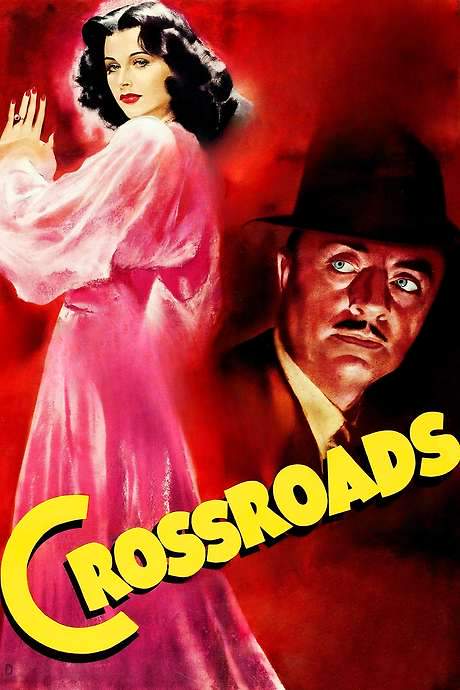
Crossroads (1942) movie poster

Timeline

Crossroads (1942) Timeline Explained – Every Event in Order

Release, runtime and language
1942 · 83 mins · English
Directed by
Jack Conway
Starring
Claire Trevor, Basil Rathbone, William Powell, Sig Ruman, Philip Merivale, Torben Meyer

Where women wait to seal your fate! A French diplomat who’s recovered from amnesia is blackmailed over crimes he can’t remember.

On this page (7)
  1. 1 Where to watch
  2. 2 Events in order (15)
  3. 3 Timeline questions answered
  4. 4 Movie threads
  5. 5 Movies like Crossroads
  6. 6 Categories
  7. 7 Every angle

Where to watch

Where to Watch Crossroads (1942)

Where can you watch Crossroads? Stream, rent or buy it in the US, including on YouTube TV: current JustWatch availability with up-to-date prices.

Streaming availability powered by JustWatch

15 events in order · contains spoilers

Crossroads Timeline: Events in Chronological Order

Every key event of Crossroads (1942) in order, scene by scene, with when and where it takes place. Use it to untangle flashbacks, time jumps and parallel storylines, to refresh your memory before the sequel or to find the exact scene you are thinking of.

  1. 1922 train disaster and amnesia begins

    A devastating train accident in 1922 leaves David Talbot with amnesia and a murky past. Dr. Tessier treats him after the wreck, hoping to recover his identity. The incident raises the possibility that two similar men boarded the train and only one survived, casting doubt on which man Talbot really is.

    When
    1922
    Where
    Train and hospital
  2. Ransom note interrupts marriage; extortion arrest

    During their 1935 celebration, a note from Le Duc demands one million francs for an old debt, and Talbot is arrested for attempted extortion. Le Duc is hauled into court to face charges. In his testimony, Le Duc claims he knew David in 1922 as a petty criminal named Jean Pelletier.

    When
    1935
    Where
    Paris
  3. Amnesia vs. identity: trial confrontation

    At the trial, Talbot's amnesia is challenged by Dr. Alex Dubroc, who convinces Tessier to concede the diagnosis's unreliability. He suggests Talbot fabricated his memory loss to hide his real identity. The judge and witnesses are left with the unsettling possibility that Pelletier and Talbot could be the same man, with no definitive proof.

    When
    1935
    Where
    Courtroom
  4. Allaine enters as defense witness

    Michelle Allaine, a glamorous nightclub singer, is introduced as a defense witness. She studies David and identifies him as Pelletier, her former lover, complicating Talbot's claimed amnesia. Her testimony connects David to Pelletier's past.

    When
    1935
    Where
    Courtroom, Paris
  5. Sarrou's evidence undermines amnesia; Pelletier died

    Henri Sarrou presents documents showing he and Pelletier were roommates in an African hospital, and that Pelletier died of illness. This evidence undermines Talbot's claim of identity and helps convict Le Duc of extortion.

    When
    1935
    Where
    Courtroom
  6. Sarrou privately pressures Talbot

    Sarrou privately confronts David, asserting that David is actually Pelletier and that he helped with a decade-old robbery involving a murdered courier. He warns that he will recant unless Talbot pays the million francs. David's fear of exposure grows as the threat looms.

    When
    1935
    Where
    Talbot's residence, Paris
  7. Allaine corroborates and reveals the locket

    Allaine corroborates the claim that David and Pelletier are the same man, and she still has feelings for him. She shows him a locket containing a photo of the two of them and hints that she will present it as evidence to Sarrou. Her testimony deepens the stakes of the conspiracy.

    When
    1935
    Where
    Talbot home
  8. Allaine's warning and suspicion in the Talbot home

    Allaine appears at the Talbot home and implicitly threatens exposure, planting suspicions in Lucienne's mind. David conceals his fears from his wife, though his doubt about his own identity grows stronger. The couple's stability begins to fracture under the pressure.

    When
    1935
    Where
    Talbot residence, Paris
  9. David seeks Allaine again at the nightclub

    David clandestinely visits Allaine at the nightclub where she works, hoping to draw her out. She continues to treat him as Pelletier and accuses him of faking amnesia to betray his friends. She also reveals that his mother is living in penury.

    When
    1935
    Where
    Nightclub, Paris
  10. David meets Madame Pelletier; fraud revealed

    David goes to the address given by Allaine and meets Madame Pelletier, who claims that he is not her son, though her demeanor suggests otherwise. He learns that the real Pelletier is dead and that an actress has been hired to play Madame Pelletier. The fraud behind his identity grows increasingly tangled.

    When
    1935
    Where
    Address of Madame Pelletier, Paris
  11. Escape attempt blocked; money is discussed

    David collects his passport and tries to flee the country, but Sarrou blocks his escape while hinting that a stash of government funds in Talbot's office can be taken as an outside robbery. The two men discuss hijacking the funds as a bargaining chip in the scheme.

    When
    1935
    Where
    Talbot's office / Foreign Ministry, Paris
  12. Raid on the safe and confrontation

    With Sarrou watching, David and Sarrou sneak past guards at the Foreign Ministry and open the safe, retrieving the million francs. Lucienne has followed and tries to intervene, but the police arrive to stop the confrontation.

    When
    1935
    Where
    Foreign Ministry, Paris
  13. Arrests and initial confessions

    At the police headquarters, David confesses to the old robbery and admits that he and his co-conspirators must be punished for murder. Allaine panics and admits that David is not Pelletier, turning the case's direction.

    When
    1935
    Where
    Police headquarters, Paris
  14. The truth about the locket and identity

    David reveals that the locket image was a fabrication used to mislead Sarrou, and that the passport photo he wore as proof of identity does not match the real story. The revelation finally resolves the question of who he really is.

    When
    1935
    Where
    Police HQ / Courtroom, Paris
  15. Resolution: Talbot cleared; marriage and career saved

    With the blackmailers behind bars, Talbot is cleared of the charges and his reputation is restored. Lucienne remains by his side, and his ambassadorial career is saved. The film ends with the truth prevailing and the couple's future secured.

    When
    1935
    Where
    Paris

Last updated: October 09, 2025 at 11:18

Was this helpful?

Timeline questions answered

Crossroads Timeline Explained: Your Questions Answered

When does it happen, and why in that order? The questions people ask about the chronology of Crossroads (1942): time jumps, flashbacks, cause and effect between scenes and the correct order of events, each answered with spoilers.

Q1

Why does Carlos Le Duc blackmail David Talbot?

Le Duc sends a ransom note demanding one million francs from Talbot, claiming an old debt from 1922. He asserts he knew Talbot then as Jean Pelletier, a petty criminal, using this alleged past connection to extort money. Talbot has no memory of this period due to amnesia from a train accident, so he has no way to verify or refute the claim.

  • le duc
  • blackmail
  • extortion
  • one million francs
  • debt
Q2

What happened in the 1922 train accident that caused David's amnesia?

In 1922, David Talbot was involved in a devastating train disaster that left him with amnesia. Two similar men reportedly boarded that train, but only one survived, raising the possibility that the survivor may not be Talbot at all. Dr. Tessier treated him after the wreck and supported his amnesia claim for years.

  • train accident
  • 1922
  • amnesia
  • dr. tessier
  • identity
Q3

Is David Talbot actually Jean Pelletier?

No. While the film creates genuine uncertainty, David Talbot is ultimately revealed to be the real Talbot, not Jean Pelletier. The conspiracy involved Sarrou and Le Duc who orchestrated a decade-old robbery and then tried to blackmail the real Talbot by pretending he was Pelletier. The actual Pelletier died of illness in an African hospital, as Sarrou's documents initially seemed to prove.

  • jean pelletier
  • identity
  • impersonation
  • conspiracy
Q4

Why did Dr. Tessier change his position on Talbot's amnesia?

Dr. Tessier initially supported Talbot's amnesia diagnosis, having treated him since the 1922 train wreck. However, the defense psychologist Dr. Alex Dubroc challenged the reliability of such diagnoses and suggested Talbot may have fabricated his amnesia. This expert testimony convinced Tessier to concede that his diagnosis could be wrong, opening the door to the possibility that Talbot was hiding his true identity.

  • dr. tessier
  • dr. dubroc
  • amnesia
  • testimony
  • psychology
Q5

What was Michelle Allaine's role in the scheme against Talbot?

Michelle Allaine, a nightclub singer, was recruited by Sarrou to pose as a defense witness and claim Talbot was her former lover Pelletier. She presented a locket with a photo as proof of their past relationship. Later, she helped finance the deception by hiring an actress to play Madame Pelletier. However, she eventually confessed that Talbot was not Pelletier when confronted at the police headquarters.

  • michelle allaine
  • locket
  • defense witness
  • pelletier
  • actress
Q6

What was the truth about the locket Michelle Allaine showed?

The locket containing a photo of Allaine and Talbot was a fabrication designed to support the conspiracy. Sarrou and Allaine used it to trick Talbot into believing he had been Pelletier. When David finally examined it closely at the climax, he recognized it was manufactured evidence meant to manipulate him and mask his real identity.

  • locket
  • photo
  • fabrication
  • evidence
  • manipulation
Q7

Why did Henri Sarrou blackmail Talbot after the trial?

After Sarrou's testimony helped convict Le Duc of extortion, he privately confronted Talbot with a different claim: that Talbot was actually Pelletier and that they, along with Le Duc, had committed a robbery in which a courier was murdered years earlier. Sarrou threatened to recant his testimony unless Talbot paid him one million francs, essentially demanding hush money for his silence about the alleged crime.

  • henri sarrou
  • blackmail
  • robbery
  • courier murder
  • payment
Q8

Why did David Talbot try to flee France with his passport?

When Sarrou threatened to expose him unless paid, David attempted to escape the country to avoid exposure and the financial demand. However, Sarrou blocked his exit and instead proposed they steal government funds from Talbot's office at the Foreign Ministry, making it appear as an outside robbery. This led to the climactic raid on the safe.

  • passport
  • flee
  • escape
  • foreign ministry
  • safe
Q9

Why did David confess to the robbery at the climax?

At the police headquarters, David confessed to the decade-old robbery and accepted punishment for murder, seemingly accepting his fate as Pelletier. This was actually a strategic move, Allaine panicked and immediately admitted that David was not Pelletier, which finally revealed the truth about the conspiracy and cleared Talbot's name.

  • confession
  • robbery
  • murder
  • police headquarters
  • climax
Q10

How was David Talbot's true identity finally proven?

The truth emerged through multiple revelations: the passport photo showed a hidden scar that matched David's actual appearance, the locket was exposed as a fabrication, and the actress playing Madame Pelletier was arrested. Most critically, Allaine confessed that David was not Pelletier. These pieces together proved Talbot was who he claimed to be, allowing him to be cleared of all charges.

  • passport photo
  • scar
  • identity proven
  • cleared
  • resolution

Movie threads

More Movies Like Crossroads, by Mood & Story

Curated lists built around what makes Crossroads tick: the same mood, the same kind of story or the same emotional payoff. Each list explains why these movies belong together.

Mystery thrillers with amnesia like Crossroads

Stories where lost memories unravel into thrilling puzzles of identity and deception. If you enjoyed the suspense of Crossroads unraveling a forgotten past, you'll like these movies. This collection features similar mystery thrillers and dramas where characters must uncover the truth about their own identity, often amid blackmail and psychological tension.

  • suspenseful
  • paranoid
  • uncertain
  • psychological
  • mysterious
  • anxious
  • Tone: tense, mysterious, paranoid
  • Pacing: steady, deliberate
Why these movies?

The story pattern: The narrative follows a protagonist who has lost their memory, thrusting them into a world where they cannot trust their own history. As clues emerge, they must discern friend from foe and piece together a timeline of events they cannot recall, leading to a climactic revelation about their true self.

Why they belong together: Movies are grouped here because they share the central plot device of amnesia, creating a unique blend of mystery, personal crisis, and suspense. They explore themes of trust, deception, and the fundamental question of identity under psychological pressure.
Psychological tension with legal stakes like Crossroads

Psychological dramas where the threat of justice creates a web of personal anxiety. For viewers who liked the legal pressure and blackmail in Crossroads, this thread features movies with similar high-stakes psychological tension. These stories often involve characters facing courtroom drama or criminal accusations, creating a steady build of anxiety and moral uncertainty.

  • anxious
  • suspenseful
  • atmospheric
  • uncertain
  • tense
  • methodical
  • Tone: tense, anxious, uncertain
  • Pacing: steady, methodical
Why these movies?

The story pattern: The story often begins with a character accused of, or vulnerable to, a crime they may or may not have committed. The narrative unfolds as they navigate a web of evidence, testimonies, and personal relationships under intense scrutiny, with the truth—and their fate—hanging in the balance.

Why they belong together: These films are connected by their use of a legal framework to amplify psychological tension. They share a mood of sustained anxiety, a steady pacing that builds paranoia, and a complex narrative where truth is subjective and allegiances shift.

If you liked this

Movies Like Crossroads

Similar movies to Crossroads: the same genre, themes or kind of story. Each one comes with its own plot summary, timeline and ending explained.

Browse all movie summaries

Categories

Movie Lists Featuring Crossroads

Crossroads appears in these hand-built movie categories. Each one groups movies by a specific mood, theme or story type, with their plot summaries and endings explained.

View all movie categories

Every angle

Crossroads (1942) Explained: Plot, Timeline & Characters

Everything about Crossroads in one place: what happens in the plot summary, the timeline in chronological order, the characters and meaning and a spoiler-free summary. What's After the Movie adds the cast, box office and post-credit scenes.

Coming soon on iOS and Android

The Plot Explained Movie Summary App

Plot summaries, endings explained and timelines on your phone. Catch up on any movie in minutes, save your favorites and never miss a twist again.

Be the first to know when we launch. Your email stays private, always.

Learn more about the app