






Plot Explained Spoilers guaranteed!
Plot Explained

Browse by genre

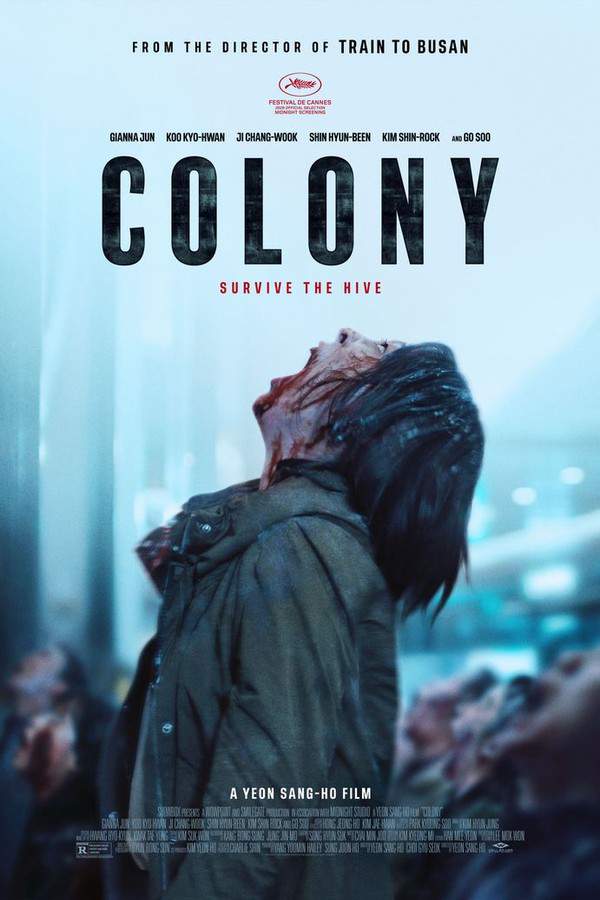
Colony (2026) movie poster

Ending Explained

Colony (2026) Ending Explained – Final Scene & Meaning

Release, runtime and language
2026 · 2 h 2 m · Korean
Echo score 66
Directed by
Sang-ho Yeon
Starring
Ji Chang-wook, Koo Kyo-hwan, Go Soo, Jun Ji-hyun, Kim Hyung-mook, Hyeon-bin Shin

When a rapidly mutating virus erupts at a biotech conference, Professor Se‑jeong (Ji‑hyun) finds herself and a handful of survivors sealed inside the facility. With no way out, they must battle the infected, whose gruesome transformations turn the building into a blood‑soaked nightmare as they struggle to stay alive.

On this page (6)
  1. 1 Where to watch
  2. 2 What happens at the end
  3. 3 Final events in order
  4. 4 Ending questions answered
  5. 5 Movie threads
  6. 6 Every angle

Where to watch

Where to Watch Colony (2026)

Where can you watch Colony? Stream, rent or buy it in the US, including on Amazon Video, Apple TV Store and Fandango At Home: current JustWatch availability with up-to-date prices.

Streaming availability powered by JustWatch

Ending explained · contains spoilers

What Happens at the End of Colony?

How Colony (2026) ends, what the final scene means, which earlier moments set it up and how to read the ending if the film leaves it open. The full ending explained, with every spoiler.

Killing Kang does not end the outbreak, revealing that the infected network depends on Seo instead. Sejeong and Gong abandon the immediate prospect of a vaccine and concentrate on destroying that controlling centre. Sejeong uses the mycelium coating to manipulate the infected's recognition and movement, disrupting their coordination before drawing Seo toward a bus advertisement. The redirected horde knocks him into a burning vehicle. His death freezes the network, but Gong reports infected people remaining dormant elsewhere, and the final movement of one body undermines any claim that the danger is finished.

The apparent victory depends on exploiting the colony's collective behaviour rather than defeating every infected individual. Its loss of coordination allows Sejeong to act, making communication both the source of the threat's strength and the weakness she can turn against it. Destroying Seo saves lives immediately while sacrificing a route toward treatment, so survival carries an unresolved medical cost. The stirring body leaves recovery and renewed catastrophe possible. It is a warning that disabling the hive's present command structure is not the same as curing its members.

Last updated: October 01, 2026 at 22:05

Was this helpful?

The last 4 events

How Colony Ends: The Final Events in Order

The last events of Colony (2026) in chronological order, the run-up to the ending explained above. The complete timeline has all 15 events, scene by scene.

Open the full timeline
  1. Hyun-hee sacrifices; control room threatened

    Hyun-hee volunteers to stay behind to guide the others via CCTV and chat, but is killed when Hyun-seok's plan falls apart and the control room is overrun. The confrontation between Bong-seok and Hyun-seok exposes betrayals that fracture the group just before Young-chul’s last stand.

    When
    Confrontation
    Where
    Underground control room
  2. SWAT detains Young-chul; city-wide outbreak unleashed

    SWAT breaches the area and detains Young-chul, but the entire group is infected and turned into his personal guard. He escapes the building and unleashes the infection on the city center, triggering a full-scale outbreak.

    When
    Final confrontation
    Where
    From building to city center
  3. Mycelium jacket trap and Young-chul's demise

    Se-jeong dons a jacket soaked with mycelium and drives a car to ram Young-chul, trapping hundreds in a collective, spinning ant mill. The overload of sensory data collapses the hive's intelligence, and Young-chul dies in a burning car as the citywide chaos freezes.

    When
    Climax
    Where
    City center
  4. Aftermath: uneasy calm and a final spark

    With Young-chul dead and the vaccine effectively gone, Se-jeong contemplates how to explain the outbreak to the public, but a single infected flickers to life, leaving a chilling final note. The film closes on a note of uneasy calm and lingering fear.

    When
    Aftermath
    Where
    City streets

Ending questions answered

Colony Ending: Your Questions Answered

The questions people ask most about the ending of Colony (2026): what the final scene means, how the twist works, what happens to each character and how to read the ending. Each answer contains spoilers.

Q1

Why doesn't killing Kang stop the outbreak in Colony?

Kang is not the actual controller of the infected network. The hive operates through Seo, who functions as the central command hub coordinating the infected's collective behaviour. Removing Kang only eliminates a subordinate, leaving the signal source that keeps the horde organized intact.

  • kang
  • seo
  • infected network
  • hive control
  • outbreak
  • command centre
Q2

How does Sejeong use the mycelium to defeat the infected?

Sejeong applies the mycelium coating to her body, which interferes with the infected's ability to recognize and track targets. This disrupts the hive's coordination and allows her to redirect the horde's movement, turning the colony's own communication system into the mechanism of its defeat.

  • sejeong
  • mycelium
  • infected
  • hive
  • coordination
  • recognition
Q3

What is the role of the bus advertisement in the ending?

The bus advertisement is the bait Sejeong uses to funnel Seo into a kill zone. She manipulates the redirected horde so their movement pushes Seo toward a burning vehicle, making the everyday urban image the final delivery mechanism for the hive's destruction.

  • bus advertisement
  • seo
  • trap
  • burning vehicle
  • sejeong
  • horde
Q4

Why do Sejeong and Gong give up on a vaccine?

Once Seo is identified as the true control hub, pursuing treatment no longer matches the urgency of stopping coordinated killings. Destroying the command structure buys immediate survival, but it eliminates the most direct route to understanding and eventually curing the infection.

  • vaccine
  • gong
  • sejeong
  • seo
  • cure
  • treatment
  • sacrifice
Q5

What happens to the infected after Seo dies?

Seo's death severs the central signal, freezing the entire network so the active horde stops moving. However, Gong reports that infected people remain dormant elsewhere, meaning the hive is disabled but not eradicated, leaving the door open to reactivation.

  • seo
  • death
  • infected
  • dormant
  • hive
  • network collapse
Q6

What does the final shot of the moving infected body mean?

The closing image of an infected body stirring again signals that the danger has not truly ended. It implies the dormant infected can recover, reactivate, or respond to a new signal, undermining any sense of final resolution and warning that the hive is only paused, not cured.

  • final scene
  • infected moving
  • dormant
  • ending
  • reactivation
  • colony
Q7

Is the ending of Colony hopeful or hopeless?

Colony's ending is deliberately ambiguous and unsettling rather than hopeful. The immediate villain is dead and the horde freezes, but Sejeong's cover-up conversation and the final stirring body leave the threat unresolved, with survivors escaping at the cost of any medical solution.

  • colony ending
  • hopeful
  • ambiguous
  • cover-up
  • resolution
Q8

What is the unresolved medical cost of destroying Seo?

By killing Seo instead of capturing him, Sejeong destroys the most direct route to understanding the pathogen. Survivors are saved in the short term, but the possibility of a cure or treatment dies with him, leaving the medical dimension of the crisis permanently compromised.

  • seo
  • cure
  • medical cost
  • treatment
  • sejeong
  • sacrifice
Q9

Could the infected come back after Colony's ending?

Yes, the ending strongly implies they can. Gong's report of dormant infected in other locations and the final movement of one body suggest that the surviving infected retain the capacity to wake up, either spontaneously or under a new controlling influence.

  • infected return
  • dormant
  • gong
  • colony
  • outbreak
  • reactivation
Q10

Why does Sejeong cover up what really happened?

Sejeong's cover-up conversation suggests she wants to conceal the true mechanics of the outbreak and how it was stopped. It reflects distrust of how authorities or the public would respond to the information, and it preserves the ambiguity that defines the film's final message.

  • sejeong
  • cover-up
  • conspiracy
  • truth
  • colony
  • authorities
Q11

What is the central theme of Colony's ending?

The ending frames communication as both the infected's greatest strength and their critical weakness. Sejeong exploits the hive's own recognition system to dismantle it, but the final image warns that disabling coordination is not the same as curing the infected, leaving the threat structurally unresolved.

Foreshadowing: Earlier scenes establish the infected moving as a single coordinated mass rather than as individual threats, hinting at the communication network that Sejeong later weaponizes.

  • theme
  • communication
  • hive
  • colony
  • coordination
  • strength
  • weakness

Movie threads

More Movies Like Colony, by Mood & Story

Curated lists built around what makes Colony tick: the same mood, the same kind of story or the same emotional payoff. Each list explains why these movies belong together.

Contained siege horror like Colony

Trapped in one sealed location, survivors turn on each other as threats close in. Movies like Colony where survivors are sealed inside a single location and must fight both a relentless threat and each other. These claustrophobic siege stories lean on paranoia, dwindling resources, and graphic violence to keep pressure unbearable throughout. If you loved the trapped-in-a-building dread of Colony, these contained survival horrors will deliver the same suffocating tension.

  • claustrophobic
  • paranoia
  • siege
  • trapped
  • desperate
  • contained
  • Tone: dark, tense, paranoid
  • Pacing: variable, with bursts of violence
Why these movies?

The story pattern: Stories in this thread typically begin with an inciting disaster—an outbreak, attack, or collapse—that seals the characters inside a confined space. A small band of survivors, often strangers or uneasy allies, must navigate internal conflicts and shifting loyalties as the external threat intensifies. The structure usually oscillates between moments of planning, negotiation, or stealth and sudden bursts of brutal violence that thin the group. By the final act, the threat has usually infiltrated the group itself, forcing devastating moral choices, betrayals, or sacrifices. Endings tend to be bleak or ambiguous, leaving a lingering sense that no one truly escaped.

Why they belong together: These films share the same core emotional cocktail: claustrophobia, paranoia, and a constant sense of dwindling options. They lean on limited settings to maximize dread, push group survival dynamics to their breaking point, and rarely offer clean redemption. Whether the threat is biological, supernatural, or human, the experience is about feeling trapped alongside the characters and watching fear corrode every relationship.


Mutation body horror like Colony

A mutating biological force reshapes every body it touches, turning survival into a visceral nightmare. Movies like Colony where a mutating biological force turns victims into something monstrous and the body itself becomes the battleground. These horror films blend scientific dread, parasitic infections, and graphic transformation to deliver a uniquely draining experience. If the slime mold swarm and grotesque body horror of Colony hooked you, these mutating bio-threat stories deliver the same visceral nightmare.

  • body horror
  • mutation
  • parasitic
  • visceral
  • grotesque
  • outbreak
  • Tone: dark, visceral, oppressive
  • Pacing: variable, escalating dread
Why these movies?

The story pattern: These stories often begin with corporate or scientific hubris—an experiment, a leaked sample, or an engineered organism—that escapes containment and begins transforming hosts. The narrative typically alternates between victims undergoing horrifying physical change and survivors trying to understand, contain, or escape the spread. Body horror escalates in stages: initial symptoms, visible mutations, behavioral shifts, and finally grotesque full transformation. Character arcs usually involve sacrifice, ethical compromise, or reluctant heroism against a threat that cannot be reasoned with. Endings often leave the threat unresolved, hinting that the biological horror has outlasted the survivors.

Why they belong together: These films share a commitment to visceral, graphic physical transformation as the primary source of fear, paired with an undercurrent of scientific or corporate responsibility. They tend to use biological mechanics—parasites, fungi, viruses, mutagens—to make body horror feel plausible and intimate. The emotional experience is one of repulsion, dread, and helplessness, as the threat proves impossible to fully understand, negotiate with, or contain.

Every angle

Colony (2026) Explained: Plot, Ending, Timeline & Characters

Everything about Colony in one place: what happens in the plot summary, the timeline in chronological order, the characters and meaning, the ending explained and a spoiler-free summary. What's After the Movie adds the cast, box office and post-credit scenes.

Coming soon on iOS and Android

The Plot Explained Movie Summary App

Plot summaries, endings explained and timelines on your phone. Catch up on any movie in minutes, save your favorites and never miss a twist again.

Be the first to know when we launch. Your email stays private, always.

Learn more about the app