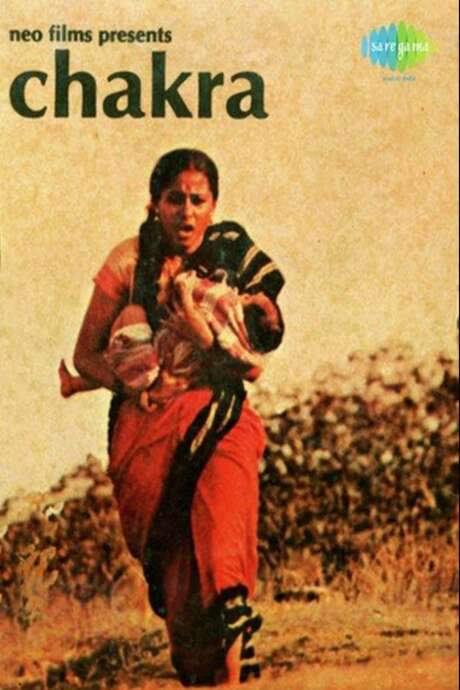
Year: 1981
Runtime: 135 mins
Language: Hindi
Director: Rabindra Dharmaraj
Amma, after being raped, flees her village with her husband and child when he kills her attacker. In the chaotic city her husband is later murdered by smugglers, leaving her alone to raise her son. She strives to teach him moral values amid pervasive immorality, receiving reluctant help from a dubious figure, but hope remains fragile.
Find where to stream, rent, or buy Chakra (1981) in the US with current JustWatch availability, up-to-date pricing, and platform listings for subscription, rental, and digital purchase options.
Warning: spoilers below!
Haven’t seen Chakra yet? This summary contains major spoilers. Bookmark the page, watch the movie, and come back for the full breakdown. If you're ready, scroll on and relive the story!
Explore the full timeline and setting of Chakra (1981). Follow every major event in chronological order and see how the environment shapes the story, characters, and dramatic tension.
Last updated: February 18, 2026 at 23:21
Meet the key characters of Chakra (1981), with detailed profiles, motivations, and roles in the plot. Understand their emotional journeys and what they reveal about the film’s deeper themes.
Last updated: February 18, 2026 at 23:21
Explore the central themes of Chakra (1981), from psychological, social, and emotional dimensions to philosophical messages. Understand what the film is really saying beneath the surface.
Last updated: February 18, 2026 at 23:21
Browse frequently asked questions about Chakra (1981) focused on characters, relationships, themes, symbols, setting, and story context. This movie info FAQ gives spoiler-aware explanations for character arcs, world details, and thematic interpretation so readers can better understand what the film is really about.
The story unfolds in two main locations: a rural village where the family initially lives, and the sprawling slums of Bombay where they migrate after fleeing violence. The Bombay slums are depicted as a dense, improvised community built from tin and tar, where survival depends on precarious relationships and quick money opportunities.
The film explores four interconnected themes: poverty as a driving force that shapes every decision; crime and survival in the urban underworld; displacement through demolition and forced migration; and family bonds tested by extreme hardship. These themes intersect to show how systemic poverty traps characters in cycles of desperation.
Amma (played by Smita Patil) is the film's central character, a resilient mother who flees her village after being raped and attempts to raise her son alone in the city after her husband is murdered. She navigates precarious relationships to secure resources, reflecting the impossible compromises poverty imposes on women.
Benwa is Amma's son, torn between loyalty to his mother and the lure of criminal life in the slums. He idolizes Lukka, gets married, and becomes entangled in the illegal activities that his environment normalizes, ultimately leading to violence and arrest.
Lukka (played by Naseeruddin Shah) is a on-parole pimp who embodies both the glamor and danger of street crime. He serves as a mentor to Benwa while remaining trapped in criminal life, creating tension between his flashes of remorse and his continued involvement in illegal activities.
Poverty drives every decision in the narrative, pushing Amma into risky choices to care for her son. The slum environment amplifies daily struggles with housing, food, and safety, revealing how scarcity shapes morality and ambitions. The story uses intimate family stakes to illuminate the wider grind of urban deprivation.
Lukka's criminal world and Amma's navigation of it reveal how people resort to crime and manipulation to survive. Benwa's loyalty to Lukka pulls him toward illegal paths and violent outcomes. The film depicts police raids, drug use, and illegal commerce as a cycle that traps generations in the slums.
The bulldozers at the end symbolize the erasure of the slum, forcing characters to relocate to a new, uncertain shantytown. This displacement compounds their vulnerability and highlights the fragility of life in urban margins, the characters are displaced but not saved, simply moving to continue the same struggle.
The title 'Chakra' refers to the cycle of poverty, crime, and displacement that traps characters in the slums. The bleak ending reinforces this nihilistic theme, characters are displaced but not saved, simply moving to a new location to continue the same relentless struggle, suggesting an inescapable循环.
Characters inhabit a harsh urban margins world where family survival hinges on precarious relationships and quick money. The slum is a dense, improvised community where illegal commerce and violence are normalized. The setting underscores the relentless realities of poverty, with demolition always threatening to erase their makeshift homes.
Anna (played by Kulbhushan Kharbanda) is Amma's husband from the village. He commits a violent act to protect Amma after she is attacked, killing her rapist. The family then flees to Bombay, but Anna is later murdered by smugglers while attempting to steal tin for a hut, leaving Amma alone to raise their son.
The film has a bleak tone with heavy emotional weight, driven by its unflinching depiction of extreme poverty, moral compromise, and cyclical despair. The steady pacing reflects a relentless march of misfortunes, rape, murder, addiction, miscarriage, and arrest occur in a continuous sequence that prevents any sense of respite, creating high-intensity viewing.
Discover curated groups of movies connected by mood, themes, and story style. Browse collections built around emotion, atmosphere, and narrative focus to easily find films that match what you feel like watching right now.
Stories of lives consumed by the harsh realities of the city.If the stark portrayal of survival in Chakra resonated with you, explore this collection of movies like Chakra. These films share a gritty, hopeless atmosphere and focus on characters trapped in cycles of urban poverty.
These narratives typically follow a linear descent, where characters move from one misfortune to the next with little to no respite. The plot is driven by external societal pressures rather than individual agency, leading to an ending that reinforces the futility of the struggle.
Movies are grouped here by their shared oppressive atmosphere, bleak worldview, and focus on the destructive impact of an urban environment on the human spirit. They offer an unflinching, emotionally heavy viewing experience.
The heartbreaking effort to uphold virtue in a world that rewards vice.For viewers moved by the maternal struggle to teach morality in Chakra, this list features similar stories about moral decay and survival. Discover movies like Chakra where characters fight a losing battle against a corrupt world.
The story revolves around a fundamentally good character, often a parent, trying to protect a loved one or a principle from being corrupted by their environment. Their efforts are depicted as noble yet ultimately futile, as the oppressive forces of the world prove too powerful to overcome.
These films are united by their thematic focus on the conflict between moral conviction and harsh reality. They explore the concept of goodness as a vulnerability and present a pessimistic view of whether virtue can survive in a corrupt system.
Don't stop at just watching - explore Chakra in full detail. From the complete plot summary and scene-by-scene timeline to character breakdowns, thematic analysis, and a deep dive into the ending - every page helps you truly understand what Chakra is all about. Plus, discover what's next after the movie.
Read a complete plot summary of Chakra, including all key story points, character arcs, and turning points. This in-depth recap is ideal for understanding the narrative structure or reviewing what happened in the movie.
Track the full timeline of Chakra with every major event arranged chronologically. Perfect for decoding non-linear storytelling, flashbacks, or parallel narratives with a clear scene-by-scene breakdown.