Plot Explained Spoilers guaranteed!
Plot Explained

Browse by genre

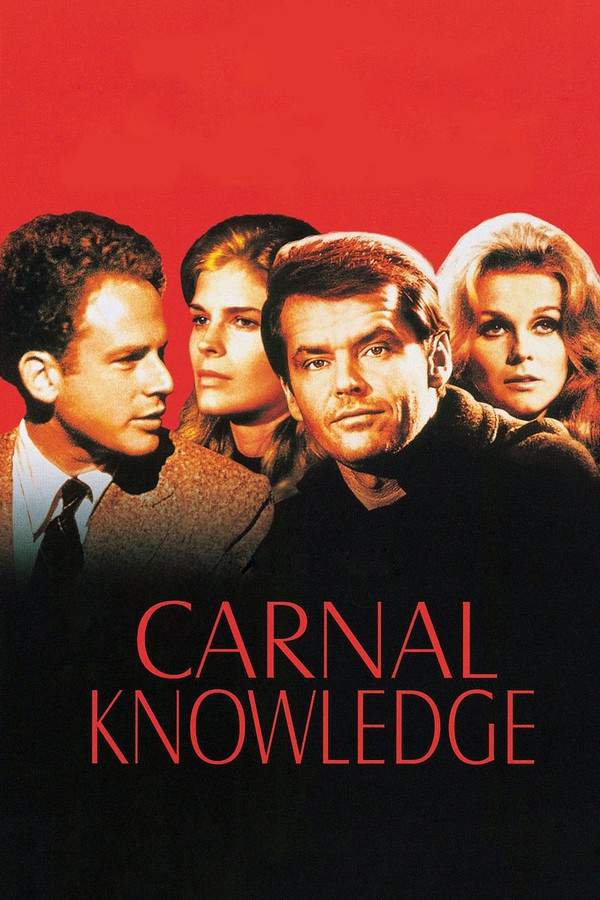
Carnal Knowledge (1971) movie poster

Plot Summary

Carnal Knowledge (1971) Plot Summary Explained

Release, runtime and language
1971 · 98 min · English
Loading streaming availability…
Directed by
Mike Nichols
Starring
Rita Moreno, Candice Bergen, Jack Nicholson, Carol Kane, Art Garfunkel, Ann-Margret

Sandy and Jonathan, charming roommates in 1940s America, find their lives entangled in a web of love, loyalty, and desire. As they pursue various relationships, Sandy’s naivete is challenged by unexpected betrayals. Meanwhile, Jonathan's seemingly carefree and hedonistic lifestyle hides a deeper yearning for genuine connection. The film explores themes of masculinity, moral boundaries, and the complicated nature of intimacy and infidelity within the backdrop of a changing era.

On this page (6)
  1. 1 Where to watch
  2. 2 What happens: full plot
  3. 3 Plot questions answered
  4. 4 Movie threads
  5. 5 Movies like Carnal Knowledge
  6. 6 Every angle
Loading streaming availability…

Full plot summary · contains spoilers

What Happens in Carnal Knowledge: Full Plot Summary

The whole story of Carnal Knowledge (1971) explained, from the opening scene to the final frame: every key event, every twist and what it all adds up to. Read it as a quick recap before the sequel, to check a scene you missed, or to finally understand what really happened.

As the post-war landscape of the late 1940s began to unfold against the backdrop of Amherst College, an unexpected encounter between student Sandy and coed Susan ignited a romance that would carry them through the years. Their initial bond, centered on mutual respect and trust, showcased Susan’s hesitance to give in to physical desire, highlighting her dedication to a deeper emotional connection. However, unbeknownst to Sandy, his roommate Jonathan had his own intentions regarding Susan. Driven by his charming yet womanizing ways, Jonathan managed to allure her into an ill-fated night of passion, ultimately spiraling into a toxic breakup that would leave lasting scars.

Years later, the ripples of their college days began to surface. Sandy and Susan exchanged vows, while Jonathan continued his seemingly endless pursuit of the ideal partner. His relationship with Bobbie, a breathtaking yet superficial beauty, soon faltered as he grew weary of her shallow demeanor. Their romance deteriorated rapidly, marked by Jonathan’s verbal tirades and belittling comments, which pushed Bobbie into a deep depression.

Simultaneously, Sandy's marriage to Susan also faced significant challenges. Their once passionate relationship had become lackluster, even as they tried earnestly to rekindle their intimacy. Sandy began to reflect on the nature of sex, viewing it less as an expression of love and more as a mere biological obligation. Eventually, he made the difficult decision to end things with Susan, seeking solace in a new relationship with Cindy.

Fate intervened, bringing these former college acquaintances together once more at Jonathan’s apartment. In a private conversation, Sandy confided to Jonathan about his growing frustrations regarding Cindy. Ever the provocateur, Jonathan suggested a radical remedy—why not swap partners for a change? While Sandy sought out Bobbie in the bedroom, Cindy found herself dancing with Jonathan. She admonished him for pursuing Sandy right in front of him, yet hinted at her own willingness to forge a new connection with him independently.

In the midst of this emotional turbulence, tragedy struck. Struggling with her earlier confrontations with Jonathan about their lack of commitment, Bobbie attempted suicide, her desperate plea for help answered by Sandy, who rushed her to the hospital’s intensive care unit. As the consequences of their past choices unfolded, it became evident that these characters were forever affected by their intertwined lives, influencing their relationships and personal growth.

As the years rolled on, Jonathan re-entered the scene, this time presenting a slideshow to Sandy and his 18-year-old girlfriend, Jennifer. Titled “Ballbusters on Parade,” Jonathan’s visually captivating narrative chronicled his romantic escapades over the decades. With a blend of nostalgia and cringe-worthy moments, he flicked through images, pausing with an uncomfortable hesitation on a particularly revealing moment featuring Susan. Sandy picked up on Jonathan’s subtle discomfort, hinting at the convoluted history between them. The slideshow included poignant remarks about Bobbie, now divorced and receiving alimony, deepening the emotional weight of their shared history. Jennifer, visibly shaken by the unvarnished glimpse into Jonathan’s past, left the scene in tears.

As time passed, while Jonathan’s professional success blossomed, his personal life took a perplexing turn. He found himself in the company of a prostitute, engaging in a scripted dialogue that delved into the intricate dynamics between men and women. Concluding their conversation, the prostitute delivered a captivating monologue, authored by Jonathan himself, which sang his praises and emphasized his perceived “perfection.” This strange ritual served as a unique coping mechanism for him, allowing Jonathan to regain a semblance of control over his desires in a world where he felt increasingly adrift. The stark contrast between Jonathan's professional triumphs and his personal struggles painted a profound picture of the human experience, exposing the vulnerabilities and yearnings that often lurk beneath a confident exterior.

Last updated: November 21, 2024 at 11:27

Was this helpful?

Plot questions answered

Carnal Knowledge Plot Explained: Your Questions Answered

The questions people ask most about Carnal Knowledge (1971): what happens in the confusing scenes, why the characters do what they do, the twists, hidden details and what the ending means. Each answer contains spoilers.

Q1

Why did Jonathan pursue Susan when she was Sandy's girlfriend?

Jonathan, characterized as charming yet womanizing throughout the film, pursued Susan despite knowing she was Sandy's girlfriend. This reflects his hedonistic approach to relationships and his competitive nature with Sandy. His seduction of Susan represents the first major betrayal that sets the destructive pattern for all subsequent relationships in the film, demonstrating how Jonathan's inability to form genuine connections stems from his superficial approach to intimacy.

Foreshadowing: Early scenes establish Jonathan's womanizing reputation and his habit of pursuing what belongs to his roommate.

  • jonathan
  • susan
  • seduction
  • college
  • betrayal
  • roommates
Q2

Why did Bobbie try to commit suicide?

Bobbie's suicide attempt was triggered by her toxic relationship with Jonathan. After years of enduring his verbal tirades, belittling comments, and emotional abuse, she fell into a deep depression. The final confrontation with Jonathan about their lack of commitment and genuine connection drove her to desperate action, highlighting the devastating psychological impact of Jonathan's emotional cruelty.

Foreshadowing: The timeline shows their romance deteriorating rapidly under the weight of Jonathan's increasingly harsh treatment.

  • bobbie
  • jonathan
  • suicide
  • depression
  • emotional abuse
  • toxic relationship
Q3

Why did Sandy leave Susan to be with Cindy?

Sandy's decision to leave Susan stemmed from the deterioration of their marriage. After years together, their once passionate relationship had become lackluster, and Sandy began viewing sex as a mere biological obligation rather than an expression of love. Seeking a fresh start and a deeper connection he believed was missing, Sandy ended his marriage to Susan and pursued Cindy, though this new relationship would also prove problematic.

Foreshadowing: Sandy's reflection on the nature of sex as a 'biological obligation' early in his marriage signaled his emotional disconnect.

  • sandy
  • susan
  • divorce
  • cindy
  • marriage
  • commitment
Q4

What was the purpose of Jonathan's partner swap suggestion?

Jonathan's suggestion that the two couples swap partners was meant to shock and provoke. Having already seduced Susan years earlier, Jonathan viewed relationships as transactional experiments. His 'radical remedy' for romantic discontent reflected his cynical view that novelty and variety, rather than emotional depth, could solve unhappiness. The scene exposes how Jonathan's performative masculinity drives him to treat people as objects rather than partners.

Foreshadowing: Jonathan's history of treating women as conquests foreshadows this explicit objectification.

  • jonathan
  • partner swap
  • experiment
  • provocation
  • cindy
  • bobbie
Q5

Why was Jennifer upset by Jonathan's slideshow?

Jennifer was shaken when she realized the extent of Jonathan's past relationships, particularly when he lingered on a revealing photo of Susan. Seeing this unvarnished glimpse into the group's history, filled with infidelity, emotional cruelty, and betrayals, confronted her with the uncomfortable reality of the man Sandy called a friend. Her emotional exit reflects her recognition of the moral decay underlying these relationships.

Foreshadowing: The slideshow's title 'Ballbusters on Parade' signals Jonathan's celebratory attitude toward his destructive behavior.

  • jennifer
  • slideshow
  • susan
  • shock
  • realization
  • emotional reaction
Q6

Why does Jonathan end up with a prostitute at the end of the film?

Jonathan's encounter with the prostitute represents his ultimate failure to achieve genuine intimacy. Despite professional success, he remains emotionally hollow, unable to form real connections. The scripted ritual where she recites his authored monologue about his 'perfection' serves as a sad coping mechanism, a way to manufactured the validation and control he cannot obtain through authentic relationships. This hollow victory underscores the film's dark theme that his performed masculinity has left him fundamentally alone.

Foreshadowing: Jonathan's slideshow already demonstrated his need to control and curate how others perceive his romantic history.

  • jonathan
  • prostitute
  • ritual
  • perfection
  • validation
  • isolation
Q7

What is the significance of the slideshow title 'Ballbusters on Parade'?

The title 'Ballbusters on Parade' is Jonathan's crassly humorous term for his collection of past romantic conquests. The term 'ballbusters' is slang for women who allegedly castrate or dominate men, and Jonathan presents these relationships as a nostalgic 'parade' of his exploits. The title encapsulates his cynical, performative approach to masculinity, bragging about relationships that ultimately left all parties damaged.

Foreshadowing: The title appears early in the timeline, foreshadowing Jonathan's retrospective celebration of destructive behavior.

  • ballbusters
  • slideshow
  • title
  • nostalgia
  • conquests
  • jonathan
Q8

Why do all the relationships in the film eventually fail?

The relationships fail because of the characters' inability to move beyond superficiality and emotional immaturity. Jonathan treats women as objects and cannot form genuine connections. Sandy retreats into viewing sex as obligation rather than intimacy. Susan and Bobbie both seek deeper emotional bonds but become casualties of their partners' emotional unavailability. The film suggests that performed masculinity and fear of vulnerability create a cycle of relational destruction that spans decades.

Foreshadowing: The very first relationship, Jonathan's seduction of Susan, establishes the pattern of betrayal that repeats throughout.

  • relationships
  • failure
  • masculinity
  • intimacy
  • emotional unavailability
  • pattern

Movie threads

More Movies Like Carnal Knowledge, by Mood & Story

Curated lists built around what makes Carnal Knowledge tick: the same mood, the same kind of story or the same emotional payoff. Each list explains why these movies belong together.

Movies about toxic masculinity like Carnal Knowledge

Unflinching character studies that dissect the emotional toll of patriarchal conditioning. If you were fascinated by Carnal Knowledge's critique of male behavior, this thread gathers similar movies that explore the dark side of masculinity. These character-driven dramas examine themes of emotional immaturity, sexism, and the personal cost of performing a toxic male identity.

  • raw
  • uncomfortable
  • introspective
  • cynical
  • melancholic
  • disillusioned
  • Tone: dark, cynical, raw
  • Pacing: steady, character driven
Why these movies?

The story pattern: Stories in this thread typically follow male protagonists over a significant period, often from youth to middle age, tracing how their adherence to or struggle with masculine norms corrupts their relationships and sense of self. The narrative arc is one of moral and emotional decay, rather than redemption.

Why they belong together: These films are grouped by their shared thematic focus on deconstructing masculinity. They share a dark, cynical tone, a raw and uncomfortable intimacy, and a heavy emotional weight derived from observing characters trapped by their own flawed worldview.

Decades-spanning dramas of disillusionment like Carnal Knowledge

Chronological narratives where youthful ideals curdle into midlife bitterness. For viewers who appreciated the long-term perspective of Carnal Knowledge, this collection highlights movies that follow characters over decades. These stories capture the slow, steady pace of life and the often bittersweet or bleak realization of how choices shape a lifetime.

  • melancholic
  • disillusioned
  • introspective
  • bittersweet
  • chronological
  • life-spanning
  • Tone: melancholic, bittersweet, disillusioned
  • Pacing: steady, chronological
Why these movies?

The story pattern: The narrative pattern involves a linear, steady progression through time—often from post-war optimism to a more cynical modern era—focusing on the evolution of a central friendship or romantic relationship. The structure emphasizes the cumulative weight of decisions, leading to an ending that contrasts external success with internal failure.

Why they belong together: They are united by a specific structural and emotional blueprint: a steady pacing over a long timeline, a heavy emotional weight, and a dominant tone of melancholy and disillusionment. The ending feeling is typically bittersweet or bleak, reflecting on promises unfulfilled.

If you liked this

Movies Like Carnal Knowledge

Similar movies to Carnal Knowledge: the same genre, themes or kind of story. Each one comes with its own plot summary, timeline and ending explained.

Browse all movie summaries

Every angle

Carnal Knowledge (1971) Explained: Plot, Timeline & Characters

Everything about Carnal Knowledge in one place: what happens in the plot summary, the timeline in chronological order, the characters and meaning and a spoiler-free summary. What's After the Movie adds the cast, box office and post-credit scenes.

Coming soon on iOS and Android

The Plot Explained Movie Summary App

Plot summaries, endings explained and timelines on your phone. Catch up on any movie in minutes, save your favorites and never miss a twist again.

Be the first to know when we launch. Your email stays private, always.

Learn more about the app