Plot Explained Spoilers guaranteed!
Plot Explained

Browse by genre

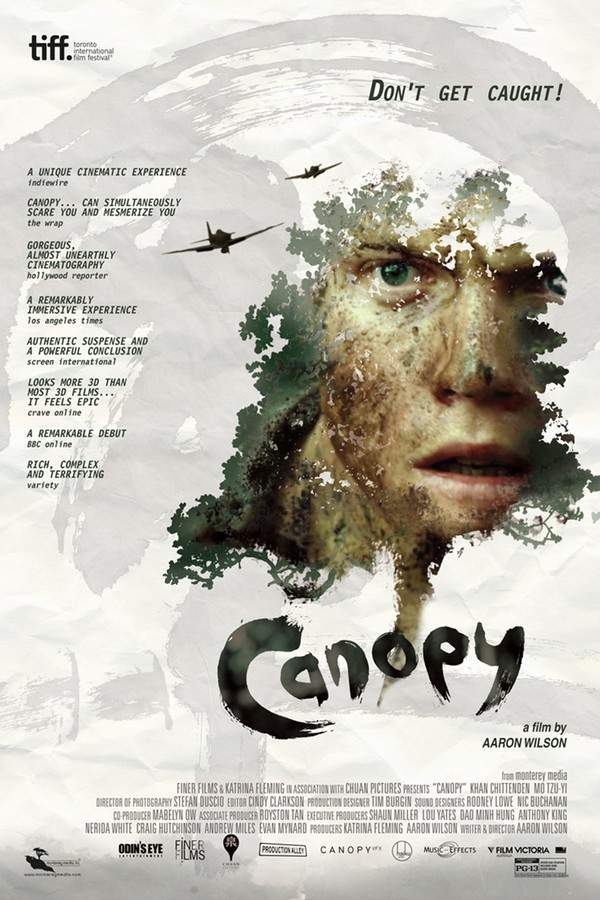
Canopy (2014) movie poster

Plot Summary

Canopy (2014) Plot Summary Explained

Release, runtime and language
2014 · 84 min · English
Loading streaming availability…
Directed by
Aaron Wilson

During World War II in Singapore, an Australian pilot finds himself separated from his unit and unexpectedly joins forces with a local resistance fighter. Together, they embark on a perilous journey, desperately trying to evade the pursuing Japanese forces while seeking a path to safety and liberation. Their survival depends on courage, ingenuity, and an unwavering hope for freedom.

On this page (6)
  1. 1 Where to watch
  2. 2 What happens: full plot
  3. 3 Plot questions answered
  4. 4 Movie threads
  5. 5 Movies like Canopy
  6. 6 Every angle
Loading streaming availability…

Full plot summary · contains spoilers

What Happens in Canopy: Full Plot Summary

The whole story of Canopy (2014) explained, from the opening scene to the final frame: every key event, every twist and what it all adds up to. Read it as a quick recap before the sequel, to check a scene you missed, or to finally understand what really happened.

In 1942, the jungle front of the war between the Allies and the Japanese stretches across the harsh terrain of Singapore. A Flight Lieutenant in the Royal Australian Air Force, Jim, wakes to a violent, disorienting reality: he is suspended from a tree by his parachute, having been shot down. Freeing himself with effort, he discovers that his pistol is missing, his one line of defense, yet he salvages whatever survival gear he can and steels himself to press on. With careful caution, he threads his way through treacherous mud and dense undergrowth, narrowly slipping past a watchful Japanese patrol and slipping deeper into the unknown.

As he moves, the landscape reveals its grim textures—swamps that gulp at his boots, fields strewn with Japanese propaganda leaflets that flutter like ghostly warnings, and the constant, pulse-quickening fear of discovery. It is in this unforgiving environment that he encounters Seng, a Chinese Dalforce guerrilla fighter who has already been separated from his unit behind enemy lines. Although language separates them, a practical alliance forms quickly: the two men decide to travel together, each offering the other a measure of survival in a world where trust must be earned in the dust of battle.

Early in their trek, Jim discovers the body of a comrade Seng had cared for, a moment that weighs heavily on Seng and stirs a complex mix of grief and resolve. The two become a fragile team, moving in tandem through danger. When Seng collapses from a gunshot wound to the abdomen, Jim is forced into a grim, improvisational role: he must perform emergency surgery with bare hands and whatever minimal tools his kit affords, all while contending with the need to keep Seng quiet and hidden from the ever-present Japanese patrols. In a moment of desperate solidarity, Jim rips a portion of his own pants to fashion a makeshift wrap for Seng’s wound, a crude but vital lifeline that speaks to the depth of their shared peril.

Night brings a fleeting lull, but danger remains never far away. Seng wakes Jim with the sound of a patrol moving nearby, and the pair are briefly compelled to fend off biting insects that threaten their fragile shelter in the treetop. As they settle back under the shelter of that tree, Seng retrieves from Jim’s pant leg pocket an object tied to his waist—a photograph of Jim’s family. The image triggers a reverie in Jim, a quiet, aching memory of his wife and the life he might be fighting to return to. The morning light arrives with a hard clarity: they have learned each other’s names, a small but meaningful milestone in a landscape governed by fear and survival.

The calm is shattered when Japanese soldiers discover them, forcing a separation that tests every ounce of resolve. Seng’s name and his life are cut short in cold, merciless fashion by an officer of the patrol, a moment that lands with crushing finality. Jim is dragged away, his bid for freedom slipping away as he is loaded onto a mobile truck and carried toward a distant base. The world he knew becomes a distant echo as the vehicle carries him away, and the view from the back of the truck becomes a stark reminder that escape is no longer within reach.

A quiet time jump reveals Jim back home in Australia, standing motionless in a field of wheat with the murmur of the jungle lingering at the edges of his memory. The sounds of those jungles creep back in, intertwining with the sunlit quiet of the homeland he longs for but cannot fully forget. The story lingers on the line between duty and memory, exploring how a man can hold onto his humanity even as war steals so much of the world around him.

In this stark, intimate portrait of endurance, the film quietly unpacks themes of survival, connection, and the price of freedom, anchored by two men who meet, fight, and endure together even as the war around them tries to erase their chances of making it home. The emotional core rests in the small, human moments—the shared silence, the improvised care for a wounded comrade, the weight of a family photograph, and the unspoken promise of a life beyond the jungle’s reach.
Last updated: October 09, 2025 at 16:19

Was this helpful?

Plot questions answered

Canopy Plot Explained: Your Questions Answered

The questions people ask most about Canopy (2014): what happens in the confusing scenes, why the characters do what they do, the twists, hidden details and what the ending means. Each answer contains spoilers.

Q1

Why does Jim decide to travel with Seng despite the language barrier?

Jim decides to ally with Seng because survival in the hostile Singapore jungle demands mutual support. Both men are separated from their units and face the constant threat of Japanese patrols. Despite not sharing a common language, they recognize that traveling together doubles their chances of reaching friendly territory, Seng knows the local terrain while Jim has military training and supplies.

  • jim
  • seng
  • alliance
  • survival
  • language barrier
Q2

How does Jim perform emergency surgery on Seng with no medical equipment?

After Seng is shot in the abdomen during a near-encounter with Japanese soldiers, Jim must extract the bullet to prevent fatal infection. Using only his bare hands and minimal survival kit tools, he performs improvised surgery while keeping Seng quiet to avoid attracting patrols. Jim tears part of his own pants to create a makeshift bandage, sustaining Seng long enough for the bullet wound to be crudely addressed.

Foreshadowing: Earlier, the two men nearly encounter a Japanese patrol, establishing the constant danger that leads to Seng's injury.

  • seng
  • wound
  • surgery
  • jim
  • bullet
  • improvisation
Q3

What happens to Seng at the end of the movie?

Seng is killed in cold blood by a Japanese patrol officer after the soldiers discover Jim and Seng hiding in the jungle. The officer executes Seng while Jim watches helplessly, and Jim is then captured and dragged away toward a Japanese base. This marks the tragic end of their fragile alliance.

  • seng
  • death
  • japanese
  • patrol
  • capture
Q4

Why does Jim keep a photograph of his family during the mission?

Jim carries a photograph of his wife tucked in his pant leg pocket as a personal reminder of what he's fighting to return to. When Seng discovers the photo during a rest stop, it triggers Jim to reflect on his life back home in Australia, strengthening his resolve to survive the jungle and escape captivity. The photograph symbolizes his humanity amid the brutality of war.

  • jim
  • family
  • photo
  • wife
  • memories
Q5

How do Japanese soldiers discover Jim and Seng in the jungle?

Japanese soldiers locate Jim and Seng while they are hiding in the jungle, though the summary does not specify exactly how the patrol finds them. The discovery results in their separation, Seng is immediately executed while Jim is captured and loaded onto a truck heading toward a Japanese base, ending their attempt to reach friendly territory.

Foreshadowing: Earlier, Seng wakes Jim to warn him about a nearby patrol, demonstrating how constant the threat of discovery is throughout their journey.

  • japanese
  • patrol
  • discovery
  • capture
  • separation
Q6

What does the ending scene with the wheat field represent?

The final scene shows Jim back in Australia standing in a wheat field after the war ends, but the distant sounds of the Singapore jungle creep back into his memory. This suggests he has physically returned home but remains psychologically haunted by his experiences, the trauma of Seng's death and his captivity lingers, representing how war leaves lasting psychological scars even when survival is achieved.

  • jim
  • australia
  • trauma
  • memories
  • war
  • return
Q7

Why does Seng continue fighting after being separated from his unit?

Seng, a Chinese Dalforce guerrilla fighter, was already separated from his unit behind enemy lines when he encounters Jim. Despite being alone and wounded, he continues toward friendly territory rather than surrendering. His determination appears rooted in both resistance against the Japanese occupation and the practical need to survive, aligning with Jim gives him a better chance of making it out alive.

  • seng
  • dalforce
  • guerrilla
  • resistance
  • unit
Q8

Why is Seng's death significant to the story's emotional impact?

Seng's death represents the brutal randomness of war and the loss of the human connection Jim formed during his ordeal. Their alliance, built across language barriers through shared survival, ends in tragedy when Seng is executed while Jim watches helplessly. This moment transforms Jim's story from mere survival into one of profound loss, setting up the haunting conclusion where he returns home but cannot escape the memories of what he witnessed.

Foreshadowing: The earlier moment where Jim cares for Seng's wound establishes their bond, making the subsequent execution more devastating.

  • seng
  • death
  • loss
  • jim
  • emotional
  • connection
Q9

Why does Jim return home haunted by his memories even though he survived?

Jim survives the war and returns to Australia, but the ending suggests he suffers from unresolved trauma. The memories of the Singapore jungle, the constant fear, Seng's death, and his capture, follow him into civilian life. The final image of him standing motionless in a wheat field while hearing jungle sounds illustrates that psychological survival differs from physical survival; the horrors he experienced cannot be simply left behind.

  • jim
  • trauma
  • ptsd
  • memories
  • survival
  • haunted
Q10

How does the relationship between Jim and Seng develop throughout the movie?

Jim and Seng's relationship evolves from cautious strangers to fragile allies. Initially, they decide to travel together for practical survival reasons despite not sharing a language. After Jim performs emergency surgery to save Seng's life, a bond forms. They share a quiet moment learning each other's names, and the discovery of Jim's family photo deepens their human connection. However, their alliance is cut short when Japanese soldiers capture and kill Seng.

  • jim
  • seng
  • relationship
  • alliance
  • bond
  • trust

Movie threads

More Movies Like Canopy, by Mood & Story

Curated lists built around what makes Canopy tick: the same mood, the same kind of story or the same emotional payoff. Each list explains why these movies belong together.

Movies about wartime partnerships like Canopy

Survival forces unexpected bonds between enemies and allies in dangerous lands. Discover movies like Canopy, where survival in enemy territory hinges on an uneasy alliance. These films explore the powerful, often unspoken bonds formed under extreme pressure, focusing on stories of forced cooperation and shared hardship in war-torn landscapes.

  • tense
  • desperate
  • survivalist
  • unspoken friendship
  • grim
  • anxious
  • Tone: tense, grim, bittersweet
  • Pacing: steady, forward-moving
Why these movies?

The story pattern: The narrative pattern follows characters who must overcome initial distrust or animosity to achieve a common goal, usually survival or escape. The journey tests their prejudices and forges a deep, complex connection, often ending with a bittersweet acknowledgment of their bond amidst tragedy or separation.

Why they belong together: Movies are grouped here by their central theme of an emergent partnership born from dire necessity. They share a tense, high-stakes atmosphere where character development is driven by the precarious balance between conflict and cooperation, leading to emotionally heavy and bittersweet conclusions.

Claustrophobic survival movies like Canopy

Relentless, tense journeys where the environment itself is a trap. If you liked the tense, immersive pursuit in Canopy, explore these movies. They capture the high-intensity experience of being hunted in a hostile environment, where every decision is critical and the feeling of being trapped is palpable, much like a jungle chase thriller.

  • claustrophobic
  • tense
  • desperate
  • anxious
  • survivalist
  • grim
  • Tone: tense, anxious, claustrophobic
  • Pacing: steady, relentless
Why these movies?

The story pattern: Stories unfold linearly, driven by the immediate goal of evasion and survival. Characters are pushed to their physical and psychological limits by a persistent threat, with the narrative maintaining a steady, urgent pace and few respites. The focus is on the gritty, visceral experience of the chase itself.

Why they belong together: These films are united by a specific, immersive vibe: high-intensity survival against both a human enemy and an oppressive natural world. They share a tense, claustrophobic tone, steady pacing that mimics a constant state of movement, and a heavy emotional weight derived from life-or-death stakes.

If you liked this

Movies Like Canopy

Similar movies to Canopy: the same genre, themes or kind of story. Each one comes with its own plot summary, timeline and ending explained.

Browse all movie summaries

Every angle

Canopy (2014) Explained: Plot, Timeline & Characters

Everything about Canopy in one place: what happens in the plot summary, the timeline in chronological order, the characters and meaning and a spoiler-free summary. What's After the Movie adds the cast, box office and post-credit scenes.

Coming soon on iOS and Android

The Plot Explained Movie Summary App

Plot summaries, endings explained and timelines on your phone. Catch up on any movie in minutes, save your favorites and never miss a twist again.

Be the first to know when we launch. Your email stays private, always.

Learn more about the app