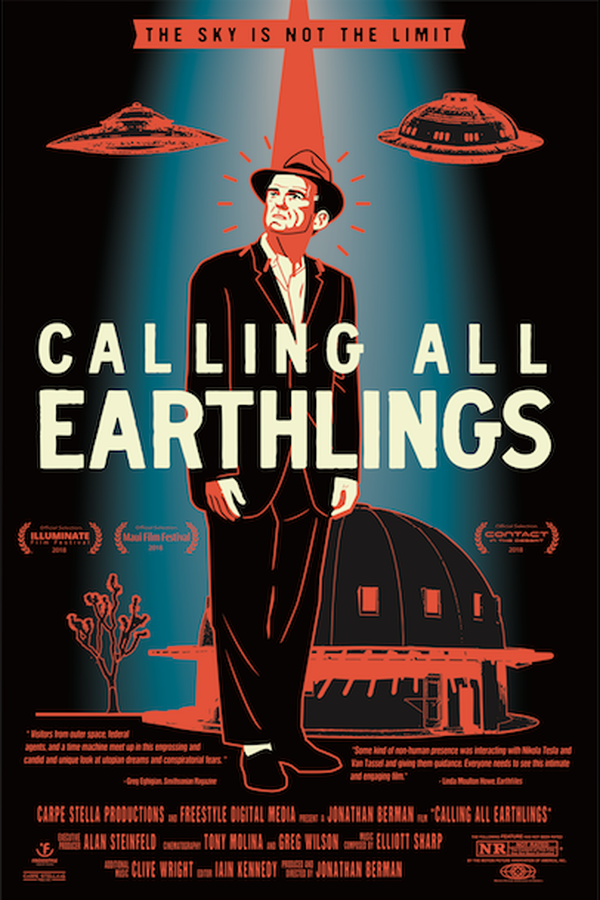
In 1950s California, George Van Tassel, a confidant of Howard Hughes, claims to channel alien guidance and draws upon Nikola Tesla's inventions to build the Integratron, a mysterious dome-shaped structure. As followers gather in the desert, the FBI investigates, suspecting potential unrest. The story explores the intrigue surrounding the Integratron's construction and purpose, ultimately questioning the fate of humanity and revealing unexpected secrets.
Find where to stream, rent, or buy Calling All Earthlings (2018) in the US with current JustWatch availability, up-to-date pricing, and platform listings for subscription, rental, and digital purchase options.
Warning: spoilers below!
Haven’t seen Calling All Earthlings yet? This summary contains major spoilers. Bookmark the page, watch the movie, and come back for the full breakdown. If you're ready, scroll on and relive the story!
Read the complete plot breakdown of Calling All Earthlings (2018), including all key story events, major twists, and the ending explained in detail. Discover what really happened, and what it all means.
In 1947, George Van Tassel, a former employee and confidant of Howard Hughes, makes the bold decision to leave behind his mundane life in Los Angeles filled with postwar anxiety. He relocates with his family to the serene Mojave Desert, where they make their home beneath a massive boulder. As he abandons the chaos of the city, he finds solace in the magnificent tranquility that Joshua Tree offers.
The turning point comes during the full moon in August 1953, when he encounters extraterrestrial beings who share with him the blueprint for a revolutionary rejuvenation device he dubs “The Integratron.” This moment convinces Van Tassel that he has been chosen by these extraterrestrial visitors, led by Solganda, whose voice intriguingly resembles that of Ronald Coleman. Inspired, he embarks on an ambitious project to create a monumental dome capable of opening portals through time and space, merging the received wisdom with the groundbreaking work of Nikolai Tesla and other visionary scientists.
Long before contemporary shows like The X-Files and Stranger Things captured imaginations with themes of otherworldly contact, the harsh realities of nuclear threats and social conformity compelled artists, innovators, and adventurers in the postwar era to flock to the desert. They sought new lifestyles and futures while residing in the jack-rabbit shacks, plots of land allocated by the government through the Small Tract Act of 1938.
As a self-taught inventor and skilled pilot, Van Tassel quickly rises to prominence, becoming one of the pioneering figures of alien contact culture. His endeavors combine science with spirituality, forging a vision of a new utopia through the creation of the Integratron, which aims to resolve the issues of aging and harness unlimited energy for the world.
During the 1950s, Van Tassel sets in motion the Interplanetary Spacecraft Conventions to promote the dome and advance his anti-nuclear sentiments. Many affluent individuals from Los Angeles, eager for rejuvenation, support his project, including his old boss, Howard Hughes, who shares Van Tassel’s concerns about contamination. Together, they contribute significantly to the development of the dome.
With the help of his neighbors, including an early follower of Yogananda, Van Tassel actualizes his dream, working tirelessly to complete the dome and prepare for its activation. His crusade attracts a diverse group of people to the area, igniting a peace-loving, alien-inspired movement. This convergence brings together an eclectic mix of alternative scientists, FBI agents, and eccentric individuals, all compelled by the burgeoning American Dream as they seek to either support or obstruct this emerging reality.
However, challenges arise as the Integratron’s location poses a dilemma; it sits adjacent to one of the largest military installations worldwide, the Marine Corps Air Ground Combat Center, in Twentynine Palms. Balancing the scene is the enigmatic Giant Rock, a site with deep cultural significance to American Indians and a history of conflict.
The complexities of the Integratron’s design unfold as its purposes remain cryptic. Although some of its electromagnetic principles prove promising, they require precise adjustment; failure to calibrate could lead to catastrophic consequences as one participant warns: >“Southern California could be blown off the map.” As the project nears completion, unexpected twists threaten the culmination of Van Tassel’s vision.
Ultimately, the Integratron serves different purposes for various individuals: some see it as a means for global colonization, others perceive it as a chance for companionship and guidance, while for many, it becomes a vibrant hub for culture and art. Calling All Earthlings vividly shares these narratives through the voices of both current and past inhabitants of the Joshua Tree region, featuring notable personalities such as Eric Burdon, medicine woman Valerie Brightheart, historian Ernest Siva of the Morongo Indians, publisher Art Kunkin, and the contemporary custodians of the dome, the Karl sisters. Supplementing the story are insights from esteemed Californian historian Dr. Kevin Starr, skeptical astronomer Bob Berman, and futurist duo Drs. JJ and Desiree Hurtak.
Accompanied by a celestial score crafted by Elliott Sharp alongside the legendary Harmonia, and other creative collaborators like Clive Wright and Dave Catching’s Earthlings?, this documentary presents an enigmatic exploration of the boundary-defying culture inherent to Joshua Tree and its inhabitants, all the while patiently awaiting their spacecraft.
Last updated: October 25, 2024 at 09:41
Explore frequently asked questions about Calling All Earthlings (2018) with spoiler-rich answers covering the full plot summary, major story beats, character motivations, hidden details, and ending meaning. This movie summary FAQ helps explain confusing scenes, plot twists, and narrative decisions in clear, searchable detail.
George Van Tassel left Los Angeles in 1947 because he was disillusioned with his mundane life in the city, which was filled with postwar anxiety. He moved with his family to the Mojave Desert seeking solace and tranquility away from the chaos of city life. They established their home beneath a massive boulder in the Joshua Tree area, where he found peace in the serene desert landscape.
The Integratron was a dome-shaped structure designed as a rejuvenation device capable of opening portals through time and space. Van Tassel claimed it could reverse aging and harness unlimited energy for the world. The design combined alien technology blueprints he received with principles from Nikola Tesla and other visionary scientists.
The full moon encounter in August 1953 provided the original blueprint that launched the entire project.
Solganda was the extraterrestrial being who contacted George Van Tassel during a full moon in August 1953. Solganda shared with Van Tassel the blueprint for the Integratron and convinced him he had been chosen for a greater purpose. Interestingly, Solganda's voice was said to resemble that of actor Ronald Coleman, adding an unusual detail to this alien communication.
Howard Hughes, who had previously employed Van Tassel, became a significant financial supporter of the Integratron project. Hughes shared Van Tassel's concerns about nuclear contamination and believed in the project's potential. Their alliance provided substantial funding that helped advance the dome's construction during the 1950s.
While some of the Integratron's electromagnetic principles showed promise, they required extremely precise calibration. One participant warned that failure explicitly to properly adjust the device could lead to catastrophic consequences, cautioning that 'Southern California could be blown off the map.' This added an element of potential disaster to the project.
The Integratron was constructed near Twentynine Palms, directly adjacent to the Marine Corps Air Ground Combat Center, one of the largest military installations in the world. This proximity created tension between Van Tassel's utopian vision and ongoing military operations, raising questions about the project's feasibility and security implications in this sensitive area.
The Interplanetary Spacecraft Conventions were events organized by George Van Tassel during the 1950s to promote the Integratron and spread his anti-nuclear sentiments. These conventions attracted affluent individuals from Los Angeles who were interested in rejuvenation and alternative futures. The events became a gathering point for the growing alien contact culture movement in the desert.
The FBI investigated the Integratron project because they suspected potential unrest among the growing group of followers gathering in the desert. With the community attracting diverse people including alternative scientists, eccentric individuals, and others drawn to Van Tassel's vision, authorities were concerned about the possibility of cult-like behavior or other activities that might pose a threat to public order.
The documentary leaves the ultimate purpose and fate of the Integratron open-ended and ambiguous. While the structure was completed, the summary mentions 'unexpected twists' that threatened Van Tassel's vision. Different people came to view the Integratron in various ways, as a tool for global colonization, a source of companionship and guidance, or simply a vibrant hub for culture and art, without revealing whether its intended rejuvenation capabilities were ever realized.
The jack-rabbit shacks were simple dwellings built on plots of land allocated by the government through the Small Tract Act of 1938. During the 1950s, artists, innovators, and adventurers fleeing the pressures of postwar America flocked to these desert plots near Joshua Tree, creating a community that aligned with Van Tassel's alien contact vision. Many of these early settlers became his neighbors and helped construct the Integratron.
According to the documentary's context, Van Tassel worked tirelessly to complete the Integratron and prepare it for activation, believing he was chosen by extraterrestrial visitors. The documentary follows his journey through the 1950s and beyond, documenting how his ambitious project attracted followers and supporters while facing challenges from military proximity and the complexities of his visionary invention.
Yogananda's early followers in the Joshua Tree area became part of Van Tassel's community and helped him realize his dream. These neighbors provided essential labor and support for constructing the dome. Their involvement exemplified how Van Tassel's project brought together diverse groups, including spiritual practitioners, alternative scientists, and eccentrics, all united by the pursuit of a new utopian future.
Discover curated groups of movies connected by mood, themes, and story style. Browse collections built around emotion, atmosphere, and narrative focus to easily find films that match what you feel like watching right now.
Documentaries exploring eccentric figures and their otherworldly utopian visions.If you enjoyed the eccentric story of the Integratron in Calling All Earthlings, you'll find more movies like it here. This section features documentaries about real-life visionaries, utopian schemes, and mysterious investigations that have a similarly whimsical and inquisitive feel.
Narratives in this thread typically follow an investigative path, uncovering the history and motivations behind a peculiar idea or individual. They often juxtapose earnest believers with skeptical authorities, creating a gentle tension between hope and reality, and frequently leave the central mystery tantalizingly unresolved.
These films are grouped together for their shared focus on quirky, real-world mysteries and the charismatic figures who champion them. They possess a unique tonal blend of nostalgic curiosity, light speculative wonder, and the atmospheric tension of being watched or doubted.
Stories of postwar society searching for hope through radical ideas.For viewers who liked the postwar setting and utopian themes of Calling All Earthlings, this section highlights movies with a similar feel. These films explore the tension between societal anxiety and the hopeful pursuit of radical futures, often with an ambiguous or thought-provoking conclusion.
The narrative pattern involves characters or communities reacting to the pressures of a conformist society by embracing radical, often scientifically-tinged, alternative visions. The conflict arises from the friction between their hopeful ideals and the skeptical establishment, leading to journeys that are both personally transformative and socially resonant.
These movies share a specific historical mood—postwar anxiety—coupled with themes of utopianism and scientific pursuit. They are united by a sense of speculative hope emerging from a backdrop of societal tension, creating a uniquely bittersweet and inquisitive viewing experience.
Don't stop at just watching - explore Calling All Earthlings in full detail. From the complete plot summary and scene-by-scene timeline to character breakdowns, thematic analysis, and a deep dive into the ending - every page helps you truly understand what Calling All Earthlings is all about. Plus, discover what's next after the movie.
Track the full timeline of Calling All Earthlings with every major event arranged chronologically. Perfect for decoding non-linear storytelling, flashbacks, or parallel narratives with a clear scene-by-scene breakdown.
Discover the characters, locations, and core themes that shape Calling All Earthlings. Get insights into symbolic elements, setting significance, and deeper narrative meaning - ideal for thematic analysis and movie breakdowns.
Discover movies like Calling All Earthlings that share similar genres, themes, and storytelling elements. Whether you’re drawn to the atmosphere, character arcs, or plot structure, these curated recommendations will help you explore more films you’ll love.
Calling All Earthlings (2018) Scene-by-Scene Movie Timeline
Calling All Earthlings (2018) Movie Characters, Themes & Settings
Calling All Earthlings (2018) Spoiler-Free Summary & Key Flow
Movies Like Calling All Earthlings – Similar Titles You’ll Enjoy
The Day the Earth Stood Still (2008) Detailed Story Recap
Alien Contact: Outer Space (2017) Spoiler-Packed Plot Recap
Close Encounters of the Fifth Kind (2020) Movie Recap & Themes
Earthlings (2023) Full Summary & Key Details
Accidental Truth: UFO Revelations (2023) Detailed Story Recap
Alien Island (2023) Plot Summary & Ending Explained
Earth vs. the Flying Saucers (1956) Spoiler-Packed Plot Recap
Mysteries of the Gods (1976) Full Summary & Key Details
The Outer Space Connection (1975) Full Movie Breakdown
Target Earth (1998) Full Summary & Key Details
In Search of Ancient Astronauts (1973) Spoiler-Packed Plot Recap
The Invaders (1995) Story Summary & Characters
UFO: Target Earth (1974) Full Summary & Key Details
The Cosmic Man (1959) Spoiler-Packed Plot Recap
Aliens from Spaceship Earth (1977) Ending Explained & Film Insights