





Plot Explained Spoilers guaranteed!
Plot Explained

Browse by genre

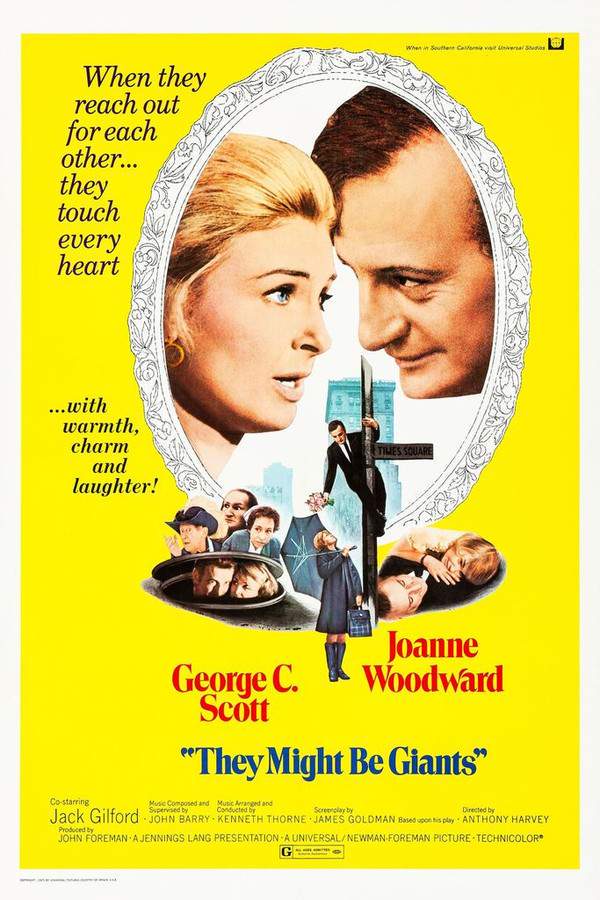
They Might Be Giants (1971) movie poster

Plot Summary

They Might Be Giants (1971) Plot Summary Explained

Release, runtime and language
1971 · 91 min · English
Directed by
Anthony Harvey
Starring
Jack Gilford, George C. Scott, Joanne Woodward, Oliver Clark, Al Lewis, Theresa Merritt

Following the death of his parents, a man is committed to a mental institution. There, he convinces a psychiatrist that he is the famous detective Sherlock Holmes. As she tries to treat him, she becomes drawn into his elaborate games and deductive reasoning, unsure if he’s genuinely brilliant or simply delusional. The psychiatrist finds herself increasingly involved in his invented cases and the blurring lines between their roles lead to unexpected complications.

On this page (7)
  1. 1 Where to watch
  2. 2 What happens: full plot
  3. 3 Plot questions answered
  4. 4 Movie threads
  5. 5 Movies like They Might Be Giants
  6. 6 Categories
  7. 7 Every angle

Where to watch

Where to Watch They Might Be Giants (1971)

Where can you watch They Might Be Giants? Stream, rent or buy it in the US, including on Amazon Video, Apple TV Store and Fandango At Home: current JustWatch availability with up-to-date prices.

Streaming availability powered by JustWatch

Full plot summary · contains spoilers

What Happens in They Might Be Giants: Full Plot Summary

The whole story of They Might Be Giants (1971) explained, from the opening scene to the final frame: every key event, every twist and what it all adds up to. Read it as a quick recap before the sequel, to check a scene you missed, or to finally understand what really happened.

As Judge Justin Playfair](/actor/george-c-scott) struggles with the profound emptiness after his wife's passing, he seeks refuge in a fantastical world where he embodies the legendary detective, Sherlock Holmes. Clad in the signature deerstalker hat, with a pipe in one hand and a violin in the other, he constructs a quirky makeshift criminal lab, absorbed in the task of deciphering the convoluted schemes concocted by the sinister Professor Moriarty.

The situation escalates when his brother, Lester Rawlins, attempts to have him committed. However, during this turmoil, he unwittingly piques the interest of Dr. Mildred Watson, a psychiatrist who finds his case to be both perplexing and fascinating. As she probes into his mind, Justin astonishes her with his remarkable skill in abductive reasoning, reminiscent of Holmes's acute observational skills. Amidst the ensuing madness, he boldly breaks free from the institution, and Dr. Watson, captivated by his peculiar situation, cannot help but get involved.

Though initially hesitant to embrace Dr. Watson's therapeutic insights, Justin flips the script by exploring the labyrinth of her psyche instead. His intrigue deepens when he reveals her true identity, leading him to eagerly integrate her into his imaginative escapades as his trusted companion, Doctor Watson. Together, they embark on an enigmatic journey to apprehend Moriarty, encountering an array of eccentric characters as they traverse the vibrant streets of the city.

The excitement reaches a boiling point when Dr. Watson, in a flurry of nerves, extends an invitation for dinner, adorning herself in a wedding gown for what she believes to be a landmark event. What begins as a seemingly mundane dinner spirals into an extraordinary adventure, as they revisit the eccentric individuals they've met along the way, who eventually become part of their quirky procession. Remarkably, Dr. Watson's wedding gown remains a constant throughout this whimsical ritual.

As darkness envelops the night, the eclectic ensemble begins to disperse, leaving just Holmes and Watson standing before an underpass in the park, like two worshippers at a sacred altar. With a confrontation with Moriarty looming on the horizon, they stand entranced, listening to the rumble of approaching hooves accompanied by a bright light that evokes the glow of a police vehicle or perhaps a subway train, rather than celestial radiance.

Last updated: November 17, 2024 at 22:12

Was this helpful?

Plot questions answered

They Might Be Giants Plot Explained: Your Questions Answered

The questions people ask most about They Might Be Giants (1971): what happens in the confusing scenes, why the characters do what they do, the twists, hidden details and what the ending means. Each answer contains spoilers.

Q1

Why does Justin Playfair believe he is Sherlock Holmes?

After his wife's death, Justin Playfair was overwhelmed by profound grief and emptiness. Rather than facing his loss directly, he retreated into a fantastical world where he could embody Sherlock Holmes, a figure of logic, purpose, and heroic purpose. This persona allowed him to escape his emotional pain and create meaning through imagined crime-solving adventures.

Foreshadowing: Early scenes establish his wife’s death as the catalyst for his withdrawal into fantasy.

  • grief
  • wife death
  • mental institution
  • Sherlock Holmes delusion
  • escape
Q2

Why does Dr. Watson go along with Justin's games?

Dr. Mildred Watson initially becomes professionally interested in Justin's case because of his exceptional abductive reasoning skills, which genuinely impress her. As she probes his mind, she finds herself captivated by his eccentric worldview. Her curiosity evolves into genuine involvement as he flips their roles by exploring her psyche and reveals what he claims is her true identity, pulling her deeper into his imaginative adventures.

Foreshadowing: Her fascination begins when she discovers his remarkable deductive abilities, showing she's drawn to his intellect.

  • psychiatrist
  • Dr. Watson
  • patient relationship
  • involvement
  • curiosity
Q3

What is the significance of the wedding gown Dr. Watson wears to dinner?

Dr. Watson wears a wedding gown to dinner because she believes the occasion is a significant milestone, her nervousness suggests she views it as a proposal or romantic turning point. The fact that she keeps wearing the gown throughout their subsequent whimsical adventure adds to the film's surreal quality, making it a recurring symbol of her emotional investment in the relationship.

Foreshadowing: Her nervous invitation to dinner earlier hints at her deeper romantic intentions.

  • wedding gown
  • dinner scene
  • romantic intention
  • Dr. Watson nerves
Q4

Is Professor Moriarty real in the movie?

The film deliberately keeps Moriarty's existence ambiguous, reflecting the central question of whether Justin is genuinely brilliant or simply delusional. Some scenes suggest Moriarty could be a real criminal they are pursuing, while others imply the entire conspiracy may be a product of Justin's imagination. This ambiguity is never resolved, leaving viewers to decide whether the confrontations and cases are real or part of his fantasy.

Foreshadowing: The whimsical tone and imaginary villain setup throughout suggest Moriarty may be another aspect of Justin's elaborate game.

  • Moriarty
  • real or imaginary
  • villain
  • delusion
  • ambiguity
Q5

What happens at the end of They Might Be Giants?

At the end, Justin and Dr. Watson stand alone before an underpass in the park, waiting for their confrontation with Moriarty. As darkness falls, they hear the rumble of approaching hooves accompanied by a bright light, which could be a police vehicle, a subway train, or something more symbolic. The film ends ambiguously on this image, leaving whether they actually confront Moriarty or if this is another fantasy sequence open to interpretation.

Foreshadowing: The build-up to the Moriarty confrontation throughout the second half of the film sets up this final symbolic encounter.

  • ending
  • finale
  • underpass
  • confrontation
  • ambiguous ending
  • Moriarty
Q6

Why does Justin's brother try to have him committed?

Justin’s brother, Lester Rawlins, becomes increasingly concerned about his brother's mental state after his wife's death. Witnessing Justin's complete transformation into Sherlock Holmes, complete with the deerstalker hat, violin, and makeshift criminal lab, Lester believes Justin has suffered a mental break. His desperate attempt to have Justin committed comes from a place of genuine concern for his brother's wellbeing, though Justin interprets it as another attack in Moriarty's conspiracy.

Foreshadowing: The brother’s concern is established early when he witnesses Justin’s extreme behavioral changes.

  • brother
  • Lester Rawlins
  • commitment
  • concern
  • family
Q7

What is abductive reasoning in the film?

Abductive reasoning is the logical process Justin uses that impresses Dr. Watson, the same method Sherlock Holmes employs. It involves making educated guesses based on limited observations, forming the most likely explanation for seemingly unrelated clues. Dr. Watson is stunned to find that Justin, despite his delusional state, possesses genuine remarkable skill at this form of deduction, which blurs the line between his brilliance and his delusion.

Foreshadowing: Dr. Watson's initial professional curiosity is sparked specifically by this unexpected intellectual ability.

  • abductive reasoning
  • deduction
  • Sherlock Holmes method
  • intellectual ability
Q8

What does Justin discover about Dr. Watson's true identity?

Justin reveals to Dr. Watson that she has a 'true identity' beyond being his psychiatrist, which he claims to have deduced. Intrigued by this, she allows him to integrate her into his adventures as his trusted companion, echoing the Holmes and Watson dynamic. The film doesn't explicitly reveal what Justin discovered about her, keeping this detail ambiguous, but it serves as the turning point where she fully commits to participating in his imagined world.

Foreshadowing: This discovery happens during their role-reversal session where Justin explores her psyche.

  • true identity
  • Watson companion
  • deduction
  • role reversal
Q9

Is there a romantic relationship between Justin and Dr. Watson?

The film develops an unconventional romantic bond between them, rated 7 in intensity. What begins as a psychiatrist-patient dynamic evolves as Dr. Watson becomes emotionally invested in Justin's world. Her decision to wear a wedding gown to dinner, believing it marks a significant occasion, signals her romantic intentions. The relationship blurs professional boundaries as she transitions from therapist to participant in his adventures.

Foreshadowing: Her nervous dinner invitation and wedding gown signal her romantic feelings developing.

  • romance
  • romantic relationship
  • Doctor Watson
  • unconventional love
  • bond
Q10

What is the symbolic meaning of the final scene?

The final scene, set before an underpass in the park at night, is highly symbolic. Justin and Dr. Watson stand like 'two worshippers at a sacred altar,' waiting for the confrontation with Moriarty. The approaching hooves and bright light could represent various things, a police car, a subway train, or something transcendent. The ambiguous image reflects the film's central theme of blurred realities and the question of whether Justin's world is fantasy or a different kind of truth.

Foreshadowing: The buildup throughout the film establishes Moriarty as both a literal and symbolic antagonist.

  • symbolism
  • underpass
  • final scene
  • Moriarty
  • blurred realities
  • meaning

Movie threads

More Movies Like They Might Be Giants, by Mood & Story

Curated lists built around what makes They Might Be Giants tick: the same mood, the same kind of story or the same emotional payoff. Each list explains why these movies belong together.

Movies about therapeutic boundaries like They Might Be Giants

Stories where a caregiver becomes entangled in a patient's intricate fantasy world. If you liked the dynamic in They Might Be Giants, you'll find similar movies here. This collection features films where doctors, therapists, or caregivers become deeply involved in their patients' constructed realities, exploring themes of mental health, escapism, and the ethics of connection.

  • quirky
  • reflective
  • melancholic
  • unconventional
  • psychological
  • intimate
  • Tone: whimsical, reflective, melancholic
  • Pacing: steady, conversational
Why these movies?

The story pattern: The narrative typically centers on a professional relationship—doctor/patient, therapist/client—that gradually transforms as the caregiver is seduced by the patient's unique worldview. The story unfolds through a series of shared 'cases' or invented scenarios, creating a bubble of shared reality that challenges professional boundaries and often leads to unexpected emotional consequences for both parties.

Why they belong together: These films are grouped together because they share a specific character dynamic and thematic focus on the psychology of care. They blend drama with elements of mystery or comedy, maintaining a steady, character-driven pace while exploring the delicate balance between treatment and human connection.

Movies with a whimsical melancholy vibe like They Might Be Giants

Playful stories with a bittersweet heart, leaving reality open to interpretation. Discover films that share the distinctive bittersweet and whimsical feel of They Might Be Giants. These movies often blend comedy and drama, using eccentricity to explore deeper themes of loss and memory, and typically conclude with thoughtful, ambiguous endings that linger in the mind.

  • whimsical
  • melancholic
  • bittersweet
  • dreamlike
  • quirky
  • reflective
  • Tone: whimsical, melancholic, bittersweet
  • Pacing: steady, contemplative
Why these movies?

The story pattern: Narratives in this thread often follow eccentric protagonists using imagination or fantasy as a coping mechanism for pain or loss. The journey is not about solving a problem in a conventional way, but about the emotional experience of living in a slightly off-kilter world. The pacing is steady, allowing the mood to settle, and the conclusion often reflects the central theme of blurred lines between reality and perception.

Why they belong together: Movies are grouped here based on their unique emotional blend and tonal quality. They share a specific vibe: a surface-level whimsy that is consistently tempered by a melancholic foundation, resulting in an experience that is both charming and poignant, with a deliberate ambiguity that invites reflection.

If you liked this

Movies Like They Might Be Giants

Similar movies to They Might Be Giants: the same genre, themes or kind of story. Each one comes with its own plot summary, timeline and ending explained.

Browse all movie summaries

Categories

Movie Lists Featuring They Might Be Giants

They Might Be Giants appears in these hand-built movie categories. Each one groups movies by a specific mood, theme or story type, with their plot summaries and endings explained.

View all movie categories

Every angle

They Might Be Giants (1971) Explained: Plot, Timeline & Characters

Everything about They Might Be Giants in one place: what happens in the plot summary, the timeline in chronological order, the characters and meaning and a spoiler-free summary. What's After the Movie adds the cast, box office and post-credit scenes.

Coming soon on iOS and Android

The Plot Explained Movie Summary App

Plot summaries, endings explained and timelines on your phone. Catch up on any movie in minutes, save your favorites and never miss a twist again.

Be the first to know when we launch. Your email stays private, always.

Learn more about the app