Plot Explained Spoilers guaranteed!
Plot Explained

Browse by genre

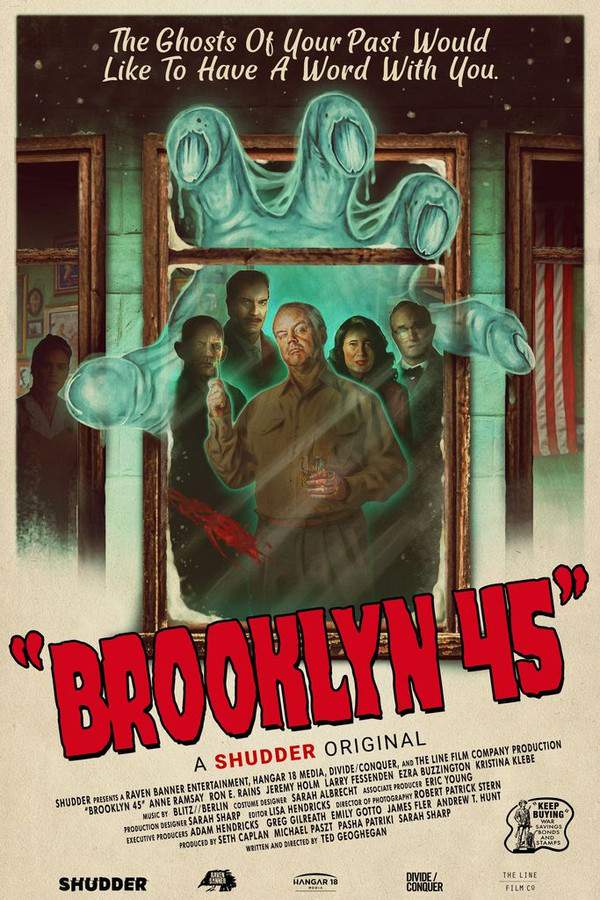
Brooklyn 45 (2023) movie poster

Plot Summary

Brooklyn 45 (2023) Plot Summary & Ending Explained

Release, runtime and language
2023 · 92 min · English
Echo score 73
JustWatch #16,999 11
Directed by
Ted Geoghegan
Starring
Larry Fessenden, Ezra Buzzington, Jeremy S. Holm, Kristina Klebe, Anne Ramsay, Lucy Carapetyan

Five lifelong friends gather at a Brooklyn brownstone for a reunion, intending to spend an evening of cocktails and reminiscing. However, their plans take a dark turn when a séance unleashes supernatural forces linked to their shared, troubled history. As the night progresses, they find themselves trapped and confronted by the ghosts of their past, forcing them to fight for survival against a terrifying reality and face a final, harrowing test.

On this page (7)
  1. 1 Where to watch
  2. 2 What happens: full plot
  3. 3 Plot questions answered
  4. 4 How it ends
  5. 5 Movie threads
  6. 6 Movies like Brooklyn 45
  7. 7 Every angle

Where to watch

Where to Watch Brooklyn 45 (2023)

Where can you watch Brooklyn 45? Stream, rent or buy it in the US, including on AMC+, Philo and Shudder: current JustWatch availability with up-to-date prices.

Streaming availability powered by JustWatch

Full plot summary · contains spoilers

What Happens in Brooklyn 45: Full Plot Summary

The whole story of Brooklyn 45 (2023) explained, from the opening scene to the final frame: every key event, every twist and what it all adds up to. Read it as a quick recap before the sequel, to check a scene you missed, or to finally understand what really happened.

On the night of December 27, 1945, a group of military veterans and lifelong friends gather at the home of their esteemed commander, Clive "Hock" Hockstatter (Larry Fessenden), in Park Slope, New York, to enjoy some cocktails. This reunion includes Marla Sheridan (Anne Ramsay), her husband Bob (Ron E. Rains), as well as Archibald "Archie" Stanton (Jeremy S. Holm) and Paul DiFranco (Ezra Buzzington).

While the friends reminisce, Hock is burdened by the recent suicide of his mentally ill wife, Susan (Lucy Carapetyan), who tragically took her life after no one believed her claims that their German neighbor, Hildegard (Kristina Klebe), was spying for Hitler. In a moment of grief, Hock reveals his fading belief in organized religion, resorting to spiritualism for solace. He persuades his friends to partake in an unexpected séance in a desperate hope to reach out to Susan.

The séance reveals itself to be a shocking success, with candles igniting, a closet door banging, and Susan’s ectoplasmic arm emerging as the music of Louis Jordan blasts from the radio. In a moment of desperation, Hock breaks the circle and reaches out, causing Susan's spirit to recede. Overwhelmed by the occurrence and grappling with the reality of an afterlife, Hock shockingly pulls out a pistol and takes his own life.

Amidst the chaos, the closet bursts open, revealing Hildegard, bound and gagged. As she breaks free, the friends question her identity and motives, resulting in tension and suspicion amongst the group. Archie reveals he's committed a war crime, while Marla showcases an unexpected brutality during her interrogation of Hildegard, much to Bob's astonishment.

Realizing they are trapped in the room by mystical forces, Marla believes the only escape is to finish the séance. As Hock's spirit possesses his lifeless body, he demands that the group kill Hildegard to secure their freedom. The situation escalates when Susan's ghost appears, accusing Hildegard of her murder. The revelations send Archie into a panic, forcing him to confront his horrific past.

In a frenzy, Hock's possessed body becomes increasingly violent, leading to a series of betrayals and tragic events. Bob, now wielding the gun, shoots at Paul in self-defense before turning the weapon on Hildegard, killing her amid the turmoil. Bob, feeling compelled to act for survival's sake, drops the gun, shaken by the horrors that unfolded.

Upon fulfilling Hock's malevolent demand, the parlor doors finally swing open. Bob, Marla, and Archie exit, but not without the weight of their shared trauma. Archie, grappling with his own guilt, decides to turn himself in. As Bob and Marla sit in their car, the emotional toll of the night engulfs them, ending with them overwhelmed in silence and tears, processing the grim events they just endured.
Last updated: October 25, 2024 at 11:38

Was this helpful?

Plot questions answered

Brooklyn 45 Plot Explained: Your Questions Answered

The questions people ask most about Brooklyn 45 (2023): what happens in the confusing scenes, why the characters do what they do, the twists, hidden details and what the ending means. Each answer contains spoilers.

Q1

Why does Hock commit suicide after the séance?

Hock takes his own life because the séance proves the existence of an afterlife, shattering his already fragile faith. Having lost his wife Susan to suicide after no one believed her claims about their German neighbor Hildegard being a spy, Hock was already struggling with grief and despair. The overwhelming evidence of supernatural forces, combined with his guilt over not believing Susan, drives him to end his life in that moment.

Foreshadowing: Earlier in the evening, Hock expresses his lost faith in organized religion and turns to spiritualism as his only hope for reaching his wife.

  • Hock suicide
  • séance aftermath
  • grief
  • afterlife proof
  • spiritualism
Q2

Why was Hildegard bound and gagged in the closet?

Hildegard was hidden in Hock's closet because he had discovered she was indeed a German spy reporting to Hitler. After Susan's suicide, Hock presumably learned the truth about his wife being right all along. Rather than turn Hildegard over to authorities, Hock took matters into his own hands, keeping her imprisoned in his home, though the exact timeline of when he captured her remains unclear.

Foreshadowing: Hock mentions Susan's claims about Hildegard being a spy and reveals his guilt for not believing her.

  • Hildegard spy
  • bound in closet
  • Hock revenge
  • German neighbor
Q3

Why can't the friends leave the room after the séance?

The friends become trapped in Hock's parlor by supernatural forces unleashed during the séance. The mystical barrier appears to be tied to the incomplete ritual - Marla suggests that finishing the séance is the only way to break the hold and escape. The supernatural prison forces them to confront and resolve the spiritual disturbance before they can leave.

Foreshadowing: The séance begins with candles igniting and physical phenomena occurring, indicating the ritual has tapped into real spiritual power.

  • trapped in room
  • supernatural forces
  • séance ritual
  • can't escape
Q4

Why does Hock's possessed body demand they kill Hildegard?

After Hock's death, his spirit possesses his lifeless body and demands the group kill Hildegard as the price for their freedom. This appears to be a corrupted version of Hock's desire for vengeance against the woman he blamed for his wife's death. The supernatural forces seem to twistedly reward this demand - fulfilling it is what finally breaks the mystical hold on the room.

Foreshadowing: Hock's grief over Susan's suicide and his discovery that Hildegard was truly a spy creates his motive for wanting her dead.

  • Hock possession
  • kill Hildegard
  • demand murder
  • supernatural demand
Q5

What war crime did Archie commit during the war?

Archie confesses to having committed a war crime, though the specific details are not explicitly revealed in the film. His revelation comes during the height of the supernatural chaos when the group is under extreme psychological pressure. The war crime clearly haunts him, as he becomes increasingly panicked when Susan's ghost appears and he faces the accumulated weight of everyone's hidden secrets and guilt.

Foreshadowing: Archie's nervousness and discomfort throughout the evening hints at something significant he's hiding.

  • Archie war crime
  • confession
  • guilt
  • wartime past
Q6

Why does Bob shoot Paul during the chaos?

Bob shoots Paul in what he claims is self-defense during the escalating violence of the possessed Hock's attack. With Hock's body violently attacking the group and the room filled with panic, Bob fires the gun at Paul - the specific reason is unclear, but it appears to be a desperate act under extreme duress rather than a calculated choice. This moment demonstrates how the supernatural siege breaks down normal moral constraints.

Foreshadowing: The possessed Hock becomes increasingly violent, forcing the group into desperate survival mode.

  • Bob shoots Paul
  • self defense
  • violence
  • chaos
Q7

What does Susan's ghost reveal about her death?

Susan's ghost appears and accuses Hildegard of murdering her, suggesting that Hildegard's actions or presence directly contributed to Susan's suicide. This accusation vindicates Susan's earlier claims about Hildegard being dangerous and implies that the stress of living next to a Nazi spy, combined with being disbelieved, drove Susan to take her own life. The ghost's appearance also confirms the supernatural connection between the spy and the household's tragedy.

Foreshadowing: Susan's mental illness and her desperate claims about Hildegard being a spy plant the seeds for this revelation.

  • Susan ghost accusation
  • murder
  • Hildegard guilt
  • suicide cause
Q8

Why do the parlor doors finally open after Hildegard is killed?

The parlor doors swing open only after Bob kills Hildegard, fulfilling the demand made by Hock's possessed body. This suggests the supernatural forces binding them in the room required this sacrifice to be completed. The mystical rules of the séance appear to demand blood payment - killing Hildegard was the condition set for releasing the trapped friends.

Foreshadowing: Marla explains that finishing the séance is their only escape, and Hock's spirit makes the killing of Hildegard the specific requirement for freedom.

  • parlor doors open
  • sacrifice fulfilled
  • release condition
  • supernatural rule
Q9

Why does Marla become so brutal during Hildegard's interrogation?

Marla displays unexpected brutality when interrogating Hildegard, shocking her husband Bob. This reveals hidden psychological depths and suggests that the trauma of war and the events of the evening have fractured her composure. Her aggression may stem from the same source of suppressed guilt and violence that affects all the veterans, showing how the supernatural chaos brings buried darkness to the surface.

Foreshadowing: The veterans all carry unresolved trauma from their wartime experiences, which begins surfacing once the séance disrupts the evening.

  • Marla brutality
  • interrogation
  • hidden violence
  • psychological breakdown
Q10

How do the supernatural forces manifest during the séance?

The séance manifests physically through candles igniting on their own, a closet door banging open and closed, and most dramatically, Susan's ectoplasmic arm emerging from somewhere in the room. These phenomena escalate as the ritual progresses, ultimately leading to actual spirits appearing and possessing the living. The supernatural elements are directly tied to the emotional and spiritual weight of the group's shared history and guilt.

Foreshadowing: Hock's desperate desire to reach Susan and his fading belief in the afterlife create the spiritual connection that allows the phenomena to occur.

  • supernatural manifestation
  • ectoplasm
  • séance phenomena
  • spiritual appearance
Q11

Why does Archie decide to turn himself in after escaping?

Archie decides to turn himself in for his war crimes because the night's events have broken him psychologically. Confronted by the supernatural manifestation of his guilt, forced to witness extreme violence, and already burdened by secrets he's kept hidden for years, Archie chooses accountability as his only remaining option. The weight of the night's horror makes continuing to hide his crime impossible.

Foreshadowing: Archie's confession during the chaos shows how desperately he's been carrying this secret, and the supernatural confrontation forces him to face it directly.

  • Archie surrender
  • war crimes confession
  • guilt
  • accountability
Q12

Why does Bob kill Hildegard after shooting Paul?

Bob kills Hildegard because Hock's possessed body demands it as the price for their freedom, and Bob is the one left holding the gun during the chaos. While Bob claims to act for survival's sake, his killing of Hildegard fulfills the supernatural demand and breaks the hold on the room. The film presents this as a desperate, primal act driven by fear and the breakdown of normal moral judgment under extreme supernatural pressure.

Foreshadowing: Hock's possessed body directly commands them to kill Hildegard, making it clear this is the requirement for escape.

  • Bob kills Hildegard
  • survival murder
  • possessed Hock demand
  • sacrifice

Ending explained

What Happens at the End of Brooklyn 45?

How Brooklyn 45 (2023) ends, in short: the final scene, the last twist and what it means for the characters. The full ending explained, with every spoiler, lives on its own page.

Read the full ending explained

In the climax of Brooklyn 45, the spirits of Susan and Clive become relentless in preventing the characters from leaving the haunted room, especially if Hildegard remains alive. Despite various attempts, Paul is the first to raise his gun to shoot Hildegard, driven by fear and xenophobia, but Bob intervenes, shooting and killing Paul instead. Knowing that the ghosts are still exerting their power and that the only way to escape is to free themselves from the spirits' grip, Bob also kills Hildegard. His actions seem to be motivated by a desperate desire to escape the torment and the haunted cycle of their sins. After this violent act, Marla, Bob, and Archie manage to leave the house, but the damage is profound—Marla is devastated by Bob's brutality, and Archie contemplates turning himself in for war crimes. The ending underscores how the characters, haunted by their past sins committed during the war—such as Clive’s war crime of bombing a kindergarten, Archie’s killing of children, and Hildegard’s possible involvement in espionage—are unable to escape their guilt. The spirits serve as manifestations of their collective guilt and unresolved trauma, and in their attempt to purge the ghosts, they ultimately destroy their moral selves, illustrating that these ghosts of the past are impossible to escape from without confronting and accepting the darkness within themselves. The film ends on a tragic note, highlighting that the horror of past actions continues to haunt them, tearing their lives and relationships apart in the process.
Brooklyn 45 ending explained in full

Movie threads

More Movies Like Brooklyn 45, by Mood & Story

Curated lists built around what makes Brooklyn 45 tick: the same mood, the same kind of story or the same emotional payoff. Each list explains why these movies belong together.

Claustrophobic chamber horror movies like Brooklyn 45

Characters trapped in a confined space, forced to confront escalating terror. If you enjoyed the suffocating tension of Brooklyn 45, explore more movies that trap characters in a single location with supernatural or psychological threats. These films use confined spaces to build dread and force confrontations with the past.

  • claustrophobic
  • tense
  • paranoid
  • suffocating
  • trapped
  • escalating
  • Tone: tense, paranoid, dark
  • Pacing: fast, relentless
Why these movies?

The story pattern: Stories unfold almost entirely within one location, where a group is trapped by external or internal forces. The narrative escalates in real-time, often beginning with a familiar gathering that spirals into a fight for survival against a terrifying, intimate threat.

Why they belong together: They are grouped by their masterful use of a limited setting to generate unbearable tension, a focus on character dynamics under extreme pressure, and a pacing that feels like a tightening vise, offering a pure, concentrated horror experience.

Movies where ghosts represent trauma like Brooklyn 45

Where supernatural forces force characters to face their buried guilt and grief. Discover films similar to Brooklyn 45, where supernatural events directly force characters to confront traumatic pasts like grief, loss, or guilt. These stories blend psychological horror with ghostly elements for a heavy emotional impact.

  • melancholic
  • somber
  • traumatic
  • anxious
  • grief
  • haunted
  • Tone: dark, melancholic, somber
  • Pacing: steady, building to a climax
Why these movies?

The story pattern: The plot is driven by a supernatural incursion that is intrinsically linked to the characters' shared or individual trauma. The horror serves as a crucible, testing relationships and forcing long-buried truths into the open, often with tragic consequences.

Why they belong together: They share a core premise where the supernatural is a metaphor for psychological pain, resulting in narratives that are emotionally heavy, thematically dark, and focused on the destructive power of secrets and unprocessed grief.

If you liked this

Movies Like Brooklyn 45

Similar movies to Brooklyn 45: the same genre, themes or kind of story. Each one comes with its own plot summary, timeline and ending explained.

Browse all movie summaries

Every angle

Brooklyn 45 (2023) Explained: Plot, Ending, Timeline & Characters

Everything about Brooklyn 45 in one place: what happens in the plot summary, the timeline in chronological order, the characters and meaning, the ending explained and a spoiler-free summary. What's After the Movie adds the cast, box office and post-credit scenes.

Coming soon on iOS and Android

The Plot Explained Movie Summary App

Plot summaries, endings explained and timelines on your phone. Catch up on any movie in minutes, save your favorites and never miss a twist again.

Be the first to know when we launch. Your email stays private, always.

Learn more about the app