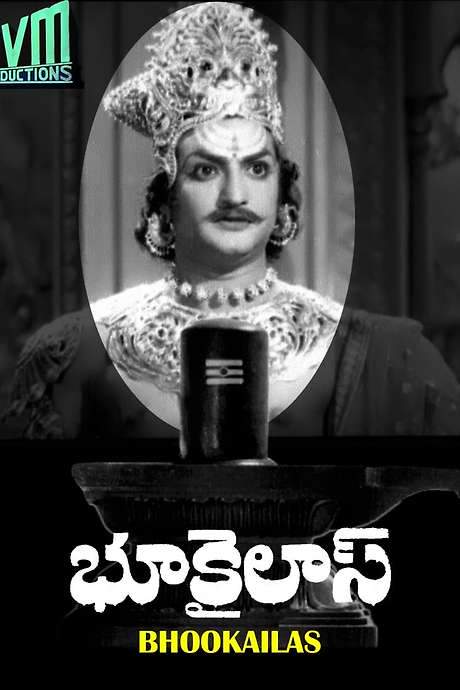
Bhookailas
Year: 1958
Runtime: 174 mins
Language: Telugu
Director: K. Shankar
The story is based on the Sthala Purana of Gokarna Kshetram in Karnataka
Where to Watch Bhookailas?
Find where to stream, rent, or buy Bhookailas (1958) in the US with current JustWatch availability, up-to-date pricing, and platform listings for subscription, rental, and digital purchase options.

Streaming availability powered by 
Warning: spoilers below!
Haven’t seen Bhookailas yet? This summary contains major spoilers. Bookmark the page, watch the movie, and come back for the full breakdown. If you're ready, scroll on and relive the story!
Timeline – Bhookailas (1958)
Trace every key event in Bhookailas (1958) with our detailed, chronological timeline. Perfect for unpacking nonlinear stories, spotting hidden connections, and understanding how each scene builds toward the film’s climax. Whether you're revisiting or decoding for the first time, this timeline gives you the full picture.
Last updated: October 05, 2025 at 11:09
Bhookailas (1958) Timeline Questions Answered – Chronology FAQ
Find frequently asked questions about the Bhookailas (1958) timeline, including chronological order, nonlinear jumps, cause-and-effect links, and scene sequence clarifications. This timeline FAQ helps explain when key events happen, how moments connect, and why the story unfolds in that specific order.
Why is Ravana so devoted to his mother Kaikashi?
Ravana's devotion to his mother Kaikashi is the source of his immense power. The film establishes that his strength comes from her deep religious devotion and daily worship of the Saikathalingam (the sand-carved Siva lingam) on the seashore. His promise to gift her the Atmalingam drives his entire journey and penance.
The film opens with Narada explaining to Indra that Ravana's power stems from his secret devotion to his mother.
Why does Vishnu create an illusion to make Ravana crave Parvati?
Vishnu creates this illusion in response to Parvati's plea for help when she learns Ravana intends to take her as his wife after Shiva approves a duplicate. The illusion inflames Ravana's desire for Parvati, but when Parvati discovers Vishnu's trick, she becomes enraged and curses him to cry whenever separated from his wife.
Parvati trembles and seeks Vishnu's aid after hearing Ravana's plan to claim her.
Why does Parvati curse Vishnu to cry when separated from his wife?
Parvati curses Vishnu because she realizes that Vishnu manipulated her by creating an illusion that made Ravana desire her. Feeling used by the divine trick, she turns her wrath on Vishnu himself, decreeing that he will weep whenever he is apart from his wife.
This curse is a direct consequence of Vishnu's intervention in Ravana's penance.
Why does Mandodari agree to marry Ravana despite knowing about his deception?
Mandodari, the daughter of Mayasura, falls in love with Ravana at first sight when she sees him. Narada disguises himself as Parvati to arrange the match, and though Mayasura initially objects because he is a devotee of Vishnu while Ravana is his foe, Narada smooths the path and they marry.
Mandodari's arrival in Lanka marks a turning point in the narrative and sets up later revelations.
Why does Ravana fail the Atmalingam test set by Ganesha?
Ravana fails because he cannot fulfill the condition of the test. Ganesha, disguised as a Brahmin boy, tells Ravana that during the Surya ritual, if Ravana is not called thrice, he must place the Atmalingam on the ground. Ravana is called only twice, and when he places the lingam down in anger and tries to attack the boy (who is Ganesha), he loses the sacred object forever.
Narada deliberately sets up this test to challenge Ravana's commitment to his vow.
What is the Atmalingam and why is it so important?
The Atmalingam (Atmalinga) is considered the soul of Lord Shiva, a sacred lingam representing his divine essence. In the story, Shiva grants this powerful artifact to Ravana after his intense penance, but with one critical condition: it must never touch the ground until he reaches Lanka.
Shiva grants the Atmalingam with the warning about not placing it on the ground.
Why does Shiva grant the Atmalingam to Ravana despite his negative qualities?
Shiva is pleased with Ravana's intense penance and unwavering devotion, even when Ravana offers to decapitate himself as an act of sacrifice. Despite Ravana's flaws and the manipulations surrounding him, his sincere devotion earns Shiva's grace and the Atmalingam.
Ravana's deep penance and willingness to sacrifice himself demonstrate his genuine devotion.
What is the connection between the Atmalingam story and Gokarna?
According to the film's conclusion, Ravana failed to bring the Atmalingam to Lanka. The sacred lingam became permanently fixed at the location where he placed it, the site now known as the Mahabaleshwar Temple in Gokarna, Karnataka. This temple remains a revered pilgrimage site where the legend is still celebrated today.
The film ends by showing the enduring reverence of the myth at the Mahabaleshwar Temple.
What is the significance of Ravana's guilt and attempted self-sacrifice?
After learning how Narada manipulated him into marrying Mandodari by disguising her as Parvati, Ravana is overwhelmed with guilt and contemplates self-sacrifice. However, his mother Kaikashi stops him, urging him to seek forgiveness through continued devotion instead of self-destruction.
This moment shows Ravana's moral struggle and sets up his eventual redemption through penance.

Explore Movie Threads
Discover curated groups of movies connected by mood, themes, and story style. Browse collections built around emotion, atmosphere, and narrative focus to easily find films that match what you feel like watching right now.
Mythological tales with bittersweet endings like Bhookailas
Sacred quests where divine plans lead to profound, imperfect human outcomes.For viewers seeking movies like Bhookailas, this section features similar mythological stories where grand quests and divine interventions lead to poignant, bittersweet conclusions. These films explore themes of devotion, cosmic justice, and the solemn beauty found in imperfect outcomes, offering a resonant emotional experience.

CBGB
2013

The Other Man: F.W. de Klerk and the End of Apartheid
2015

Reagan
2024

Cholo Paltai
2011

The Pregnancy Project
2012

Becoming Bond
2006

Four Faces West
1948

The Sunday Woman
1975

Doc West
2009

The Blonde Captive
1931

The Golden Twenties
1950

Wells Fargo
1937
Bhookailas
1958

Nouvelle Vague
2025
Narrative Summary
Stories in this thread typically follow a linear, steady-paced arc: a character undertakes a sacred quest or intense penance, often encounters divine deception or a test of will, and culminates in an ending that blends personal failure with enduring spiritual significance. The narrative is more about the moral and devotional lesson than a traditional victory.
Why These Movies?
Movies are grouped here for their shared focus on mythological epics, a neutral-to-reverent tone, medium emotional weight from themes of devotion and failure, and a consistently bittersweet ending feel that leaves a lasting, contemplative impression.
Movies about divine deception and redemption like Bhookailas
Narratives where higher powers use trickery to guide flawed characters toward wisdom.If you liked the theme of cosmic trickery in Bhookailas, this section highlights other films where gods or fate use deception to test characters. These movies often involve a fall from grace, a quest for power, and a final reckoning that brings spiritual insight, sharing a similar narrative structure and mood.

Legend
1986

Clash of the Titans
2010
Gods of Egypt
2016
The Legend of Hercules
2014

God's Not Dead
2014
God's Not Dead: A Light in Darkness
2018

Leap of Faith
2024

Journey to Promethea
2010

Rajakali Amman
2000

Resurrection
1980

The Curse of King Tut’s Tomb
1000

The Man Who Played God
1932

Leap of Faith
1992

The Miracle Woman
1931
Bhookailas
1958
Narrative Summary
The narrative pattern involves a proud or ambitious character seeking ultimate power or knowledge. Their path is interrupted by a deceptive act from a divine source, which serves as a crucial test of character. This leads to a crisis, a moment of realization, and ultimately a form of penitence or a redefined, more humble understanding of their place in the cosmos.
Why These Movies?
These films are united by the central theme of 'cosmic deception' as a plot device, a medium-intensity dramatic conflict, a straightforward mythological narrative structure, and a focus on the moral and spiritual consequences of ambition challenged by higher powers.
Unlock the Full Story of Bhookailas
Don't stop at just watching - explore Bhookailas in full detail. From the complete plot summary and scene-by-scene timeline to character breakdowns, thematic analysis, and a deep dive into the ending - every page helps you truly understand what Bhookailas is all about. Plus, discover what's next after the movie.
Bhookailas Summary
Read a complete plot summary of Bhookailas, including all key story points, character arcs, and turning points. This in-depth recap is ideal for understanding the narrative structure or reviewing what happened in the movie.

Characters, Settings & Themes in Bhookailas
Discover the characters, locations, and core themes that shape Bhookailas. Get insights into symbolic elements, setting significance, and deeper narrative meaning - ideal for thematic analysis and movie breakdowns.


