Year: 1986
Runtime: 130 min
Language: English
Director: Jean-Jacques Annaud
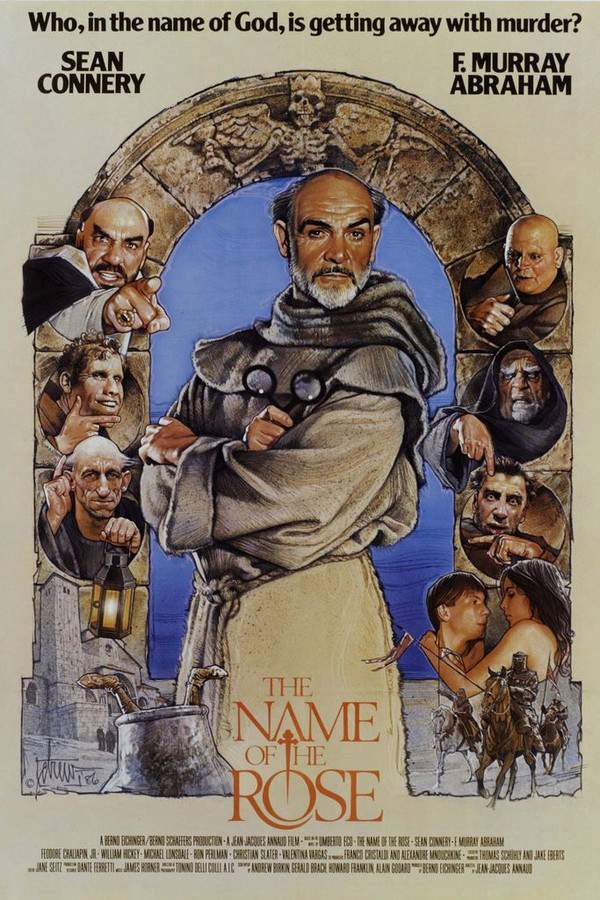
In 14th-century Italy, a seasoned Franciscan friar and his young apprentice are dispatched to a remote mountain monastery to investigate a series of bizarre deaths. As they examine the abbey's extensive library and interview its inhabitants, they uncover a sinister plot involving forbidden knowledge and long-held secrets. Their investigation leads them deeper into a web of deceit, challenging their beliefs and endangering their lives as they race to expose the truth before more lives are lost.
Warning: spoilers below!
Haven’t seen The Name of the Rose yet? This summary contains major spoilers. Bookmark the page, watch the movie, and come back for the full breakdown. If you're ready, scroll on and relive the story!
Read the complete plot breakdown of The Name of the Rose (1986), including all key story events, major twists, and the ending explained in detail. Discover what really happened—and what it all means.
Franciscan friar William of Baskerville and his novice, Adso of Melk, arrive at a Benedictine abbey in Northern Italy during the early 14th century. The abbey is shrouded in mystery as it faces the unsettling aftermath of a young illuminator’s apparent suicide just before a significant theological Church conference. With a reputation for his sharp deductive reasoning, William approaches the anxious Abbot and receives permission to delve into the circumstances surrounding the death. As days unfold, the situation worsens when more unusual fatalities arise.
Their investigation introduces them to Salvatore, a hunchback who struggles to communicate coherently in various tongues, alongside his protector, Remigio da Varagine. William discerns from Salvatore’s mention of a penitenziagite that he might have previously belonged to a heretical sect, raising suspicions about their connection to the recent killings. Meanwhile, Adso engages with a peasant girl who has cleverly infiltrated the abbey, trading sexual favors for food and, in the process, experiences a pivotal loss of innocence.
Yearning to prevent any misconduct allegations, William and Adso explore a concealed library within the abbey’s forbidden main tower. William uncovers that it boasts “one of the greatest libraries in all Christendom,” filled with lost works from Classical thinkers like Aristotle. This knowledge is deliberately hidden, as it’s deemed incompatible with Christian teachings. William also concludes that all previous victims had perused the only extant copy of Aristotle’s Second Book of Poetics.
Their inquiries are abruptly interrupted by the arrival of Bernardo Gui, an Inquisition representative summoned for the conference who is eager to bring those he suspects of wrongdoing to justice. Having clashed with William previously, Gui dismisses alternative theories. During a chaotic moment, Salvatore and the girl get into a struggle over a black cockerel amidst the presence of a black cat. Gui seizes this opportunity as undeniable evidence of their supposed pact with Satan and forcibly extracts a false confession from Salvatore. Both Salvatore and Remigio, alongside the girl, face persecution in a tribunal overseen by Gui, who coerces the Abbot into supporting his heresy claim. William, although forced to join the panel of judges, challenges the accusations by noting that the real murderer must have been able to read Greek—a skill beyond Remigio.
Following a series of intense events, when the head librarian dies like the others, William and Adso ascend to the forbidden library, confronting Jorge, the abbey’s oldest inhabitant, who possesses the fatal book that discusses comedy and its potential as a teaching tool. Jorge, believing humor to be a tool of the Devil, has poisoned the pages to prevent the dissemination of what he perceives as dangerous ideas. In a desperate turn, Jorge ignites a candle that sets the library ablaze. William urgently instructs Adso to escape while he futilely attempts to salvage valuable texts, ultimately losing the Poetics, Jorge, and the entire library to the flames.
Tragedy befalls Salvatore and Remigio, who are executed by fire. The girl, marked for a similar fate, is liberated by local peasants amidst the chaos ignited by the library fire, who also seize the opportunity to retaliate against Gui. In his desperate escape, Gui meets his end when his wagon is toppled over a cliff by the enraged villagers. As the dust settles, William and Adso leave the abbey, yet not without a poignant moment when Adso is momentarily halted by the girl, silently urging him to remain. Despite the temptation, Adso continues with William. In a reflective narration later in life, Adso contemplates his choices, stating that he has never regretted his decision, having gained profound wisdom from William. He acknowledges the girl as the singular earthly love of his existence, lamentably admitting that he never came to learn her name.
Last Updated: November 15, 2024 at 19:40
Discover curated groups of movies connected by mood, themes, and story style. Browse collections built around emotion, atmosphere, and narrative focus to easily find films that match what you feel like watching right now.
Where an investigation uncovers secrets in a sealed-off, authoritarian society.If you liked the intellectual detective work in The Name of the Rose, explore more movies where a sharp-minded investigator uncovers dangerous truths within a sealed-off society. These films share a claustrophobic, atmospheric setting and a plot driven by philosophical inquiry and hidden knowledge.
The narrative follows a logical, often methodical investigation into a series of unsettling events within a highly controlled environment. The protagonist, usually an outsider or a skeptic, must navigate complex social hierarchies and ideological dogma to expose a truth that the powers-that-be wish to keep buried. The central conflict is often between reason and dogma, or individual inquiry and collective authority.
Movies are grouped here for their shared core structure: a cerebral mystery set against the backdrop of an insular, rule-bound society. They prioritize atmosphere and intellectual tension over physical action, creating a suspenseful experience rooted in the pursuit of forbidden knowledge.
Stories where uncovering a grim truth leaves profound scars.For viewers who appreciated the heavy emotional toll and melancholic resolution of The Name of the Rose, this section gathers movies about investigations that uncover painful truths. These stories often end on a bittersweet note, where the solution comes at a significant personal or philosophical cost.
The narrative arc is one of descent and revelation. The protagonist begins with a clear mission but becomes increasingly burdened by the grim nature of their discoveries. The climax resolves the central mystery but often at the expense of the character's peace of mind or cherished beliefs, resulting in an ending that is emotionally resonant and far from purely triumphant.
This thread connects films based on their shared emotional journey: a serious investigation that leads to a bittersweet or morally ambiguous conclusion. The focus is on the heavy emotional weight and the lasting impact of the truth on the protagonist, creating a thoughtful and melancholic viewing experience.
Don't stop at just watching — explore The Name of the Rose in full detail. From the complete plot summary and scene-by-scene timeline to character breakdowns, thematic analysis, and a deep dive into the ending — every page helps you truly understand what The Name of the Rose is all about. Plus, discover what's next after the movie.
Track the full timeline of The Name of the Rose with every major event arranged chronologically. Perfect for decoding non-linear storytelling, flashbacks, or parallel narratives with a clear scene-by-scene breakdown.
Discover the characters, locations, and core themes that shape The Name of the Rose. Get insights into symbolic elements, setting significance, and deeper narrative meaning — ideal for thematic analysis and movie breakdowns.
Get a quick, spoiler-free overview of The Name of the Rose that covers the main plot points and key details without revealing any major twists or spoilers. Perfect for those who want to know what to expect before diving in.
Visit What's After the Movie to explore more about The Name of the Rose: box office results, cast and crew info, production details, post-credit scenes, and external links — all in one place for movie fans and researchers.
Discover movies like The Name of the Rose that share similar genres, themes, and storytelling elements. Whether you’re drawn to the atmosphere, character arcs, or plot structure, these curated recommendations will help you explore more films you’ll love.
The Name of the Rose (1986) Scene-by-Scene Movie Timeline
The Name of the Rose (1986) Movie Characters, Themes & Settings
The Name of the Rose (1986) Spoiler-Free Summary & Key Flow
Movies Like The Name of the Rose – Similar Titles You’ll Enjoy
Black Death (2011) Story Summary & Characters
The Crimson Rivers (2001) Movie Recap & Themes
The Da Vinci Code (2006) Complete Plot Breakdown
The Black Book of Father Dinis (2020) Detailed Story Recap
The Black Book (2018) Complete Plot Breakdown
Day of Wrath (2006) Spoiler-Packed Plot Recap
The Monk (1990) Film Overview & Timeline
Monsignor (1982) Spoiler-Packed Plot Recap
Chronicle of a Death Foretold (1987) Full Movie Breakdown
The Rosary Murders (1987) Movie Recap & Themes
The Rose King (1986) Full Summary & Key Details
Brother Sun, Sister Moon (1972) Ending Explained & Film Insights
The Monk (1972) Plot Summary & Ending Explained
The Convent (1995) Detailed Story Recap
In the Name of the Pope King (1977) Ending Explained & Film Insights