Plot Explained Spoilers guaranteed!
Plot Explained

Browse by genre

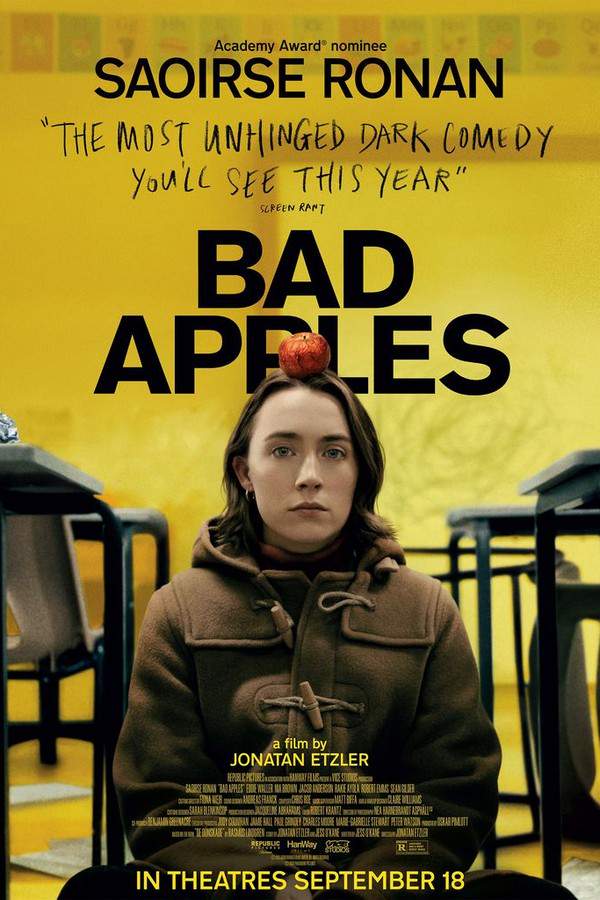
Bad Apples (2026) movie poster

Characters & Themes

Bad Apples (2026) Characters, Setting & Themes Explained

Release, runtime and language
2026 · 1 h 40 m · English
Echo score 71
Loading streaming availability…
Directed by
Jonatan Etzler
Starring
Saoirse Ronan, Sean Gilder, Eva Tennear, Jack Ashton, Danny Iqbal, Eddie Waller

When a primary‑school teacher (Saoirse Ronan) is forced to confront a foul‑mouthed, violent student, she resorts to drastic measures. In doing so, she discovers that the town’s residents deliberately ignore escalating atrocities, choosing the illusion of harmony and a false sense of safety over confronting the truth.

On this page (3)
  1. 1 Where to watch
  2. 2 Movie threads
  3. 3 Every angle
Loading streaming availability…

Characters, themes & setting

Bad Apples (2026) Characters & Themes Coming Soon

The character, theme and setting guide of Bad Apples (2026) is not written yet. Request it to move it up the list, or read the full plot summary in the meantime.

Request this guide

Movie threads

More Movies Like Bad Apples, by Mood & Story

Curated lists built around what makes Bad Apples tick: the same mood, the same kind of story or the same emotional payoff. Each list explains why these movies belong together.

Movies like Bad Apples about communities that enable abuse

Stories where ordinary communities choose comfortable silence over uncomfortable truth. If you liked Bad Apples, these movies explore the same chilling theme of collective complicity, where an entire town or social group turns a blind eye to atrocities to preserve a comfortable illusion. These dark, morally complex thrillers show how ordinary people rationalize the unthinkable, making the community itself the true villain. Perfect for fans of unsettling social commentary and shared silence.

  • collective complicity
  • claustrophobic
  • morally ambiguous
  • dark satire
  • social commentary
  • oppressive
  • Tone: dark, morally ambiguous
  • Pacing: steady, escalating
Why these movies?

The story pattern: These stories typically begin with an outwardly harmonious community, then gradually reveal a festering secret that everyone has agreed not to see. A protagonist who refuses to look away forces the issue, exposing how thin the veneer of civility really is. The climax rarely offers clean justice; instead, it lays bare how complicity becomes a shared identity, with characters choosing comfort, reputation, or normalcy over moral action. The journey is less about catching a villain than about diagnosing a sickness in the social fabric.

Why they belong together: Movies in this thread share an unsettling commitment to portraying collective moral failure rather than individual evil. They use slow escalation, dark satire, and claustrophobic community settings to show how ordinary people make monstrous choices feel reasonable. The pacing tends to be steady and suffocating, the tone dark and morally ambiguous, and the endings often leave audiences squirming with mixed feelings rather than catharsis, exactly the discomfort Bad Apples trades in.
Dark satirical thrillers like Bad Apples that leave you disturbed

Unsettling stories where wicked humor collides with deeply disturbing truths. If Bad Apples kept you unsettled, these dark satirical thrillers deliver a similar mix of wicked humor, psychological tension, and disturbing themes. Each film uses sharp social commentary to skewer the polite fictions communities tell themselves, mixing uncomfortable comedy with thriller mechanics. Perfect for viewers who want their satire with teeth and a lingering sense of moral unease.

  • dark satire
  • morally ambiguous
  • uncomfortable humor
  • chilling
  • grim
  • psychological
  • Tone: dark, satirical, grim
  • Pacing: steady, deliberate
Why these movies?

The story pattern: Stories in this thread typically frame a horrifying premise through an ironic, darkly comic lens, giving the audience critical distance even as the content grows grimmer. A flawed protagonist, often a professional, parent, or institutional figure, slides into an escalating moral compromise justified by the logic of their environment. Satirical framing, tonal whiplash, and uncomfortable humor punctuate the dread, and resolutions tend to be morally mixed rather than clean, forcing viewers to confront complicity in themselves and their world.

Why they belong together: Movies in this thread share a commitment to using dark humor as a scalpel for uncomfortable subjects like childhood, institutions, power, and normalized cruelty. They tend to be moderately complex, steady paced, and heavy in emotional weight, with tones that braid satire, tension, and grimness. They often feature morally compromised narrators and endings that refuse easy moral closure, mirroring Bad Apples' refusal to let the audience off the hook.

Every angle

Bad Apples (2026) Explained: Plot, Ending, Timeline & Characters

Everything about Bad Apples in one place: what happens in the plot summary, the timeline in chronological order, the characters and meaning, the ending explained and a spoiler-free summary. What's After the Movie adds the cast, box office and post-credit scenes.

Coming soon on iOS and Android

The Plot Explained Movie Summary App

Plot summaries, endings explained and timelines on your phone. Catch up on any movie in minutes, save your favorites and never miss a twist again.

Be the first to know when we launch. Your email stays private, always.

Learn more about the app