Plot Explained Spoilers guaranteed!
Plot Explained

Browse by genre

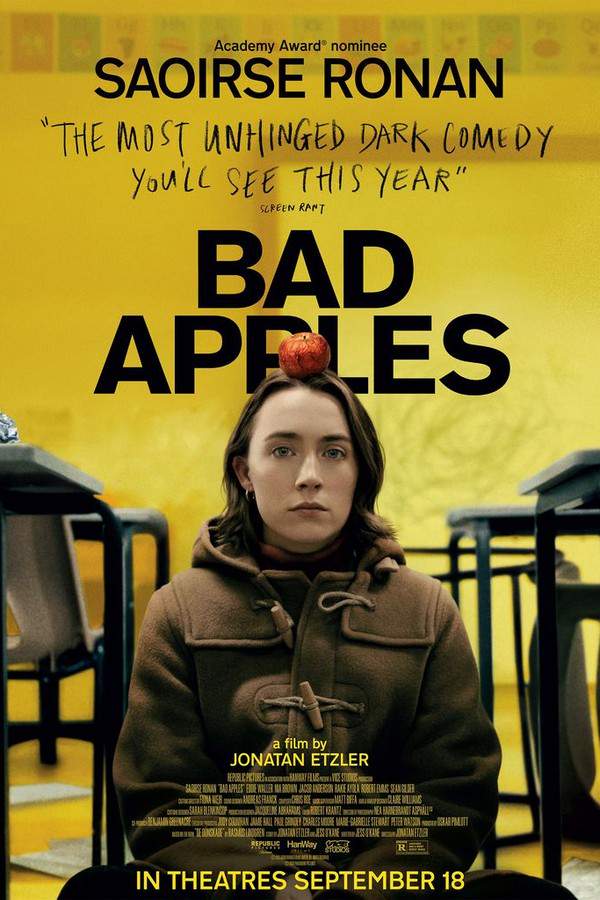
Bad Apples (2026) movie poster

Ending Explained

Bad Apples (2026) Ending Explained – Final Scene & Meaning

Release, runtime and language
2026 · 1 h 40 m · English
Echo score 71
Loading streaming availability…
Directed by
Jonatan Etzler
Starring
Saoirse Ronan, Sean Gilder, Eva Tennear, Jack Ashton, Danny Iqbal, Eddie Waller

When a primary‑school teacher (Saoirse Ronan) is forced to confront a foul‑mouthed, violent student, she resorts to drastic measures. In doing so, she discovers that the town’s residents deliberately ignore escalating atrocities, choosing the illusion of harmony and a false sense of safety over confronting the truth.

On this page (6)
  1. 1 Where to watch
  2. 2 What happens at the end
  3. 3 Final events in order
  4. 4 Ending questions answered
  5. 5 Movie threads
  6. 6 Every angle
Loading streaming availability…

Ending explained · contains spoilers

What Happens at the End of Bad Apples?

How Bad Apples (2026) ends, what the final scene means, which earlier moments set it up and how to read the ending if the film leaves it open. The full ending explained, with every spoiler.

Pauline exposes Danny's imprisonment through her performance at the parents' evening, but the revelation does not produce the rescue Maria fears. The parents prefer keeping him confined because their own children's results have improved. Sylvia leaves, Sam and Maria become head and deputy head, and the former couple reunite. Their later celebration of the school's success is intercut with Danny finally escaping and running beside a busy road. He is free of the immediate prison, but the film does not show the school's complicity being formally punished.

The reversal shifts the blame from one panicked teacher to a community willing to benefit from a child's disappearance. Educational success becomes the excuse for treating Danny as expendable, even while his father has suffered suspicion over the missing boy. Maria's professional and romantic rewards reveal how easily wrongdoing can become normal when it serves shared interests. Danny's escape interrupts that comfortable settlement, suggesting that the person excluded from the system may return to expose it. His precise destination and the eventual consequences remain uncertain, leaving the celebration morally hollow.

Last updated: October 01, 2026 at 22:05

Was this helpful?

The last 4 events

How Bad Apples Ends: The Final Events in Order

The last events of Bad Apples (2026) in chronological order, the run-up to the ending explained above. The complete timeline has all 15 events, scene by scene.

Open the full timeline
  1. The Truth Comes Out

    At a parents' evening, Pauline interrupts the proceedings with a performance that reveals to everyone that Maria is keeping Danny in her basement. Maria breaks down and admits the truth to the assembled parents.

    Where
    Primary school
  2. The Parents' Dark Bargain

    The parents decide not to report Maria to the authorities, reasoning that their children and the school have improved since Danny disappeared. They even begin bringing food for Danny to ensure that their children's progress continues.

  3. A New Headteacher and a Grim Promise

    Sylvia, the headteacher, resigns over the incident, and Sam is made the new headteacher in her place. Maria returns home and tells Danny that he will never be released from the basement.

  4. Freedom at Last

    Months pass, and Maria is honoured at a large school assembly for her success as a teacher, with the school announcing a scholarship in honour of the still-missing Danny. Meanwhile, Danny has gradually dug through the basement wall using an electric toothbrush and escapes, and the film ends with him running freely alongside a road.

    When
    Months later
    Where
    Maria's basement

Ending questions answered

Bad Apples Ending: Your Questions Answered

The questions people ask most about the ending of Bad Apples (2026): what the final scene means, how the twist works, what happens to each character and how to read the ending. Each answer contains spoilers.

Q1

How does the truth about Danny come out in Bad Apples?

Pauline exposes Danny's imprisonment by performing a dramatic retelling at the parents' evening, turning the event into a public confession of what Maria has been hiding. Instead of triggering a rescue, the performance sparks outrage directed at the teacher rather than sympathy for the missing boy. The scene marks the moment the film's cover-up becomes community knowledge rather than a private secret.

Foreshadowing: Pauline's increasingly erratic behavior and her fixation on exposing wrongdoing throughout the film build toward this public act of disclosure.

  • pauline
  • parents evening
  • expose
  • revelation
  • danny
Q2

Why do the parents choose not to rescue Danny after learning the truth?

The parents decide to keep Danny confined because their own children's academic results have dramatically improved in his absence. In the satirical logic of Bad Apples, his removal is reframed as a sacrifice that benefits the entire school community. This choice exposes how collective self-interest can outweigh the moral obligation to protect a child.

Foreshadowing: Earlier classroom scenes show teachers celebrating rising test scores without ever questioning where Danny has gone, hinting that success has become the community's priority.

  • parents
  • academic results
  • complicity
  • cover-up
  • danny imprisoned
Q3

Why does Maria get promoted to head teacher at the end?

Maria is elevated to head teacher because the school community views her actions as responsible leadership rather than criminal abuse. Her promotion is the clearest sign that Bad Apples' town has normalized her behavior in exchange for better grades. The reward system inverts moral judgment, treating her captivity of a child as administrative competence.

Foreshadowing: Sam's earlier admiration of Maria's classroom results hints at how the school will eventually rationalize her methods.

  • maria
  • head teacher
  • promotion
  • school success
  • complicity
Q4

What happens to Sam and Maria's relationship by the end?

Sam and Maria reunite romantically after Maria's promotion, with Sam becoming deputy head. Their reconciliation is framed as a personal happy ending that the film deliberately undercuts. By rewarding the couple professionally and romantically, Bad Apples emphasizes how the community has absorbed wrongdoing into its normal functioning.

Foreshadowing: Sam's complicit silence about Danny throughout the film signals he is willing to live with the truth rather than challenge it.

  • sam
  • maria
  • deputy head
  • relationship
  • reunion
Q5

What does Danny's escape at the end of Bad Apples symbolize?

Danny's escape symbolizes the return of the person the system tried to erase, breaking the false equilibrium the town has built around his disappearance. By ending with him running free beside a busy road, Bad Apples suggests that excluded victims cannot be permanently silenced. His freedom reopens a moral question the community had tried to close.

Foreshadowing: Earlier glimpses of Danny confined in the basement hint at his resilience and the instability of any long-term cover-up.

  • danny
  • escape
  • freedom
  • road
  • symbolism
Q6

What does the final celebration scene in Bad Apples mean?

The final scene cuts between a celebratory gathering honoring the school's success and Danny running along a busy road after escaping. This juxtaposition is the film's central moral argument: public triumph and hidden suffering are happening simultaneously. Bad Apples uses the contrast to show that a community can feel victorious while a child remains in crisis.

Foreshadowing: Throughout the film, scenes of classroom achievement are quietly intercut with hints of Danny's confinement, preparing viewers for this final parallel.

  • celebration
  • final scene
  • montage
  • moral
  • contrast
Q7

Does anyone face consequences for Danny's imprisonment?

No one in the town faces formal consequences by the end of Bad Apples. Maria keeps her job, Sam becomes deputy head, and the parents continue benefiting from improved results. The absence of punishment is the point of the ending, illustrating how easily institutional success can eclipse accountability when a community chooses comfort over justice.

Foreshadowing: Early hints that authorities and parents look away from warning signs foreshadow the film's refusal to deliver institutional justice.

  • consequences
  • accountability
  • justice
  • community
  • impunity
Q8

Is the ending of Bad Apples hopeful or dark?

The ending is deliberately mixed: his freedom is a sign that the cover-up cannot last forever, yet the community's continued celebration shows that moral reckoning has not occurred. Bad Apples ends on a note of uneasy relief rather than resolution. The film trusts the audience to recognize that Danny's survival does not undo the harm already done.

  • ending meaning
  • hopeful
  • dark
  • tone
  • moral
Q9

What happens to Danny after he escapes?

Bad Apples does not specify where Danny goes or whether he is reunited with his father, leaving his future deliberately open. The film ends on the image of him running beside a busy road, emphasizing his vulnerability rather than his safety. This ambiguity forces the viewer to sit with the unresolved cost of the town's choices.

  • danny
  • escape
  • future
  • ambiguous ending
  • open
Q10

Why does Sylvia leave the school after the parents' evening?

Sylvia leaves because she has exhausted her moral position within the institution after attempting to expose what Maria has done. Her departure signals that remaining at the school would mean accepting the community's normalization of abuse. In Bad Apples, her exit represents the only clean refusal to participate in the cover-up.

Foreshadowing: Sylvia's earlier confrontations with Maria establish her as the one colleague unwilling to tolerate the situation.

  • sylvia
  • leaves
  • parents evening
  • refusal
  • integrity
Q11

What is the main message of Bad Apples' ending?

The ending argues that collective complicity is more dangerous than individual wrongdoing, because a community can absorb even a child's abuse into its daily functioning if it produces the right results. Bad Apples frames the town as the true antagonist, not Maria alone. The final scenes show how shared利益 can transform cruelty into ordinary routine.

  • theme
  • complicity
  • message
  • community
  • satire
Q12

Why doesn't Pauline's performance lead to Danny being rescued?

Pauline's performance fails to trigger a rescue because the parents are already invested in Danny's absence, having seen their own children thrive academically. Bad Apples shows that exposure is not enough when the audience has a vested interest in maintaining the secret. The scene illustrates how truth-telling can be absorbed and neutralized by a complicit group.

Foreshadowing: Pauline's growing obsession with Danny's case throughout the film builds toward a moment of disclosure that the town is prepared to ignore.

  • pauline
  • performance
  • parents evening
  • failed rescue
  • exposure

Movie threads

More Movies Like Bad Apples, by Mood & Story

Curated lists built around what makes Bad Apples tick: the same mood, the same kind of story or the same emotional payoff. Each list explains why these movies belong together.

Movies like Bad Apples about communities that enable abuse

Stories where ordinary communities choose comfortable silence over uncomfortable truth. If you liked Bad Apples, these movies explore the same chilling theme of collective complicity, where an entire town or social group turns a blind eye to atrocities to preserve a comfortable illusion. These dark, morally complex thrillers show how ordinary people rationalize the unthinkable, making the community itself the true villain. Perfect for fans of unsettling social commentary and shared silence.

  • collective complicity
  • claustrophobic
  • morally ambiguous
  • dark satire
  • social commentary
  • oppressive
  • Tone: dark, morally ambiguous
  • Pacing: steady, escalating
Why these movies?

The story pattern: These stories typically begin with an outwardly harmonious community, then gradually reveal a festering secret that everyone has agreed not to see. A protagonist who refuses to look away forces the issue, exposing how thin the veneer of civility really is. The climax rarely offers clean justice; instead, it lays bare how complicity becomes a shared identity, with characters choosing comfort, reputation, or normalcy over moral action. The journey is less about catching a villain than about diagnosing a sickness in the social fabric.

Why they belong together: Movies in this thread share an unsettling commitment to portraying collective moral failure rather than individual evil. They use slow escalation, dark satire, and claustrophobic community settings to show how ordinary people make monstrous choices feel reasonable. The pacing tends to be steady and suffocating, the tone dark and morally ambiguous, and the endings often leave audiences squirming with mixed feelings rather than catharsis, exactly the discomfort Bad Apples trades in.


Dark satirical thrillers like Bad Apples that leave you disturbed

Unsettling stories where wicked humor collides with deeply disturbing truths. If Bad Apples kept you unsettled, these dark satirical thrillers deliver a similar mix of wicked humor, psychological tension, and disturbing themes. Each film uses sharp social commentary to skewer the polite fictions communities tell themselves, mixing uncomfortable comedy with thriller mechanics. Perfect for viewers who want their satire with teeth and a lingering sense of moral unease.

  • dark satire
  • morally ambiguous
  • uncomfortable humor
  • chilling
  • grim
  • psychological
  • Tone: dark, satirical, grim
  • Pacing: steady, deliberate
Why these movies?

The story pattern: Stories in this thread typically frame a horrifying premise through an ironic, darkly comic lens, giving the audience critical distance even as the content grows grimmer. A flawed protagonist, often a professional, parent, or institutional figure, slides into an escalating moral compromise justified by the logic of their environment. Satirical framing, tonal whiplash, and uncomfortable humor punctuate the dread, and resolutions tend to be morally mixed rather than clean, forcing viewers to confront complicity in themselves and their world.

Why they belong together: Movies in this thread share a commitment to using dark humor as a scalpel for uncomfortable subjects like childhood, institutions, power, and normalized cruelty. They tend to be moderately complex, steady paced, and heavy in emotional weight, with tones that braid satire, tension, and grimness. They often feature morally compromised narrators and endings that refuse easy moral closure, mirroring Bad Apples' refusal to let the audience off the hook.

Every angle

Bad Apples (2026) Explained: Plot, Ending, Timeline & Characters

Everything about Bad Apples in one place: what happens in the plot summary, the timeline in chronological order, the characters and meaning, the ending explained and a spoiler-free summary. What's After the Movie adds the cast, box office and post-credit scenes.

Coming soon on iOS and Android

The Plot Explained Movie Summary App

Plot summaries, endings explained and timelines on your phone. Catch up on any movie in minutes, save your favorites and never miss a twist again.

Be the first to know when we launch. Your email stays private, always.

Learn more about the app