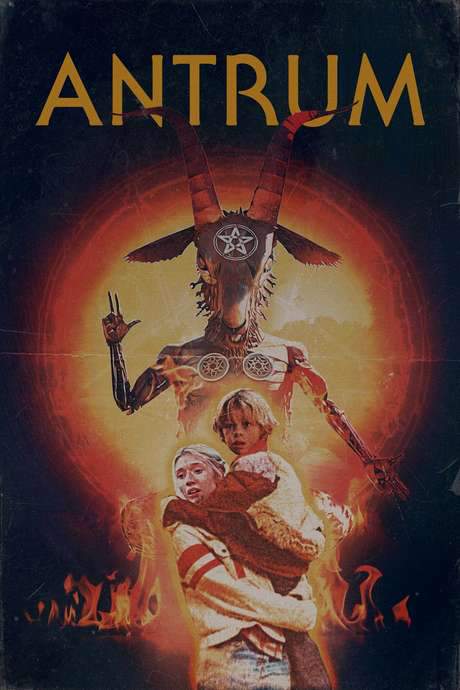
In the long shadow of a film that began its life in 1983, Antrum faced rejection after rejection from film festivals, and with each blank acceptance letter came a chilling consequence: the festival directors died under suspicious circumstances. In 1988, the movie finally reached a Budapest theater, but during the screening a fire—believed to be started by audience members—devoured the building. Several years later, in a 1993 California screening, chaos followed when a concession stand worker spiked the popcorn with LSD. The combination of drugged perception and the film’s unsettling imagery sparked a riot, and a pregnant woman died. After that night, every copy of the film vanished, and it acquired a notorious reputation for being cursed.
Fast-forward to 2018, when a copy of Antrum reappears and prompts a documentary crew to dig into its history and influence. Scientists and archivists studying the 35 mm reel conclude that the film deploys disorienting sounds and subliminal imagery, weaving in disjointed black-and-white fragments that hint at a snuff-film splice. The documentary pauses to present Antrum in its entirety for the first time in 25 years. The centerpiece of the story follows siblings Oralee [Nicole Tompkins] and Nathan [Rowan Smyth], whose beloved dog Maxine has recently been euthanized. Their mother [Kristel Elling] needles Nathan by joking that Maxine has gone to Hell for being a bad dog, a taunting line that unsettles him deeply. After a nightmare in which Maxine seems to attack him, Nathan begins to suffer disturbing dreams and visions of demons that blur the line between sleep and waking life.
To quiet his nerves, Oralee tries a ritual designed to help Nathan recover Maxine’s soul. She produces a sketchbook filled with arcane drawings—presented as a grimoire recovered from Ike [Amy Collisson], a non-existent classmate. With Nathan in tow, she leads him into a nearby forest and guides him through a sequence of “rites,” hoping to locate Maxine’s collar, a sign that they have rescued her soul. As the day unfolds, however, the boundary between magic and reality loosens: the rituals seem to conjure real, infernal presences, and the two inadvertently stumble upon the rotting remnants of a suicide near their campsite.
During their first night in the woods, Nathan witnesses a boat carrying a nude woman being rowed by a figure that resembles Charon, and he hears a rattling chain he interprets as Cerberus. The next day, the pair encounters two cannibals who cook people alive inside an iron statue of Baphomet, including the man whose suicide they had previously interrupted. When the cannibals spot them, Oralee and Nathan flee, paddling downriver in the same boat from Nathan’s vision, only to discover they’ve somehow circled back to their camp. They hide for the night, and Oralee confesses the ruse to Nathan, though he claims Ike warned him not to trust her.
The following morning the cannibals capture them. Oralee escapes her cage and frees Nathan, and in the ensuing struggle, Nathan escapes the dire fate by the skin of his teeth as Oralee seizes a gun and fatally shoots the cannibals. In a wooded stretch, Nathan stumbles upon a dog trapped in a bear trap and frees it, interpreting this act as a sign that Maxine’s soul has been released from Hell. A triumphant, if abrupt, The End title card appears on screen. Yet the film does not end there. The narrative resumes, shifting to Oralee as she runs through the trees, pursued by demons, and beset by violent hallucinations. She returns to the campsite, hides in the tent, and points a gun at the entrance as Nathan approaches; panic overtakes her, and the screen cuts to black as the story leaves her fate uncertain.
In the documentary’s coda, scholars turn to a recurring rune that appears throughout Antrum. They associate the symbol with a demon named Astaroth, and the analysis shows the rune surfacing subliminally across the reel while historians recount tragedies attributed to the demon across history. This layered exploration leaves viewers with a sense that the film’s history—its curses, its rituals, and its chilling imagery—continues to shadow those who dared to watch it.