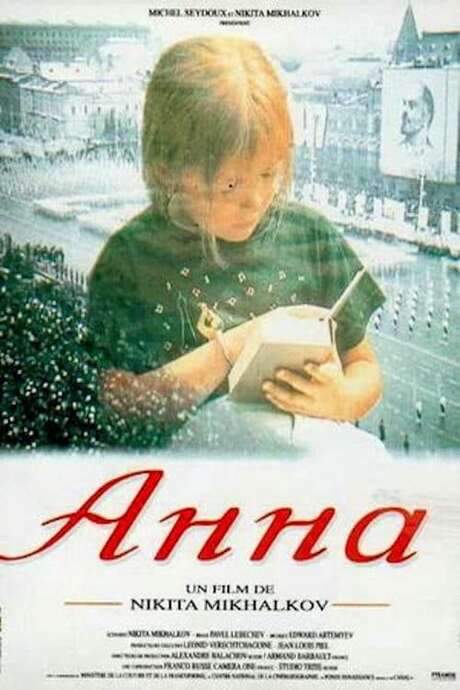
In 1949, Anna Aleksakhina returns from a labor camp to Leningrad, stepping into a city still haunted by the war’s aftershocks and a fragile sense of direction. A young man, Victor Sibilyov, is covered in liquid clay and wears a women’s purse on his belt as he shoots at her with an imaginary bow, a surreal first brush with danger that foreshadows the film’s dreamlike logic. On the train, Anna keeps a diary and contemplates a future that feels uncertain and unsettled, the pages fluttering with the weight of memory and desire.
She reaches her apartment, only to find it already inhabited by three Uzbek women. One of them, Tatyana Drubich, tries to pull a milk tooth from a child, a tense scene that hints at brittle, private rituals living inside public spaces. Anna then goes to a communal apartment where her documents were once hidden. A child speaks from behind a door, claiming to be alone and unable to open it. Anna is about to leave but is recognized and let in; inside, three people wait: two men Pyotr Mamonov and Aleksandr Feklistov, and a woman Svetlana Nemolyaeva, who had been pretending to be the child. The chest with the documents has been burned, and a new thread of destiny begins to pull Anna into stranger rooms and stranger loyalties.
Later, Anna visits a house where a mad grandmother, Mariya Kapnist, lives with her grandsons—the boy Alexander and the girl Mari. Anna helps pull a tooth from the boy, and the apartment overflows with avant-garde artworks that seem to murmur of past revolutions and future possibilities. There, she learns of her mother’s death, Maria Alexandrovna, and the girl Mari tells her how to find her mother’s grave: “There lives a Big Black Dog—Kaplan, she will show you the way.” The dog is Greta, a black German shepherd, and the film notes reveal Greta’s role as a double for the heroine in scenes with the dog, guided by Nadezhda Borisovna Sager, the dog’s trainer behind the scenes.
At the cemetery, the Big Black Dog Kaplan (Greta) passes by, signaling presence and guiding Anna toward the search for her mother’s grave. She returns to the city and sees a boy in a rabbit costume, then chases him into a cinema where a black-and-white film unfolds, built from fragments of Khodjamirov’s Unexpected Joys. In this meta-film, the sisters Natasha (Natalya Leble) and Lena (Yelena Solovey) collect carpets and learn a legend about a main carpet with magical powers. They buy it, only to discover that the legend was contingent on a condition that no innocent blood had been spilled on the carpet in a hundred years—an old myth laid bare.
Persuaded by the filmmaker Prokudin-Gorsky, Emmanuil Vitorgan invites the sisters to the front line, hoping to lay the carpet under the feet of an innocent victim and resurrect belief by spilling blood. But Prokudin-Gorsky spills his own blood on the carpet and is felled by a sabre. The attempt to revive belief fails, and the deception remains intact, leaving Anna and her companions unsettled and disillusioned.
Later, Anna meets a hopeful but impoverished young man who once transcribed notes for a singer called “Divine.” Victor Sibilyov is the actor here, and together they decide to kill and rob a rich retired military officer who, according to Anna’s memory, had once written a denunciation about her. Anna carries poison in a vial she took from the labor camp. They go to the Yeliseevsky store and buy Crimean apples. Anna injects the poison into one apple and, after waiting for the officer’s wife, brings the poisoned fruit to him. He misidentifies her as Anna Karamazova, the name he heard on the phone, and invites her in. After he eats the apple, he dies, and Anna robs him, though his wife unexpectedly returns. A struggle ensues, and Anna escapes with the stolen goods.
The couple then goes to a theater, where Anna leaves the purse in a box, and it begins to swell with some unseen force. She descends into a flooded toilet and passes the stolen clothes to an elderly cleaning lady, effectively shedding the identity she wore for a time. Back at the young man’s house, a passing train causes a portrait of a young Vladimir Lenin to fall and crack, and the wall echoes with the chant of a fabled command: > Sesame, open up!



-HOGtBZMKH4I3HQ.jpg)