Plot Explained Spoilers guaranteed!
Plot Explained

Browse by genre

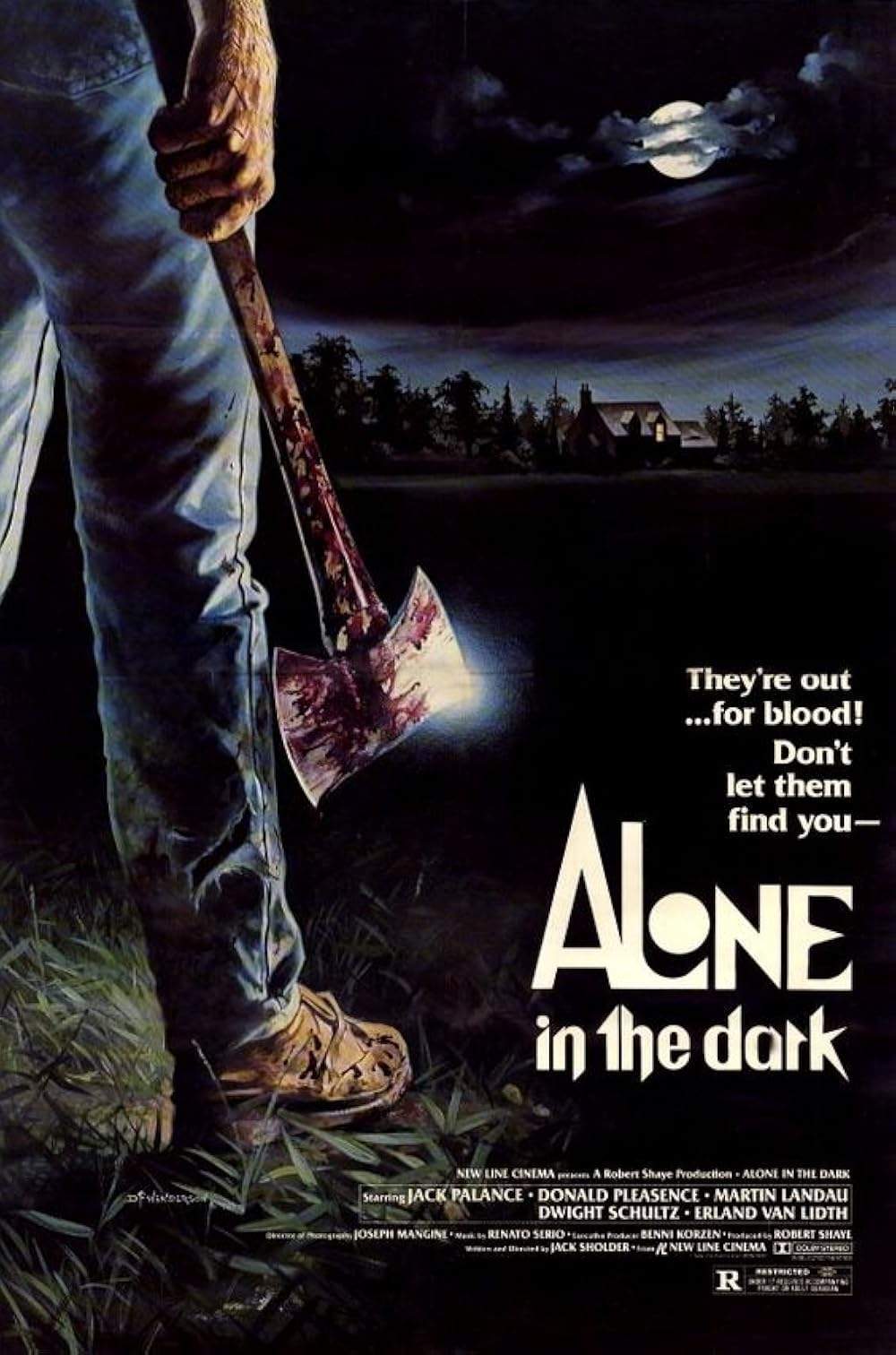
Alone in the Dark (1982) movie poster

Plot Summary

Alone in the Dark (1982) Plot Summary Explained

Release, runtime and language
1982 · 92 min · English
JustWatch #19,423 1
Starring
Deborah Hedwall, Donald Pleasence, Jack Palance, Dwight Schultz, Martin Landau, Brent Jennings

Haunted by a recent divorce and struggling with personal demons, Bri finds herself isolated and vulnerable. When a menacing stalker begins to terrorize her home, she must face not only the immediate threat but also the unsettling secrets of her past. As the stalker's presence intensifies, the lines between her memories and the present danger become dangerously blurred, plunging her into a terrifying fight for survival.

On this page (6)
  1. 1 Where to watch
  2. 2 What happens: full plot
  3. 3 Plot questions answered
  4. 4 Movie threads
  5. 5 Movies like Alone in the Dark
  6. 6 Every angle

Where to watch

Where to Watch Alone in the Dark (1982)

Where can you watch Alone in the Dark? Stream, rent or buy it in the US, including on Philo, Amazon Video and Apple TV Store: current JustWatch availability with up-to-date prices.

Streaming availability powered by JustWatch

Full plot summary · contains spoilers

What Happens in Alone in the Dark: Full Plot Summary

The whole story of Alone in the Dark (1982) explained, from the opening scene to the final frame: every key event, every twist and what it all adds up to. Read it as a quick recap before the sequel, to check a scene you missed, or to finally understand what really happened.

A man known as Preacher (Martin Landau) enters Mom's Diner on a wintry evening, settling at the counter while ordering "the usual." What arrives is an unappealing fish on a platter, prompting the chef, Leo Bain (Donald Pleasence), to step out from the kitchen for a chat. Suddenly, rain begins to pour inside the diner, and Preacher finds himself bound by chains, facing Bain who threatens him with a cane knife. This chaotic moment jolts Preacher awake in his bed with a scream, revealing it all as a haunting nightmare within the gloomy confines of an insane asylum.

The following day, Dr. Dan Potter (Dwight Schultz) arrives at the hospital to meet with Dr. Leo Bain, who greets him with an unexpected hug despite their unfamiliarity. It quickly becomes apparent that Bain shares the same eccentricities as the hospital's patients. At home, Dan is seen unpacking alongside his wife, Nell (Deborah Hedwall), and their young daughter Lyla (Elizabeth Ward). As night falls, one patient, Frank Hawkes (Jack Palance), breaks free from his bed, jeopardizing the safety of the facility.

The next day, Dan returns to the hospital, where Bain introduces him to the more dangerous patients on the maximum-security third floor, referred to as "voyagers." Among them are Hawkes, a former WWII prisoner who was committed for his violent outbursts, and Byron Sutcliff, known as Preacher, who was institutionalized for setting fire to three churches, convinced he was a messenger of God. The group also includes Ronald "Fatty" Elster (Erland van Lidth), a large pedophile, and John Skagg, ominously dubbed "the Bleeder" (Phillip Clark), a murderer whose killings are marked by uncontrollable nosebleeds. Tensions rise as Hawkes sows doubt among the group, claiming Dan has sinister intentions towards them.

Later, head orderly Ray Curtis (Brent Jennings) informs Dan of the intense feelings the voyagers have toward him, hinting at their murderous designs. Outside, in the hospital courtyard, Preacher ignites his coat in an act of rebellion. Despite Dan's attempts to intervene, the situation escalates until Bain intervenes, whispering a calming message to Preacher.

That night, Dan is faced with increasingly suspicious behavior from Hawkes and his cohorts. After a series of chaotic events, including a blackout affecting the area, Preacher and his fellow patients seize the opportunity to escape, leading to a spree of violence on the streets. As they navigate a nearby shopping center, they adopt new identities, arming themselves with various weapons and leaving a trail of destruction behind them.

Back at the hospital, Dan learns of the escapees' atrocities and grows increasingly frantic as they impede upon normalcy. While Nell and her sister Toni (Lee Taylor-Allan) delve into their daily lives, they are suddenly haunted by Preacher's ominous reappearance at their home, bearing unsettling intentions and a sliver of deception. As darkness engulfs the evening, tensions mount in the Potter household, culminating in a horrifying confrontation when Dan returns home unexpectedly to a scene no one could ever anticipate.

As tumult reigns, Dan finds himself in a frenzied fight for survival, attempting to keep his family safe from the raving murderers hunting them down. The intensity reaches a peak as the once-ordinary suburban life becomes a battlefield, revealing the depths of madness that blur the lines between sanity and insanity. When nightmare becomes reality, the question looms: will any of them survive the unfathomable horrors awaiting them?

Their struggle transforms into a fight not just for survival, but for humanity itself, as they confront the chilling truth that Hawkes ominously concludes—> "It's not just us crazy ones who kill."
Last updated: November 03, 2024 at 13:06

Was this helpful?

Plot questions answered

Alone in the Dark Plot Explained: Your Questions Answered

The questions people ask most about Alone in the Dark (1982): what happens in the confusing scenes, why the characters do what they do, the twists, hidden details and what the ending means. Each answer contains spoilers.

Q1

Why does Preacher dream about being attacked by Leo Bain in the diner?

Preacher's nightmare in the diner serves as a psychological introduction to his fractured state of mind. The dream sequence, where Chef Leo Bain threatens him with a cane knife while rain pours inside the diner, foreshadows the real-life power dynamic between Preacher and Bain at the asylum. In the asylum, Bain has an unusual, almost hypnotic control over the patients, particularly Preacher, which the dream symbolically represents.

Foreshadowing: The dream hints at Bain's manipulative influence over Preacher, which becomes clear later when Bain whispers to calm Preacher during his rebellion in the courtyard.

  • preacher nightmare
  • bain
  • escaped patient
  • psychoanalysis
  • flashback dream
Q2

Why is Dr. Leo Bain so unusual and eccentric at the asylum?

Dr. Leo Bain appears deeply eccentric, greeting Dan with an enthusiastic hug despite barely knowing him and sharingodd mannerisms with the patients themselves. The summary doesn't fully explain Bain's behavior, but he demonstrates an uncanny ability to control the dangerous patients, particularly through psychological manipulation rather than physical force. His whispered calming message to Preacher during the courtyard incident suggests he understands the patients' minds in ways others cannot.

Foreshadowing: Bain's unusual demeanor foreshadows his unusual methods of patient control and hints he may understand madness from a unique perspective.

  • dr bain
  • eccentric behavior
  • asylum doctor
  • patient control
Q3

Why do the patients escape during the blackout?

The blackout provides the perfect opportunity for the patients to execute their escape plan. Hawkes has been sowing distrust among the group, convincing them that Dr. Dan has sinister intentions toward them. With the power out and security compromised, Preacher and his fellow patients seize the moment to break free from their restraints and flee the maximum-security floor.

Foreshadowing: Earlier tensions planted by Hawkes about Dan's intentions build to this moment of collective action against perceived threat.

  • blackout escape
  • patient escape
  • hawkes
  • preacher
  • maximum security floor
Q4

Why does Preacher go to Dr. Dan's house specifically?

Preacher targets Dan's family as part of his delusion that he is a messenger of God, carrying out divine judgment. Having escaped the asylum and embarked on a violent rampage, Preacher views Dan's home as the next target in his mission. His return to the Potter household is driven by the same religious conviction that led him to burn three churches, he sees himself as an instrument of divine will, punishing those he perceives as enemies or imposters.

Foreshadowing: Preacher's earlier statement that he was institutionalized for setting fire to three churches establishes his messianic delusions as the driving force behind his violent actions.

  • preacher attacks family
  • dans family
  • home invasion
  • survival siege
  • preacher motive
Q5

Why do the escaped patients go to the shopping center after escaping?

After breaking free from the asylum during the blackout, the patients head to a nearby shopping center to regroup, adopt new identities, and arm themselves with weapons. The mall provides resources, anonymity, and a symbolic space, transforming from confined patients into predators in normal society. This represents the terrifying ease with which dangerous individuals can disappear into civilian life.

Foreshadowing: The escape sequence transitions directly from the asylum breakout to urban violence, showing how quickly institutional failure becomes community danger.

  • shopping center
  • escaped patients
  • weapons
  • new identities
  • mall scene
Q6

What does Hawkes mean when he says "It's not just us crazy ones who kill"?

Hawkes' chilling final statement serves as the movie's dark philosophical thesis, a commentary that violence and murder are not confined to those labeled mentally ill. The quote suggests that society's institutions, whether asylum or suburban normality, are just thin facades hiding humanity's capacity for brutality. By having the apparent 'madman' deliver this observation, the film implies that so-called sane society perpetrates its own violence through war, oppression, and indifference.

Foreshadowing: Throughout the film, Hawkes plants seeds of distrust about Dan and normal society, making this conclusion feel like an inevitable realization rather than a random statement.

  • hawkes quote
  • sanity vs insanity
  • murder
  • society violence
  • psychological horror meaning
Q7

Why is Frank Hawkes considered the most dangerous patient at the asylum?

Frank Hawkes is a former WWII prisoner who was committed for violent outbursts, making him the archetypal traumatized warrior turned dangerous. His psychological profile suggests combat-induced trauma transformed into uncontrollable aggression. More importantly, Hawkes possesses manipulative influence over the other patients, using his charisma to sow distrust and coordinate collective action, as seen when he convinces the group that Dr. Dan intends to harm them.

Foreshadowing: Hawkes' early escape attempt and his role in organizing the breakout demonstrate his leadership among the dangerous patients.

  • frank hawkes
  • dangerous patient
  • wwii veteran
  • asylum
  • prisoner of war
Q8

What does Bain whisper to Preacher in the courtyard?

The summary doesn't reveal the exact words Bain whispers to Preacher during the courtyard incident, but the moment reveals Bain's unique psychological influence over the most disturbed patients. While Dan attempts to intervene physically, Bain's whispered message calms Preacher immediately, stopping his act of self-immolation. This suggests Bain understands Preacher's religious delusions and can speak directly to that fractured psyche in ways conventional methods cannot.

Foreshadowing: This moment establishes Bain's mysterious control over Preacher, which becomes relevant when Preacher later targets Dan's family.

  • bain whispers
  • preacher fire
  • courtyard scene
  • patient control
  • hypnosis
Q9

Why does Dan become so desperate to protect his family after the escape?

Dan grows frantic when he learns the escaped patients' atrocities have intertwined with his family life because he realizes his professional decision to work at this particular asylum has brought danger directly to his loved ones. The patients now know where he lives, and Preacher's targeting of the Potter home represents the collapse of the boundary between Dan's professional world of madness and his private world of family normalcy. His helplessness stems from having opened that door inadvertently.

Foreshadowing: Earlier hints about the voyagers' murderous designs toward Dan, plus the head orderly's warning about their intense feelings toward him, make this home invasion feel like an inevitable consequence.

  • dan protects family
  • home invasion
  • potter family
  • danger to family
  • desperation
Q10

Why is Nell and her daughter Lyla in danger at the Potter household?

Nell and Lyla become targets because Preacher's delusional mission extends to punishing Dan's entire household. When Preacher and the escaped patients arrive at the Potter home, they represent the final breach of the boundary between institutional violence and domestic sanctuary. The home invasion siege turns an ordinary suburban family into victims of the same psychosis that was supposed to be contained behind asylum walls.

Foreshadowing: Preacher's earlier statement that he burned churches because he believed he was a messenger of God establishes his pattern of targeting symbols of perceived impurity or corruption.

  • nell danger
  • lyla danger
  • home invasion
  • daughter lyla
  • family under siege
Q11

How does the movie blur the line between sanity and insanity?

The film systematically blurs reality and illusion through multiple mechanisms: Preacher's opening dream makes viewers question what is real from the start, Bain's eccentric behavior mirrors patient symptoms, and the home invasion transforms ordinary domesticity into a nightmare landscape. By the climax, Dan, once the outsider observing madness, must fight for survival using the same brutal instincts as his patients. Hawkes' final quote crystallizes this theme: the 'sane' world is equally capable of violence, making the distinction between victim and perpetrator meaningless.

Foreshadowing: The recurring motif of dreams versus reality, combined with Bain's unusual control methods, establishes early that the film's true horror is the instability of normalcy.

  • sanity vs insanity
  • reality blurred
  • psychological horror
  • theme
  • meaning

Movie threads

More Movies Like Alone in the Dark, by Mood & Story

Curated lists built around what makes Alone in the Dark tick: the same mood, the same kind of story or the same emotional payoff. Each list explains why these movies belong together.

Movies with Intense Home Sieges like Alone in the Dark

Ordinary people pushed to the brink by relentless, personal threats at home. If you liked the relentless home invasion terror of Alone in the Dark, you'll find similar movies here. These films focus on ordinary people fighting for survival against invaders in their own homes, creating a potent mix of claustrophobic tension, high-stakes violence, and psychological dread.

  • claustrophobic
  • frenzied
  • anxious
  • oppressive
  • terrifying
  • desperate
  • Tone: dark, tense
  • Pacing: fast, relentless
Why these movies?

The story pattern: These narratives typically begin with an ordinary life disrupted by a sudden, violent intrusion. The story unfolds in a confined space, often a single house, where the protagonists are besieged. The plot is a straightforward escalation of threat, moving from initial vulnerability to a desperate, often brutal, fight for survival, testing the characters' will and sanity.

Why they belong together: They are grouped by their shared core premise: the violation of the home as a sanctuary. This creates a universally relatable fear, amplified by fast pacing, high intensity, and a dark tone focused on the primal terror of being hunted in a place meant to be safe.

Psychological Horror Movies about Unraveling Sanity like Alone in the Dark

Stories where the protagonist's grasp on reality becomes the central terror. For viewers who enjoyed the blurred reality and psychological terror of Alone in the Dark, this thread collects movies where the protagonist's sanity is the battleground. These stories masterfully weave external threats with internal psychological collapse, leaving you questioning what is real.

  • paranoid
  • unsettling
  • oppressive
  • anxious
  • disorienting
  • chaotic
  • Tone: dark, paranoid
  • Pacing: variable, disorienting
Why these movies?

The story pattern: The journey in these films often follows a character already vulnerable due to trauma or stress. An external catalyst then pushes them over the edge, causing their perception of reality to fracture. The narrative structure mirrors this collapse, often becoming less linear and more disorienting as the story progresses, leading to an ambiguous or unsettling conclusion.

Why they belong together: They are united by their central theme: the erosion of sanity. This is achieved through a mix of oppressive moods, ambiguous storytelling, and a heavy emotional weight that forces the audience to experience the protagonist's paranoid and fractured point of view.

If you liked this

Movies Like Alone in the Dark

Similar movies to Alone in the Dark: the same genre, themes or kind of story. Each one comes with its own plot summary, timeline and ending explained.

Browse all movie summaries

Every angle

Alone in the Dark (1982) Explained: Plot, Timeline & Characters

Everything about Alone in the Dark in one place: what happens in the plot summary, the timeline in chronological order, the characters and meaning and a spoiler-free summary. What's After the Movie adds the cast, box office and post-credit scenes.

Coming soon on iOS and Android

The Plot Explained Movie Summary App

Plot summaries, endings explained and timelines on your phone. Catch up on any movie in minutes, save your favorites and never miss a twist again.

Be the first to know when we launch. Your email stays private, always.

Learn more about the app