Year: 2018
Runtime: 90 min
Language: English
Director: Rory Kennedy
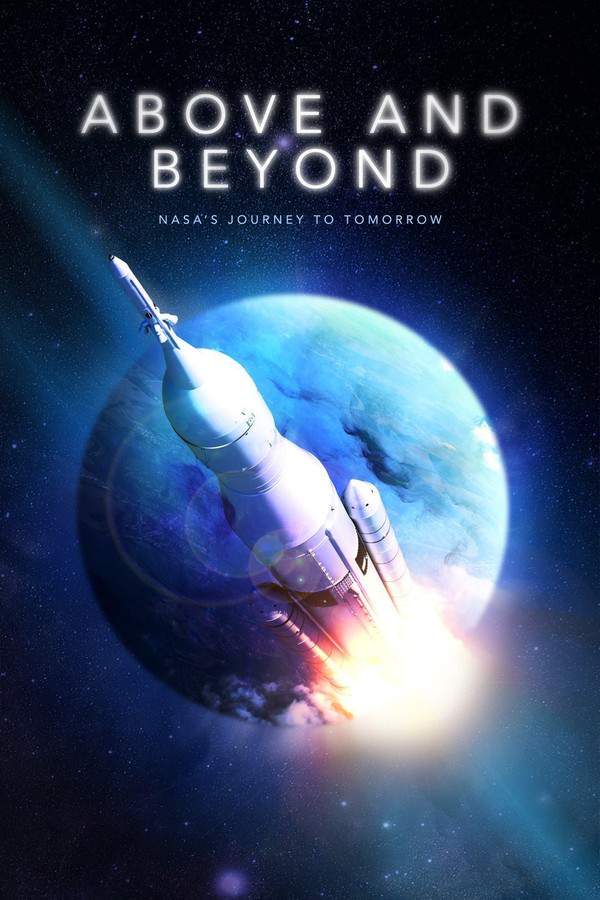
This documentary explores NASA's ambitious legacy, showcasing remarkable achievements in space exploration from lunar landings to ongoing cosmic missions. Directed by Rory Kennedy, the film reveals how NASA's work has broadened our understanding of the universe, our planet, and the place of humanity within it. It highlights the innovative spirit and dedication that drive NASA’s pursuit of discovery and its impact on future generations.
Find where to stream, rent, or buy Above and Beyond: NASA's Journey To Tomorrow (2018) in the US with current JustWatch availability, up-to-date pricing, and platform listings for subscription, rental, and digital purchase options.
Warning: spoilers below!
Haven’t seen Above and Beyond: NASA's Journey To Tomorrow yet? This summary contains major spoilers. Bookmark the page, watch the movie, and come back for the full breakdown. If you're ready, scroll on and relive the story!
Trace every key event in Above and Beyond: NASA's Journey To Tomorrow (2018) with our detailed, chronological timeline. Perfect for unpacking nonlinear stories, spotting hidden connections, and understanding how each scene builds toward the film’s climax. Whether you're revisiting or decoding for the first time, this timeline gives you the full picture.
Last updated: November 04, 2024 at 00:55
Find frequently asked questions about the Above and Beyond: NASA's Journey To Tomorrow (2018) timeline, including chronological order, nonlinear jumps, cause-and-effect links, and scene sequence clarifications. This timeline FAQ helps explain when key events happen, how moments connect, and why the story unfolds in that specific order.
President Kennedy announced the moon landing goal in 1961, declaring it a 'high national priority' despite acknowledging that the benefits were unknown. He framed it as 'an act of faith and vision,' recognizing that exploration requires committing to goals whose rewards cannot yet be predicted. This speech inspired a national effort that ultimately led to the Apollo 11 landing in 1969.
Kennedy's 1961 speech established the philosophical foundation for NASA's decades of exploration that the documentary celebrates.
The documentary reveals that NASA simultaneously explores the cosmos while monitoring Earth. While telescopes gaze into deep space, NASA also tracks Antarctica, the Great Barrier Reef, ocean temperatures, and rising sea levels. This dual purpose allows NASA to understand both the universe beyond and our own planet's fragile environmental systems.
The documentary emphasizes that as NASA reaches further into space, it also keeps a watchful eye on Earth.
NASA uses advanced satellite technology to continuously observe Earth's oceans, atmosphere, snows, and sands. This includes tracking water temperatures in the Gulf of Mexico, measuring ice mass loss in Antarctica, monitoring coral health in the Great Barrier Reef, and measuring rising sea levels across the Atlantic. The data builds an unparalleled knowledge base about our planet's systems.
The documentary shows how space-based observations provide unique insights into Earth's environmental changes.
Launched in 1990, Hubble has allowed scientists to gaze upon tens of thousands of previously hidden galaxies, study star formation, and observe cosmic phenomena. It opened a new frontier in astronomy by providing stunning images and unprecedented data about the vastness of space, fundamentally changing our understanding of the universe.
Hubble's launch in 1990 represents a major milestone in NASA's astronomical exploration.
NASA searches for signs of life within our solar system and beyond, exploring potentially habitable planets orbiting nearby stars. This quest represents humanity's deepest curiosity, seeking to answer whether we are alone in the universe. The documentary frames this as essential to understanding our own place in the cosmos.
The documentary positions the search for extraterrestrial life as a natural extension of humanity's drive to explore.
The Apollo missions, culminating in the historic Apollo 11 landing in 1969, marked humanity's first steps on another celestial body. These missions showcased America's technical capabilities, pushed the boundaries of space exploration, and ignited widespread public interest in science and technology worldwide.
Apollo 11 represents the fulfillment of Kennedy's 1961 vision and a defining moment in human history.
NASA's Earth science programs monitor environmental changes through satellite observations, tracking ice melt, sea level rise, ocean temperatures, and ecosystem changes. This research provides vital data for understanding climate patterns and informs global strategies for climate change mitigation and adaptation.
NASA's environmental monitoring capabilities have grown alongside its space exploration missions.
NASA aims to extend its reach beyond the solar system, unlocking mysteries of distant worlds and searching for possible life beyond Earth. The documentary emphasizes that ongoing research and technological developments continue humanity's quest for knowledge, maintaining the spirit of exploration that began with the moon landing.
The documentary ends on a hopeful note, looking toward future discoveries beyond our current understanding.
NASA studies Antarctica to understand ice mass loss and its implications for global sea levels. Researchers analyze how melting ice affects ocean levels and climate patterns, making this research crucial for predicting future environmental changes and preparing for their impacts on coastal communities worldwide.
Antarctica represents one of NASA's key focuses for understanding Earth's changing climate systems.
The documentary describes Earth as a 'fragile, little blue marble adrift in the vast, silent void of space', unique in its ability to support life as we know it. NASA exploration aims to deepen our appreciation of this fragility while seeking to understand whether life exists elsewhere in the universe.
This perspective shapes NASA's dual mission of exploring space while protecting our home planet.
Discover curated groups of movies connected by mood, themes, and story style. Browse collections built around emotion, atmosphere, and narrative focus to easily find films that match what you feel like watching right now.
Documentaries that celebrate ambitious human achievements in science and exploration.If you enjoyed Above and Beyond: NASA's Journey To Tomorrow, explore more movies about groundbreaking scientific missions and discoveries. These documentaries share a hopeful tone and steady pacing, celebrating the human drive to explore and understand our world and the cosmos.
Stories in this thread typically follow a linear progression of a major scientific endeavor, from conception to execution and impact. The narrative arc is driven by problem-solving, teamwork, and the pursuit of a grand goal, culminating in a sense of achievement and optimism for the future.
Movies are grouped here for their shared focus on real-world achievement, their reverent and awe-inspiring tone, and their ability to make complex scientific pursuits feel accessible and profoundly inspiring.
Films that inspire awe by examining our small but significant place in the universe.Find films similar to Above and Beyond: NASA's Journey To Tomorrow that inspire a sense of awe and contemplation about the universe. These movies, whether documentaries or narrative fiction, use the vastness of space to explore profound ideas about humanity and our home planet.
The narrative pattern involves shifting focus from the microscopic details of human life to the macroscopic scale of the cosmos. This perspective shift is the core journey, leading characters and viewers alike to a renewed understanding of fragility, connection, and possibility.
These films are connected by their primary emotional effect: a feeling of awe. They share a contemplative mood, a medium intensity that allows for reflection, and a central theme of gaining a broader, more meaningful perspective on existence.
Don't stop at just watching - explore Above and Beyond: NASA's Journey To Tomorrow in full detail. From the complete plot summary and scene-by-scene timeline to character breakdowns, thematic analysis, and a deep dive into the ending - every page helps you truly understand what Above and Beyond: NASA's Journey To Tomorrow is all about. Plus, discover what's next after the movie.
Read a complete plot summary of Above and Beyond: NASA's Journey To Tomorrow, including all key story points, character arcs, and turning points. This in-depth recap is ideal for understanding the narrative structure or reviewing what happened in the movie.
Discover the characters, locations, and core themes that shape Above and Beyond: NASA's Journey To Tomorrow. Get insights into symbolic elements, setting significance, and deeper narrative meaning - ideal for thematic analysis and movie breakdowns.
Get a quick, spoiler-free overview of Above and Beyond: NASA's Journey To Tomorrow that covers the main plot points and key details without revealing any major twists or spoilers. Perfect for those who want to know what to expect before diving in.
Visit What's After the Movie to explore more about Above and Beyond: NASA's Journey To Tomorrow: box office results, cast and crew info, production details, post-credit scenes, and external links - all in one place for movie fans and researchers.