Plot Explained Spoilers guaranteed!
Plot Explained

Browse by genre

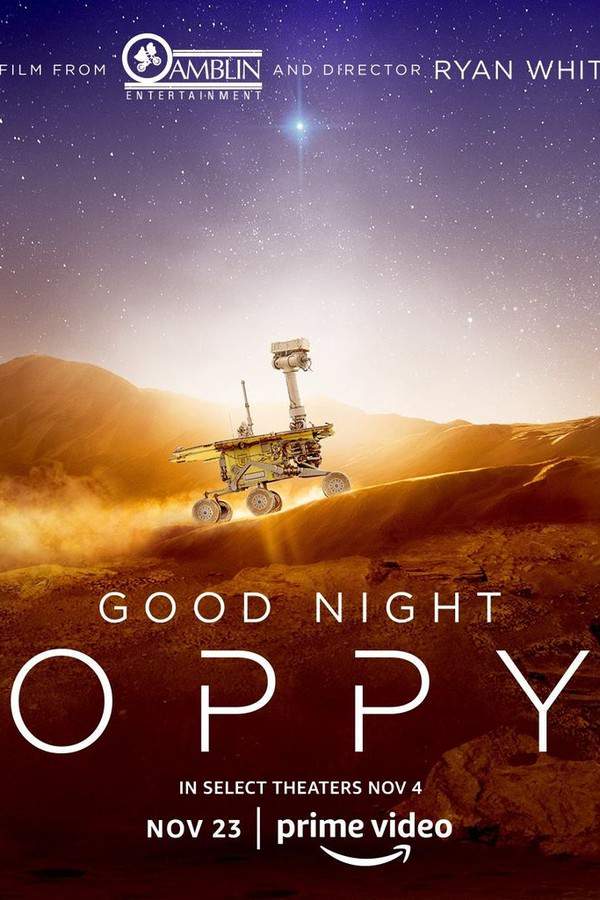
Good Night Oppy (2022) movie poster

Plot Summary

Good Night Oppy (2022) Plot Summary Explained

Release, runtime and language
2022 · 105 min · English
Echo score 79
JustWatch #19,940 7
Directed by
Ryan White

The Opportunity rover’s journey across the Martian surface lasted fifteen years, far exceeding its initial lifespan. This is the true story of how a remarkable bond developed between the resilient rover and the dedicated team of engineers and scientists who guided it. Witness the challenges and triumphs as Opportunity explored the Red Planet, showcasing the ingenuity of its design and the emotional connection forged between humans and a mechanical pioneer.

On this page (6)
  1. 1 Where to watch
  2. 2 What happens: full plot
  3. 3 Plot questions answered
  4. 4 Movie threads
  5. 5 Movies like Good Night Oppy
  6. 6 Every angle

Where to watch

Where to Watch Good Night Oppy (2022)

Where can you watch Good Night Oppy? Stream, rent or buy it in the US, including on Amazon Prime Video and Amazon Prime Video Free: current JustWatch availability with up-to-date prices.

Streaming availability powered by JustWatch

Full plot summary · contains spoilers

What Happens in Good Night Oppy: Full Plot Summary

The whole story of Good Night Oppy (2022) explained, from the opening scene to the final frame: every key event, every twist and what it all adds up to. Read it as a quick recap before the sequel, to check a scene you missed, or to finally understand what really happened.

In 2003, the twin robots Opportunity and Spirit were dispatched to Mars, with expectations of lasting just 90 days. Once activated, these rovers commenced their own journey filled with unforeseen challenges. Under the guidance of the Jet Propulsion Laboratory (JPL) in Pasadena, California, the team, led by mission manager Jennifer Trosper, systems engineer Rob Manning, and rover driver Ashley Stroupe, pursued a critical quest: to determine if life once existed on Mars by following the path of water.

The historical backdrop reveals that in the 1970s, NASA had launched the Viking missions, comprising two orbiters and two landers that provided a first close-up examination of the Martian landscape. Notably, scientist Steve Squyres, who had participated in that mission, documented the signs of water, drafting proposals to NASA in hopes of constructing a rover that could inspect Martian rocks for organic materials. His prior efforts met with rejection until JPL finally embraced his concept of two identical, autonomous rovers capable of sustaining themselves on Mars for 90 Sols. The meticulously timed launch window was dictated by planetary alignment—a missed opportunity would mean waiting 26 months for the next chance.

Moreover, Kobie Boykins served as the chief engineer for the rovers, while Ashitey Trebi-Ollennu contributed as a robotics engineer. Designed with wheels, a robust power system, cameras resembling eyes, and a robotic arm stocked with various instruments to detect life, each rover stood 5 feet 2 inches tall. Yet, landing on Mars posed significant challenges, with inflated airbags designed to protect the rovers during their descent prone to being shredded by sharp rocks. Parachute failures compounded the difficulties leading up to launch.

On June 10, 2003, Spirit launched, followed by Opportunity on July 7, 2003, embarking on a 6.5-month journey only to face the threat of intense solar flares—historically the most significant in the solar system—causing software malfunctions that necessitated urgent reboots. As fate would have it, both missions were set to land on opposite sides of Mars, with Spirit making contact first on January 3, 2004, celebrated enthusiastically by the JPL team. Opportunity followed three weeks later, sending back images that showcased sedimentary evidence of past water flows.

Despite initial expectations, Spirit's findings differed dramatically; it encountered only lava rock at its site in Gusev Crater, while Opportunity stumbled upon what appeared to be hematite—an indicator of water's past presence, albeit in an acidic state. Overcoming setbacks, including a temporary malfunction, Spirit thrived, marvelously recovering from what seemed like certain failure. Daring predictions for the longevity of the rovers soon turned optimistic as Martian winds swept clear dust from their solar panels, allowing them to perform exceptionally well.

As their journey unfolded, Spirit explored the Columbia Hills, while Opportunity navigated the demanding Endurance Crater, deftly escaping perilous obstacles along the way. The vastness of Mars was revealing itself through each rover's explorations. However, challenges lurked, such as getting stuck in soft sand, damaged wheels, and seasonal dust storms that tested their endurance.

Despite the rigors of time, public interest surged, and the rovers continued their grueling missions. Spirited persistence led Opportunity to the Endeavour Crater, unearthing a treasure trove of findings over 14 years before an unexpected dust storm dimmed its communications. On Sol 5111, it went silent, marking the quiet end of a remarkable journey as NASA prepared to bid farewell to its extraordinary robotic pioneers and look forward to the next chapter with the launch of Perseverance.
Last updated: November 03, 2024 at 23:47

Was this helpful?

Plot questions answered

Good Night Oppy Plot Explained: Your Questions Answered

The questions people ask most about Good Night Oppy (2022): what happens in the confusing scenes, why the characters do what they do, the twists, hidden details and what the ending means. Each answer contains spoilers.

Q1

Why did Opportunity last 15 years when it was only supposed to last 90 days?

Opportunity's solar panels were repeatedly cleaned by Martian winds, which removed dust buildup and kept the rover powered. The JPL team also expertly managed the rover's limited resources and creatively solved problems as they arose, allowing the mission to extend far beyond its original 90-sol design life.

Foreshadowing: Early in the mission, Martian winds already began clearing dust from the panels, hinting at the rovers' unexpected longevity.

  • solar panels
  • martian winds
  • mission extension
  • 90 sols
  • durability
Q2

Why was the launch window so critical for the Mars rovers?

The launch window was determined by planetary alignment between Earth and Mars. If the rovers weren't launched during this specific period, NASA would have had to wait 26 months for the next optimal alignment to send spacecraft to Mars.

Foreshadowing: The timeline emphasizes that the meticulously timed launch window was essential, without which the entire mission would be delayed.

  • launch window
  • planetary alignment
  • 26 months
  • earth mars
Q3

What did Opportunity find that Spirit didn't?

While Spirit found only lava rock at Gusev Crater, Opportunity discovered hematite at its landing site, an iron oxide mineral that forms in water, providing strong evidence that water once flowed on Mars.

Foreshadowing: The mission's primary goal was to follow the path of water, and Opportunity's discovery directly fulfilled this scientific objective.

  • hematite
  • water evidence
  • spirit
  • comparison
  • discovery
Q4

Why was finding hematite on Mars significant?

Hematite is an iron oxide mineral that typically forms in the presence of water, often in acidic or hot springs. Its discovery confirmed that liquid water had once existed on Mars, supporting the possibility that the planet may have once harbored life.

Foreshadowing: Steve Squyres had documented signs of water during the Viking missions, driving his insistence on sending rovers to search for organic materials.

  • hematite
  • water
  • life
  • mars exploration
  • evidence
Q5

How did dust storms affect the Mars rovers?

Dust storms blocked sunlight from reaching the rovers' solar panels, severely limiting their power supply. The massive storm on Sol 5111 was particularly devastating, cutting off Opportunity's communications permanently.

Foreshadowing: Seasonal dust storms had been mentioned as ongoing challenges throughout the mission, building to the final catastrophic storm.

  • dust storm
  • solar panels
  • power
  • communication loss
  • sol 5111
Q6

Why did Opportunity stop communicating with Earth?

An intense global dust storm engulfed Mars in 2018, coating Opportunity's solar panels with thick dust and draining its batteries. After 5111 sols of operation, the rover lost power and never reestablished contact with JPL.

Foreshadowing: The rovers had weathered multiple dust storms before, but this one proved overwhelming and marked the mission's final challenge.

  • dust storm
  • communication
  • sol 5111
  • power loss
  • nasa
Q7

How did solar flares threaten the Mars rovers?

During the 6.5-month journey to Mars, the rovers faced the most significant solar flares ever recorded in the solar system. These intense radiation bursts caused software malfunctions that required urgent system reboots to recover.

Foreshadowing: The launch preparation noted parachute failures and other difficulties, showing the mission faced multiple technical threats.

  • solar flares
  • software malfunction
  • radiation
  • journey
  • reboot
Q8

How did the JPL team overcome technical failures during the mission?

The JPL engineers adapted innovatively to each crisis, including recovering Spirit from a seemingly terminal malfunction, freeing Opportunity when it became stuck in soft sand, and improvising solutions for damaged wheels, all while operating the rovers remotely from Earth.

Foreshadowing: Early challenges like airbag landing risks and the temporary malfunction of Spirit demonstrated the team's problem-solving capabilities.

  • jpl
  • engineers
  • technical problems
  • recovery
  • adaptation
Q9

What was the main purpose of the Mars rover mission?

The primary mission was to determine if life ever existed on Mars by following the path of water and searching for organic materials in Martian rocks. Both rovers were designed to search for signs of past water activity.

Foreshadowing: Steve Squyres' proposals emphasized searching for organic materials after documenting water evidence during the Viking missions.

  • life
  • water
  • organic materials
  • mission objective
  • exploration
Q10

Why were two identical rovers sent to Mars?

Sending two rovers provided redundancy and allowed exploration of different Martian locations simultaneously. Spirit landed in Gusev Crater while Opportunity landed on the opposite side of Mars, maximizing scientific return and reducing risk if one rover failed.

Foreshadowing: The mission design reflected lessons from previous Mars missions and the need to explore multiple sites for water evidence.

  • twin rovers
  • spirit
  • opportunity
  • redundancy
  • exploration

Movie threads

More Movies Like Good Night Oppy, by Mood & Story

Curated lists built around what makes Good Night Oppy tick: the same mood, the same kind of story or the same emotional payoff. Each list explains why these movies belong together.

True stories of human ingenuity like Good Night Oppy

Stories celebrating human perseverance and technological brilliance overcoming immense challenges. If you were inspired by the story of Opportunity, explore more movies like Good Night Oppy. This collection features documentaries and dramas about scientific discovery, engineering marvels, and the teams who achieve the extraordinary against all odds.

  • inspiring
  • hopeful
  • tense
  • triumphant
  • awe-inspiring
  • scientific
  • Tone: hopeful, inspiring
  • Pacing: steady, mission-driven
Why these movies?

The story pattern: Movies in this thread typically follow a 'mission' structure, starting with a grand challenge and proceeding through cycles of problem-solving, setback, and breakthrough. The narrative arc builds towards a triumphant, often bittersweet, conclusion that honors both the achievement and the effort required.

Why they belong together: They are grouped by their shared focus on real-world problem-solving, a hopeful and inspiring tone, and the emotional resonance of watching dedicated individuals or teams achieve something monumental through intellect and perseverance.
Movies about emotional bonds with technology like Good Night Oppy

Emotional stories exploring the profound bonds formed between humans and their creations. For viewers moved by the relationship between the engineers and the Opportunity rover, find movies similar to Good Night Oppy. These films explore the unique, bittersweet connections we form with technology and the emotional weight of their final chapters.

  • melancholic
  • nostalgic
  • bittersweet
  • hopeful
  • touching
  • sad
  • Tone: melancholic, nostalgic, hopeful
  • Pacing: steady, reflective
Why these movies?

The story pattern: The narrative pattern involves introducing a technological 'character', developing its 'personality' through its actions and interactions, and building towards an inevitable, emotionally charged end of service. The focus is on legacy and the lingering impact of the machine's existence.

Why they belong together: They share a specific emotional core: a melancholic yet hopeful tone derived from anthropomorphizing technology, a medium emotional weight centered on loss and legacy, and a bittersweet ending that acknowledges the beauty of a journey's conclusion.

If you liked this

Movies Like Good Night Oppy

Similar movies to Good Night Oppy: the same genre, themes or kind of story. Each one comes with its own plot summary, timeline and ending explained.

Browse all movie summaries

Every angle

Good Night Oppy (2022) Explained: Plot, Timeline & Characters

Everything about Good Night Oppy in one place: what happens in the plot summary, the timeline in chronological order, the characters and meaning and a spoiler-free summary. What's After the Movie adds the cast, box office and post-credit scenes.

Coming soon on iOS and Android

The Plot Explained Movie Summary App

Plot summaries, endings explained and timelines on your phone. Catch up on any movie in minutes, save your favorites and never miss a twist again.

Be the first to know when we launch. Your email stays private, always.

Learn more about the app