







Plot Explained Spoilers guaranteed!
Plot Explained

Browse by genre

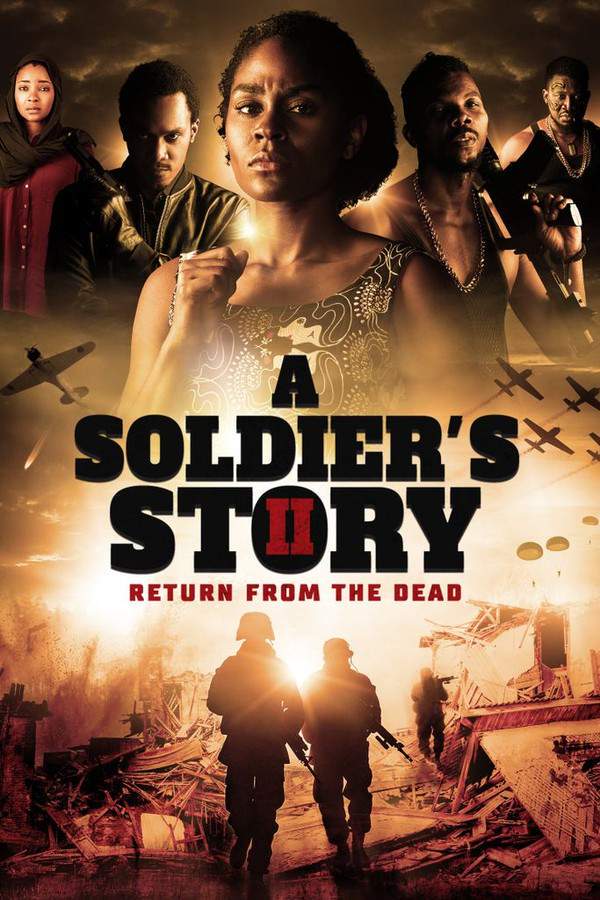
A Soldier's Story (1984) movie poster

Timeline

A Soldier's Story (1984) Timeline Explained – Every Event in Order

Release, runtime and language
1984 · 101 min · English
JustWatch #29,090 6
Directed by
Norman Jewison
Starring
David Alan Grier, Denzel Washington, David Harris, Art Evans, Dennis Lipscomb, Howard E. Rollins Jr.

Following a devastating war in the Watz Republic, Regina entrusts her friend Zaya with the care of her brother before embarking on a journey to Nigeria with her fiancé, Major Egan. Their trip is abruptly threatened when they become the targets of a dangerous assassination attempt. They must then fight to protect themselves and uncover the dark conspiracy behind the attack, revealing the sinister forces at play.

On this page (6)
  1. 1 Where to watch
  2. 2 Events in order (14)
  3. 3 Timeline questions answered
  4. 4 Movie threads
  5. 5 Movies like A Soldier's Story
  6. 6 Every angle

Where to watch

Where to Watch A Soldier's Story (1984)

Where can you watch A Soldier's Story? Stream, rent or buy it in the US, including on Tubi TV, Amazon Video and Apple TV Store: current JustWatch availability with up-to-date prices.

Streaming availability powered by JustWatch

14 events in order · contains spoilers

A Soldier's Story Timeline: Events in Chronological Order

Every key event of A Soldier's Story (1984) in order, scene by scene, with when and where it takes place. Use it to untangle flashbacks, time jumps and parallel storylines, to refresh your memory before the sequel or to find the exact scene you are thinking of.

  1. Vernon Waters' Death

    In 1944, Master Sergeant Vernon Waters was tragically killed outside Fort Neal, a segregated Army base in Louisiana. His last words, a haunting declaration of hatred, echoed in the air, marking the scene of his untimely demise.

    When
    1944
    Where
    Fort Neal, Louisiana
  2. Investigation Begins

    Captain Richard Davenport from the Judge Advocate General's Corps was assigned to investigate Waters' death. Despite Colonel Nivens' reluctance, Davenport faced the challenge head-on, trying to uncover the truth behind this violent act.

    Where
    Fort Neal, Louisiana
  3. Ku Klux Klan Speculation

    Initially, the investigation led to speculation that Waters was murdered by the local Ku Klux Klan. However, as Captain Davenport dug deeper, this theory began to unravel, raising questions about the circumstances surrounding his death.

  4. Conflicted Loyalties

    Captain Taylor, the only white officer who could assist Davenport, displayed reluctance in cooperating due to the nature of the investigation. This created tensions among Black soldiers, who were divided in their support for Davenport's leadership.

  5. Waters' Military Uniform Discovery

    Davenport discovered that unlike other Black soldiers killed by the Klan, Waters was found still wearing his military uniform. This critical detail contradicted earlier assumptions and pointed to deeper, more complex issues regarding his death.

  6. 221st Chemical Smoke Generator Battalion

    Waters led the 221st Chemical Smoke Generator Battalion, which was relegated to non-combat roles despite their eagerness for action. This unit, composed of former Negro baseball league stars, even dreamed of playing against the New York Yankees.

  7. James Wilkie's Account

    James Wilkie, a former sergeant in Waters' unit, shared insights into Waters' character—an esteemed leader who had seen war but was also troubled by class differences within the ranks. His conflicting nature painted a complicated picture of the late sergeant.

  8. Peterson's Encounter with Waters

    Private Peterson recounted a disturbing interaction with Sergeant Waters, where he stood up to racial disdain only to face physical assault from Waters. This encounter left Peterson haunted and highlighted the internal strife within the unit.

  9. C.J.'s Decline

    Corporal Cobb revealed that Waters had visited C.J. in the brig, confessing to a sinister plot against him. C.J.'s tragic death from suicide following a court-martial compounded the emotional turmoil within the battalion and devastated his teammates.

  10. Confrontation with White Officers

    Just before Waters' death, he was confronted by racist officers Captain Wilcox and Lieutenant Byrd, who admitted to assaulting him. Their claims of innocence only intensified the atmosphere of hate swirling around his tragic fate.

  11. Revelations of Betrayal

    During intense questioning, Wilkie revealed that Waters had directed him to plant a weapon in C.J.'s quarters out of racial animosity. This shocking confession unveiled the depths of betrayal and violence amidst the soldiers.

  12. Witness to the Murder

    The investigation took a crucial turn when Smalls confessed to witnessing Peterson shooting Waters. He framed it as a misguided act of justice, exposing the complex and corrupt dynamics within the battalion.

  13. Davenport's Resolve

    Major Taylor praised Davenport for his determination in arresting the right suspects, recognizing the need for the military to adapt to the inclusion of Black officers. Davenport's resolve to bring justice shone through in the face of adversity.

  14. Preparing for Deployment

    As the battalion prepared for imminent deployment to the European theater, the weight of the investigation and its unresolved tensions loomed over them. Each soldier carried both the memories and the learning experiences that would define their path in the war ahead.

Last updated: November 18, 2024 at 20:40

Was this helpful?

Timeline questions answered

A Soldier's Story Timeline Explained: Your Questions Answered

When does it happen, and why in that order? The questions people ask about the chronology of A Soldier's Story (1984): time jumps, flashbacks, cause and effect between scenes and the correct order of events, each answered with spoilers.

Q1

Why did Private Peterson kill Sergeant Waters?

Private Peterson killed Sergeant Waters because he believed Waters had framed C.J. Memphis, an innocent Black soldier who later committed suicide while awaiting court-martial. Peterson saw this as a betrayal of their people and considered himself the judge of who was 'fit' to be Black. He viewed his actions as delivering justice for C.J. and all Black soldiers wronged by Waters' actions.

  • peterson
  • waters
  • c.j. memphis
  • murder
  • justice
  • betrayal
Q2

Why did Sergeant Waters frame C.J. Memphis?

Sergeant Waters framed C.J. Memphis by having James Wilkie plant a weapon in C.J.'s quarters. Waters harbored intense hatred toward uneducated, Gullah-speaking Southern Black soldiers like C.J., believing they set back the cause for racial equality. This animosity stemmed from a traumatic experience during World War I at Cafe Napoleon, where a Black soldier from their unit was humiliated by white comrades, a memory that haunted Waters and twisted his worldview.

Foreshadowing: Earlier testimony revealed Waters had a violent outburst toward Black soldiers he considered inferior, hinting at his deep-seated class-based prejudice.

  • waters
  • c.j. memphis
  • frame
  • planted weapon
  • gullah
  • cafe napoleon
Q3

What happened to C.J. Memphis after being framed?

C.J. Memphis was arrested and placed in the brig after Waters planted a weapon in his quarters. Confined and unable to cope with the shame of the false accusation, C.J. tragically took his own life while awaiting court-martial. The baseball team was devastated and chose to forfeit their final game in mourning, which disturbed Waters and led Captain Taylor to disband the unit entirely.

Foreshadowing: Corporal Cobb had earlier warned that Waters had visited C.J. in the brig and bragged about the framing, foreshadowing the sinister plot.

  • c.j. memphis
  • suicide
  • brig
  • court-martial
  • baseball team
Q4

Why was Captain Davenport investigating Waters' murder?

Captain Richard Davenport from the Judge Advocate General's Corps was assigned to investigate Sergeant Waters' murder because the military needed to determine what happened. Colonel Nivens was reluctant, but the case required a proper inquiry. Davenport was Black, which created tension among white officers but also gave Black soldiers pride in seeing one of their own in a position of authority.

  • davenport
  • investigation
  • judge advocate
  • colonel nivens
  • authority
Q5

Why was Waters' murder suspect despite being found in uniform?

Captain Davenport noticed that unlike other Black soldiers killed by the Ku Klux Klan, Waters was found still wearing his military uniform. This discrepancy contradicted the initial speculation that the KKK was responsible and pointed to someone within the military who had a personal motive rather than a racially motivated attack from outside the base.

  • uniform
  • kkk
  • military
  • discrepancy
  • Fort Neal
Q6

Why did Waters hate Gullah-speaking Black soldiers?

Waters' hatred of Gullah-speaking Southern Black soldiers like C.J. stemmed from traumatic experiences during World War I. At Cafe Napoleon, a Black soldier from their unit was mocked and humiliated by racist white comrades. This long-standing humiliation, combined with Waters' belief that less educated Black people held the race back, led him to view C.J. and others like him as obstacles to racial progress, ironically causing him to betray his own people.

Foreshadowing: James Wilkie mentioned Waters' Croix de Guerre and WWI service, establishing his traumatic military past.

  • gullah
  • southern black
  • cafe napoleon
  • world war i
  • self-hatred
  • betrayal
Q7

What happened to the 221st Chemical Smoke Generator Battalion?

The 221st Chemical Smoke Generator Battalion was composed of former Negro baseball league stars led by Sergeant Waters. Despite their fame and a potential exhibition game against the New York Yankees, they were relegated to menial tasks on the Home Front. After C.J.'s suicide, the team forfeited their final game in mourning, and Captain Taylor disbanded the unit, sending Waters into a downward spiral that preceded his death.

Foreshadowing: The timeline established the 221st as a celebrated baseball team with high hopes before the tragic events unfolded.

  • 221st battalion
  • baseball
  • negro leagues
  • disbanded
  • deployment
Q8

What was the relationship between Waters and Peterson?

Private Peterson had a personal confrontation with Sergeant Waters where he stood up to Waters after being berated following a victory. Waters responded by assaulting Peterson, leaving him traumatized. However, unlike C.J., Waters did not frame Peterson because he respected Peterson's English proficiency and self-worth, a distinction that made Peterson even more furious, as he saw Waters as a hypocrite who betrayed his own people while selectively sparing those he deemed acceptable.

  • peterson
  • waters
  • assault
  • confrontation
  • english
  • self-worth
Q9

Why did Peterson think he could decide who was 'Black enough'?

Peterson believed he had the authority to determine who was fit to be Black, viewing himself as an arbiter of racial identity. He saw Waters' framing of C.J. as a betrayal that disqualified Waters from being truly Black. His smug reasoning was that he had simply removed those he deemed 'unfit', a tragic example of internalized racism where a Black soldier became judge, jury, and executioner over another's Blackness.

  • peterson
  • blackness
  • internalized racism
  • judge
  • fitness
Q10

What happened to James Wilkie after his testimony?

James Wilkie was arrested after confessing that Waters had directed him to plant the weapon in C.J.'s quarters. Wilkie, a former sergeant who had served with Waters in World War I and earned the Croix de Guerre, revealed the full extent of Waters' plot. His arrest occurred just as the 221st Infantry Regiment prepared for overseas deployment to the European theater.

  • james wilkie
  • arrest
  • testimony
  • confession
  • weapon
  • deployment

Movie threads

More Movies Like A Soldier's Story, by Mood & Story

Curated lists built around what makes A Soldier's Story tick: the same mood, the same kind of story or the same emotional payoff. Each list explains why these movies belong together.

Investigative dramas with moral weight like A Soldier's Story

Methodical inquiries that expose deep-seated corruption and ethical rot. For viewers who appreciated the methodical investigation and heavy themes of A Soldier's Story, this list features movies where a search for truth within a strict institution exposes deep-seated corruption and ethical dilemmas. Find similar investigative dramas that are morally complex and emotionally heavy.

  • tense
  • thought-provoking
  • gritty
  • oppressive
  • suspenseful
  • morally complex
  • Tone: dark, thought-provoking
  • Pacing: steady, procedural
Why these movies?

The story pattern: These stories typically follow a protagonist, often an outsider or insider with a moral compass, who is tasked with investigating a crime or incident within a closed system. The narrative unfolds through interviews and evidence, gradually revealing that the crime is a symptom of a larger, systemic failure or prejudice.

Why they belong together: They are grouped by their shared focus on a procedural investigation that serves as a catalyst for exploring weighty themes of injustice, systemic corruption, and the psychological toll of uncovering bitter truths within a powerful institution.
Claustrophobic societal dramas like A Soldier's Story

Stories where characters are trapped by the oppressive weight of their environment. If you liked the oppressive, tense atmosphere of A Soldier's Story, this collection features movies where characters are trapped by societal pressures in a confined setting. Discover similar dramas with a claustrophobic vibe, high tension, and themes of injustice.

  • claustrophobic
  • oppressive
  • tense
  • gritty
  • melancholic
  • suspenseful
  • Tone: oppressive, tense
  • Pacing: steady, building dread
Why these movies?

The story pattern: The narrative pattern involves characters operating in a confined, high-pressure environment where societal rules and prejudices create an inescapable sense of dread. Conflict arises from the friction between individual morality and the oppressive norms of the group, often leading to tragic consequences and profound psychological turmoil.

Why they belong together: These films share a specific atmospheric quality: a palpable, claustrophobic tension generated by a restrictive setting and heavy societal themes. They deliver a consistent mood of unease and oppression, making the viewer feel the weight of the environment on the characters.

If you liked this

Movies Like A Soldier's Story

Similar movies to A Soldier's Story: the same genre, themes or kind of story. Each one comes with its own plot summary, timeline and ending explained.

Browse all movie summaries

Every angle

A Soldier's Story (1984) Explained: Plot, Timeline & Characters

Everything about A Soldier's Story in one place: what happens in the plot summary, the timeline in chronological order, the characters and meaning and a spoiler-free summary. What's After the Movie adds the cast, box office and post-credit scenes.

Coming soon on iOS and Android

The Plot Explained Movie Summary App

Plot summaries, endings explained and timelines on your phone. Catch up on any movie in minutes, save your favorites and never miss a twist again.

Be the first to know when we launch. Your email stays private, always.

Learn more about the app