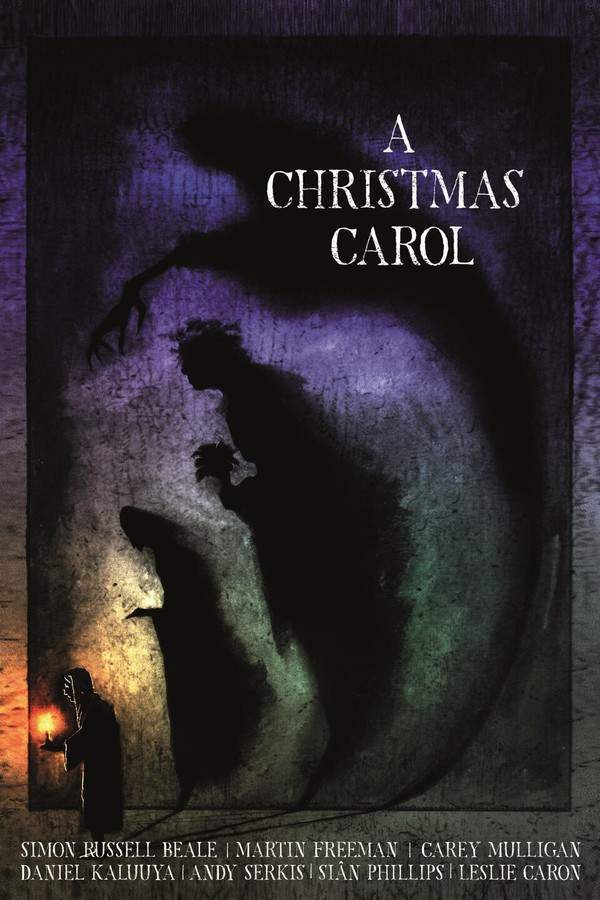
The story opens with a Grandmother Siân Phillips narrating to her children as they stage a toy theatre for their annual performance of A Christmas Carol. The imagination of Emily unfolds, and the cardboard stage dissolves into a magical world where the familiar tale comes to life. This adaptation leans close to the book’s prose, setting a mood of quiet, wintry realism that soon gives way to sweeping, dreamlike moments.
The film moves to a bleak, cold Christmas Eve in London, seven years after the death of Ebenezer Scrooge’s business partner, Jacob Marley. Scrooge, an elderly miser who despises Christmas, refuses a dinner invitation from his generous nephew Fred and turns away two men asking for help for the poor. He only grudgingly allows his overworked, underpaid clerk, Bob Cratchit Martin Freeman a single Christmas Day off with pay to conform to the social custom.
That night, Marley’s Ghost Andy Serkis appears, tethered to earth by heavy chains and money boxes forged in a lifetime of greed. He warns Scrooge that he has one chance to change his fate: he will be visited by three spirits, and he must listen, or be doomed to carry heavier chains of his own. The ghost’s warning hangs in the cold air, a reminder that mercy and memory can still alter a life.
The first spirit, the Ghost of Christmas Past Leslie Caron, takes Scrooge on a journey through scenes from his youth. He revisits a lonely boarding-school childhood, cherishes the memory of his sister Fan, and revisits the festive warmth of a Christmas party hosted by his first employer, Mr Fezziwig Colin Mace. The ghost then shows Scrooge’s neglected fiancée Belle and the moment she realizes he will never love her as much as he loves money. The image of Belle, now happy with a large family, wounds Scrooge deeply, and when Belle speaks of him with pity, she asks the ghost to remove him from the house. Throughout, the vivid recollections reveal how Scrooge’s heart was hardened long before the present moment.
The second spirit, the Ghost of Christmas Present Daniel Kaluuya, opens Scrooge’s eyes to a world full of life and abundance, even amid hardship. They wander a bustling market where families assemble the makings of their Christmas dinner, and then into the warmth of a miner’s cottage and the glow of a lighthouse. The journey includes Fred’s Christmas party, a scene of communal laughter and cheer that contrasts with Scrooge’s solitary life. A central thread follows Bob Cratchit’s family feast, highlighting Tiny Tim, the youngest Cratchit boy whose frailty presages a fragile future. The spirit also unveils two hideous, emaciated children—Ignorance and Want—warning Scrooge to fear their rise if he fails to reform. A short, dynamic dance sequence suggests the potential futures these children symbolize, leaving a stark impression of what Scrooge might become if he does not change.
The third spirit, the Ghost of Christmas Yet to Come, presents a future shrouded in silence and fear. This visitor shows Scrooge a Christmas Day in which a disliked man dies and is mourned by few, while others profit from his absence. A charwoman, laundress, and undertaker quietly profit from his belongings, and the only real emotion comes from a poor couple who welcome his death as a chance to restore their finances. When Scrooge pleads to see any tenderness surrounding a death, the ghost reveals a neglected grave bearing Scrooge’s own name, an image that breaks his resolve. Overwhelmed, Scrooge pledges to change his ways.
The morning after this spectral visitation, Scrooge awakens a reformed man. He makes a substantial, anonymous donation to charity, and that evening he sends a generous turkey to the Cratchit home for Christmas dinner. He spends the afternoon with Fred’s family, and the next day he increases Bob Cratchit’s pay, embracing a new role as a guiding, affectionate figure for Tiny Tim. From that moment on, Scrooge treats everyone with kindness, generosity, and compassion, embodying the true spirit of Christmas.
Emily’s eyes widen with delight at the transformed tale, while the grandmother closes the narration with a warm, hopeful note about the power of imagination to carry the story forward.