Plot Explained Spoilers guaranteed!
Plot Explained

Browse by genre

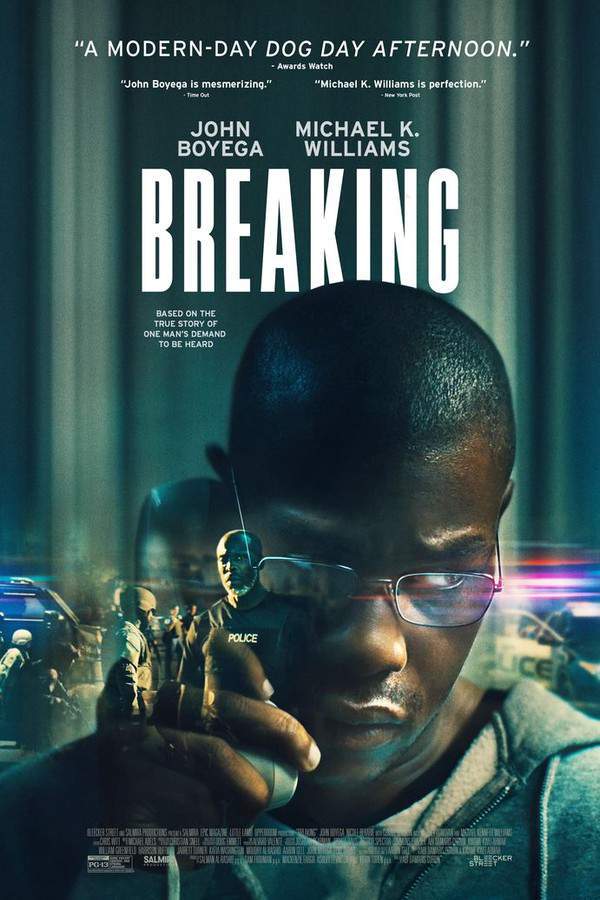
Breaking (2022) movie poster

Timeline

Breaking (2022) Timeline Explained – Every Event in Order

Release, runtime and language
2022 · 103 min · English
Echo score 62
Loading streaming availability…
Directed by
Abi Damaris Corbin
Starring
Connie Britton, Nicole Beharie, John Boyega, Michael Kenneth Williams, Jeffrey Donovan, Selenis Leyva

A Marine veteran's urgent request for assistance is ignored, leading to a tense standoff with devastating consequences. Brian Brown-Easley’s struggle against bureaucratic indifference evolves into a desperate fight for survival, pushing him to the edge. The situation escalates, endangering lives and highlighting the fragility of the system designed to help those in need, ultimately testing the boundaries of human endurance.

On this page (7)
  1. 1 Where to watch
  2. 2 Events in order (12)
  3. 3 How it worked in Breaking
  4. 4 Timeline questions answered
  5. 5 Movie threads
  6. 6 Movies like Breaking
  7. 7 Every angle
Loading streaming availability…

12 events in order · contains spoilers

Breaking Timeline: Events in Chronological Order

Every key event of Breaking (2022) in order, scene by scene, with when and where it takes place. Use it to untangle flashbacks, time jumps and parallel storylines, to refresh your memory before the sequel or to find the exact scene you are thinking of.

  1. Background: Military service and financial collapse

    Easley is a former Marine who struggles with PTSD and financial hardship after his honorable discharge. He relies on a monthly VA disability check of $892, but the payment is withheld due to a disputed debt to a for-profit college. The resulting financial instability leaves him homeless and increasingly desperate as he tries to navigate a system that seems to fail him.

  2. Bank entry and bomb threat declaration

    He walks into a Wells Fargo bank branch in Marietta, Georgia and quietly informs two employees that there is a bomb in his backpack, asking them to lock the doors. He makes clear that he does not intend to hurt anyone, but insists that the VA fix the error and pay him the money he is owed. He allows other customers to leave the bank unharmed as he takes control of the situation.

    Where
    Wells Fargo bank branch, Marietta, GA
  3. Non-monetary demand and restraint

    Rather than demanding money, Easley emphasizes his demand for accountability from the VA. He instructs the bank staff to stay calm and keeps the hostages safe while the standoff unfolds. He then calls 911 to explain the situation and reaches out to a local news outlet to ensure the story is heard.

    Where
    Wells Fargo bank branch, Marietta, GA
  4. Negotiator arrives and connects with the veteran

    Crisis negotiator Eli Bernard tries to build rapport with Easley, treating him as a fellow veteran and seeking to connect over shared experiences. He pressures the situation toward a peaceful surrender while coordinating with police outside. The negotiation faces bureaucratic hurdles that limit timely decisions.

    Where
    Wells Fargo bank branch, Marietta, GA
  5. Public attention and hostage empathy

    Over hours, the hostages grow to sympathize with Easley, witnessing his calm demeanor and sincere frustration. Media and SWAT units circle the bank as reporters chase his story. Easley reiterates that his goal is the VA's acknowledgment, not bloodshed.

    Where
    Wells Fargo bank branch, Marietta, GA
  6. Demand for VA acknowledgment intensifies

    Easley becomes agitated as his narrative seems to be ignored or distorted by authorities. He repeats his demand that the VA acknowledge and correct the error and expresses frustration with the delay. The tension centers on whether his plight will be publicly recognized.

    Where
    Wells Fargo bank branch, Marietta, GA
  7. Diaz allowed to contact her family

    Diaz, a bank teller, is allowed to call her child to confirm she is safe, a moment that underscores Easley's concern for the safety of others. He continues to monitor the hostages' reactions and tries to maintain control through calm dialogue. The scene reinforces his insistence on a non-violent resolution.

    Where
    Wells Fargo bank branch, Marietta, GA
  8. Easley releases a hostage in good faith

    In a move meant to show cooperation, Easley releases one hostage to demonstrate willingness to cooperate with the authorities. The act is intended to propel the negotiations forward and to show he is not seeking to harm anyone. The remaining hostages observe the exchange with mixed emotions.

    Where
    Wells Fargo bank branch, Marietta, GA
  9. Bureaucratic miscommunication hampers negotiations

    Bernard and the police struggle with bureaucratic miscommunication from higher-ups, which complicates the decision-making process in the standoff. The delay fuels Easley's frustration and makes the negotiation more unstable. The situation becomes a test of communication as much as a standoff.

    Where
    Wells Fargo bank branch, Marietta, GA
  10. Tragic conclusion: Easley is shot

    A police sniper fatally shoots Easley as he steps toward the front of the bank while still holding his backpack. The shot ends the standoff and shocks the hostages and observers. The movie later reveals that the bomb threat was a bluff, since the backpack contained no explosives.

    Where
    Wells Fargo bank branch, Marietta, GA
  11. Media aftermath and public reaction

    News coverage highlights the fatal ending and sparks public outrage over how veterans are treated and how the crisis was handled. The incident prompts scrutiny of police tactics and communication with the VA and other social services. The community's response fuels a broader conversation about accountability.

  12. Legacy: unfolding symbol of neglect

    A postscript reveals that the VA never repaid the withheld funds, and Easley's case becomes a symbol of bureaucratic neglect and systems failing vulnerable veterans. The narrative serves as a critique of how administrative errors can have deadly consequences. The film closes by urging reflection on veterans' welfare and institutional responsibility.

Last updated: October 09, 2025 at 16:21

Was this helpful?

deception · contains spoilers

How It Worked in Breaking

How the deception in Breaking really worked, step by step: what each move looked like at the time, what was actually going on and how one step made the next possible.

Deception 5 steps

How a Claimed Bomb Turned a Bank Branch into a Public Platform

Brian Brown-Easley walked into a Wells Fargo branch, told the manager and a teller he had a bomb in his backpack, and had the doors locked, then reported the situation himself to 911 and a news outlet so his grievance against the VA could not be ignored. The mechanism unpacks how the bomb claim, the contained hostages, and the self-generated publicity built a high-pressure standoff that was later revealed to have involved no explosives at all.

1Looked like something else at the timeBomb claim seizes thebranch2Hostages containedwhile customers leave3Easley reports thestandoff himself4Police, media, andSWAT surround thebank5Backpack revealed tocontain no explosives
WhoLeads to3Reveals1Looked like something else
Read the 5 steps as text
  1. 1

    Bomb claim seizes the branch

    Brian Brown-Easley · Estel Valerie · Rosa Diaz

    What it looked like: Valerie and Diaz are led to believe Easley is carrying a bomb in his backpack.

    Easley walks into a Wells Fargo branch in Marietta, Georgia, and calmly tells branch manager Estel Valerie and teller Rosa Diaz that he has a bomb in his backpack, asking them to lock the doors.

  2. 2

    Hostages contained while customers leave

    Brian Brown-Easley

    Easley demands no money, instead insisting the VA correct its error and pay funds he is owed, and he allows the other customers to leave unharmed while keeping the situation contained.

  3. 3

    Easley reports the standoff himself

    Brian Brown-Easley

    To ensure his message is heard, Easley calls 911 himself and reaches out to a local news outlet so the story cannot be buried.

  4. 4

    Police, media, and SWAT surround the bank

    Brian Brown-Easley · Eli Bernard

    The bank becomes surrounded by police, a media presence, and SWAT units, and crisis negotiator Eli Bernard, a fellow veteran, attempts to bridge the gap and earn Easley's trust through empathy and patience.

  5. 5

    Backpack revealed to contain no explosives

    Brian Brown-Easley

    It is revealed that Easley's backpack contained no explosives, reframing the standoff and prompting news coverage of public outrage over the treatment of veterans and the crisis response.
Timeline questions answered

Breaking Timeline Explained: Your Questions Answered

When does it happen, and why in that order? The questions people ask about the chronology of Breaking (2022): time jumps, flashbacks, cause and effect between scenes and the correct order of events, each answered with spoilers.

Q1

Why did Brian Brown-Easley take hostages at the Wells Fargo bank?

Brian took hostages because his $892 monthly VA disability check was withheld due to a disputed debt to a for-profit college, leaving him homeless and desperate. He wasn't after money, he wanted the VA to correct the error and pay what he was owed. The bank hostage situation was his way of forcing the system to acknowledge his plight when all other avenues failed.

Foreshadowing: Earlier scenes establish that Brian had repeatedly tried to resolve the VA error through normal channels without success.

  • Brian Brown-Easley
  • VA check
  • bank hostage
  • disability payment
  • veteran
Q2

Why didn't Brian demand money from the bank instead of just holding hostages?

Brian explicitly refused to take any money from the bank. His goal was never financial gain, it was accountability from the VA. He stated he wanted the VA to fix the error and pay the funds he was owed. By calling 911 and a news outlet himself, he ensured his message about bureaucratic failure would reach the public, not just extract cash.

Foreshadowing: From the moment he entered the bank, Brian stated he had a bomb but made clear he wasn't there for robbery.

  • no money demanded
  • VA accountability
  • bank robbery
  • protest
Q3

Who was Eli Bernard and why was he chosen to negotiate with Brian?

Eli Bernard was a crisis negotiator who was also a veteran, which made him uniquely positioned to connect with Brian. His approach was rooted in empathy and shared experience, trying to build trust as a fellow veteran who understood Brian's pain. Bernard worked to de-escalate the situation while pushing for a peaceful resolution.

Foreshadowing: The film establishes Bernard as someone who genuinely cares about veteran welfare, distinguishing him from typical law enforcement negotiators.

  • Eli Bernard
  • crisis negotiator
  • veteran negotiator
  • negotiation
Q4

What was actually in Brian's backpack?

Brian's backpack contained no explosives, it was a bluff. The reveal that there was no bomb reframes the entire standoff and casts critical light on how police handled the situation. Despite Brian's repeated assurances that he didn't want to hurt anyone and his careful efforts to keep hostages safe, the sniper still took his life.

Foreshadowing: Brian consistently emphasized he didn't want anyone harmed and allowed customers to leave freely.

  • no bomb
  • bluff
  • backpack
  • police shooting
Q5

Why was Brian's VA disability check withheld?

Brian's $892 monthly VA disability check was stopped because of a disputed debt to a for-profit college. The exact nature of the debt was contested, but the result was that his only source of income was cut off, quickly leading to homelessness and desperation.

Foreshadowing: The opening establishes Brian as a former Marine struggling with PTSD and financial hardship after his honorable discharge.

  • VA disability
  • for-profit college
  • debt
  • financial hardship
  • veteran benefits
Q6

Why was Brian shot by police during the standoff?

Brian was shot by a police sniper as he moved toward the front of the bank while still holding his backpack. The shooting occurred despite Brian's repeated assurances that he had no intention of hurting anyone and after hours of negotiation. The police decision to shoot remains controversial, especially given that the backpack contained no explosives.

Foreshadowing: The tension had been building as Brian grew increasingly frustrated with bureaucratic delays in resolving his case.

  • police sniper
  • fatal shooting
  • bank standoff
  • death
Q7

What happened to the hostages during the bank standoff?

Brian treated the hostages with remarkable restraint throughout the standoff. He allowed other customers to leave unharmed when he first entered, permitted bank teller Rosa Diaz to call her child to reassure them she was safe, and released one hostage in good faith to demonstrate cooperation. The hostages ultimately survived, though they were deeply affected by the experience.

Foreshadowing: Brian repeatedly emphasized he didn't want anyone hurt and maintained a calm demeanor that surprised the hostages.

  • hostages
  • Rosa Diaz
  • safe
  • released
Q8

Did the VA ever repay Brian the owed money after his death?

No, the postscript reveals that the VA never repaid the withheld funds, even after Brian's death turned his case into a symbol of bureaucratic neglect. His case became a galvanizing example of how administrative errors and institutional failure can drive vulnerable people to desperate acts, yet the system he fought against remained unchanged.

Foreshadowing: Brian's central demand throughout the standoff was that the VA acknowledge and correct the error, something that never happened.

  • VA funds
  • never repaid
  • bureaucratic failure
  • symbol
Q9

Why did Brian release one of the hostages during the standoff?

Brian released one hostage as a gesture of good faith to demonstrate his willingness to cooperate with authorities and to push the negotiations forward. The act was intended to show he was not seeking to harm anyone and was genuinely interested in resolving the situation peacefully rather than escalating to violence.

Foreshadowing: This decision reflected Brian's consistent emphasis throughout the standoff that he wanted a non-violent resolution.

  • released hostage
  • cooperation
  • negotiation
  • good faith
Q10

What happened to Estel Valerie and Rosa Diaz after the standoff?

Both bank employees survived the standoff. Rosa Diaz was allowed to call her child during the crisis to reassure them of her safety, a moment that underscored Brian's concern for the hostages' wellbeing. They were present throughout the tense hours-long negotiation and witnessed Brian's calm but desperate plea for justice.

Foreshadowing: Both women were the first people Brian addressed when he entered the bank, and he specifically instructed them to stay calm.

  • Estel Valerie
  • Rosa Diaz
  • branch manager
  • teller
  • survived
Q11

What was the public reaction after Brian was killed?

News coverage of Brian's fatal shooting sparked public outrage over how veterans are treated and how crisis situations are handled by police. The incident prompted scrutiny of police tactics and raised pressing questions about communication between law enforcement and institutions like the VA. It fueled a broader conversation about accountability and the treatment of vulnerable veterans.

Foreshadowing: The tragic outcome surprised those who had watched Brian's calm, reasoned approach throughout the standoff.

  • public outrage
  • media coverage
  • police tactics
  • veteran treatment

Movie threads

More Movies Like Breaking, by Mood & Story

Curated lists built around what makes Breaking tick: the same mood, the same kind of story or the same emotional payoff. Each list explains why these movies belong together.

Desperate Standoff Dramas Similar to Breaking

Stories where one desperate person confronts a vast, indifferent bureaucracy. Explore movies like Breaking that feature tense confrontations between individuals and indifferent systems. If you were gripped by Brian Brown-Easley's struggle, you'll find similar stories of desperation, bureaucratic failure, and high-stakes human drama in these films.

  • tense
  • desperate
  • frustrating
  • gripping
  • tragic
  • anxious
  • Tone: tense, tragic, frustrating
  • Pacing: steady, real-time escalation
Why these movies?

The story pattern: Narratives in this thread often unfold in real-time or over a compressed period, escalating from a personal plea into a public crisis. The protagonist, typically a sympathetic figure pushed to the edge, uses a drastic act to gain a platform, forcing a dialogue with authorities that highlights systemic flaws.

Why they belong together: These films are grouped by their shared core conflict: the individual vs. the institution. They generate tension from the power imbalance and create a heavy, somber mood by exploring themes of neglect, trauma, and the high cost of being ignored.

Real-Time Thrillers with a Tense Vibe Like Breaking

High-tension stories that unfold in a single location, trapping you with the characters. Find movies with a similar tense, real-time feel to Breaking. If you appreciated the claustrophobic atmosphere and steady build of pressure in a single location, these psychological thrillers and dramas will deliver a comparable gripping experience.

  • claustrophobic
  • anxious
  • gripping
  • tense
  • psychological
  • unrelenting
  • Tone: tense, anxious, claustrophobic
  • Pacing: steady, relentless
Why these movies?

The story pattern: These stories are structurally defined by their constraints: a single primary location and a timeline that mirrors real-time. This forces a direct, intimate focus on the protagonist's deteriorating mental state and the escalating stakes of their situation, with minimal relief from the building tension.

Why they belong together: They share a specific cinematic technique—the use of time and space—to generate a unique viewing experience. The combination of a steady pace, high intensity, and a claustrophobic setting creates a consistently anxious and gripping vibe that is central to their identity.

If you liked this

Movies Like Breaking

Similar movies to Breaking: the same genre, themes or kind of story. Each one comes with its own plot summary, timeline and ending explained.

Browse all movie summaries

Every angle

Breaking (2022) Explained: Plot, Ending, Timeline & Characters

Everything about Breaking in one place: what happens in the plot summary, the timeline in chronological order, the characters and meaning, the ending explained and a spoiler-free summary. What's After the Movie adds the cast, box office and post-credit scenes.

Coming soon on iOS and Android

The Plot Explained Movie Summary App

Plot summaries, endings explained and timelines on your phone. Catch up on any movie in minutes, save your favorites and never miss a twist again.

Be the first to know when we launch. Your email stays private, always.

Learn more about the app