Plot Explained Spoilers guaranteed!
Plot Explained

Browse by genre

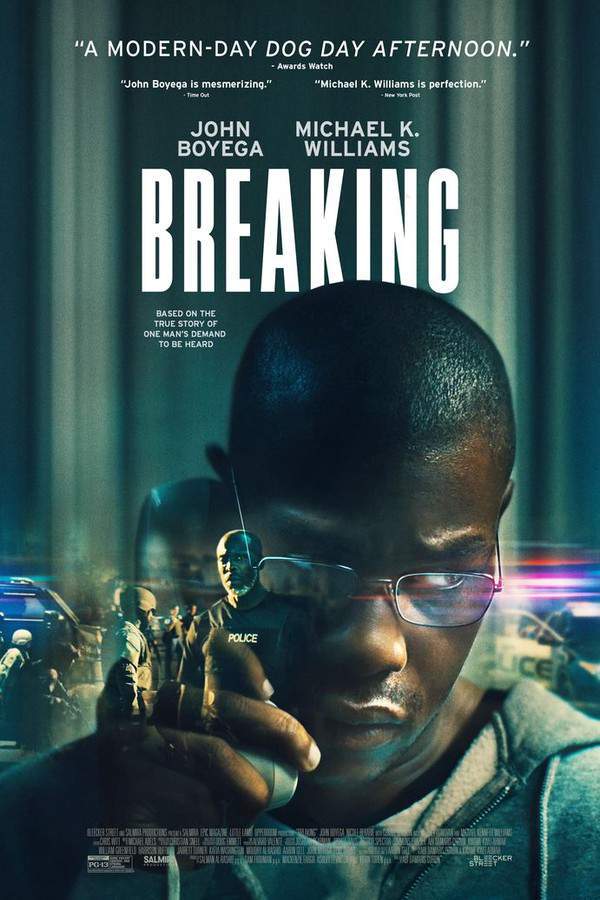
Breaking (2022) movie poster

Plot Summary

Breaking (2022) Plot Summary & Ending Explained

Release, runtime and language
2022 · 103 min · English
Echo score 62
Directed by
Abi Damaris Corbin
Starring
Connie Britton, Nicole Beharie, John Boyega, Michael Kenneth Williams, Jeffrey Donovan, Selenis Leyva

A Marine veteran's urgent request for assistance is ignored, leading to a tense standoff with devastating consequences. Brian Brown-Easley’s struggle against bureaucratic indifference evolves into a desperate fight for survival, pushing him to the edge. The situation escalates, endangering lives and highlighting the fragility of the system designed to help those in need, ultimately testing the boundaries of human endurance.

On this page (6)
  1. 1 What happens: full plot
  2. 2 Plot questions answered
  3. 3 How it ends
  4. 4 Movie threads
  5. 5 Movies like Breaking
  6. 6 Every angle

Full plot summary · contains spoilers

What Happens in Breaking: Full Plot Summary

The whole story of Breaking (2022) explained, from the opening scene to the final frame: every key event, every twist and what it all adds up to. Read it as a quick recap before the sequel, to check a scene you missed, or to finally understand what really happened.

Brian Brown-Easley [John Boyega] is a former Lance Corporal in the U.S. Marine Corps who carries the quiet weight of war long after his service ends. Struggling with financial hardship and the persistent sting of psychological trauma, he can’t hold a steady job and relies on a monthly VA disability check of $892. When that check is unexpectedly withheld because of a disputed debt to a for-profit college, the situation snowballs into homelessness and mounting desperation. His life, already frayed by physical pain and invisible wounds, hangs in the balance as the system he trusted fails to deliver what he was promised.

In a bid to make his story heard and shine a light on a broken process, Easley walks into a Wells Fargo branch in Marietta, Georgia. Inside, Estel Valerie [Nicole Beharie] (the branch manager) and Rosa Diaz [Selenis Leyva] (a teller) become the first people he addresses, calmly stating that he has a bomb in his backpack and asking them to lock the doors. He does not demand money; instead, he insists that the VA correct the error and pay the funds he’s owed. He asks for a measured response, and he allows the other customers to leave unharmed, aiming to keep the situation contained while he seeks justice.

To ensure his message is heard, Easley calls 911 himself and reaches out to a local news outlet so the story cannot be buried. As the bank is surrounded by police, a media presence, and SWAT units, crisis negotiator Eli Bernard [Michael Kenneth Williams], who is described as a fellow veteran, attempts to bridge the gap and earn Easley’s trust. Bernard’s approach is rooted in empathy and patience, trying to acknowledge the veteran’s pain while steering him toward a peaceful resolution. The hostages, watching the scene unfold, begin to see Easley in a more sympathetic light as they witness his composed demeanor and earnest frustration.

The narrative follows the slow grind of negotiation, as Easley repeatedly asserts that his main goal is to be heard and acknowledged—“the VA must fix the error and pay what’s owed.” He grows increasingly agitated when he feels his story is being ignored or distorted, yet he maintains a calm exterior that keeps the tension from snapping into outright violence. The hostages’ sympathy deepens, and even a moment allows Rosa Diaz to call her child and reassure them she is safe, underscoring the humanity at stake in a standoff that could have exploded into tragedy.

As hours pass, the negotiation ebbs and flows. Bernard works to de-escalate, encourage surrender, and keep Easley focused on the essential demand: rightful payment and recognition from the VA. Easley’s resolve remains sharply focused on correcting a process that let him slip through the cracks, and the documentary-like realism of the exchanges paints a stark picture of veterans caught in bureaucratic inertia. Then, when it seems negotiations might bend toward a peaceful end, a fatal moment occurs: a police sniper shoots Easley as he moves near the front of the bank holding his backpack. The scene is chilling in its immediacy and abruptness, underscoring the fragility of the moment and the high stakes of a crisis that spiraled from a plea for justice into a fatal outcome.

The reveal that Easley’s backpack contained no explosives reframes what happened, casting a critical light on how the standoff was handled. News coverage follows, highlighting the public outrage and raising pressing questions about the treatment of veterans and the effectiveness of crisis response. A postscript notes that the VA never repaid the withheld funds, turning Easley’s case into a galvanizing symbol of how bureaucratic failures and neglect can drive vulnerable people to desperate acts—and how the aftermath of such tragedies can linger long after the cameras fade.

In this portrait of a life upended, the human cost of systemic failure is laid bare: a veteran’s plea for acknowledgment becomes a test of institutional accountability, and the people caught in the middle—the bank staff, the negotiator, and the surrounding community—are left to reflect on what justice should look like when the system itself falters. Easley’s story is not just about a single incident; it’s a meditation on memory, service, and the long arc of healing that society owes to those who have served.
Last updated: October 09, 2025 at 16:21

Was this helpful?

Plot questions answered

Breaking Plot Explained: Your Questions Answered

The questions people ask most about Breaking (2022): what happens in the confusing scenes, why the characters do what they do, the twists, hidden details and what the ending means. Each answer contains spoilers.

Q1

Why did Brian Brown-Easley take hostages at the Wells Fargo bank?

Brian took hostages because his $892 monthly VA disability check was withheld due to a disputed debt to a for-profit college, leaving him homeless and desperate. He wasn't after money, he wanted the VA to correct the error and pay what he was owed. The bank hostage situation was his way of forcing the system to acknowledge his plight when all other avenues failed.

Foreshadowing: Earlier scenes establish that Brian had repeatedly tried to resolve the VA error through normal channels without success.

  • Brian Brown-Easley
  • VA check
  • bank hostage
  • disability payment
  • veteran
Q2

Why didn't Brian demand money from the bank instead of just holding hostages?

Brian explicitly refused to take any money from the bank. His goal was never financial gain, it was accountability from the VA. He stated he wanted the VA to fix the error and pay the funds he was owed. By calling 911 and a news outlet himself, he ensured his message about bureaucratic failure would reach the public, not just extract cash.

Foreshadowing: From the moment he entered the bank, Brian stated he had a bomb but made clear he wasn't there for robbery.

  • no money demanded
  • VA accountability
  • bank robbery
  • protest
Q3

Who was Eli Bernard and why was he chosen to negotiate with Brian?

Eli Bernard was a crisis negotiator who was also a veteran, which made him uniquely positioned to connect with Brian. His approach was rooted in empathy and shared experience, trying to build trust as a fellow veteran who understood Brian's pain. Bernard worked to de-escalate the situation while pushing for a peaceful resolution.

Foreshadowing: The film establishes Bernard as someone who genuinely cares about veteran welfare, distinguishing him from typical law enforcement negotiators.

  • Eli Bernard
  • crisis negotiator
  • veteran negotiator
  • negotiation
Q4

What was actually in Brian's backpack?

Brian's backpack contained no explosives, it was a bluff. The reveal that there was no bomb reframes the entire standoff and casts critical light on how police handled the situation. Despite Brian's repeated assurances that he didn't want to hurt anyone and his careful efforts to keep hostages safe, the sniper still took his life.

Foreshadowing: Brian consistently emphasized he didn't want anyone harmed and allowed customers to leave freely.

  • no bomb
  • bluff
  • backpack
  • police shooting
Q5

Why was Brian's VA disability check withheld?

Brian's $892 monthly VA disability check was stopped because of a disputed debt to a for-profit college. The exact nature of the debt was contested, but the result was that his only source of income was cut off, quickly leading to homelessness and desperation.

Foreshadowing: The opening establishes Brian as a former Marine struggling with PTSD and financial hardship after his honorable discharge.

  • VA disability
  • for-profit college
  • debt
  • financial hardship
  • veteran benefits
Q6

Why was Brian shot by police during the standoff?

Brian was shot by a police sniper as he moved toward the front of the bank while still holding his backpack. The shooting occurred despite Brian's repeated assurances that he had no intention of hurting anyone and after hours of negotiation. The police decision to shoot remains controversial, especially given that the backpack contained no explosives.

Foreshadowing: The tension had been building as Brian grew increasingly frustrated with bureaucratic delays in resolving his case.

  • police sniper
  • fatal shooting
  • bank standoff
  • death
Q7

What happened to the hostages during the bank standoff?

Brian treated the hostages with remarkable restraint throughout the standoff. He allowed other customers to leave unharmed when he first entered, permitted bank teller Rosa Diaz to call her child to reassure them she was safe, and released one hostage in good faith to demonstrate cooperation. The hostages ultimately survived, though they were deeply affected by the experience.

Foreshadowing: Brian repeatedly emphasized he didn't want anyone hurt and maintained a calm demeanor that surprised the hostages.

  • hostages
  • Rosa Diaz
  • safe
  • released
Q8

Did the VA ever repay Brian the owed money after his death?

No, the postscript reveals that the VA never repaid the withheld funds, even after Brian's death turned his case into a symbol of bureaucratic neglect. His case became a galvanizing example of how administrative errors and institutional failure can drive vulnerable people to desperate acts, yet the system he fought against remained unchanged.

Foreshadowing: Brian's central demand throughout the standoff was that the VA acknowledge and correct the error, something that never happened.

  • VA funds
  • never repaid
  • bureaucratic failure
  • symbol
Q9

Why did Brian release one of the hostages during the standoff?

Brian released one hostage as a gesture of good faith to demonstrate his willingness to cooperate with authorities and to push the negotiations forward. The act was intended to show he was not seeking to harm anyone and was genuinely interested in resolving the situation peacefully rather than escalating to violence.

Foreshadowing: This decision reflected Brian's consistent emphasis throughout the standoff that he wanted a non-violent resolution.

  • released hostage
  • cooperation
  • negotiation
  • good faith
Q10

What happened to Estel Valerie and Rosa Diaz after the standoff?

Both bank employees survived the standoff. Rosa Diaz was allowed to call her child during the crisis to reassure them of her safety, a moment that underscored Brian's concern for the hostages' wellbeing. They were present throughout the tense hours-long negotiation and witnessed Brian's calm but desperate plea for justice.

Foreshadowing: Both women were the first people Brian addressed when he entered the bank, and he specifically instructed them to stay calm.

  • Estel Valerie
  • Rosa Diaz
  • branch manager
  • teller
  • survived
Q11

What was the public reaction after Brian was killed?

News coverage of Brian's fatal shooting sparked public outrage over how veterans are treated and how crisis situations are handled by police. The incident prompted scrutiny of police tactics and raised pressing questions about communication between law enforcement and institutions like the VA. It fueled a broader conversation about accountability and the treatment of vulnerable veterans.

Foreshadowing: The tragic outcome surprised those who had watched Brian's calm, reasoned approach throughout the standoff.

  • public outrage
  • media coverage
  • police tactics
  • veteran treatment

Ending explained

What Happens at the End of Breaking?

How Breaking (2022) ends, in short: the final scene, the last twist and what it means for the characters. The full ending explained, with every spoiler, lives on its own page.

Read the full ending explained

In the final moments of "Breaking," Brian Brown-Easley, having been bargaining for his dignity and justice, ultimately chooses to release the women hostage after convincing the police that he is willing to surrender. As he steps closer to the bank door, an FBI sniper, misjudging the situation and perhaps influenced by the police's earlier dismissiveness, shoots him dead, ending his life tragically. This shooting underscores the film’s powerful commentary on the systemic neglect and racial bias faced by Black Americans like Brian. Throughout the hostage crisis, Brian’s respectful treatment of Rosa and Estel demonstrated his desire for dignity and justice, not violence. His demands were simple: he just wanted the VA to honor its promise of financial support for his service, which had been unjustly denied due to administrative corruption. Despite his calm and composed demeanor, he was met with brutality, as the authorities appeared more inclined to dismiss his message and devalue his life because of racial prejudice. The film concludes with a haunting image of Brian's real-life photo alongside his daughter and a clip of his first 911 call — a poignant reminder of the real man behind the tragic end, emphasizing the ongoing struggles faced by many Black veterans and vulnerable Americans who are ignored and dehumanized by a system that failed them."

Breaking ending explained in full

Movie threads

More Movies Like Breaking, by Mood & Story

Curated lists built around what makes Breaking tick: the same mood, the same kind of story or the same emotional payoff. Each list explains why these movies belong together.

Desperate Standoff Dramas Similar to Breaking

Stories where one desperate person confronts a vast, indifferent bureaucracy. Explore movies like Breaking that feature tense confrontations between individuals and indifferent systems. If you were gripped by Brian Brown-Easley's struggle, you'll find similar stories of desperation, bureaucratic failure, and high-stakes human drama in these films.

  • tense
  • desperate
  • frustrating
  • gripping
  • tragic
  • anxious
  • Tone: tense, tragic, frustrating
  • Pacing: steady, real-time escalation
Why these movies?

The story pattern: Narratives in this thread often unfold in real-time or over a compressed period, escalating from a personal plea into a public crisis. The protagonist, typically a sympathetic figure pushed to the edge, uses a drastic act to gain a platform, forcing a dialogue with authorities that highlights systemic flaws.

Why they belong together: These films are grouped by their shared core conflict: the individual vs. the institution. They generate tension from the power imbalance and create a heavy, somber mood by exploring themes of neglect, trauma, and the high cost of being ignored.

Real-Time Thrillers with a Tense Vibe Like Breaking

High-tension stories that unfold in a single location, trapping you with the characters. Find movies with a similar tense, real-time feel to Breaking. If you appreciated the claustrophobic atmosphere and steady build of pressure in a single location, these psychological thrillers and dramas will deliver a comparable gripping experience.

  • claustrophobic
  • anxious
  • gripping
  • tense
  • psychological
  • unrelenting
  • Tone: tense, anxious, claustrophobic
  • Pacing: steady, relentless
Why these movies?

The story pattern: These stories are structurally defined by their constraints: a single primary location and a timeline that mirrors real-time. This forces a direct, intimate focus on the protagonist's deteriorating mental state and the escalating stakes of their situation, with minimal relief from the building tension.

Why they belong together: They share a specific cinematic technique—the use of time and space—to generate a unique viewing experience. The combination of a steady pace, high intensity, and a claustrophobic setting creates a consistently anxious and gripping vibe that is central to their identity.

If you liked this

Movies Like Breaking

Similar movies to Breaking: the same genre, themes or kind of story. Each one comes with its own plot summary, timeline and ending explained.

Browse all movie summaries

Every angle

Breaking (2022) Explained: Plot, Ending, Timeline & Characters

Everything about Breaking in one place: what happens in the plot summary, the timeline in chronological order, the characters and meaning, the ending explained and a spoiler-free summary. What's After the Movie adds the cast, box office and post-credit scenes.

Coming soon on iOS and Android

The Plot Explained Movie Summary App

Plot summaries, endings explained and timelines on your phone. Catch up on any movie in minutes, save your favorites and never miss a twist again.

Be the first to know when we launch. Your email stays private, always.

Learn more about the app