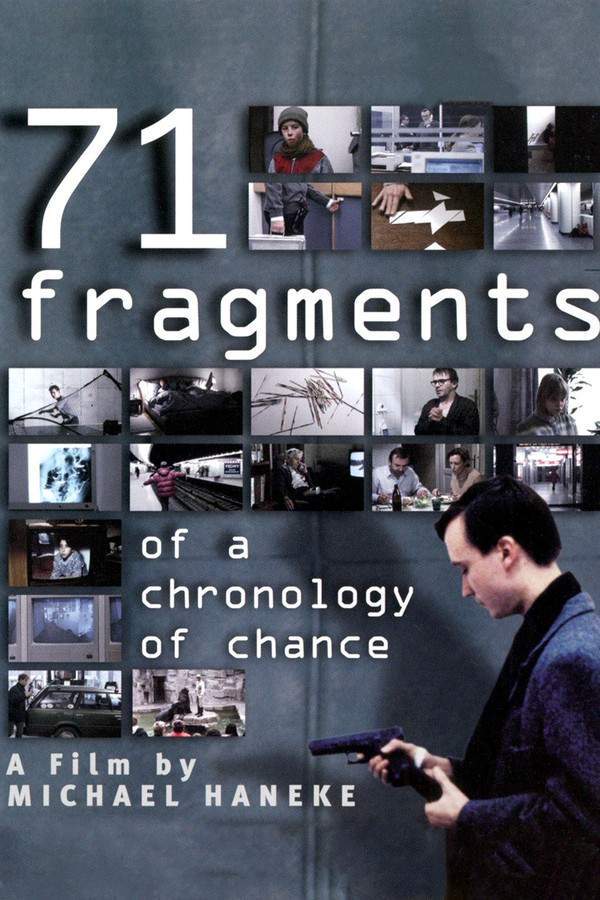







Year: 2005
Runtime: 100 min
Language: German
Director: Michael Haneke
On Christmas Eve, the life of a young man takes a dark turn, leading to a series of escalating events with tragic consequences. A devastating chain reaction unfolds, impacting numerous lives and leaving a lasting mark of sorrow and loss as the night progresses.
Find where to stream, rent, or buy 71 Fragments of a Chronology of Chance (2005) in the US with current JustWatch availability, up-to-date pricing, and platform listings for subscription, rental, and digital purchase options.
Warning: spoilers below!
Haven’t seen 71 Fragments of a Chronology of Chance yet? This summary contains major spoilers. Bookmark the page, watch the movie, and come back for the full breakdown. If you're ready, scroll on and relive the story!
Trace every key event in 71 Fragments of a Chronology of Chance (2005) with our detailed, chronological timeline. Perfect for unpacking nonlinear stories, spotting hidden connections, and understanding how each scene builds toward the film’s climax. Whether you're revisiting or decoding for the first time, this timeline gives you the full picture.
Last updated: November 15, 2024 at 19:05
Find frequently asked questions about the 71 Fragments of a Chronology of Chance (2005) timeline, including chronological order, nonlinear jumps, cause-and-effect links, and scene sequence clarifications. This timeline FAQ helps explain when key events happen, how moments connect, and why the story unfolds in that specific order.
The college student's breakdown is triggered by a combination of frustrations: he's low on cash after finding the ATM out of order, he's in a crowded bank with a long line, and when he tries to jump ahead, another customer aggressively confronts him. These mounting pressures cause him to snap. He retrieves a gun he had previously won in a bet (a stolen pistol) from his car and returns to commit the shooting before taking his own life.
Earlier, the student stakes his watch against a stolen pistol during a game with friends, establishing his access to a weapon.
The characters are connected through chance encounters and proximity on the day of the shooting. The Romanian boy, taken in by an adoptive couple, is left in their car outside a bank where the retired man has come to visit his daughter who works there. The college student, frustrated by the out-of-order ATM, enters the same bank. Their convergence creates the tragic circumstances where the shooting claims multiple lives including the retired man's daughter.
The intertitles at the start reveal the mass killing, hinting that these separate storylines will catastrophically intersect.
After the Romanian boy's story gains media attention, a married couple looking to adopt him takes him in. On the day of the tragedy, the wife leaves him in the car outside the bank while she runs errands. The boy's fate during the shooting is not explicitly shown, but he is present at the location when violence erupts.
The couple's adoption storyline builds throughout the film, creating hope that is shattered when they bring the boy to the site of the massacre.
The film uses a non-linear structure that begins with intertitles describing the mass killing, then unfolds through flashbacks showing the events leading up to it. This approach creates a sense of fatalism and impending doom, turning the entire viewing experience into an examination of how chance circumstances converge to produce tragedy. The audience knows the outcome from the start, which shifts focus from what happens to how and why it happens.
The opening establishes the dark, inevitable tone that pervades the entire narrative.
The retired man visits the bank primarily to see his daughter, who works there. He initially pretends to collect his pension, but his real motivation is connecting with his daughter, who is too busy with work to give him attention. His presence at the bank places him directly in the path of the tragedy.
Earlier scenes show his loneliness and his daughter's neglect, establishing why he seeks her out at her workplace.
The college student stops for gas and finds the ATM out of order, leaving him low on cash. This simple mechanical failure sets off a chain of frustrations. When he enters the crowded bank, his impatience grows as he waits in line, and his confrontation with another customer about cutting ahead becomes the final trigger that leads him to retrieve the gun from his car.
The ATM malfunction is presented as a minor inconvenience that escalates into catastrophic consequences.
The gun the student uses is a stolen pistol that he wins in a bet during a game with friends. During one round of gambling, he stakes his watch against the pistol, demonstrating the reckless youth culture and the normalization of violence among his peer group. This establishes that he has easy access to a weapon.
The game night scene explicitly shows the student acquiring the pistol through gambling.
The married couple in the film is trying to adopt a young girl, representing their desire for family and parenthood. Their struggle to adopt highlights themes of hope and social challenges. When they take in the Romanian boy after his story receives media attention, it appears they may have shifted their adoption efforts toward him, giving the boy a chance at a better life before tragedy strikes.
Their adoption storyline runs parallel to the main narrative, offering a brief glimmer of hope that is ultimately overshadowed by the violence.
The student is not portrayed with a clear political or personal ideological motive. His actions appear to be an impulsive, desperate reaction to accumulated stress and frustration rather than a planned attack. The film presents him as a young man overwhelmed by daily irritations, financial stress, social confrontation, and emotional isolation, who channels his rage into violent action. The randomness of his victims underscores the senseless nature of the tragedy.
The film offers no explicit warning signs, making the violence feel even more random and shocking.
The security worker performs routine pickups at a bank but is depicted separately from the main tragedy. His storyline illustrates the everyday struggles of ordinary people, marital tension, financial stress, and the search for solace through prayer. While present in the bank's environment, he is not directly involved in the shooting itself, representing another threads of urban life intersecting with the central event.
His routine bank work establishes the setting but doesn't directly connect to the shooting.
Discover curated groups of movies connected by mood, themes, and story style. Browse collections built around emotion, atmosphere, and narrative focus to easily find films that match what you feel like watching right now.
Stories where isolated lives collide with devastating and irreversible consequences.If the interconnected tragic narratives of 71 Fragments of a Chronology of Chance gripped you, explore these other movies. This collection features bleak dramas and intense thrillers where disparate urban lives are pulled into a devastating chain of events, leading to a shocking and sorrowful conclusion.
Films in this thread typically unfold through fragmented, non-linear storytelling, juxtaposing the mundane details of various characters' lives. The early establishment of a tragic outcome creates a powerful sense of fatalism. The narrative journey is one of escalating desperation, where small cracks in society widen into chasms, leading to a violent and seemingly preordained ending that highlights the interconnected nature of modern alienation.
These films are grouped together because they share a specific narrative structure and thematic focus. They combine a bleak, oppressive tone with a complex, interweaving plot to explore themes of social breakdown, chance, and violence. The viewing experience is defined by a slow-building tension that erupts into high-intensity tragedy, leaving a heavy emotional residue.
A grim character study tracing an inevitable path towards a tragic, violent act.For viewers affected by the heavy emotional weight and tragic violence in 71 Fragments of a Chronology of Chance, this list offers similar experiences. Discover other dark, high-intensity films that follow a character's bleak journey into despair, culminating in a devastating act that feels both shocking and tragically inevitable.
The narrative pattern follows a central character, often isolated or marginalized, as they experience a series of setbacks and humiliations. The pacing is often variable, beginning with a slow, observational study that allows despair to simmer before accelerating into a tense, fast-paced conclusion. There is a strong emphasis on the psychological process, making the final act of violence feel like a terrible, yet understandable, release of accumulated pressure.
These movies are united by their unflinching focus on a protagonist's psychological collapse and the ensuing violence. They share a dark tone, high emotional intensity, and a narrative that builds towards a sad or bleak ending. The similarity lies in the visceral, heavy feeling of watching a life spiral out of control with catastrophic results.
Don't stop at just watching - explore 71 Fragments of a Chronology of Chance in full detail. From the complete plot summary and scene-by-scene timeline to character breakdowns, thematic analysis, and a deep dive into the ending - every page helps you truly understand what 71 Fragments of a Chronology of Chance is all about. Plus, discover what's next after the movie.
Read a complete plot summary of 71 Fragments of a Chronology of Chance, including all key story points, character arcs, and turning points. This in-depth recap is ideal for understanding the narrative structure or reviewing what happened in the movie.
Discover the characters, locations, and core themes that shape 71 Fragments of a Chronology of Chance. Get insights into symbolic elements, setting significance, and deeper narrative meaning - ideal for thematic analysis and movie breakdowns.
Get a quick, spoiler-free overview of 71 Fragments of a Chronology of Chance that covers the main plot points and key details without revealing any major twists or spoilers. Perfect for those who want to know what to expect before diving in.