Plot Explained Spoilers guaranteed!
Plot Explained

Browse by genre

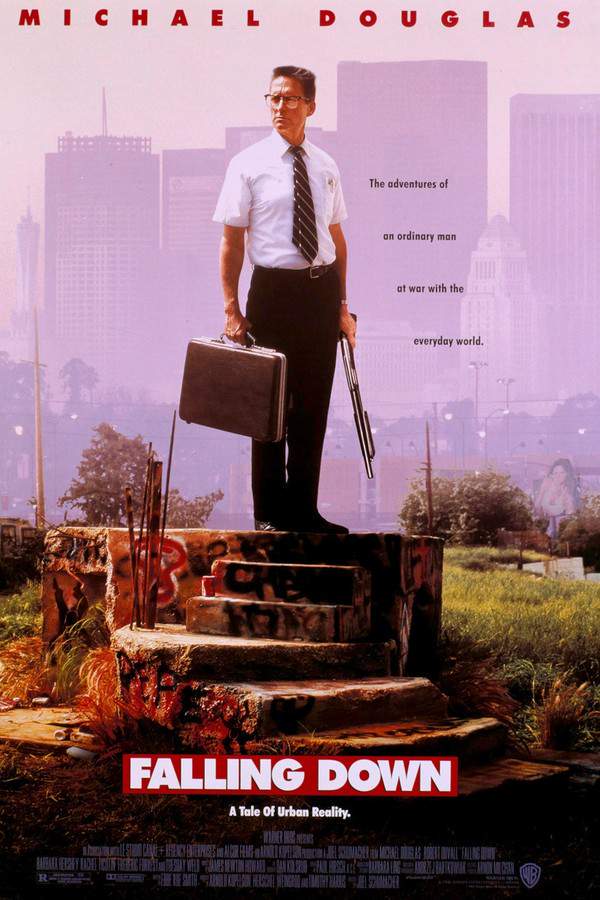
Falling Down (1993) movie poster

Plot Summary

Falling Down (1993) Plot Summary Explained

Release, runtime and language
1993 · 113 min · English
Directed by
Joel Schumacher
Starring
Michael Douglas, Robert Duvall, Barbara Hershey

A recently laid-off man, struggling to buy his daughter a celebratory birthday present, finds himself trapped in a frustrating traffic jam. As his mounting frustration intensifies, he abandons his car and begins a volatile journey through Los Angeles. His desperate attempt to regain control leads him to increasingly erratic behavior, encountering a series of unsettling characters and leaving a trail of disruption and unexpected consequences in his wake.

On this page (6)
  1. 1 Where to watch
  2. 2 What happens: full plot
  3. 3 Plot questions answered
  4. 4 Movie threads
  5. 5 Movies like Falling Down
  6. 6 Every angle

Where to watch

Where to Watch Falling Down (1993)

Where can you watch Falling Down? Stream, rent or buy it in the US, including on YouTube Free, Amazon Video and Apple TV Store: current JustWatch availability with up-to-date prices.

Streaming availability powered by JustWatch

Full plot summary · contains spoilers

What Happens in Falling Down: Full Plot Summary

The whole story of Falling Down (1993) explained, from the opening scene to the final frame: every key event, every twist and what it all adds up to. Read it as a quick recap before the sequel, to check a scene you missed, or to finally understand what really happened.

A deeply troubled man, portrayed by Michael Douglas, finds himself lost in the chaos of Los Angeles traffic on a scorching summer day. Frustrated and desperate, he abandons his car and begins an odyssey westward, determined to reunite with his estranged wife, Beth, and his daughter, Adele. With it being his daughter's birthday, the stakes of his journey could not be higher.

Meanwhile, Detective Prendergast is gearing up for his last day on the force, heading toward retirement. His day takes a turn when he discovers the abandoned vehicle belonging to the man known as D-Fens. Years ago, he had been relegated to a desk job after being pressured by his wife, and now he confronts the turmoil that swirls around D-Fens's erratic actions.

Desperate and short on coins for a phone call, D-Fens enters a Korean convenience store. A simple purchase spirals into chaos when the store owner demands 85 cents for a can of Coke. Angered, D-Fens lashes out, grabbing a baseball bat and wreaking havoc within the store. His rage grows as he pushes on toward Venice Beach, where he encounters two young gang members. In a tense confrontation, he defends himself, injuring one and successfully repelling the other.

As threats from these gangsters loom, D-Fens makes a bold call to his ex-wife, asserting himself as a looming presence at their daughter's birthday celebration. A failed drive-by shooting by the gang leads to further violence, but D-Fens manages to procure a weapon in the ensuing chaos. Haunted by fear and anger, he gives a briefcase, mistakenly believed to be his only means of sustenance, to a panhandler.

In search of food, he visits Whammy Burger, where a minor inconvenience leads him to brandish a submachine gun, causing terror among patrons and forcing the staff to reckon with their failure to meet his expectations. Following another outburst at a payphone, where he becomes enraged after being interrupted, Detective Prendergast begins to piece together the connection between these violent incidents.

Despite D-Fens's ex-wife's concerns, the police dismiss her fears as overblown, with the situation rapidly escalating as D-Fens interacts with various segments of society, leaving destruction in his wake. At one point, he visits an Army-Navy surplus store, where a misunderstanding with the Nazi owner leads to a deadly confrontation, solidifying D-Fens’s impending downfall.

As he ventures into a golf course, he confronts elderly players and expresses his disdain for their frivolities, before taking drastic measures that lead to a heart attack. Struggling with his moral compass, he continues down a reckless path, ultimately aiming for his former house where his ex-wife narrowly escapes.

Prendergast finally unravels the mystery and learns D-Fens's true identity—William Foster, who has lost his job and family. He races against time to stop a potential confrontation between D-Fens and his family. In a tragic climax on a fishing pier, a showdown ensues where D-Fens's tragic motivations are laid bare. As he attempts to regain a semblance of control and seek revenge, Prendergast intervenes, ultimately leading to a heart-wrenching conclusion. The detective acknowledges Foster's grievances about societal inequalities yet cannot condone his violent path. In an agonizing twist, Foster's self-destruction compels Prendergast to reconsider his retirement, suggesting that his fight against chaos is far from over.

Last updated: November 03, 2024 at 14:50

Was this helpful?

Plot questions answered

Falling Down Plot Explained: Your Questions Answered

The questions people ask most about Falling Down (1993): what happens in the confusing scenes, why the characters do what they do, the twists, hidden details and what the ending means. Each answer contains spoilers.

Q1

Why does D-Fens abandon his car in the beginning of the movie?

D-Fens abandons his car because he is trapped in severe Los Angeles traffic on an extremely hot day. He has been sitting in gridlock for hours, is already late for his daughter's birthday, and reaches a breaking point when he realizes he cannot even make a simple phone call to explain his situation. His frustration represents the final straw after losing his job, his family, and his sense of purpose.

Foreshadowing: The opening traffic jam establishes the suffocating feeling of being trapped that defines D-Fens's entire existence.

  • traffic jam
  • los angeles
  • frustration
  • breakdown
  • job loss
Q2

What triggers D-Fens's violent behavior throughout the film?

D-Fens's violence is triggered by cumulative frustration rather than any single event. Each confrontation, starting with the 85-cent Coke controversy at the convenience store, represents the final push from a man who has lost his job, his family, and his place in society. His violence is an extreme expression of feeling invisible, unheard, and powerless against systems and people he perceives as refusing to accommodate his simple needs.

Foreshadowing: The Korean store owner demanding payment for a can of Coke that D-Fens already has creates the first violent outburst.

  • violence
  • frustration
  • mental breakdown
  • alienation
  • job loss
Q3

Why is D-Fens so determined to reach his daughter's birthday party?

D-Fens is determined to reach his daughter's birthday because it represents his last connection to his former life and his identity as a father. The birthday is the one day he still has a legitimate reason to see his family. His job loss and estrangement from his wife have stripped away his sense of self, and reaching Adele on her birthday becomes his way of proving he still matters and can fulfill his role as a father.

Foreshadowing: The timeline establishes that the date being Adele's birthday creates the urgent deadline that fuels his increasingly reckless behavior.

  • daughter
  • adele
  • birthday
  • family
  • estranged wife
  • reconnection
Q4

Why does Detective Prendergast take on this case when he's about to retire?

Prendergast becomes obsessed with the case because it forces him to confront his own failures. Years earlier, he was pushed out of active detective work by his wife, and he has spent years feeling useless at a desk. When he discovers the abandoned car and realizes the growing danger, he sees an opportunity to prove he still matters and do meaningful work before his career ends. The case becomes his final chance at meaningful purpose.

Foreshadowing: Prendergast's discovery of the abandoned vehicle occurs on his last day, setting up his personal redemption arc.

  • prendergast
  • detective
  • retirement
  • last case
  • redemption
Q5

Why does D-Fens pull a weapon at Whammy Burger?

At Whammy Burger, D-Fens is frustrated because the restaurant cannot fulfill his simple order of breakfast food after their stated hours have ended. After being denied service and then interrupted during a phone call by a nagging customer, he explodes. The scene illustrates how his frustration has escalated to the point where any minor rejection triggers an extreme response, as he now believes no one will help him and the only power he has is through intimidation.

Foreshadowing: The Whammy Burger scene follows a pattern of escalating confrontations that began at the convenience store.

  • whammy burger
  • weapon
  • intimidation
  • escalation
  • denial
Q6

Why does D-Fens go to his former house at the end?

D-Fens goes to his former house because it represents everything he has lost, his home, his family, his normal life. By this point in his rampage, he has moved beyond trying to simply attend the birthday party. He is now seeking confrontation with his ex-wife Beth, whom he blames for his current situation. The visit is less about reconciliation and more about forcing acknowledgment of the pain he feels from being abandoned.

Foreshadowing: Earlier scenes establish that Beth left him and took their daughter, creating the resentment that fuels this confrontation.

  • former house
  • ex-wife
  • beth
  • confrontation
  • loss
Q7

What happens at the fishing pier in the final confrontation?

At the fishing pier, D-Fens confronts Prendergast with the gun, and Beth and Adele happen upon the scene. D-Fens's final breakdown reveals his underlying motivation, not to harm his family, but to force his ex-wife to acknowledge his existence and pain. When he realizes his daughter is frightened of him, the recognition that he has become a monster destroys him. He turns the gun on himself rather than harm anyone, choosing self-destruction over further violence.

Foreshadowing: The phone calls throughout the film build toward this confrontation, with D-Fens repeatedly demanding to be heard by his ex-wife.

  • fishing pier
  • final confrontation
  • self-destruction
  • tragic ending
  • beth
  • adele
Q8

Why does D-Fens kill the Nazi owner at the Army-Navy store?

D-Fens kills the store owner because the man makes a Nazi salute and appears to celebrate the violence D-Fens has already committed. When the owner hands him a shotgun and seems to approve of his actions, D-Fens recognizes a sickening mirror, someone celebrating destruction without understanding the human cost. This forces him to confront what he has become, leading him to shoot the owner in horror at being associated with such ideology.

Foreshadowing: The Army-Navy store scene shows D-Fens still possessing a weapon from previous confrontations.

  • nazi
  • army navy store
  • kill
  • moral horror
  • ideology
Q9

What is the significance of D-Fens confronting golfers on the golf course?

D-Fens confronts the golfers because he sees their leisure as obscene while he struggles to survive. He accuses them of ignoring real problems, living in a bubble of privilege while people like him are being crushed by systems. The scene represents his rage at perceived unfairness, how people with money and comfort can ignore those who are struggling. It also triggers his heart attack, showing his body literally cannot handle the stress of his rage.

Foreshadowing: Earlier scenes establish D-Fens's resentment toward people who have what he has lost.

  • golf course
  • privilege
  • class anger
  • heart attack
  • frustration
Q10

Why does Prendergast decide to return to work after the events of the film?

Prendergast decides to return to work because he realizes the case has revealed systemic problems he cannot ignore. He tells his wife that if he retires now, he will spend the rest of his life wondering what else he could have prevented. The tragedy of D-Fens, someone whose legitimate grievances about society led to violence because no one helped him, convinces Prendergast that his work protecting people is not finished.

Foreshadowing: Prendergast's earlier conversation with his wife about retiring shows his uncertainty about leaving the force.

  • prendergast
  • return to work
  • retirement
  • city
  • systemic failure
Q11

What does the name D-Fens mean and where does it come from?

D-Fens is an alias derived from the license plate on his car, D-FENS. The character Bill Foster uses this as a symbol to strip away his identity and become a representative of frustration rather than an individual. By the time anyone investigates, Prendergast must piece together who D-Fens really is, as he has abandoned his own identity in favor of this symbol of anger.

Foreshadowing: The license plate appears in the opening scene when he abandons the car.

  • license plate
  • name
  • d-fens
  • identity
  • bill foster
Q12

Why does Prendergast's wife not want him to pursue the D-Fens case?

Prendergast's wife has spent years pushing him toward a safe, quiet retirement and worries the case will put him in danger or derail their plans. She represents the safe, comfortable life he is supposed to embrace. Her opposition reflects the film’s theme of choosing comfort over confronting difficult truths, a choice that Prendergast ultimately rejects when he returns to work.

Foreshadowing: Early scenes show tension between Prendergast and his wife about his career and future.

  • prendergast
  • wife
  • retirement
  • tension
  • comfort
Q13

How does Prendergast discover D-Fens's real identity?

Prendergast discovers D-Fens's identity by tracing the abandoned vehicle and interviewing people D-Fens encountered. Through these conversations and his ex-wife's description, he pieces together that D-Fens is William Foster, a man who has lost his job at a defense contractor and has been evicted from his home. This revelation gives Prendergast a complete picture of a man who has fallen through every crack in society.

Foreshadowing: The investigation builds throughout the film as Prendergast connects each violent incident.

  • bill foster
  • identity
  • investigation
  • job loss
  • eviction
Q14

Why does the drive-by shooting happen and how does D-Fens get a weapon?

The gang members from Venice Beach attempt a drive-by shooting on D-Fens as retaliation for their earlier confrontation. However, they accidentally shoot a different car, and in the chaos, D-Fens is able to grab a weapon from one of the wounded gang members. This moment shows how violence begets more violence, his earlier confrontation with the gang has now escalated to a potentially fatal attack, and he gains a weapon through this cycle of retaliation.

Foreshadowing: The Venice Beach confrontation establishes the gang as ongoing threats who promise revenge.

  • drive by
  • gang
  • weapon
  • venice beach
  • retaliation

Movie threads

More Movies Like Falling Down, by Mood & Story

Curated lists built around what makes Falling Down tick: the same mood, the same kind of story or the same emotional payoff. Each list explains why these movies belong together.

Urban Descent into Madness Movies Like Falling Down

Single-day journeys through a hostile city that breaks a desperate protagonist. If you liked the intense, single-day journey of Falling Down, you'll find similar movies here. These stories feature protagonists unraveling under urban pressure, with fast pacing, dark tones, and a focus on societal breakdown. They capture the feeling of a city pushing a desperate individual to the edge.

  • unraveling
  • chaotic
  • oppressive
  • desperate
  • rage-filled
  • claustrophobic
  • Tone: dark, oppressive, bleak
  • Pacing: fast, relentless
Why these movies?

The story pattern: These narratives are linear and relentless, often unfolding over a single day. They follow a protagonist who, already under significant stress, is pushed over the edge by the antagonistic nature of the city itself. The journey is a cascade of confrontations that strip away their civility, leading to an inevitable and tragic conclusion.

Why they belong together: These films are grouped by their shared setting as a catalyst for chaos, a fast-paced linear structure, and a deeply dark tone focused on alienation. They create a cohesive experience of watching a person's life violently implode in real-time against a backdrop of urban decay.

Anti-Hero Breakdown Stories Similar to Falling Down

Stories of ordinary men pushed to extreme violence by societal failure. Find movies like Falling Down that explore the theme of the broken everyman. These films feature protagonists who spiral into violence from a place of desperation, creating a heavy emotional weight and a dark, tense tone. They are character studies of men at their absolute breaking point.

  • frustrated
  • rage-filled
  • desperate
  • tragic
  • unraveling
  • tense
  • Tone: dark, tragic, tense
  • Pacing: steady, escalating
Why these movies?

The story pattern: The narrative is a character-driven downward spiral. It begins by establishing the protagonist's relatable grievances (job loss, family issues) to build a shaky empathy. The plot then chronicles their escalating actions, which become increasingly unjustifiable, forcing the audience to grapple with the conflict between understanding their pain and condemning their violence.

Why they belong together: These movies share a core focus on a specific character arc: the tragic, violent unraveling of a frustrated man. They are connected by a heavy emotional weight, a dark tone, and a straightforward narrative that follows the cause and effect of the protagonist's breakdown, making the experience feel coherent and intense.

If you liked this

Movies Like Falling Down

Similar movies to Falling Down: the same genre, themes or kind of story. Each one comes with its own plot summary, timeline and ending explained.

Browse all movie summaries

Every angle

Falling Down (1993) Explained: Plot, Timeline & Characters

Everything about Falling Down in one place: what happens in the plot summary, the timeline in chronological order, the characters and meaning and a spoiler-free summary. What's After the Movie adds the cast, box office and post-credit scenes.

Coming soon on iOS and Android

The Plot Explained Movie Summary App

Plot summaries, endings explained and timelines on your phone. Catch up on any movie in minutes, save your favorites and never miss a twist again.

Be the first to know when we launch. Your email stays private, always.

Learn more about the app