Year: 2007
Runtime: 160 mins
Language: Hindi
Director: Amrit Sagar Chopra
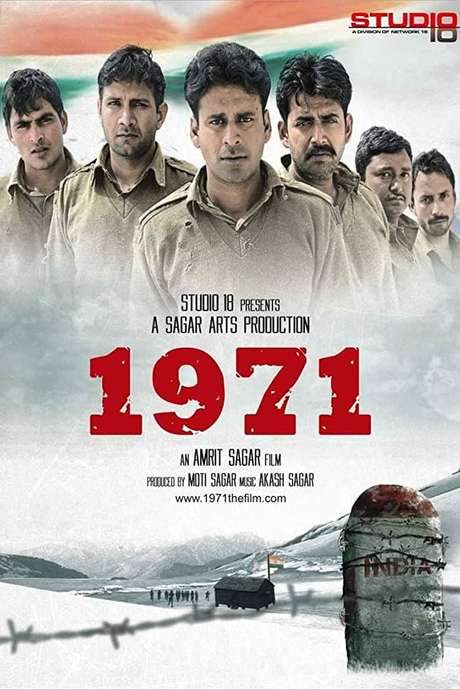
Based on true events, the story follows six courageous soldiers who manage to break free from the grip of the Pakistan Army, undertaking a perilous trek across hostile terrain. Their quest is marked by honor, bravery, and self‑sacrifice as they battle countless dangers to reach home.
Warning: spoilers below!
Haven’t seen 1971 yet? This summary contains major spoilers. Bookmark the page, watch the movie, and come back for the full breakdown. If you're ready, scroll on and relive the story!
Read the complete plot breakdown of 1971 (2007), including all key story events, major twists, and the ending explained in detail. Discover what really happened—and what it all means.
In 1977, Pakistan becomes the setting for a tense chapter in the lives of Indian POWs, six years after the 1971 Indo-Pakistani War. The camp houses veterans from both conflicts, with the 1971 POWs appearing comparatively healthier while the 1965 prisoners have drifted into despair. Among the inmates, Subedar Ahmed, Captain Kabir, Captain Jacob, and Major Suraj Singh reflect on the camp’s supposedly good facilities and the strange comfort they’ve found in a place uprooted from normal life. They’ve been relocated here from a string of Pakistani jails, a detail that underscores the fragile line between survival and surrender.
When dawn breaks, an army truck rolls toward the camp carrying a handful of new prisoners. Among them are Flight Lt. Ram, Flight Lt. Gurtu, and Col. Puri. The group soon realizes they are not far from the Indian frontier, their location pinpointed at Chaklala, a fact that will shape every decision to come. The arrival of Colonel Shakoor at Chaklala adds another layer of command and menace to the unfolding plan, as he informs the POWs that repatriation is the order of the day. He even allows them to watch any movie, a small concession that later triggers a harsher truth—Ahmed seizes a newspaper and discovers the truth behind the “repatriation”—that it’s a fabrication used to hide the prisoners from the Red Cross.
A Ghazal singer is invited to the camp as part of the supposed celebration of 14 August, and the prisoners seize the moment to stage an audacious escape. They forge fake IDs and obtain Pakistani uniforms, using the event as cover for their covert operation. In the ensuing act of sacrifice, Subedar Ahmed sacrifices himself to blow up both the ammunition room and the electrical room, dying in the blast. With Ahmed gone, the remaining five—Captain Kabir, Captain Jacob, Major Suraj Singh, Flight Lt. Ram, and Flight Lt. Gurtu—manage to escape with the singer, who is later revealed to be part of a Pakistani human rights commission. They leave behind a scene of chaos as the Pakistanis mount a massive manhunt, recasting the escaped as common criminals to obscure the truth from the Red Cross.
The hunt intensifies even as the human rights leader and the Red Cross arrive, pressing questions about the missing prisoners. The escapees’ fate weighs heavily: Captain Jacob shoots himself after a grave injury sustained in a hideout, while Flight Lt. Ram shoots Colonel Shakoor and detonates a grenade on himself to destroy more search-party vehicles, enabling the others to slip away. The mission’s moral complexity deepens as the leaders’ deception is revealed to the Red Cross, who find themselves blocked from meaningful progress.
Tragedy punctuates the escape: Captain Kabir sustains a mangled leg while riding a captured motorcycle, only to succumb to frostbite and die peacefully near the Indian border. Major Suraj Singh is killed as he nears the border, his body taken by the Pakistanis, and Flight Lt. Gurtu witnesses Suraj’s death before being recaptured offscreen. The escapees’ status becomes a lingering mystery tied to the wider fate of Indian POWs.
Fast forward to 2007, and the story shifts to Multan Jail in Pakistan. Here, an elderly inmate—revealed to be Flight Lt. Gurtu—tends to five small mounds of earth in the prison yard, placing flowers beside them. He reflects on the sustaining power of hope, insisting that he remains alive because of it. The film closes with a sobering tally: there are still 54 Indian POWs from 1971 unaccounted for in Pakistani jails, their last known status dated back to 1988, a haunting reminder of the unresolved fates that followed the conflict. The narrative leaves the viewer with a quiet, stubborn sense of resilience—hope as a constant undercurrent amid the long shadows of war and captivity.
Last Updated: October 09, 2025 at 15:11
Discover curated groups of movies connected by mood, themes, and story style. Browse collections built around emotion, atmosphere, and narrative focus to easily find films that match what you feel like watching right now.
Desperate escapes across hostile lands, marked by sacrifice and tragedy.If you liked the tense escape and tragic sacrifices in 1971, explore more movies about perilous war survival odysseys. These films share a high-intensity, fast-paced narrative, heavy emotional weight, and a grim perspective on the personal toll of conflict, focusing on desperate journeys across dangerous terrain.
The narrative typically centers on a group or individual forced into a desperate flight for survival. The plot is a linear, often fast-paced sequence of escape, pursuit, and confrontation with overwhelming dangers. The journey is punctuated by loss and sacrifice, leading to a conclusion that is more tragic than triumphant, emphasizing the bleak costs of war.
Movies are grouped here based on their shared high-intensity, fast-paced survival narrative set against the backdrop of war. They consistently feature a tense, grim tone, straightforward plotting focused on a central mission, and emotionally heavy endings that underscore tragedy and sacrifice.
Stories of captivity, resistance, and the grim reality of imprisonment during war.For viewers of 1971 who appreciated its depiction of POW captivity and escape, this list features similar bleak prisoner of war dramas. These films are characterized by a tense, heavy tone, themes of honor and sacrifice, and a focus on the psychological toll and grim realities of military imprisonment.
The narrative pattern revolves around characters enduring the hardships of captivity, often plotting an escape that serves as the story's driving force. Conflict arises from the oppressive captors and the internal dynamics of the prisoner group. The journey is emotionally devastating, frequently exploring themes of sacrifice, duty, and the lasting trauma of war, even in freedom.
These movies are united by their central focus on the prisoner of war experience. They share a consistently tense and grim mood, high emotional weight, and often tragic endings. The setting of confinement and the themes of resilience, sacrifice, and the brutal cost of war create a cohesive viewing experience.
Don't stop at just watching — explore 1971 in full detail. From the complete plot summary and scene-by-scene timeline to character breakdowns, thematic analysis, and a deep dive into the ending — every page helps you truly understand what 1971 is all about. Plus, discover what's next after the movie.
Track the full timeline of 1971 with every major event arranged chronologically. Perfect for decoding non-linear storytelling, flashbacks, or parallel narratives with a clear scene-by-scene breakdown.
Discover the characters, locations, and core themes that shape 1971. Get insights into symbolic elements, setting significance, and deeper narrative meaning — ideal for thematic analysis and movie breakdowns.
Get a quick, spoiler-free overview of 1971 that covers the main plot points and key details without revealing any major twists or spoilers. Perfect for those who want to know what to expect before diving in.
Visit What's After the Movie to explore more about 1971: box office results, cast and crew info, production details, post-credit scenes, and external links — all in one place for movie fans and researchers.
Discover movies like 1971 that share similar genres, themes, and storytelling elements. Whether you’re drawn to the atmosphere, character arcs, or plot structure, these curated recommendations will help you explore more films you’ll love.
1971 (2007) Scene-by-Scene Movie Timeline
1971 (2007) Movie Characters, Themes & Settings
1971 (2007) Spoiler-Free Summary & Key Flow
Movies Like 1971 – Similar Titles You’ll Enjoy
1917 (2019) Story Summary & Characters
1971 (2015) Film Overview & Timeline
D-Day (2013) Detailed Story Recap
Raazi (2018) Detailed Story Recap
Paltan (2018) Plot Summary & Ending Explained
Mission Majnu (2023) Spoiler-Packed Plot Recap
IB 71 (2023) Full Summary & Key Details
Yalghaar (2017) Film Overview & Timeline
1971: Beyond Borders (2017) Detailed Story Recap
Deewaar: Let’s Bring Our Heroes Home (2004) Detailed Story Recap
Bhuj: The Pride of India (2021) Full Summary & Key Details
Shershaah (2021) Movie Recap & Themes
Ora 11 Jon (1972) Spoiler-Packed Plot Recap
Border (1997) Film Overview & Timeline
Pippa (2023) Ending Explained & Film Insights