Plot Explained Spoilers guaranteed!
Plot Explained

Browse by genre

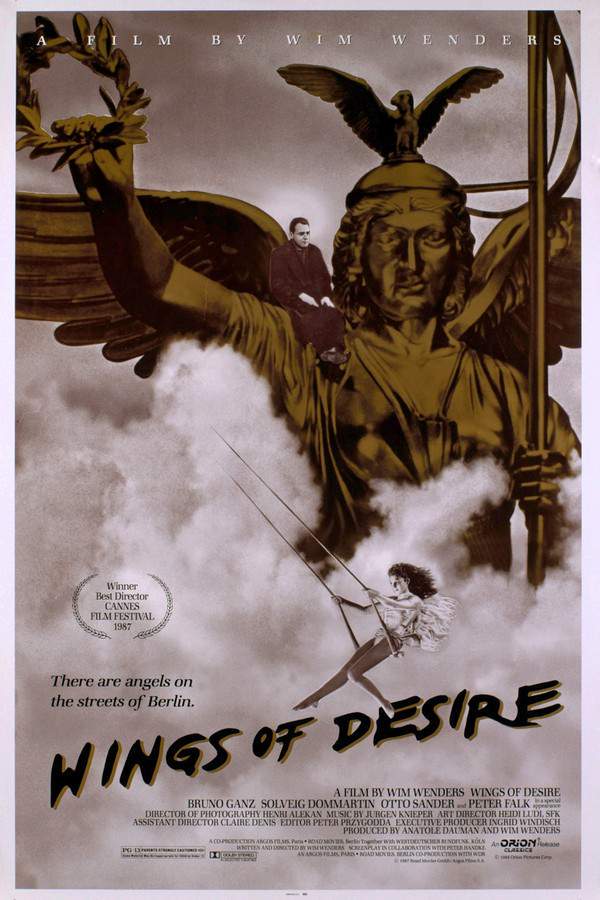
Wings of Desire (1988) movie poster

Plot Summary

Wings of Desire (1988) Plot Summary Explained

Release, runtime and language
1988 · 128 min · German
Loading streaming availability…
Directed by
Wim Wenders
Starring
Peter Falk, Bruno Ganz, Curt Bois, Otto Sander, Solveig Dommartin

In Berlin, the angels Damiel and Cassiel observe humanity, offering comfort and hope to those they encounter. Damiel, however, becomes captivated by Marion, a trapeze artist, and desires to experience the world as a human. Guided by the angel Peter Falk, he contemplates leaving his celestial existence to feel the joys and sorrows of life, ultimately seeking a connection with the woman he loves.

On this page (6)
  1. 1 Where to watch
  2. 2 What happens: full plot
  3. 3 Plot questions answered
  4. 4 Movie threads
  5. 5 Movies like Wings of Desire
  6. 6 Every angle
Loading streaming availability…

Full plot summary · contains spoilers

What Happens in Wings of Desire: Full Plot Summary

The whole story of Wings of Desire (1988) explained, from the opening scene to the final frame: every key event, every twist and what it all adds up to. Read it as a quick recap before the sequel, to check a scene you missed, or to finally understand what really happened.

In a Berlin split by the Berlin Wall, two angels, Damiel and Cassiel, silently observe the city, invisible to its human residents. They listen to the inner thoughts of various Berliners, such as a pregnant woman being rushed to the hospital, a young prostitute loitering on a busy street, and a despondent man who feels betrayed by his spouse. Their purpose in existence, as Cassiel puts it, is to "assemble, testify, preserve" the fabric of reality. These celestial beings have been part of Berlin since its inception, long before the first humans walked its streets.

Among the city's inhabitants, they encounter an elderly man named Homer, who yearns for an "epic of peace". Cassiel trails behind the old man as he searches for the now-demolished Potsdamer Platz, only to find himself confronted by the stark, graffiti-covered Wall. Although Damiel and Cassiel exist solely as watchful spirits, visible only to children and unable to engage with the material world, Damiel finds himself captivated by a deeply lonely circus trapeze artist named Marion. Living in a caravan in West Berlin, she faces the heartbreaking news that her troupe, the Circus Alekan, is shutting down. In her solitude, she dances to the haunting melodies of Crime & the City Solution, aimlessly wandering through the city.

Simultaneously, actor Peter Falk arrives in West Berlin to shoot a film about the city's Nazi history. Once an angel himself, Falk grew weary of the eternal observer's role and chose to embrace the mortal experience. As Damiel grapples with his own desire for a genuine, finite existence, he dreams of Marion. To his astonishment, Falk senses Damiel's presence and shares insights about the joys of human life.

Eventually, Damiel decides to cast off his angelic nature. For the first time, he feels the rush of living: he bleeds, witnesses vibrant colors, enjoys food, and savors coffee. Meanwhile, Cassiel connects with a troubled youth on the brink of suicide. Despite Cassiel's efforts to intervene, he is ultimately powerless to save the young man, leaving him haunted by this harrowing experience. Sensing the turmoil within Cassiel, Falk attempts to reach out, just as he did with Damiel, but Cassiel remains unwilling to abandon his celestial existence.

Eventually, Damiel encounters Marion at a bar during a concert featuring Nick Cave. She warmly acknowledges him and speaks of having finally discovered a love that feels profound and fulfilling. The following day, Damiel reflects on how his moments with Marion have opened his heart to wonder and granted him insights that transcend any celestial knowledge.

Last updated: November 16, 2024 at 14:41

Was this helpful?

Plot questions answered

Wings of Desire Plot Explained: Your Questions Answered

The questions people ask most about Wings of Desire (1988): what happens in the confusing scenes, why the characters do what they do, the twists, hidden details and what the ending means. Each answer contains spoilers.

Q1

Why does Damiel want to become human?

Damiel falls in love with Marion, a lonely trapeze artist living in West Berlin. After witnessing her deep loneliness and discovering her through his observations, he feels a profound desire to experience human emotions, sensations, and connections firsthand rather than merely watching from afar. His conversations with Peter Falk, a former angel now living as a human, convince him that the joys and sorrows of mortal life are worth embracing.

Foreshadowing: Damiel's fascination with Marion begins early in the film as he watches her dance alone in her caravan.

  • damiel
  • marion
  • love
  • transformation
  • desire for humanity
Q2

How does Peter Falk sense Damiel's presence?

Peter Falk was once an angel himself before choosing to become human. He grew weary of the eternal observer role and embraced mortal existence. Because of his former nature, he retains the ability to sense when angels are nearby, allowing him to recognize Damiel's invisible presence and engage with him directly.

Foreshadowing: Falk's arrival in Berlin to shoot a film about the city's Nazi history marks his return to a place significant to celestial observers.

  • peter falk
  • angel
  • former angel
  • sense
  • human life
Q3

What happens to Cassiel and the troubled youth?

Cassiel encounters a young man on the brink of suicide and attempts to intervene, but as an angel, he has no physical form and cannot meaningfully interact with the material world. Despite his efforts to guide and comfort the youth, the young man takes his own life, leaving Cassiel traumatized by his powerlessness.

Foreshadowing: The scene occurs after Damiel has already left, highlighting Cassiel's continued struggle with his role as an observer.

  • cassiel
  • suicide
  • youth
  • powerlessness
  • celestial existence
Q4

Why are angels invisible to most humans?

Angels exist as purely spiritual beings in the film, capable only of observing and listening to human thoughts. They have no physical form and cannot directly interact with the material world. Only children can see them, while adults remain completely unaware of their constant presence.

Foreshadowing: This limitation is established from the opening scenes as the angels walk invisibly through Berlin.

  • angels
  • invisible
  • spiritual beings
  • observation
  • children
Q5

Why is Marion's circus closing down?

Marion performs as a trapeze artist with Circus Alekan, which is shutting down. This closure leaves her deeply isolated, living alone in a caravan in West Berlin. The loss of her troupe intensifies her loneliness, making her vulnerable to the profound sense of disconnection that Damiel observes and is drawn to.

Foreshadowing: Marion's vulnerability is established early when she dances alone to mournful music in her caravan.

  • marion
  • circus alekan
  • trapeze artist
  • loneliness
  • closure
Q6

What does Damiel experience after becoming human?

When Damiel sheds his angelic nature, he gains a physical body for the first time. He experiences sensations he'd never known: he bleeds when cut, sees colors as vivid and beautiful, tastes food and coffee, and feels the full emotional weight of human existence. These simple experiences become profound sources of wonder.

Foreshadowing: Damiel's conversations with Falk about the joys of human life foreshadow this transformation.

  • damiel
  • human experience
  • transformation
  • sensations
  • colors
Q7

How does Damiel meet Marion at the concert?

Damiel encounters Marion at a bar where Nick Cave is performing. Since he is now human, she can see and recognize him. During their conversation, Marion tells him she has finally found a love that feels deep and genuine, creating a poignant moment of connection that validates Damiel's choice to become mortal.

Foreshadowing: This meeting fulfills Damiel's journey from silent observer to active participant in life.

  • nick cave
  • concert
  • marion
  • meeting
  • love
Q8

What does Cassiel mean by assemble, testify, preserve?

Cassiel explains that the angels' purpose is to "assemble, testify, preserve" the fabric of reality. This phrase captures their role as eternal witnesses to human existence, observing and documenting human lives, emotions, and moments to preserve the intangible fabric of human experience throughout history.

Foreshadowing: This philosophical statement appears early when the angels are introduced.

  • assemble testify preserve
  • purpose
  • celestial
  • meaning
  • existence
Q9

What is the significance of the Berlin Wall in the film?

The Berlin Wall serves as a powerful symbol of division and isolation that mirrors the angels' own separation from human connection. The film is set in Berlin when the Wall still stands, and characters like Homer search for lost places like Potsdamer Square, confronting the physical and emotional barriers that divide people.

Foreshadowing: Homer's quest to find Potsdamer Platz directly confronts the reality of the divided city.

  • berlin wall
  • division
  • symbolism
  • isolation
  • potsdamer platz
Q10

Why does Cassiel stay an angel instead of becoming human?

Unlike Damiel, Cassiel cannot bring himself to abandon his celestial existence. After his traumatic experience failing to save the suicidal youth, he remains haunted by his powerlessness but chooses not to leave his role as an observer. Falk attempts to guide him as he did Damiel, but Cassiel rejects the path toward humanity.

Foreshadowing: Cassiel's attachment to his role is tested throughout, especially after the tragedy with the youth.

  • cassiel
  • angel
  • remain
  • choice
  • observation

Movie threads

More Movies Like Wings of Desire, by Mood & Story

Curated lists built around what makes Wings of Desire tick: the same mood, the same kind of story or the same emotional payoff. Each list explains why these movies belong together.

Movies about celestial beings yearning for humanity like Wings of Desire

Celestial beings who long to experience the bittersweet joys of earthly life. For viewers who loved the poetic longing in Wings of Desire, this collection features similar movies where angels, gods, or other eternal beings desire to experience the simple, profound sensations of mortal life. These films explore themes of love, loss, and the bittersweet beauty of existence.

  • yearning
  • existential
  • poetic
  • serene
  • dreamlike
  • contemplative
  • Tone: melancholic, bittersweet
  • Pacing: slow, atmospheric
Why these movies?

The story pattern: Stories in this thread typically follow a being from a higher plane of existence who becomes captivated by the human experience. The central conflict is an internal one—a struggle between their known, peaceful state and the irresistible pull of sensory, emotional human life. The journey culminates in a choice or transformation that is both a gain and a profound loss.

Why they belong together: Movies are grouped here for their shared tone of gentle melancholy and existential wonder. They prioritize mood and philosophical inquiry over fast-paced plots, often featuring slow pacing, poetic visuals, and a deep emotional core centered on the theme of 'falling to earth'.

Movies about urban loneliness and quiet connection like Wings of Desire

Introspective stories of isolated individuals finding meaning in a vast city. If you appreciated the quiet observation of city life in Wings of Desire, this thread collects films that capture a similar vibe. These movies focus on the existential loneliness of urban dwellers and the fleeting, meaningful connections that bring solace, often with a slow, contemplative pace.

  • lonely
  • contemplative
  • serene
  • existential
  • urban
  • isolated
  • Tone: melancholic, contemplative
  • Pacing: slow, observational
Why these movies?

The story pattern: These narratives are often mosaic-like, weaving together the perspectives of multiple characters who are physically close but emotionally distant. The plot is secondary to the mood, unfolding through vignettes of daily life. The central theme is the search for meaning and human connection within the isolating anonymity of a large city.

Why they belong together: These films are united by a specific mood: a serene, almost documentary-like observation of urban existence combined with a deep sense of melancholy and poetic introspection. They share a slow pacing that allows the audience to soak in the atmosphere and empathize with the characters' inner worlds.

If you liked this

Movies Like Wings of Desire

Similar movies to Wings of Desire: the same genre, themes or kind of story. Each one comes with its own plot summary, timeline and ending explained.

Browse all movie summaries

Every angle

Wings of Desire (1988) Explained: Plot, Timeline & Characters

Everything about Wings of Desire in one place: what happens in the plot summary, the timeline in chronological order, the characters and meaning and a spoiler-free summary. What's After the Movie adds the cast, box office and post-credit scenes.

Coming soon on iOS and Android

The Plot Explained Movie Summary App

Plot summaries, endings explained and timelines on your phone. Catch up on any movie in minutes, save your favorites and never miss a twist again.

Be the first to know when we launch. Your email stays private, always.

Learn more about the app