Plot Explained Spoilers guaranteed!
Plot Explained

Browse by genre

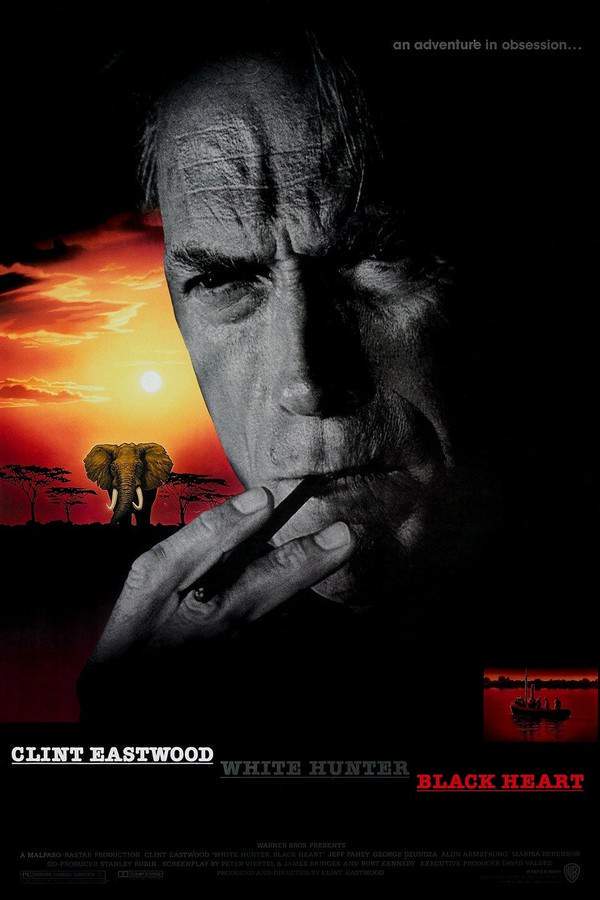
White Hunter Black Heart (1990) movie poster

Plot Summary

White Hunter Black Heart (1990) Plot Summary Explained

Release, runtime and language
1990 · 112 min · English
Loading streaming availability…
Starring
Clint Eastwood, Jeff Fahey, George Dzundza, Charlotte Cornwell, Catherine Neilson, Edward Tudor-Pole

In 1950s Zimbabwe, a driven film director, John Wilson, and his screenwriter, Pete Verrill, journey into the wilderness to shoot a film. Wilson becomes obsessed with filming a magnificent elephant, pushing himself and his crew to extreme lengths. As they venture deeper, the pursuit of the perfect shot tests the boundaries of Wilson's artistic vision and forces him to grapple with the ethical implications of his actions.

On this page (6)
  1. 1 Where to watch
  2. 2 What happens: full plot
  3. 3 Plot questions answered
  4. 4 Movie threads
  5. 5 Movies like White Hunter Black Heart
  6. 6 Every angle
Loading streaming availability…

Full plot summary · contains spoilers

What Happens in White Hunter Black Heart: Full Plot Summary

The whole story of White Hunter Black Heart (1990) explained, from the opening scene to the final frame: every key event, every twist and what it all adds up to. Read it as a quick recap before the sequel, to check a scene you missed, or to finally understand what really happened.

As the early 1950s unfolded, Pete Verrill found himself receiving an unexpected invitation from an old friend, John Wilson, the celebrated director behind The African Trader. Wilson's persuasive pitch managed to sway producer Paul Landers into making a bold decision: to film the entire project on location in Africa, accepting the steep costs involved. However, unbeknownst to everyone else, Wilson's real motive was not the film's success but his deep-rooted passion for African safaris—a desire so intense that he even splurged on an impressive collection of finely crafted hunting rifles, conveniently billed to the studio.

Upon reaching Entebbe, Wilson and Verrill settled into a lavish hotel for several days while Verrill worked on finalizing the script and Wilson prepared for his much-anticipated safari. Verrill couldn’t help but appreciate Wilson's unapologetic character, which was evident when he stood up for Verrill against a guest's antisemitic insults, as well as when he confronted the hotel manager over his unjust treatment of a black waiter. A series of animated discussions ensued, particularly regarding Verrill's insistence that Wilson reconsider his initial vision of a grisly ending where the principal characters faced their doom.

Soon, Wilson employed a pilot to ferry himself and Verrill to the hunting camp of safari guide Zibelinsky and his tracker Kivu. It was here that Wilson quickly forged a connection with the pair, much to Verrill's frustration. The film's unit director, Ralph Lockhart, also made an appearance, stressing the need for Wilson to kick off pre-production before the cast's arrival—a suggestion that flared up Wilson's typical disregard as he obsessively sought after a prized "tusker". As the absurdity of Wilson's antics became clearer to Verrill, doubts swirled in his mind about the morality of hunting such magnificent creatures.

Tensions boiled over between Wilson and Verrill, culminating in a pointed attack from Wilson who accused Verrill of playing it too safe and avoiding risks. Wilson's harsh evaluation of hunting as a "sin that can be licensed" met with a cold silence from Verrill, who ultimately faced an ultimatum: stay on the project or return to London. Meanwhile, Landers came to Entebbe brandishing dire news—the looming threat of bankruptcy if the film's completion faltered. Upon returning, Verrill encountered a shocking revelation from Lockhart: Wilson had rashly decided to shift the entire production to Kivu's village, despite Landers' careful allocation of funds for a set.

As the cast and crew begrudgingly departed their hotel, they arrived at Zibelinsky's camp, welcomed by an extravagant feast that Wilson had arranged. Despite the opulence, the mood was strained, with Landers experiencing public humiliation while Wilson seized the moment to thrive in his safari pursuits. Responding to Wilson's jibes of cowardice, Verrill reluctantly chose to join. However, when Wilson finally had the chance to take down the enormous tusker, he hesitated, unable to pull the trigger. The elephant, sensing her young nearby, charged, and Kivu's brave attempt to intervene turned fatal as he fell victim to the tusker's deadly tusks.

Consumed by guilt and horror over Kivu's tragic fate, Wilson returned to the set to find a somber air hanging heavily over everyone. The rhythmic drumming from the villagers underscored the weight of what had happened: "white hunter, black heart." Recognizing his role in the tragedy, Wilson turned to Verrill, acknowledging that the film indeed needed a happier conclusion. As he settled back into his director's chair, beset by the anticipatory energy of the crew and actors gearing up for the first scene of The African Trader, Wilson's earlier bravado gave way to a sobering sense of reflection, punctuated only by his quiet instruction: > "Action."
Last updated: November 18, 2024 at 20:28

Was this helpful?

Plot questions answered

White Hunter Black Heart Plot Explained: Your Questions Answered

The questions people ask most about White Hunter Black Heart (1990): what happens in the confusing scenes, why the characters do what they do, the twists, hidden details and what the ending means. Each answer contains spoilers.

Q1

Why did John Wilson push so hard to film in Africa?

Wilson's real motivation for filming in Africa had nothing to do with the movie's success. He was secretly using the production as a cover for his true passion: going on an African safari. He was so obsessed with hunting that he even bought expensive hunting rifles billed to the studio, using the film project as a pretense to fulfill his personal desires.

Foreshadowing: Wilson's obsessive focus on hunting a prized elephant during the production hints at his true intentions from the start.

  • john wilson
  • africa
  • safari
  • hunting
  • motivation
  • film production
Q2

Why did Wilson defend Pete Verrill against the antisemitic hotel guest?

Despite his moral failings as a hunter, Wilson demonstrated a complex character by standing up against injustice when he witnessed a fellow hotel guest making antisemitic remarks toward Verrill. He also confronted the hotel manager over unfair treatment of a black waiter, showing that he had a strong sense of justice toward certain wrongs, even if his own actions elsewhere were ethically compromised.

Foreshadowing: This display of moral clarity makes Wilson's later hunting obsession and its tragic consequences even more contradictory.

  • antisemitism
  • john wilson
  • pete verill
  • character
  • justice
Q3

Why did Wilson decide to move the entire film production to Kivu's village?

Wilson made this impulsive decision without consulting producer Paul Landers, who had carefully allocated funds for a constructed film set. Wilson disregarded the financial consequences and chose to relocate production simply because it suited his personal hunting ambitions, placing his private desires above the film's practical and economic needs.

Foreshadowing: This reckless decision directly leads to the tragic hunting expedition that costs Kivu his life.

  • production
  • kivu village
  • paul landers
  • wilson decision
  • film set
Q4

Why did Wilson hesitate to shoot the tusker elephant when he had the chance?

When Wilson finally confronted the magnificent tusker, something stopped him from pulling the trigger. The exact reason isn't explicitly detailed in the summary, but his hesitation suggests a moment of moral reckoning or perhaps a glimmer of conscience about what he was about to do, especially given his awareness of the crew's disapproval and the growing absurdity of his obsession.

Foreshadowing: His hesitation directly triggers the tragedy, as the elephant senses danger and charges.

  • tusker
  • elephant
  • hesitation
  • hunting
  • moment of decision
Q5

Why did the elephant charge and kill Kivu?

The elephant charged because she sensed her young calf nearby and perceived Wilson as a threat. When Wilson hesitated to shoot, the tusker took advantage of the situation and attacked. Kivu attempted to intervene to protect Wilson, but the elephant's deadly tusks struck him down, resulting in his tragic death.

Foreshadowing: Earlier scenes establish Kivu's loyalty and bond with Wilson, making his fatal intervention heartbreakingly predictable.

  • elephant
  • charge
  • kivu
  • tusker
  • death
  • calf
Q6

Why did Wilson suddenly agree to change the film's ending after Kivu's death?

Consumed by guilt and horror over Kivu's preventable death, Wilson recognized that his obsession had caused an innocent man's demise. He approached Verrill and acknowledged that the film needed a happier conclusion, admitting that his original grisly ending, where principal characters face their doom, no longer felt justified given the tragedy that had just unfolded on set.

Foreshadowing: This反转 directly connects to the earlier debate between Verrill and Wilson about the film's dark ending.

  • ending
  • change
  • guilt
  • wilson
  • verill
  • film conclusion
Q7

What does the phrase 'white hunter, black heart' signify in the film?

The phrase 'white hunter, black heart' serves as a haunting judgment of Wilson's character. After Kivu's death, the villagers' rhythmic drumming echoes these words, symbolizing the moral verdict on Wilson: despite his white colonial status and role as a hunter, his pursuit of personal pleasure over ethical boundaries has revealed his corrupted soul. The phrase encapsulates the film's critique of colonial exploitation and artistic hubris.

Foreshadowing: The title itself foreshadows this final judgment that comes after the hunting tragedy.

  • white hunter black heart
  • phrase
  • meaning
  • theme
  • judgment
Q8

Why did Wilson threaten to fire Pete Verrill from the project?

Wilson accused Verrill of playing it too safe and avoiding risks, calling hunting 'a sin that can be licensed' in a heated confrontation. The argument escalated to the point where Wilson gave Verrill an ultimatum: stay on the project or return to London. This conflict represented the clash between Wilson's ruthless pursuit of his desires and Verrill's moral sensibilities.

Foreshadowing: This confrontation intensifies the tension that builds toward the tragic hunting expedition.

  • pete verill
  • firing
  • conflict
  • ultimatum
  • disagreement
Q9

Why did producer Paul Landers come to Entebbe in person?

Landers traveled to Entebbe to deliver alarming news: the film was in serious financial trouble and risked bankruptcy if production didn't proceed smoothly. His visit underscored the high stakes involved, yet Wilson remained indifferent to these concerns, continuing to prioritize his hunting obsession over the film's viability.

Foreshadowing: Landers' warning about bankruptcy makes Wilson's reckless decision to move production to Kivu's village even more irresponsible.

  • paul landers
  • entebbe
  • bankruptcy
  • producer
  • financial trouble
Q10

What caused the escalating conflict between Wilson and Verrill throughout the journey?

The conflict stemmed from Verrill's growing realization that Wilson's true interest lay in hunting, not making the film. As Wilson neglected his directorial duties to obsessively pursue the tusker and made increasingly irresponsible production decisions, Verrill questioned the morality of their expedition. Wilson viewed Verrill's concerns as cowardice, leading to mutual resentment that festered from their arrival in Entebbe through the hunting camp.

Foreshadowing: The tension builds from their first days in Entebbe, with Wilson's safari preparations causing early friction.

  • conflict
  • tension
  • wilson
  • verill
  • disagreement
  • relationship

Movie threads

More Movies Like White Hunter Black Heart, by Mood & Story

Curated lists built around what makes White Hunter Black Heart tick: the same mood, the same kind of story or the same emotional payoff. Each list explains why these movies belong together.

Moral Collapse Movies like White Hunter Black Heart

Stories about ambition curdling into destructive, single-minded obsession. Find more movies like White Hunter Black Heart that explore the dangerous line between ambition and obsession. These films feature protagonists whose unwavering drive leads to ethical decay and personal tragedy, perfect for viewers who appreciate heavy, character-driven dramas about moral collapse.

  • obsessive
  • somber
  • moral conflict
  • intense
  • reckless
  • sobering
  • Tone: dark, sobering, morally complex
  • Pacing: steady, methodical build
Why these movies?

The story pattern: Stories in this thread typically follow a linear descent, charting how a character's initial admirable goal becomes corrupted by pride and hubris. The central conflict is internal and external, pitting the character's obsession against their morality and the well-being of those around them, often culminating in a preventable tragedy that serves as a sobering climax.

Why they belong together: These films are grouped by their shared focus on a protagonist's psychological unraveling. They share a dark, intense tone, a steady pacing that builds dread, and a heavy emotional weight stemming from the consequences of the character's actions, creating a coherent experience of tragic ambition.

Wilderness Survival Dramas like White Hunter Black Heart

Journeys into untamed nature that test characters' moral boundaries. If you liked the African safari setting and moral tensions of White Hunter Black Heart, explore these similar movies. This collection features intense dramatic journeys into hostile wilderness environments where characters face profound ethical tests and the consequences of their actions in a raw, unforgiving world.

  • moral conflict
  • intense
  • sobering
  • atmospheric
  • isolated
  • consequential
  • Tone: dark, tense, morally ambiguous
  • Pacing: steady, journey-like
Why these movies?

The story pattern: The narrative pattern involves characters entering a wild, often colonial or frontier setting, where the rules of civilization are blurred. The central conflict arises from the clash between their goals—be it artistic, commercial, or survivalist—and the ethical implications of their actions within this vulnerable ecosystem, leading to a bittersweet or tragic reckoning.

Why they belong together: Movies in this thread share a specific vibe defined by a formidable natural setting, a steady pacing that mirrors a journey, and a high-stakes moral conflict. The combination of a dark tone, intense personal drama, and the thematic focus on man versus nature (and his own nature) creates a distinct grouping.

If you liked this

Movies Like White Hunter Black Heart

Similar movies to White Hunter Black Heart: the same genre, themes or kind of story. Each one comes with its own plot summary, timeline and ending explained.

Browse all movie summaries

Every angle

White Hunter Black Heart (1990) Explained: Plot, Timeline & Characters

Everything about White Hunter Black Heart in one place: what happens in the plot summary, the timeline in chronological order, the characters and meaning and a spoiler-free summary. What's After the Movie adds the cast, box office and post-credit scenes.

Coming soon on iOS and Android

The Plot Explained Movie Summary App

Plot summaries, endings explained and timelines on your phone. Catch up on any movie in minutes, save your favorites and never miss a twist again.

Be the first to know when we launch. Your email stays private, always.

Learn more about the app