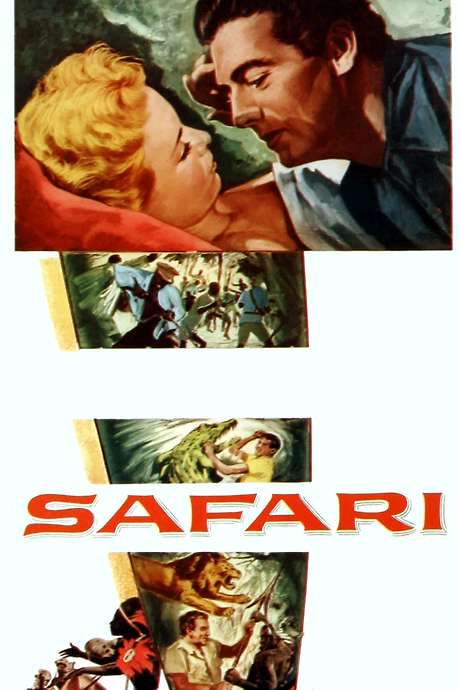
Ken Duffield [Victor Mature] is an American white hunter who leads a safari when Mau Mau rebels strike his farm, slaughtering the labourers and his livestock. The brutal assault leaves Duffield’s young son Charley [John Wynn] and Aunt May [Estelle Brody] defending the ruined homestead, but they are unaware that Jeroge [Earl Cameron], the houseboy who shelters inside, is actually a Mau Mau general. In the chaos that follows, Jeroge murders Aunt May with a machete and Charley is killed by May’s rifle, leaving Duffield to return to a scene of devastation and loss.
Back at the wrecked homestead, the police have uncovered Jeroge’s true role in the massacre. They fear Duffield will seize the chance to pursue vengeance against the terrorists, especially Jeroge, and they escort him back to Nairobi while revoking his hunting licence until the tension subsides. Duffield slips into exile in the city, drinking and piecing together information from his African friends about Jeroge and the broader Mau Mau movement.
Duffield’s opportunity for revenge arrives when Sir Vincent Brampton [Roland Culver], accompanied by his flunky Brian Sinden [John Justin] and his young American fiancée Linda Latham [Janet Leigh], arrives in Nairobi to hire him for a dangerous safari. Sir Vincent is determined to hunt a legendary man-eating lion named Hatari and wants the glory of the kill, while Sir Vincent’s influence could help Duffield regain his licence. Duffield understands that Hatari has a predator’s domain in the Maasai lands—an area where Jeroge is known to frequent—and he senses that aligning with Sir Vincent could rekindle his own standing in the hunting world.
The expedition sets off with Duffield’s young assistant Jerusalem [Orlando Martins] and Odongo [Juma] in tow as the safari party heads toward Hatari’s terrain. Sir Vincent’s suspicion about Duffield’s true motives grows when the hunter carries a Sten gun, and Duffield’s readiness to join the local police in a firefight against Mau Mau prisoners reinforces the tension. Duffield later explains, “You never know what kind of animals you may find.”—a line that signals the uneasy blend of sport, danger, and moral ambiguity that threads through the journey.
As the safari pushes deeper into the Maasai country, Duffield keeps his promise to guide Sir Vincent toward Hatari’s haunt, and the party witnesses a traditional Maasai lion hunt in the area. Yet the mission is jeopardized by a police radio report revealing that one member of the safari is a Mau Mau plant, a revelation that sows suspicion among the group. Linda, curious and bold, takes a separate excursion down a crocodile-infested river in a rubber dinghy, while a second radio message warns that as many as 200 Mau Mau prisoners have escaped and are converging on Duffield’s safari to join Jeroge.
The situation escalates when Sir Vincent becomes so fixated on killing Hatari that he fires at Duffield, turning the hunt into a volatile confrontation. Then Hatari itself makes a dramatic appearance, looming on a ledge before pouncing. The lion is killed, but not before fatally wounding Sir Vincent, leaving Duffield and the rest to contend with the fallout. In the climactic sequence, the group, aided by local police, must defend themselves against a renewed Mau Mau assault, and Duffield’s Sten gun becomes a crucial tool in repelling the attackers.
In the end, the tale blends man’s hunger for conquest with the harsh realities of colonial conflict. Duffield confronts his own impulses for revenge, Sir Vincent’s obsession with sole credit for Hatari’s death ends in tragedy, and the surviving characters unite to protect themselves from the renewed Mau Mau threat. The film closes on a note of grim resilience amid the savanna’s sweeping landscape, where duty, danger, and the lure of the hunt intersect in a history that is as fraught as it is dramatic.