





Plot Explained Spoilers guaranteed!
Plot Explained

Browse by genre

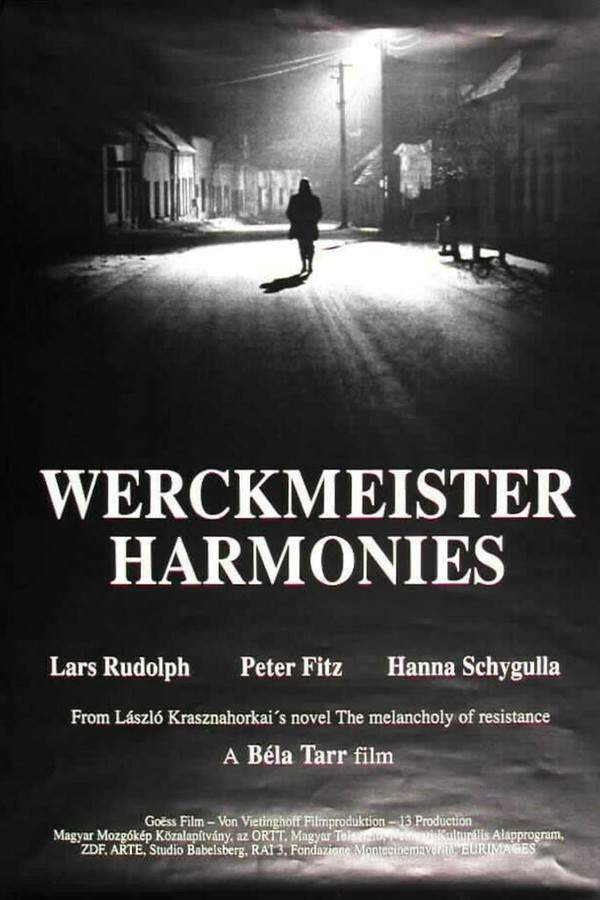
Werckmeister Harmonies (2001) movie poster

Timeline

Werckmeister Harmonies (2001) Timeline Explained – Every Event in Order

Release, runtime and language
2001 · 145 min · Unknown language
JustWatch #8,098 21
Directed by
Ágnes Hranitzky, Béla Tarr
Starring
Lars Rudolph, Peter Fitz

In a small Hungarian village teetering on the edge of turmoil, the unexpected arrival of a mysterious circus ignites a wave of unsettling emotions. The circus features a giant whale and rumors of a reclusive Prince possessing unusual powers. As anticipation builds, the villagers’ hidden desires and deepest fears are stirred, leading to a chaotic and unpredictable atmosphere.

On this page (7)
  1. 1 Where to watch
  2. 2 Events in order (15)
  3. 3 Timeline questions answered
  4. 4 The book behind the movie
  5. 5 Movie threads
  6. 6 Movies like Werckmeister Harmonies
  7. 7 Every angle

Where to watch

Where to Watch Werckmeister Harmonies (2001)

Where can you watch Werckmeister Harmonies? Stream, rent or buy it in the US, including on Klassiki, Amazon Video and Apple TV Store: current JustWatch availability with up-to-date prices.

Streaming availability powered by JustWatch

15 events in order · contains spoilers

Werckmeister Harmonies Timeline: Events in Chronological Order

Every key event of Werckmeister Harmonies (2001) in order, scene by scene, with when and where it takes place. Use it to untangle flashbacks, time jumps and parallel storylines, to refresh your memory before the sequel or to find the exact scene you are thinking of.

  1. The Solar Eclipse Performance

    In a stark winter setting, János Valuska, a young newspaper delivery man, captivates a rowdy crowd of drunken patrons. He performs a dramatic act about a total eclipse of the sun, which momentarily disrupts the animals of the town, culminating in a powerful return of sunlight that brings brief warmth to the bleak surroundings.

    When
    Winter
    Where
    Unnamed Town, Hungary
  2. Bond with Uncle György

    János shares a special bond with György Eszter, his uncle, who assumes a paternal role in his life. György, a thoughtful composer and musicologist, passionately documents his musings on the flaws of the musical scale, drawing upon Werckmeister's theories to suggest more organic ways to harmonize music.

  3. Whispers of Trouble

    During a routine visit to the post office to collect his newspapers, János overhears the worried employees discussing the looming arrival of a traveling circus. They express their fears that the circus's presence often stirs up tension and unrest within the community, foreshadowing the chaos to come.

    Where
    Post Office
  4. Arrival of the Circus

    That night, the peculiar circus arrives in the town, introducing a massive, lifelike stuffed whale and a mysterious star performer known only as 'The Prince.' János watches the surreal happenings unfold, contemplating deep philosophical questions about existence as the townspeople become increasingly captivated and agitated.

    When
    Night
    Where
    Circus
  5. Tünde's Manipulation

    György's estranged wife, Tünde, aggressively manipulates her social status to convince him to lead the 'Clean Up the Town' movement. She threatens to move back in with him if he refuses, sending her suitcase ahead with János as a messenger, further complicating the already strained family dynamics.

  6. The Town Square Outcry

    György's brother, Uncle Lajos, takes it upon himself to communicate Tünde’s demands to a growingly agitated crowd in the town square. His efforts inflame their anger over declining public services, setting the stage for the mounting unrest among the townsfolk.

    Where
    Town Square
  7. Tension at the Circus

    As János experiences the oppressive atmosphere tightening around him, he encounters a thug outside the circus, heightening his sense of danger. Meanwhile, Tünde is seen forging a troubling alliance with the intoxicated police chief, further entwining her fate with the town's turmoil.

    Where
    Circus
  8. Riot Breaks Out

    The circus's arrival, especially the spectacle of the whale and 'The Prince,' ignites a chaotic riot among the townsfolk. János overhears the panicked circus master struggling to manage the mute Prince, who conveys rebellious ideas through a translator, escalating the crowd’s fervor and sense of mob mentality.

    Where
    Circus
  9. Hospital Invasion

    Amid the riots, the frenzied crowd breaks into a local hospital, where they brutally attack defenseless patients. The violence halts only when the crowd is confronted by a haunting reminder of their despair—the sight of an old, vulnerable man, forcing them to reckon with the consequences of their actions.

    Where
    Hospital
  10. Discovery of the Diary

    After the chaos subsides, János finds a diary belonging to one of the rioters, revealing their confusion and unresolved anger towards the bleak reality of their lives. The diary includes tragic accounts of the horrors faced by two young women, deepening the sense of despair pervading the town.

  11. Tünde's Treachery

    János witnesses a secretive encounter between Tünde and a military official, culminating in their departure in a military vehicle along with armed forces. This shocking display highlights Tünde's alignment with authority and her betrayal of György.

  12. Lajos's Death

    János learns of the tragic death of Uncle Lajos amidst the chaos of the riots. He receives a warning from Lajos's wife to flee for his life, affirming his new status as a target in the town’s growing conflict, forced to navigate a perilous situation.

  13. Abduction by Helicopter

    In a shocking twist, János escapes towards the railway tracks but is suddenly snatched up by a helicopter. This unexpected turn leads him into the confines of a mental institution, symbolizing the oppressive nature of the political climate during this period.

    Where
    Railway Tracks
  14. György's Visit

    During a visit to the mental institution, György attempts to communicate the remnants of the chaos with János. However, János remains unresponsive, staring blankly into the void, highlighting the emotional and psychological toll of their harrowing experiences.

    Where
    Mental Institution
  15. A Somber Farewell

    The film concludes with György silently walking through the desolate town square, reflecting on the haunting presence of the abandoned whale. As he gazes back at the remnants of the circus shrouded in fog, it serves as a poignant symbol of lost hope and the overwhelming sorrow enveloping their lives.

    Where
    Town Square

Last updated: November 16, 2024 at 18:42

Was this helpful?

Timeline questions answered

Werckmeister Harmonies Timeline Explained: Your Questions Answered

When does it happen, and why in that order? The questions people ask about the chronology of Werckmeister Harmonies (2001): time jumps, flashbacks, cause and effect between scenes and the correct order of events, each answered with spoilers.

Q1

Why does János Valuska become a target after the riots?

János becomes a target because he witnessed too much of the chaos, including the violent hospital attack and Tünde's secret meeting with a military official. After Lajos dies in the riots, his wife warns János to flee, recognizing that he knows too much about the events and the key players. His abduction by helicopter and subsequent institutionalization represent the regime's method of silencing anyone who has seen too much.

Foreshadowing: Earlier, János is seen observing the circus arrival and the growing tension around town, establishing him as a witness to the unfolding chaos.

  • jános valuska
  • target
  • riots
  • abduction
  • helicopter
  • political repression
Q2

What does The Prince at the circus represent?

The Prince is a mute, mysterious figure who communicates revolutionary ideas through a translator. He represents the dangerous ideas that spread through a populace desperate for change, symbolizing how a mob can be ignited by any charismatic or mysterious force. His presence triggers the townspeople's violent eruption, showing how people project their own desires for upheaval onto any figure who appears to offer meaning.

Foreshadowing: The post office workers warn that the circus stirs up tension wherever it goes, foreshadowing the Prince's role in igniting the mob.

  • the prince
  • circus
  • revolutionary
  • mob
  • symbolism
  • mute performer
Q3

Why does Tünde betray György and align with the authorities?

Tünde exploits the chaos to secure her own power and status. She manipulates György into leading the "Clean Up the Town" movement using her social standing, while simultaneously forming a partnership with the intoxicated police chief. Ultimately, she departs with a military official in a military vehicle, abandoning György entirely. Her betrayal represents how crisis allows ruthless individuals to climb the power structure by aligning with whoever holds force.

Foreshadowing: Tünde threatens to move back in with György only if he complies with her demands, showing her transactional approach to relationships.

  • tünde
  • györgy
  • betrayal
  • authorities
  • military
  • police chief
  • power
Q4

What triggers the violent riot in the town?

The riot is triggered by the arrival of the circus, specifically the whale and The Prince. When the circus master struggles to control the mute Prince, who conveys revolutionary sentiments through a translator, the crowd's dormant anger explodes. The townspeople have been simmering with resentment over declining public services, and the Prince's apparent revolutionary message gives them permission to act on their fury.

Foreshadowing: Uncle Lajos inflames the crowd in the town square by传达 Tünde's demands, building anger over public service decline before the circus even arrives.

  • riot
  • circus
  • whale
  • the prince
  • mob
  • violence
  • revolution
Q5

Why is János taken to a mental institution at the end?

János is abducted by a helicopter and placed in a mental institution as a form of political repression. His institutionalization reflects the era's tactic of silencing dissidents and witnesses by pathologizing them. The film suggests his "madness" is either genuine trauma from witnessing the horrors, or a convenient label to remove him from society, possibly both.

Foreshadowing: The post office workers' warnings about impending troubles foreshadow the violence that ultimately consumes János.

  • jános
  • mental institution
  • helicopter
  • abduction
  • political repression
  • trauma
Q6

What does the stuffed whale symbolize in the film?

The massive, lifeless whale represents the emptiness and decay at the heart of the town. It is a spectacle meant to inspire wonder, but it is hollow and artificial, much like the false promises that stir the mob. In the final scene, the abandoned whale sitting in the desolate square becomes a symbol of lost hope and the suffocating despair that remains after the chaos subsides.

Foreshadowing: János contemplates profound questions about existence while watching the surreal arrival of the whale, hinting at its deeper symbolic weight.

  • whale
  • stuffed whale
  • symbol
  • decay
  • lost hope
  • emptiness
Q7

Why does György's work on musical harmony matter to the story?

György's obsession with Werckmeister's theories about imperfect musical scales and his quest for organic harmony serves as an allegory for the film's central theme of order versus chaos. His intellectual pursuit of perfect harmony mirrors his nephew's naive belief that art and reason can bring light to darkness, as shown in the eclipse performance. When society collapses into violence, György's scholarly ideals become irrelevant, symbolizing how rational order fails against primal human chaos.

Foreshadowing: János's eclipse performance temporarily brings order (silence) to the chaotic animals, mirroring György's musical theories about bringing harmony to discord.

  • györgy
  • werckmeister
  • music theory
  • harmony
  • order versus chaos
  • allegory
Q8

Why does the mob attack the hospital during the riot?

The crowd invades the hospital and brutalizes defenseless patients as an expression of their aimless, undirected fury. The diary János finds later reveals the rioters' confusion and anger at their bleak reality, they attack not for any political purpose, but because they have no constructive outlet for their despair. The violence only stops when they confront an old, vulnerable man who reflects their own mortality and hopelessness.

Foreshadowing: The diary found after the chaos reveals the rioters' confusion and rage toward their reality, explaining the senseless nature of the violence.

  • hospital
  • riot
  • mob violence
  • patients
  • brutality
  • senseless violence
Q9

Why is the town so susceptible to falling into chaos?

The town is vulnerable because it exists in a state of suppressed tension, resentment over declining services, political repression, and existential despair have been building. The circus acts as a catalyst, providing a focal point for the mob's aimless anger. Uncle Lajos deliberately fans these flames by broadcasting Tünde's demands, showing that the chaos is both organic and manipulated. The townspeople need only a spark to ignite.

Foreshadowing: The post office workers explicitly state that the circus's presence always stirs up tension, establishing the town's fragile state.

  • town
  • chaos
  • mob
  • vulnerability
  • resentment
  • social decay
  • catalyst
Q10

What is the significance of János's eclipse performance at the beginning?

János's eclipse performance, where he creates a momentary darkness that disrupts the town and then brings back the sunlight, serves as a microcosm of the film's events. Like the eclipse, the coming circus will bring darkness (chaos) before any light returns. The performance temporarily imposes order on chaos through theater, mirroring György's musical theories. Yet the eclipse's effect is temporary, just as the eventual chaos will be temporarily before the film's bleak conclusion.

Foreshadowing: The performance concludes with the anticipated return of warm sunlight, a hope that the later chaos will not fulfill.

  • eclipse
  • jános
  • performance
  • order versus chaos
  • metaphor
  • light and darkness

Movie threads

More Movies Like Werckmeister Harmonies, by Mood & Story

Curated lists built around what makes Werckmeister Harmonies tick: the same mood, the same kind of story or the same emotional payoff. Each list explains why these movies belong together.

Movies about societal dread like Werckmeister Harmonies

Stories where a fragile community unravels under the weight of mysterious forces. If you appreciated the ominous atmosphere and societal breakdown in Werckmeister Harmonies, explore these movies that depict communities succumbing to collective fear, anarchy, and the unsettling influence of mysterious forces.

  • oppressive
  • anxious
  • desolate
  • claustrophobic
  • allegorical
  • unsettling
  • Tone: bleak, tense, melancholic
  • Pacing: slow, deliberate
Why these movies?

The story pattern: Narratives in this thread typically follow a slow, deliberate build-up of unease within a confined community. A symbolic catalyst arrives, disrupting the fragile order and tapping into the populace's deepest anxieties. The story escalates towards a climax of mob violence or societal implosion, leaving behind a landscape of desolation and disillusionment.

Why they belong together: These films are grouped together for their shared focus on the psychological dynamics of a group under pressure. They create a powerful, oppressive mood through slow pacing and bleak tones, exploring how order disintegrates into chaos, making the experience intensely contemplative and emotionally heavy.

Philosophical and dreamlike movies similar to Werckmeister Harmonies

Surreal and contemplative films that use symbolic narratives to explore profound ideas. Fans of the symbolic depth and surreal imagery in Werckmeister Harmonies will find more contemplative, complex films here. These movies use allegorical stories and a dreamlike tone to explore existential and philosophical questions.

  • dreamlike
  • contemplative
  • symbolic
  • existential
  • melancholic
  • complex
  • Tone: bleak, contemplative, surreal
  • Pacing: slow, meditative
Why these movies?

The story pattern: Stories in this thread are typically non-linear and highly symbolic. They favor atmosphere and thematic resonance over clear-cut explanations. The narrative unfolds like a puzzle or a dream, inviting multiple interpretations and focusing on the internal, philosophical journey of the characters—or the society—as much as on external events.

Why they belong together: These films are united by their very complex narrative structures and their primary function as allegories. They share a dreamlike, often melancholic mood, a slow, meditative pace, and a commitment to exploring heavy philosophical themes, resulting in a challenging but deeply rewarding viewing experience.

If you liked this

Movies Like Werckmeister Harmonies

Similar movies to Werckmeister Harmonies: the same genre, themes or kind of story. Each one comes with its own plot summary, timeline and ending explained.

Browse all movie summaries

Every angle

Werckmeister Harmonies (2001) Explained: Plot, Timeline & Characters

Everything about Werckmeister Harmonies in one place: what happens in the plot summary, the timeline in chronological order, the characters and meaning and a spoiler-free summary. What's After the Movie adds the cast, box office and post-credit scenes.

Coming soon on iOS and Android

The Plot Explained Movie Summary App

Plot summaries, endings explained and timelines on your phone. Catch up on any movie in minutes, save your favorites and never miss a twist again.

Be the first to know when we launch. Your email stays private, always.

Learn more about the app