Plot Explained Spoilers guaranteed!
Plot Explained

Browse by genre

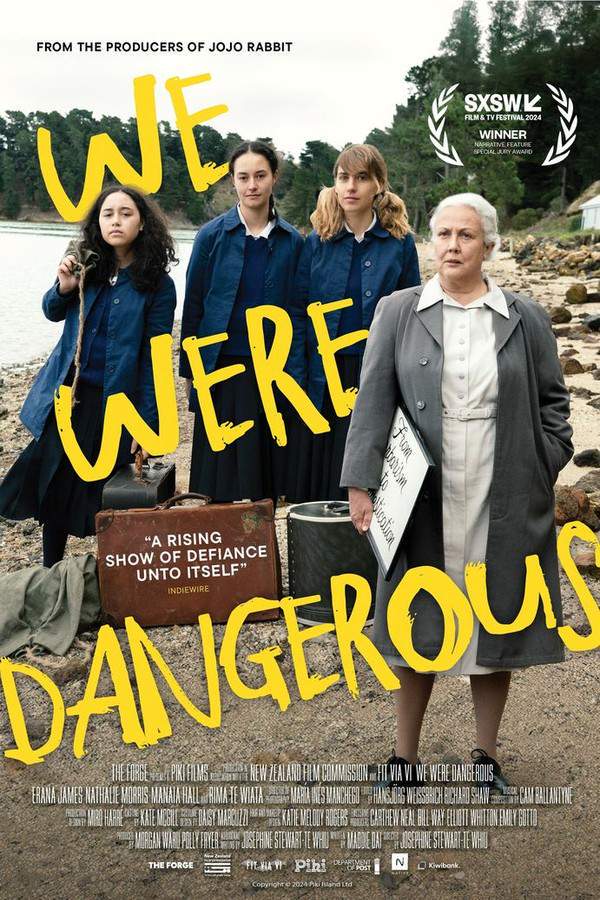
We Were Dangerous (2025) movie poster

Plot Summary

We Were Dangerous (2025) Plot Summary & Ending Explained

Release, runtime and language
2025 · 1 h 23 m · English
Echo score 84
Loading streaming availability…
Directed by
Josephine Stewart-Te Whiu
Starring
Rima Te Wiata, Erana James, Aaron Jackson, Nathalie Morris, Manaia Hall, Molly Jarvis-Taylor

In 1954, Nellie, Daisy, and Lou are sent to a secluded island institution for troubled girls. The close-knit trio find solace and strength in their friendship as they challenge the restrictive environment. However, their bond is threatened when the school’s stern matron attempts to manipulate them, creating divisions within the group and testing their loyalty to one another.

On this page (7)
  1. 1 Where to watch
  2. 2 What happens: full plot
  3. 3 Plot questions answered
  4. 4 How it ends
  5. 5 Movie threads
  6. 6 Movies like We Were Dangerous
  7. 7 Every angle
Loading streaming availability…

Full plot summary · contains spoilers

What Happens in We Were Dangerous: Full Plot Summary

The whole story of We Were Dangerous (2025) explained, from the opening scene to the final frame: every key event, every twist and what it all adds up to. Read it as a quick recap before the sequel, to check a scene you missed, or to finally understand what really happened.

In 1954, a Māori teen named Nellie faces an unexpected turn of events when her family sends her to Christchurch following the closure of her hometown's meatworks. With her relative nowhere to be found, Nellie forges a friendship with Daisy, another Māori girl who has endured a harsh upbringing in various foster homes. After an incident involving theft, both girls are dispatched to the Te Motu School for Incorrigible and Delinquent Girls, where they encounter a formidable force in the form of The Matron. This devout Māori woman, having been raised in a Christian orphanage, seeks to mold the girls into ideal subservient housewives through strict reforms, believing that the arrival of Christianity brought by the British aimed to civilize the Māori people.

As the story unfolds, Nellie and Daisy, with the help of a girl named Polly, attempt a daring escape from the reform school but ultimately face capture. In response to advice from a government official, The Matron relocates the entire school to a deserted island that once served as a leper colony. It is here that they meet Lou, a European girl who has been sent to Te Motu after being discovered engaged in a romantic relationship with her female mathematics teacher. Sharing a dilapidated hut, the three girls form a bond while navigating the oppressive environment set by The Matron.

On the island, The Matron's agenda continues with an unyielding focus on instilling her values through a blend of Christian teachings, housework duties, and other chores. She actively suppresses the girls' Māori culture and punishes them for showcasing their identity, such as when they lead a rock and roll dance among peers. During this difficult time, the girls find solace in the companionship of Barry, the friendly groundskeeper, who shows them the remnants of a hut that once belonged to a Chinese leper, a ghost from the past.

As resistance to The Matron’s harsh control grows among the girls, her desperation leads her to enlist a doctor who performs involuntary sterilization on two of the girls in the secluded medical hut. Lou desperately tries to alert her father to the alarming situation, but her efforts are thwarted when her letter is intercepted. Due to the escalating tension and mysterious disappearances, Nellie and Daisy contemplate another escape, but they find themselves divided over Lou’s hesitance to rebel against The Matron’s rule. Complicated loyalties come to light as Lou appears to conform to the oppressive environment even while fostering secret plans of resistance.

A pivotal moment arises when Nellie confronts The Matron over her harsh treatment of Daisy, resulting in Lou unexpectedly punishing Nellie. However, Lou's yoke to The Matron is soon revealed to be mere deception, a clever tactic to distract The Matron while she, Nellie, and Daisy plot their escape. United in their resolve, the trio conspires to set the medical hut ablaze, destroying its malevolent purpose and paving the way to freedom. Under the cover of night, as chaos reigns among the staff, the girls seize their chance, sailing away from the island on a makeshift raft, leaving behind the harsh reality of their confinement and heading toward the horizon, embracing the unknown future as they sail into the sunrise.
Last updated: June 23, 2025 at 06:03

Was this helpful?

Plot questions answered

We Were Dangerous Plot Explained: Your Questions Answered

The questions people ask most about We Were Dangerous (2025): what happens in the confusing scenes, why the characters do what they do, the twists, hidden details and what the ending means. Each answer contains spoilers.

Q1

Why does The Matron suppress Māori culture when she is Māori herself?

The Matron was raised in a Christian orphanage after being taken from her family as a child. She genuinely believes that Christianity and adopting European ways will give the girls better opportunities and protect them from the hardships she experienced. Her view is that British colonialism and Christianity 'civilized' the Māori people, so she sees erasing their culture as helping them survive in a Pākehā-dominated world.

Foreshadowing: Early scenes show The Matron enforcing strict Christian prayers and housekeeping routines as mandatory daily activities.

  • matron
  • maori culture
  • christianity
  • oppression
  • assimilation
Q2

Why was Lou sent to the reform school?

Lou is a European girl who was sent to Te Motu after being discovered in a romantic relationship with her female mathematics teacher. This was considered scandalous and 'delinquent' behavior by the authorities of the time, leading her father to send her away to the institution.

  • lou
  • reform school
  • teacher relationship
  • sent away
Q3

Why did The Matron move the school to a deserted island?

After Nellie, Daisy, and Pauline attempted to escape from the original Te Motu School, a government official suggested relocating the entire institution to a more isolated location. The Matron chose a former leper colony on a remote island specifically to make escape attempts nearly impossible due to the distance from the mainland.

Foreshadowing: The escape attempt ends with the girls being captured and returned to the school.

  • island
  • leper colony
  • escape attempt
  • relocation
Q4

What happened to the girls during the forced sterilization scene?

Desperate to maintain control and prevent the girls from potentially having children that would continue their 'troubled' bloodlines, The Matron enlisted a doctor to perform forced sterilization on two of the girls in the medical hut. This brutal act represents the extreme measures the institution used to control and punish the girls, showing the depth of corruption and abuse of power.

  • sterilization
  • medical hut
  • abuse
  • matron control
Q5

Why did Lou punish Nellie after she confronted The Matron?

Lou's punishment of Nellie was a deliberate act of deception to gain The Matron's trust. Lou was secretly planning an escape along with Nellie and Daisy, and she needed The Matron to believe she was still loyal. By appearing to side with The Matron, Lou distracted her while the girls prepared their escape plan.

Foreshadowing: Lou continues communicating with her father via letters and later helps gather supplies for the escape.

  • lou
  • nellie
  • betrayal
  • deception
  • escape plan
Q6

Why did The Matron punish the girls for doing a rock and roll dance?

The Matron viewed the rock and roll dance as another example of the girls embracing their Māori culture and identity, which she was determined to erase. She punished any expression of their cultural heritage because it conflicted with her goal of making them into subservient European-style housewives who had abandoned their Māori roots.

Foreshadowing: Earlier scenes show The Matron forcing the girls to abandon Māori customs and language.

  • rock and roll
  • dance
  • maori culture
  • punishment
  • oppression
Q7

How did the three girls escape from the island?

Nellie, Daisy, and Lou executed a coordinated escape plan. They set fire to the medical hut, which was the site of the forced sterilizations and represented the institution's oppression. While the staff dealt with the chaos of the fire, the girls used a makeshift raft to sail away from the island under cover of darkness, escaping into the open sea.

Foreshadowing: The girls had been secretly gathering supplies and planning the escape for some time.

  • escape
  • raft
  • fire
  • medical hut
  • freedom
Q8

Why was Nellie sent to Christchurch in the first place?

After the meatworks in Nellie's hometown closed down, her family decided to send her to Christchurch to live with a relative, hoping she would have better opportunities there. However, when Nellie arrived, her relative was nowhere to be found, leaving her alone in the city.

  • nellie
  • christchurch
  • meatworks
  • family
Q9

Who is Barry and what is his role in the story?

Barry is the friendly groundskeeper on the island who shows kindness to the girls. He reveals to them the remnants of a hut that once belonged to a Chinese leper, providing a historical connection to the island's dark past and serving as a minor ally in an otherwise hostile environment.

  • barry
  • groundskeeper
  • chinese leper
  • island history
Q10

Why do Nellie and Daisy become divided over Lou's hesistance to rebel?

When Lou appears to conform to The Matron's rule and even punishes Nellie, Daisy becomes frustrated and questions whether Lou truly shares their commitment to escape. The tension reflects the psychological toll of the oppressive environment, where trust is difficult to maintain and fear can make allies seem like enemies.

Foreshadowing: This conflict occurs during the period when Lou is secretly planning her deception of The Matron.

  • loyalty
  • trust
  • division
  • conflict
  • rebellion
Q11

What does the ending symbolize when the girls sail into the sunrise?

The sunrise represents hope, renewal, and freedom after the girls' harrowing experience at the reform school. It symbolizes their reclamation of autonomy and the beginning of a new chapter beyond the oppressive institution, while also acknowledging the uncertainty and challenges that lie ahead.

Foreshadowing: The entire film builds toward this moment of liberation and hope.

  • sunrise
  • freedom
  • hope
  • ending
  • escape

Ending explained

What Happens at the End of We Were Dangerous?

How We Were Dangerous (2025) ends, in short: the final scene, the last twist and what it means for the characters. The full ending explained, with every spoiler, lives on its own page.

Read the full ending explained

In the film's climax, Nellie, Daisy, and Louisa execute their daring plan to escape the reformatory on the island. After discovering the disturbing truth about the school's alleged 'reform' experiments—aimed at controlling young women’s sexuality and keeping the girls submissive—the trio decide they’ve had enough. They craft Molotov cocktails from stolen supplies and, with Louisa's help, secretly build a raft. Their plan is fueled by a desire for freedom and sisterhood, fueled by their shared experiences of oppression and rejection from society. In a powerful act of rebellion, they set fire to the clinic, ensuring the Matron’s authority is broken and that they can escape. The next morning, the girls are missing, and it’s revealed that Louisa had cooperated with her friends all along, pretending to be obedient while secretly planning their escape. She had helped them acquire the materials and sneak out, testament to her own desire for liberation from the constraints of her environment. As they set sail on their homemade raft at dawn, the girls are filled with joy and hope, symbolizing their break from the oppressive system and societal expectations. The story ends on a note of triumph and sisterhood, with the girls finally free to forge their own paths, leaving behind the cruel institutions meant to "civilize" them and affirming their resilience in the face of societal suppression. Their journey signifies a powerful rejection of the control and judgment imposed on them, emphasizing that their true strength lies in their unity and refusal to be defined by societal norms.

We Were Dangerous ending explained in full

Movie threads

More Movies Like We Were Dangerous, by Mood & Story

Curated lists built around what makes We Were Dangerous tick: the same mood, the same kind of story or the same emotional payoff. Each list explains why these movies belong together.

Rebellious Women Movies like We Were Dangerous

Stories of defiant women finding strength in solidarity to dismantle cruel institutions. If you enjoyed the defiant spirit and shared resilience in We Were Dangerous, explore these movies about women standing together against oppressive systems. These stories feature powerful female friendships, institutional struggles, and the enduring fight for freedom and autonomy.

  • rebellious
  • oppressive
  • tense
  • resilient
  • hopeful
  • dark
  • Tone: dark, tense, hopeful
  • Pacing: steady, building towards climax
Why these movies?

The story pattern: Narratives in this thread typically follow a group of women confined within a harsh institution—be it a prison, school, or asylum—whose initial survival tactics evolve into a unified rebellion. The central conflict pits their growing solidarity against the system's divide-and-conquer strategies, culminating in a daring act of defiance or escape that reaffirms their agency.

Why they belong together: These films are grouped together for their shared focus on female-centric rebellion, the powerful theme of found family as resistance, and the tense, high-stakes atmosphere of challenging an all-powerful institution. They deliver a potent mix of heavy emotional weight and a hopeful, empowering conclusion.

Claustrophobic Survival Dramas similar to We Were Dangerous

Intense stories of endurance within confined, high-pressure environments. Fans of the tense, oppressive atmosphere in We Were Dangerous will appreciate these claustrophobic survival dramas. These movies trap characters in restrictive environments, testing their spirit and resilience against overwhelming odds, often focusing on psychological endurance and the fight for freedom.

  • claustrophobic
  • oppressive
  • tense
  • frightening
  • resilient
  • survival
  • Tone: oppressive, tense, dark
  • Pacing: steady, methodical
Why these movies?

The story pattern: The narrative pattern revolves around characters trapped in an inescapable, controlled environment. The plot methodically builds tension as the protagonists endure daily hardships and psychological manipulation, with the central goal shifting from simple survival to planning a risky escape. The journey is defined by a steady pacing that amplifies the feeling of entrapment before a cathartic release.

Why they belong together: These movies share a deeply oppressive and tense mood, a steady pacing that builds claustrophobic dread, and a high-intensity focus on survival against a powerful adversary. They explore the psychological toll of confinement and the resilient human spirit that refuses to be broken.

If you liked this

Movies Like We Were Dangerous

Similar movies to We Were Dangerous: the same genre, themes or kind of story. Each one comes with its own plot summary, timeline and ending explained.

Browse all movie summaries

Every angle

We Were Dangerous (2025) Explained: Plot, Ending, Timeline & Characters

Everything about We Were Dangerous in one place: what happens in the plot summary, the timeline in chronological order, the characters and meaning, the ending explained and a spoiler-free summary. What's After the Movie adds the cast, box office and post-credit scenes.

Coming soon on iOS and Android

The Plot Explained Movie Summary App

Plot summaries, endings explained and timelines on your phone. Catch up on any movie in minutes, save your favorites and never miss a twist again.

Be the first to know when we launch. Your email stays private, always.

Learn more about the app