












Plot Explained Spoilers guaranteed!
Plot Explained

Browse by genre

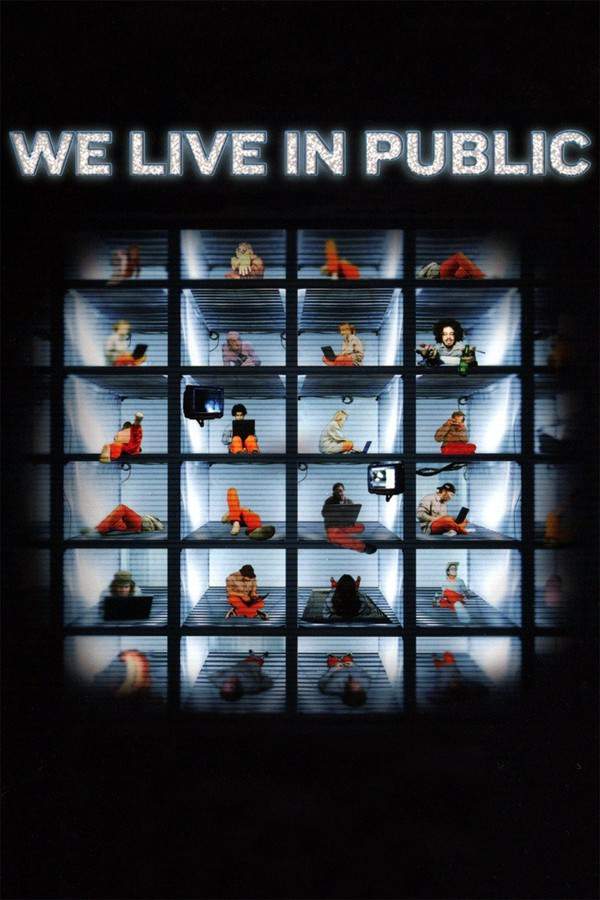
We Live in Public (2009) movie poster

Timeline

We Live in Public (2009) Timeline Explained – Every Event in Order

Release, runtime and language
2009 · English
Directed by
Ondi Timoner

This documentary follows visionary artist Josh Harris's decade-long experiment of living his life online. Award-winning filmmaker Ondi Timoner chronicles Harris's journey as he immerses himself in the internet, blurring the lines between his digital and physical existence. The film explores the unsettling consequences of our growing dependence on technology and offers a compelling look at the impact of constant online connectivity on identity and relationships.

On this page (6)
  1. 1 Where to watch
  2. 2 Events in order (14)
  3. 3 Timeline questions answered
  4. 4 Movie threads
  5. 5 Movies like We Live in Public
  6. 6 Every angle

Where to watch

Where to Watch We Live in Public (2009)

Where can you watch We Live in Public? Stream, rent or buy it in the US, including on Brew, Flix Premiere and Fawesome: current JustWatch availability with up-to-date prices.

Streaming availability powered by JustWatch

14 events in order · contains spoilers

We Live in Public Timeline: Events in Chronological Order

Every key event of We Live in Public (2009) in order, scene by scene, with when and where it takes place. Use it to untangle flashbacks, time jumps and parallel storylines, to refresh your memory before the sequel or to find the exact scene you are thinking of.

  1. Josh Harris Becomes a Pioneer

    In the early 1990s, Josh Harris rises to prominence in New York City's downtown Internet scene. His innovative chat and streaming audio platforms set the stage for what is to become the Internet's potential to reshape human interaction.

    When
    1990s
    Where
    New York City
  2. Founding Jupiter Communications

    Josh Harris establishes Jupiter Communications, the first Internet market research company. This groundbreaking venture marks his entry into the tech world, showcasing his foresight about the Internet's capabilities.

  3. Launch of Pseudo.com

    Harris founds Pseudo.com, the first Internet television network, during a time when broadband availability was scarce. This bold initiative prioritizes innovation in media consumption, solidifying Harris's status as a visionary.

  4. The Bunker Experiment

    As the millennium approaches, Harris constructs an underground bunker in New York City, where over 100 individuals live under constant surveillance. The experiment aims to explore the effects of extreme media immersion and social interaction.

    When
    2000
    Where
    New York City
  5. FEMA Shuts Down the Bunker

    On New Year's Day 2000, the bunker experiment is abruptly terminated by FEMA. The abrupt end of this groundbreaking social experiment leaves Harris searching for new ways to connect with the public.

    When
    January 1, 2000
    Where
    New York City
  6. weliveinpublic.com Launches

    Harris sets up a new experiment by rigging his loft with 32 motion-sensitive cameras. Through the website weliveinpublic.com, he broadcasts his life alongside his girlfriend Tanya for six months in an attempt to draw viewers into their intimate reality.

  7. Public Influence and Relationship Breakdown

    The constant 24/7 streaming of Harris’s life leads to a significant loss of autonomy. Viewers start to exert influence over his reality, resulting in the deterioration of his relationship with Tanya and his mental health.

  8. Retreat to Solitude

    After the collapse of his relationship and financial losses from the dot-com crash, Harris retreats to an apple farm in upstate New York. This five-year period of isolation marks a time of reflection away from the pervasive media spotlight.

    Where
    Upstate New York
  9. Return to Technology

    Upon returning to the tech landscape, Harris attempts to launch Operator 11, a platform for live streaming user content. However, he discovers that YouTube has already conquered the market with a simpler concept.

  10. Disappearance to Ethiopia

    Feeling financially vulnerable after the demise of Operator 11, Harris disappears to Ethiopia. He grapples with the reality of a world evolving beyond his initial vision and success in the tech industry.

    Where
    Ethiopia
  11. Documentary Creation

    Filmmaker Ondi Timoner documents Harris's story, capturing over a decade of his life. The film serves as a cautionary tale reflecting on human interaction in an age dominated by media and technology.

  12. Cautionary Insights

    Through interviews and vérité footage, Timoner illustrates Harris as a modern cautionary figure. The film highlights the personal ramifications of a life lived under the pressures of rapid technological advancement.

  13. Legacy of Predictions

    Josh Harris's early predictions about digital networking manifest in the rise of platforms like Friendster, MySpace, and Facebook. These developments reaffirm the relevance of his earlier visions for the future of communication.

  14. The Smoke on the Horizon

    As the film concludes, Harris warns that society is just beginning to witness the effects of digital transformation. His reflections on this change serve as a reminder of the consequences of living in a tech-driven world.

Last updated: November 03, 2024 at 22:55

Was this helpful?

Timeline questions answered

We Live in Public Timeline Explained: Your Questions Answered

When does it happen, and why in that order? The questions people ask about the chronology of We Live in Public (2009): time jumps, flashbacks, cause and effect between scenes and the correct order of events, each answered with spoilers.

Q1

Why did Josh Harris create the underground bunker experiment?

Josh Harris built the underground bunker in 1999-2000 as an extreme social experiment to explore what happens when people live under constant surveillance. Having grown up lonely as the youngest of seven children, he compensated by inviting people and cameras into his life, believing he was previewing a future where public living would become the norm. The experiment involved over 100 people living in a controlled environment with surveillance cameras, subjected to psychological experiences like artillery training and mock interrogations. Harris saw this as a literal and metaphorical exploration of how technology was reshaping human interaction and identity.

Foreshadowing: Earlier in his career, Harris had already predicted that people would voluntarily share intimate details of their lives online in exchange for fame and significance.

  • josh harris
  • bunker experiment
  • surveillance
  • social experiment
  • constant surveillance
Q2

Why did FEMA shut down Josh Harris's bunker experiment?

FEMA shut down the bunker experiment on New Year's Day 2000, though the exact reason is not detailed in the summary. The experiment was running with over 100 people living in an underground facility in New York City under constant surveillance, participating in intense psychological exercises. The shutdown marked the abrupt end of this radical social experiment and led Harris to pivot to even more extreme public living experiments, including the weliveinpublic.com broadcast.

Foreshadowing: The bunker experiment was Harris's attempt to create a controlled environment that mirrored his vision of future society under total media saturation.

  • fema
  • bunker experiment
  • shutdown
  • new york city
  • 2000
Q3

What happened to Josh Harris and Tanya on weliveinpublic.com?

Josh Harris rigged his Manhattan loft with 32 motion-sensitive cameras and broadcast his life alongside his girlfriend Tanya continuously for six months through weliveinpublic.com. The experiment aimed to showcase their entire relationship in real-time, including their attempts to conceive a child on camera. However, the constant surveillance backfired spectacularly: online chatters began exerting influence over Harris's reality, directing his actions and decisions. This loss of autonomy, combined with the extreme invasion of privacy, led to the deterioration of his relationship with Tanya and contributed to his mental breakdown.

Foreshadowing: The experiment was an evolution of Harris's earlier bunker concept, now focused on a single couple rather than a group.

  • tanya
  • weliveinpublic.com
  • relationship breakdown
  • mental health
  • reality tv
  • constant surveillance
Q4

Why did the weliveinpublic.com experiment fail?

The experiment failed because the online audience began controlling Harris's reality. What started as a transparent broadcast became a form of psychological manipulation where chatters influenced his decisions, movements, and relationship. Harris lost all autonomy in his own home, and the intense pressure of constant surveillance 24/7 shattered his mental stability and destroyed his relationship with Tanya. The project was a stark demonstration of how public living under surveillance dehumanizes rather than liberates.

Foreshadowing: Harris's earlier statement that he wanted to 'draw viewers into their intimate reality' revealed his naive belief that transparency would lead to connection rather than exploitation.

  • weliveinpublic.com failure
  • audience control
  • loss of autonomy
  • surveillance experiment
  • mental breakdown
Q5

Why did Josh Harris retreat to an apple farm in upstate New York?

After the collapse of his weliveinpublic.com experiment, his relationship with Tanya ended, and he suffered significant financial losses from the dot-com crash, Harris withdrew entirely from public life. He moved to an apple farm in upstate New York where he lived in isolation for five years, seeking refuge from the overwhelming media spotlight that had consumed him. This period represented a complete retreat from the very public existence he had championed, as the psychological toll of his experiments left him unable to continue in the tech industry.

Foreshadowing: The intense psychological experiences from both the bunker and weliveinpublic.com experiments had clearly taken a severe personal toll on Harris.

  • apple farm
  • upstate new york
  • isolation
  • retreat
  • dot-com crash
  • mental health recovery
Q6

Why did Josh Harris disappear to Ethiopia?

After returning from his five-year retreat on the apple farm, Harris attempted to reenter the tech world with Operator 11, a platform for online streaming where users could showcase content. However, YouTube had already dominated the market with its simpler 'broadcast yourself' concept. Financially depleted and having lost his visionary edge, Harris felt vulnerable and overwhelmed by a world that had evolved beyond his original predictions. He disappeared to Ethiopia to escape the tech industry and grapple with the success of the very future he had predicted but no longer controlled.

Foreshadowing: His predictions about social networking platforms had materialized in Friendster, MySpace, and Facebook, but he was now on the outside looking in.

  • ethiopia
  • disappearance
  • operator 11
  • youtube
  • financial ruin
  • tech industry exit
Q7

Did Josh Harris predict social media?

Yes, Josh Harris is credited with predicting the rise of social media platforms like MySpace, Facebook, and YouTube well before they existed. In the early 1990s, when less than 1% of the population had broadband access, Harris envisioned platforms where individuals would voluntarily share intimate details of their lives for fame and significance. He founded Pseudo.com, the first internet television network, and created early versions of concepts that would later become social networking. As he famously noted, 'The first guy gets the arrow, the second guy gets the castle.' While his predictions proved accurate, his radical methods and the dot-com crash led to his exclusion from tech history.

Foreshadowing: Harris's entire career was driven by his vision of a future dominated by online interactions and public living.

  • josh harris prediction
  • social media pioneer
  • myspace
  • facebook
  • youtube
  • visionary
  • internet pioneer
Q8

What happened to Operator 11 and why did it fail?

Operator 11 was Harris's attempt to return to the tech world after his five-year retreat. It was a platform for online streaming where users could broadcast their own content, similar to what YouTube would eventually offer. However, YouTube had already captured the market with its simpler, more accessible 'broadcast yourself' concept by the time Harris launched his competing platform. Unable to compete with YouTube's first-mover advantage and simpler business model, Operator 11 failed, leaving Harris financially depleted and leading to his departure from the tech industry.

Foreshadowing: The failure demonstrated how Harris's early vision had been co-opted by others who executed it more successfully.

  • operator 11
  • youtube
  • streaming platform
  • failure
  • competition
  • tech startup
Q9

What motivated Josh Harris to conduct these extreme experiments?

Harris's motivation stemmed from two intertwined factors: his visionary belief that technology would reshape human interaction, and his personal need to compensate for a lonely childhood. As the youngest of seven children who was frequently neglected, Harris found solace in television and later sought connection by inviting people and cameras into his life. He wanted to prove his predictions about a future of public living were correct, but his experiments also served as a way to create the family and attention he lacked growing up. His drive was expressed simply: 'I have to do this, or someone else will.'

Foreshadowing: The film reveals that Harris's childhood television dependency and loneliness directly influenced his adult fascination with broadcasting his entire existence.

  • motivation
  • childhood
  • loneliness
  • vision
  • technology
  • attention seeking
  • family
Q10

What does Josh Harris mean by 'the smoke on the horizon' at the end of the film?

In the film's conclusion, Harris warns that society is only beginning to witness the effects of digital transformation. His 'smoke on the horizon' metaphor suggests that the widespread surveillance, loss of privacy, and manipulation he experienced in his extreme experiments are just a preview of what awaits the general population as technology becomes even more pervasive. The warning is cautionary: if a tech visionary who understood these systems intimately was destroyed by them, ordinary users are even more vulnerable to the dehumanizing effects of constant connectivity and public living.

Foreshadowing: This final warning ties back to Harris's original predictions about a future where people voluntarily share everything online, a future that has now arrived.

  • smoke on the horizon
  • warning
  • digital transformation
  • privacy
  • surveillance
  • technology consequences
  • cautionary tale

Movie threads

More Movies Like We Live in Public, by Mood & Story

Curated lists built around what makes We Live in Public tick: the same mood, the same kind of story or the same emotional payoff. Each list explains why these movies belong together.

Dark Prophetic Documentaries like We Live in Public

Documentaries that serve as chillingly accurate warnings about the future. For viewers who want more movies like *We Live in Public* that function as cautionary tales. These documentaries explore technological and social trends with a dark, critical eye, often predicting future consequences with uncanny accuracy. If you liked the unsettling foresight of this film, you'll find similar stories here.

  • cautionary
  • unsettling
  • prophetic
  • thought-provoking
  • obsessive
  • critical
  • Tone: dark, cautionary, unsettling
  • Pacing: steady, investigative
Why these movies?

The story pattern: Stories in this thread typically follow a central figure—an inventor, artist, or thinker—whose groundbreaking work reveals a potential dark future. The narrative often documents their rise and the disturbing implications of their ideas, leading to a conclusion that feels both bleak and prescient.

Why they belong together: These films are grouped together because they share a dark, cautionary tone and a focus on technology or social trends that carry alarming implications for the future. They combine a documentary's realism with the tension of a thriller, creating a uniquely unsettling and thought-provoking viewing experience.

Stories of Obsessive Experimentation and Downfall like We Live in Public

Stories of characters whose radical experiments lead to their psychological undoing. If you were fascinated by the psychological unraveling in *We Live in Public*, this thread collects movies about characters who push boundaries to an extreme. These films explore the heavy cost of obsession, often depicting a brilliant mind's descent as their radical experiment consumes them.

  • obsessive
  • psychological
  • unraveling
  • intense
  • claustrophobic
  • melancholic
  • Tone: dark, psychological, intense
  • Pacing: steady, character-driven
Why these movies?

The story pattern: The narrative pattern follows a driven individual who designs and executes an extreme personal experiment. As they delve deeper, the initial intellectual curiosity gives way to psychological strain and identity crisis, culminating in a downfall that is both tragic and a direct result of their own creation.

Why they belong together: Movies in this thread share a high-intensity focus on an individual's psychological journey. They are united by themes of obsession, the blurring of reality and experiment, and a heavy emotional weight leading to a character's profound downfall, creating a compelling and often disturbing arc.

If you liked this

Movies Like We Live in Public

Similar movies to We Live in Public: the same genre, themes or kind of story. Each one comes with its own plot summary, timeline and ending explained.

Browse all movie summaries

Every angle

We Live in Public (2009) Explained: Plot, Timeline & Characters

Everything about We Live in Public in one place: what happens in the plot summary, the timeline in chronological order, the characters and meaning and a spoiler-free summary. What's After the Movie adds the cast, box office and post-credit scenes.

Coming soon on iOS and Android

The Plot Explained Movie Summary App

Plot summaries, endings explained and timelines on your phone. Catch up on any movie in minutes, save your favorites and never miss a twist again.

Be the first to know when we launch. Your email stays private, always.

Learn more about the app