Plot Explained Spoilers guaranteed!
Plot Explained

Browse by genre

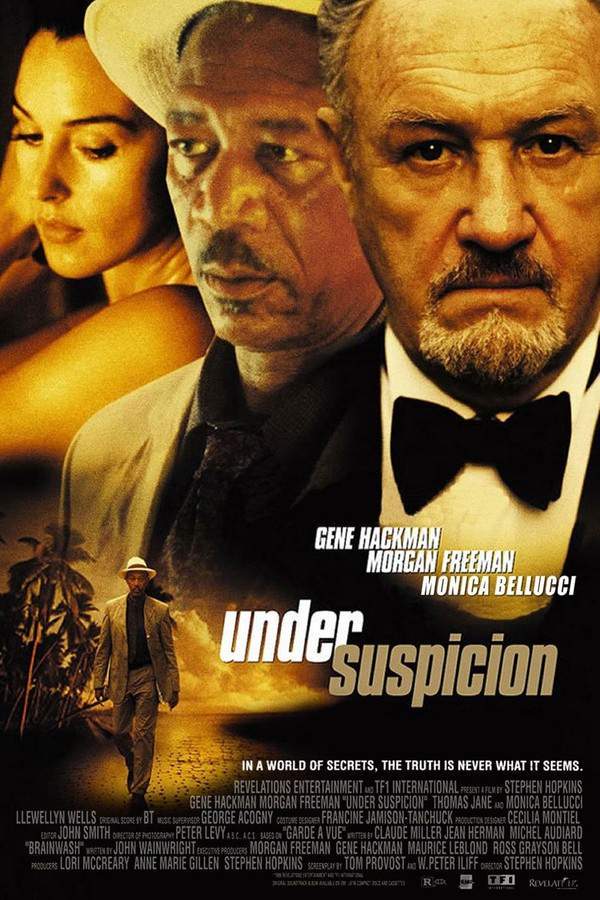
Under Suspicion (1991) movie poster

Timeline

Under Suspicion (1991) Timeline Explained – Every Event in Order

Release, runtime and language
1991 · 99 mins · English
Directed by
Simon Moore
Starring
Liam Neeson, Kenneth Cranham, Richard Graham, Victoria Alcock, Alex Norton, Laura San Giacomo

In late‑1950s Britain, officer Tony Aaron quits the police after an affair with Hazel, the wife of a man he was assigned to guard. Posing as a private investigator, he photographs staged “affairs” for divorcing couples, using Hazel as the subject. When Hazel is murdered, Tony begins an affair with the dead man’s lover, Angeline, while racing to prove his innocence.

On this page (6)
  1. 1 Events in order (14)
  2. 2 Timeline questions answered
  3. 3 Movie threads
  4. 4 Movies like Under Suspicion
  5. 5 Categories
  6. 6 Every angle

14 events in order · contains spoilers

Under Suspicion Timeline: Events in Chronological Order

Every key event of Under Suspicion (1991) in order, scene by scene, with when and where it takes place. Use it to untangle flashbacks, time jumps and parallel storylines, to refresh your memory before the sequel or to find the exact scene you are thinking of.

  1. Watch at Powers' house; affair exposed

    Tony and Frank are assigned to monitor Powers' house in Brighton toward the end of the 1950s. Tony enters the house and resumes his affair with Hazel as Powers returns unexpectedly. In the ensuing chaos, Powers shoots and kills a police officer, Colin Grace.

    When
    Late 1950s
    Where
    Powers' house, Brighton
  2. Two years later: Tony becomes a private detective

    Two years pass and Tony has left the force, working as an unsuccessful private detective who fakes adultery evidence for divorce cases. He extorts money by insisting on expensive hotels and substitutes his wife for a real prostitute in his schemes.

    When
    Christmas 1959
    Where
    Brighton
  3. Murder at the hotel: Stasio's death

    Tony collects a new customer and carries out his routine to photograph a couple in bed, only to find they have both been shot dead. The victim is Stasio, a painter seeking a divorce to marry Angeline. Stasio's will leaves everything to Angeline, not Selina.

    When
    A few days later in late 1959
    Where
    Hotel room and surrounding locations
  4. Initial investigations

    Tony and Frank begin separate inquiries into Stasio's murder. They visit Angeline and Selina to understand relationships and motives, and to learn about the will and the divorce plans.

    When
    Shortly after the murders
    Where
    Angeline's residence; Selina's residence
  5. Tony and Angeline become lovers

    Tony and Angeline begin a romance while the investigation unfolds. He discovers that Stasio imprinted his thumb on his paintings to prove authenticity, linking the murder to the painter's art.

    When
    During the investigation
    Where
    Angeline's residence; Stasio's studio
  6. Searching Stasio's studio

    Tony uses his time in shared spaces to search Stasio's studio for evidence that could tie the murders to the paintings and to the thumb-imprinting method.

    When
    During the investigation
    Where
    Stasio's studio
  7. Gun traced to Tony

    Suspicion falls on Tony when the gun used in the hotel murders is found in the hotel furnace and traced back to him. Frank and others push to clear his name while investigators close in.

    When
    During the investigation
    Where
    Hotel furnace
  8. Roscoe's suicide and incriminating note

    Frank pressures Roscoe to reveal evidence, but Roscoe commits suicide and leaves a note implicating Tony in the murders, deepening the case against him.

    When
    During the investigation
    Where
    Roscoe's location
  9. Tony's trial and Angeline's testimony

    Tony is arrested and tried for the murders; he is found guilty due to motive and deception. Angeline unexpectedly testifies about the rooftop escape and a distinctive lighter gesture used by the killer.

    When
    Trial
    Where
    Courtroom
  10. Night before the hanging

    On the eve of his hanging, Frank returns to Stasio's house and finds Stasio's thumb inside Angeline's paint box. He races to the prison to stop the execution.

    When
    Night before hanging
    Where
    Stasio's house; Prison
  11. Angeline arrested

    Angeline is arrested attempting to flee the country and is tried for Stasio’s murder, further complicating the case and the courtroom battles around the murder chain.

    When
    After the night before hanging
    Where
    Airport / Court
  12. Tony plans escape

    Tony plans to leave the country and visits Angeline in prison. She suspects that Tony and Selina conspired to frame her, creating a rift that unsettles the case.

    When
    Post-conviction
    Where
    Prison
  13. Tony meets Selina in Miami

    Tony travels to Miami where he meets Selina, who has begun releasing Stasio's paintings onto the market. She hints at money and past loyalties, chastising Tony for loving Angeline and delaying the thumb planting.

    When
    After the prison visit
    Where
    Miami
  14. Final moment with the lighter

    In the closing moments, Tony is seen using his lighter in the manner described by Angeline in court, leaving his fate and guilt open to interpretation as the story ends.

    When
    End of the story

Last updated: October 09, 2025 at 15:01

Was this helpful?

Timeline questions answered

Under Suspicion Timeline Explained: Your Questions Answered

When does it happen, and why in that order? The questions people ask about the chronology of Under Suspicion (1991): time jumps, flashbacks, cause and effect between scenes and the correct order of events, each answered with spoilers.

Q1

Why did Tony leave the police force after the incident at Powers' house?

Tony left the police force because he was having an affair with Hazel, the wife of Powers, someone he was assigned to guard. When Powers returned unexpectedly and discovered the affair, a violent struggle ensued. During the chaos, Powers shot and killed police officer Colin Grace. Tony's involvement in the extramarital affair and the resulting scandal made his position on the force untenable, so he resigned and became a private detective.

Foreshadowing: Earlier, Tony's willingness to risk his assignment by pursuing Hazel foreshadows his tendency to prioritize personal desires over professional duty.

  • Tony Aaron
  • police corruption
  • Brighton
  • Hazel
  • Powers
  • resignation
Q2

How did Officer Colin get killed during the Powers incident?

When Powers returned home unexpectedly and discovered Tony's affair with Hazel, he grabbed his shotgun to confront the intruders. In the ensuing struggle between Powers, Tony, and Frank (Tony's colleague), the gun went off. Powers accidentally shot and killed Officer Colin Grace, who had been part of the surveillance team outside the house. It was not a deliberate killing by anyone, the chaos and violence escalated unintentionally.

Foreshadowing: The reckless chaos at Powers' house establishes a pattern where Tony's illicit actions trigger unintended violent consequences.

  • Colin Grace
  • Powers
  • shotgun
  • Brighton
  • police officer killed
Q3

Why did Tony become a private detective who faked adultery evidence?

After leaving the police force, Tony struggled financially as a private detective. He discovered a lucrative but crooked niche: fabricating evidence of adultery for people seeking divorces. At the time, divorce laws in England and Wales required proof of infidelity, making his services profitable. Tony would stage photographs showing clients' spouses in compromising situations, often coaching them through elaborate ruses and insisting on expensive hotel rooms to maximize his earnings.

Foreshadowing: Tony's willingness to exploit vulnerable clients for money hints at his moral flexibility, which later makes him a plausible suspect in the murders.

  • private detective
  • divorce
  • adultery evidence
  • Brighton
  • extorting clients
Q4

Why was Stasio's severed thumb important to the murder case?

Stasio had a unique method of authenticating his paintings, he would imprint his thumb onto each canvas to prove provenance. When he was murdered, his thumb was severed and stolen, likely to forge his paintings and sell them as authentic works. This detail became crucial evidence because it revealed a financial motive beyond the apparent love triangle: someone wanted to steal Stasio's thumb to forge his art and profit from his estate.

Foreshadowing: Tony discovers Stasio's thumb-printing technique while searching the studio, linking the murder to the painter's valuable artistic method.

  • Stasio
  • severed thumb
  • paint forgery
  • painting authentication
  • art theft
Q5

What did Stasio's will reveal about his relationships?

Stasio's will revealed that he intended to leave everything, including his paintings, to Angeline, his lover, and nothing to Selina, his estranged partner. This was significant because it provided a clear motive for Selina: she would be cut out of Stasio's fortune while Angeline would inherit everything. The will also showed Stasio's intention to divorce Selina and marry Angeline, which deepened the suspicion around who might benefit from his death.

Foreshadowing: The will creates immediate suspicion toward Angeline as the primary beneficiary, while Selina appears wronged, a dynamic that fuels later conspiracy theories.

  • Stasio will
  • Angeline
  • Selina
  • inheritance
  • divorce
Q6

Why did suspicion fall on Tony for the hotel murders?

Several circumstantial factors pointed to Tony. The murder weapon was traced to Tony, and he had a clear motive: he had met Stasio as a client seeking divorce evidence, giving him access to the hotel room. Additionally, his profession involved staging infidelity scenes and photographing couples in hotels, making him appear capable of orchestrating the murders. The evidence was circumstantial but damning enough to arrest and convict him.

Foreshadowing: Tony's own dishonest profession, which involves creating false evidence in hotel rooms, becomes the very evidence used to frame him.

  • Tony Aaron
  • murder weapon
  • hotel room
  • suspicion
  • frame
Q7

What was Roscoe's role in the investigation and why did he commit suicide?

Roscoe was a key witness who had connections to rent boys and was being pressured by Frank to reveal information that could clear Tony. Under intense pressure, Roscoe broke down and committed suicide. Before dying, he left a note that directly implicated Tony in the murders, further strengthening the case against him. The suicide note proved devastating to Tony's defense despite being written by someone in emotional distress.

Foreshadowing: Roscoe's breakdown and suicide echo the film's theme of moral collapse under pressure, adding more circumstantial evidence against Tony.

  • Roscoe
  • suicide note
  • witness
  • Frank Vance
  • false accusation
Q8

Why did Angeline testify against Tony at his trial?

Angeline testified against Tony because she genuinely believed he was guilty. She claimed she saw a man climbing over the hotel roof on the night of the murders, and importantly, she described a distinctive lighter-banging gesture the killer made. This gesture matched Tony's own mannerism, something Angeline had observed during their relationship. Her testimony about the lighter and rooftop escape became the critical evidence that convicted Tony.

Foreshadowing: The lighter gesture that Angeline describes in court directly mirrors Tony's own behavior, creating a haunting detail that seems to confirm his guilt.

  • Angeline
  • testify
  • trial
  • lighter gesture
  • rooftop
  • guilty verdict
Q9

What was the lighter gesture that helped convict Tony?

During the murders, the killer made a distinctive gesture, banging a lighter in a peculiar way. Angeline testified that she saw this same gesture when she observed someone escaping over the hotel roof. Since Tony was known to use his lighter in this exact manner, the prosecution used this as proof of his identity. The gesture became an indelible clue that linked Tony to the crime scene, and the film ends with Tony repeatedly performing this same gesture, leaving his guilt ambiguous.

Foreshadowing: The lighter gesture recurs at the film's end, suggesting either Tony's guilt or his psychological torment from being falsely accused, or perhaps both.

  • lighter gesture
  • conviction
  • lighter bang
  • Angeline testimony
  • identity
Q10

How did Frank discover Stasio's thumb in Angeline's paint box?

On the night before Tony's execution, Frank returned to Stasio's house to investigate further. While searching, he discovered Stasio's severed thumb hidden inside Angeline's paint box. This crucial evidence suggested that Angeline had been involved in the murder, likely to obtain the thumb for forging paintings. Frank raced to the prison just in time to stop the hanging, proving Tony's innocence of at least that crime.

Foreshadowing: The thumb's discovery in Angeline's possession reverses the case entirely, exposing the true culprit while Tony remains condemned for other murders.

  • Frank Vance
  • Stasio thumb
  • paint box
  • Angeline arrest
  • execution stay
Q11

What did Angeline accuse Tony and Selina of in prison?

When Tony visited Angeline in prison after her arrest, she accused him of conspiring with Selina to frame her for the murders. Angeline believed Tony and Selina had worked together to orchestrate the entire situation, possibly to steal Stasio's paintings and profits. This accusation created a rift between them and introduced another layer of conspiracy into the already complex case.

Foreshadowing: This accusation plants doubt about whether Tony is entirely innocent or if he orchestrated events from the beginning, adding ambiguity to the finale.

  • Angeline
  • Selina
  • conspiracy
  • frame
  • Tony accusation
Q12

What happened when Tony met Selina in Miami at the end?

Tony travels to Miami after his release, where he encounters Selina, who has begun releasing Stasio's paintings onto the public market. Selina hands Tony payment and scolds him for falling in love with Angeline, implying their previous alliance involved money and loyalty. The meeting suggests Selina has been profiting from the art sales while Tony was imprisoned, and she hints that Tony's emotions complicated their original plan.

Foreshadowing: The Miami meeting reveals that Selina has been operating in the shadows, benefitting financially from Stasio's death while Tony was blamed.

  • Selina
  • Miami
  • Stasio paintings
  • money
  • reunion
Q13

What does the final scene with the lighter imply about Tony's guilt?

In the closing moments, Tony is shown using his lighter in the exact manner described by Angeline in her courtroom testimony, the distinctive banging gesture that supposedly identified him as the killer. The ambiguous ending leaves viewers uncertain whether Tony is guilty of the murders, whether he's traumatized by false accusation, or perhaps both. The gesture haunts him regardless of actual guilt, symbolizing how the trial and evidence have permanently marked him.

  • Tony Aaron
  • lighter gesture
  • ambiguous ending
  • guilt
  • psychological trauma

Movie threads

More Movies Like Under Suspicion, by Mood & Story

Curated lists built around what makes Under Suspicion tick: the same mood, the same kind of story or the same emotional payoff. Each list explains why these movies belong together.

Noir paranoia stories like Under Suspicion

Flawed protagonists become ensnared in conspiracies of their own making. If you liked the morally murky descent of Under Suspicion, explore more movies like it. This collection features similar neo-noir thrillers and suspenseful crime stories where flawed protagonists spiral into paranoia, framed for crimes and racing against a corrupt system.

  • noir
  • paranoid
  • suspenseful
  • grim
  • anxious
  • erotic
  • Tone: dark, tense, bleak
  • Pacing: steady, building dread
Why these movies?

The story pattern: The narrative pattern involves a protagonist with a significant moral flaw (like adultery or greed) who becomes the prime suspect in a crime, often one they are tangentially connected to. As circumstantial evidence mounts, they must investigate the truth while their own life unravels, leading to a destructive and often bleak conclusion.

Why they belong together: These films are grouped by their shared focus on psychological entrapment, moral decay, and a pervasive sense of doom. They blend erotic tension with criminal intrigue, creating a specific neo-noir vibe defined by high tension, dark tone, and a steady, fatalistic pacing that builds unbearable anxiety.

Thrillers about being framed like Under Suspicion

Innocent men uncover the truth while the walls of suspicion close in. Fans of Under Suspicion who enjoyed the 'race against time' plot will find similar movies here. These suspenseful crime thrillers feature protagonists wrongly accused of murder, forcing them to find the real killer before it's too late, often with a dark and intense tone.

  • suspenseful
  • anxious
  • tense
  • investigative
  • urgent
  • corruption
  • Tone: suspenseful, dark, anxious
  • Pacing: steady, propulsive
Why these movies?

The story pattern: The typical journey begins with an inciting incident—often a murder—that implicates the protagonist. With official channels either corrupt or convinced of their guilt, they take matters into their own hands, leading to a linear investigation filled with twists, betrayals, and narrow escapes, culminating in a final confrontation that may not offer full redemption.

Why they belong together: These films share a core narrative engine: a desperate investigation under immense pressure. They are united by high-tension pacing, a focus on procedural unraveling of a conspiracy, and the heavy emotional weight of fighting for one's freedom against overwhelming odds.

If you liked this

Movies Like Under Suspicion

Similar movies to Under Suspicion: the same genre, themes or kind of story. Each one comes with its own plot summary, timeline and ending explained.

Browse all movie summaries

Categories

Movie Lists Featuring Under Suspicion

Under Suspicion appears in these hand-built movie categories. Each one groups movies by a specific mood, theme or story type, with their plot summaries and endings explained.

View all movie categories

Every angle

Under Suspicion (1991) Explained: Plot, Timeline & Characters

Everything about Under Suspicion in one place: what happens in the plot summary, the timeline in chronological order, the characters and meaning and a spoiler-free summary. What's After the Movie adds the cast, box office and post-credit scenes.

Coming soon on iOS and Android

The Plot Explained Movie Summary App

Plot summaries, endings explained and timelines on your phone. Catch up on any movie in minutes, save your favorites and never miss a twist again.

Be the first to know when we launch. Your email stays private, always.

Learn more about the app