Plot Explained Spoilers guaranteed!
Plot Explained

Browse by genre

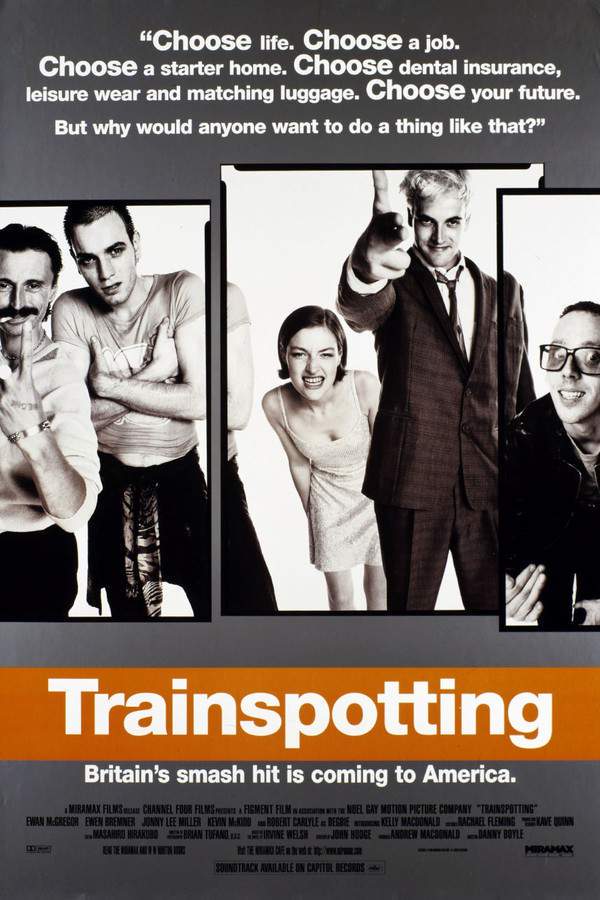
Trainspotting (1996) movie poster

Plot Summary

Trainspotting (1996) Plot Summary Explained

Release, runtime and language
1996 · 94 min · English
Directed by
Danny Boyle
Starring
Ewan McGregor, Ewen Bremner, Kevin McKidd, Jonny Lee Miller, Robert Carlyle

A heroin addict named Mark Renton struggles with addiction and relapse in this gritty drama. Living in Edinburgh and later London, he navigates a chaotic world alongside his friends, including the volatile Begbie and the cunning Sick Boy. As Mark attempts to maintain sobriety, he finds himself entangled in a cycle of bad decisions and increasingly desperate situations, confronting the consequences of his past actions.

On this page (7)
  1. 1 Where to watch
  2. 2 What happens: full plot
  3. 3 Plot questions answered
  4. 4 The book behind the movie
  5. 5 Movie threads
  6. 6 Movies like Trainspotting
  7. 7 Every angle

Where to watch

Where to Watch Trainspotting (1996)

Where can you watch Trainspotting? Stream, rent or buy it in the US, including on Amazon Video, Apple TV Store and Fandango At Home: current JustWatch availability with up-to-date prices.

Streaming availability powered by JustWatch

Full plot summary · contains spoilers

What Happens in Trainspotting: Full Plot Summary

The whole story of Trainspotting (1996) explained, from the opening scene to the final frame: every key event, every twist and what it all adds up to. Read it as a quick recap before the sequel, to check a scene you missed, or to finally understand what really happened.

The film opens with Mark Renton (Ewan McGregor) and Spud (Ewen Bremner) sprinting down Princes Street, chased by security guards. Renton reflects on his choices, asserting that while most people "choose life" with its conventional pursuits—children, financial security, and material possessions—he has opted for the chaotic existence of a heroin addict. The narrative introduces his circle of friends, which includes the unscrupulous Sick Boy (Jonny Lee Miller), the ambitious athlete Tommy (Kevin McKidd), the naïve but well-meaning Spud, and the aggressive sociopath Begbie (Robert Carlyle). All of them share a penchant for heroin, often congregating at the apartment of their drug dealer, "Mother Superior" Swanney (Peter Mullan).

After waking from a heroin stupor, Renton resolves to quit using. He meticulously constructs a plan, locking himself away in a decrepit flat, boarding up the door to prevent any potential escape. Realizing he craves one last high, he ventures out to procure opium rectal suppositories from Mikey Forrester (Irvine Welsh). Attempting to reconnect with his friends in a sober state, Renton finds himself feeling incomplete. His night out at a club rekindles his libido, leading him to a young woman named Diane (Kelly MacDonald)—only to discover, after a passionate encounter, that she is a fifteen-year-old schoolgirl living with her parents. Ashamed of the situation, Renton tries to distance himself, but Diane’s blackmail forces him to maintain contact.

Meanwhile, Tommy suffers emotionally after being jilted by his girlfriend Lizzy. Renton had a hand in this, having stolen and hidden one of their intimate tapes, inadvertently damaging their relationship. The cycle of addiction resumes as Renton, Sick Boy, and Spud fall back into heroin use, pulling Tommy down with them. Their destructive lifestyle takes a tragic turn when their friend Allison, a fellow addict, discovers that her infant daughter, Dawn, has died due to neglect. The loss sends shockwaves through the group, particularly affecting Sick Boy, who is implied to be the child's father.

In the wake of this tragedy, Renton recounts how the child's death fuels Sick Boy's self-destructive behavior. As their situation spirals further out of control, Renton narrates the events that lead to Spud's arrest and his own entry into a drug intervention program, where he receives Methadone. Despite his family's support, Renton's depression deepens, prompting an escape back to Swanney's flat, where he nearly overdoses. After surviving this near-fatal experience, Renton's parents confine him to his childhood bedroom during his withdrawal phase.

During this harrowing time, he endures vivid hallucinations involving Diane, visions of his friends, and even the ghostly image of the deceased baby. His ultimate wake-up call arrives when his parents encourage him to get tested for HIV, a looming threat given his past drug use. Remarkably, he tests negative, but this moment of relief is short-lived as he continues to grapple with boredom and despair.

Renton's journey leads him to visit Tommy, who has succumbed to full-fledged addiction and is now HIV positive. Prompted by Diane, he relocates to London, securing a job as a property letting agent and finding a measure of joy in sobriety, even exchanging letters with Diane. But his newfound happiness is upended when Begbie, fresh from an armed robbery, shows up at Renton's flat, seeking refuge. Soon after, Sick Boy arrives as well, complicating Renton's attempts to lead a normal life. The chaotic presence of his "friends" leads to constant strife, with Sick Boy even selling Renton's belongings and pressuring him into dubious schemes.

After learning about Tommy's tragic demise from toxoplasmosis, Renton returns to Edinburgh for the funeral. There, the old crew reunites with Spud, who has been granted parole. Sick Boy proposes a risky heroin deal with Mikey Forrester, and Renton, much against his better judgment, decides to partake. He injects heroin to check the substance's purity but makes a silent vow to resist returning to old habits.

The four friends successfully sell the drugs, but tension builds as Renton becomes increasingly disillusioned with Sick Boy and Begbie. In a pivotal moment that showcases his resolve, Renton decides to betray his friends. Under the cover of night, he slips away with the money, leaving only a £2,000 note for Spud. The film culminates in Renton’s escape; he walks through London, declaring his intention to embrace a traditional and stable life, while Spud discovers the money left behind—a gift for a fresh start.

Last updated: November 15, 2024 at 20:37

Was this helpful?

Plot questions answered

Trainspotting Plot Explained: Your Questions Answered

The questions people ask most about Trainspotting (1996): what happens in the confusing scenes, why the characters do what they do, the twists, hidden details and what the ending means. Each answer contains spoilers.

Q1

Why does Renton betray his friends and take the money from the heroin deal?

Renton betrays his friends because he realizes they will never stop dragging him back into addiction. After witnessing Tommy's death and seeing how Sick Boy and Begbie have already begun destroying his new life in London, he understands that the only way to escape his old patterns is to completely sever ties. He takes the money as a symbolic and practical break from his past, though he leaves £2,000 for Spud as a gesture of friendship toward the one friend who never truly betrayed him.

Foreshadowing: Earlier scenes showing Renton's attempts at sobriety and his enjoyment of normal life in London foreshadow his final choice to embrace stability.

  • renton betrayal
  • heroin deal
  • escape
  • london
  • sick boy
  • begbie
Q2

How does Tommy become HIV positive?

Tommy becomes HIV positive through sharing contaminated needles while injecting heroin. After falling back into addiction following his breakup with Lizzy, Tommy descends fully into drug use. The film shows Renton visiting Tommy later in the story, where he learns that Tommy has contracted HIV through needle sharing, representing one of the most tragic consequences of their lifestyle.

Foreshadowing: The group's collective return to heroin use after Allison's tragedy directly leads to Tommy's infection.

  • tommy
  • hiv
  • needles
  • addiction
  • heroin
Q3

Why is the baby's death such a pivotal moment in the film?

The baby's death represents the devastating collateral damage of addiction. Allison's infant daughter Dawn dies from neglect while left alone with her addict parents. This tragedy hits the group hard, particularly Sick Boy, who is implied to be the father. The event deepens the film's exploration of how addiction destroys not only the users but everyone around them, particularly the innocent. It marks a turning point that sends the group into an even deeper descent.

Foreshadowing: The film establishes early on that the group uses drugs together in dangerous conditions, making this outcome tragically inevitable.

  • baby
  • allison
  • death
  • neglect
  • sick boy
  • tragedy
Q4

Why does Renton relapse and start using heroin again after trying to quit?

Renton relapses because the cravings prove overwhelming and his environment remains unchanged. After locking himself away to withdraw, he ventures out to buy opium suppositories, and his encounter with his friends pulls him back into their circle. Additionally, his shame over the Diane situation and the emotional toll of witnessing his friends' continued self-destruction make it easy for him to fall back into old habits. The film portrays addiction as a cycle that requires complete separation from enabling environments to overcome.

Foreshadowing: Renton admitting he craves "one last high" before he Quit foreshadows his inability to resist temptation.

  • relapse
  • addiction
  • cravings
  • withdrawal
  • opium suppositories
Q5

Why does Renton steal the video tape between Tommy and Lizzy?

Renton's theft of Tommy and Lizzy's intimate video tape is a thoughtless act of petty theft that has devastating consequences. He steals it casually, but when Tommy and Lizzy cannot find it, their relationship suffers. Lizzy assumes Tommy lost or shared the tape, leading to their breakup. This seemingly minor action demonstrates how Renton's self-destructive behavior damages those around him even when he doesn't intend harm.

Foreshadowing: This event occurs early in the film, establishing Renton's careless nature and planting the seeds for Tommy's emotional breakdown.

  • video tape
  • tommy
  • lizzy
  • breakup
  • renton mistake
Q6

Why does Renton leave £2,000 specifically for Spud when he escapes?

Renton leaves money for Spud because Spud is the only friend who never betrayed or exploited him. Throughout the film, Spud remains loyal and well-meaning, despite being equally trapped in addiction. Unlike Sick Boy who sells Renton's belongings or Begbie who brings violence into his life, Spud represents genuine friendship without ulterior motives. The money serves as a fresh start for Spud, acknowledging their friendship while still choosing to leave everyone behind.

Foreshadowing: The film's early portrayal of Spud as the most innocent and harmless member of the group establishes why he alone deserves this gesture.

  • spud
  • money
  • £2000
  • betrayal
  • friendship
  • escape
Q7

Why does Begbie show up at Renton's London flat after the robbery?

Begbie arrives at Renton's flat because he has just committed an armed robbery and needs somewhere to hide from the police. Having fled Edinburgh after the robbery, he naturally seeks out his old friend Renton, who represents his closest connection to a normal life. This intrusion destroys Renton's attempts at building a stable existence in London, bringing the chaos of their old life directly into his new one.

Foreshadowing: Begbie's violent and unpredictable nature, established early in the film, makes his criminal activity and desperate arrival inevitable.

  • begbie
  • robbery
  • london
  • hide
  • police
Q8

Why do Renton's parents urge him to get tested for HIV?

Renton's parents encourage HIV testing because they fear for his life given his intravenous drug use and shared needles. The late 1980s/early 1990s era saw widespread AIDS panic, and parents of addicts were acutely aware of the risks. The test represents a moment of reckoning where Renton confronts the potential consequences of his behavior. Though he tests negative, the experience doesn't lead to lasting change, showing how deeply entrenched his addiction is.

Foreshadowing: The scene establishes the real medical dangers associated with their lifestyle, foreshadowing Tommy's eventual positive status.

  • hiv test
  • parents
  • medical
  • risk
  • needles
  • aids
Q9

Why does Diane blackmail Renton after their encounter?

Diane blackmails Renton because she is a teenager who lied about her age to be with him, and she uses the situation to gain something from the encounter. When Renton discovers she's fifteen and tries to distance himself, she threatens to tell police about their sexual encounter unless he continues seeing her. This forces Renton into an uncomfortable relationship that adds another layer of dysfunction to his life, though Diane later proves somewhat sympathetic by encouraging his move to London.

Foreshadowing: Diane's mature appearance and confident demeanor at the club initially mask her true age, making Renton's discovery shocking but not entirely implausible.

  • diane
  • blackmail
  • age
  • schoolgirl
  • teenager
Q10

What causes Tommy's death from toxoplasmosis?

Tommy dies from toxoplasmosis, a parasitic infection that commonly affects people with weakened immune systems. Having progressed to full-blown AIDS from HIV, Tommy's body could not fight off the infection. Toxoplasmosis is often contracted from cat feces or undercooked meat, but in the context of the film, it represents one of the many opportunistic infections that attack a body devastated by intravenous drug use and HIV. His death underscores the lethal consequences of their lifestyle.

Foreshadowing: Tommy's HIV-positive status earlier in the film makes his eventual death from complications inevitable.

  • tommy
  • death
  • toxoplasmosis
  • hiv
  • aids
  • infection
Q11

What motivates Renton to finally choose a normal life at the end?

Renton's final choice to pursue a normal life comes from accumulated exhaustion with addiction and witnessing its destruction. After Tommy's funeral, seeing his friends still consumed by drugs, and experiencing how Begbie and Sick Boy have invaded his attempt at a new life, Renton reaches a breaking point. He realizes his friends will always pull him back, and the only way to survive is to leave entirely. His walk through London represents a concrete choice to pursue the conventional life he mocked at the film's beginning.

Foreshadowing: RENTON's opening monologue about "choosing life" is reframed at the end as he finally makes that choice, but only after betraying those close to him.

  • choose life
  • normal life
  • escape
  • change
  • london ending
Q12

What makes Begbie so dangerous and violent throughout the film?

Begbie represents pure predatory danger in the film - a violent sociopath who uses the group mainly as cover for his criminal activities. Unlike the others whose lives revolve around heroin, Begbie's primary addiction is violence and robbery. His temper flares unpredictably, as seen in his assault on a waiter and his armed robbery that forces him to flee to London. His complete lack of loyalty or empathy makes him the most morally corrupt character, and his presence serves as a constant threat.

Foreshadowing: Begbie's violent outburst at the restaurant early in the film establishes his unpredictable, dangerous nature.

  • begbie
  • violent
  • sociopath
  • dangerous
  • robbery

Movie threads

More Movies Like Trainspotting, by Mood & Story

Curated lists built around what makes Trainspotting tick: the same mood, the same kind of story or the same emotional payoff. Each list explains why these movies belong together.

Urban Grit Dramas like Trainspotting

Raw, chaotic stories set in the desperate fringes of city life. If you liked the raw, chaotic energy of Trainspotting, explore more movies that capture the desperate feel of life on society's fringes. These films often share a similar tone of dark realism, fast pacing, and heavy emotional weight, focusing on characters navigating crime, addiction, or socioeconomic struggle in an urban setting.

  • gritty
  • chaotic
  • desperate
  • raw
  • confrontational
  • urban decay
  • Tone: dark, cynical, raw
  • Pacing: fast, chaotic
Why these movies?

The story pattern: Narratives in this thread often follow a downward spiral or a desperate struggle for survival within a corrupt or decaying urban environment. Characters are typically anti-heroes or deeply flawed individuals whose moral compromises drive the plot, leading to intense confrontations and bittersweet or bleak resolutions.

Why they belong together: Movies are grouped here for their shared commitment to a raw, visceral aesthetic, a dark and cynical tone, and a focus on the consequences of life choices made under extreme pressure. The similarity lies in the immersive, often uncomfortable, viewing experience of a chaotic world.

Movies about Self-Destruction like Trainspotting

Intense journeys of addiction and collapse, ending in morally complex freedom. For viewers who appreciated Trainspotting's harrowing look at addiction and the bittersweet cost of escape, this list features similar movies about self-destructive cycles. These films share a high intensity, heavy emotional weight, and often a bittersweet ending where survival comes at a great personal or moral cost.

  • harrowing
  • desperate
  • self-destruction
  • redemption
  • cynical
  • emotional heavy
  • Tone: dark, harrowing, bittersweet
  • Pacing: fast, episodic
Why these movies?

The story pattern: The narrative pattern is a cyclical descent into self-destructive behavior, followed by attempts at recovery and relapse. The climax typically involves a drastic, often ethically questionable act that allows the protagonist to break the cycle, resulting in an ending that is more about survival than triumph, leaving a complex emotional residue.

Why they belong together: These films are united by their intense focus on a protagonist's psychological and physical unraveling, the heavy emotional toll of their actions on themselves and others, and the specific narrative arc of achieving a fraught, morally compromised liberation from their demons.

If you liked this

Movies Like Trainspotting

Similar movies to Trainspotting: the same genre, themes or kind of story. Each one comes with its own plot summary, timeline and ending explained.

Browse all movie summaries

Every angle

Trainspotting (1996) Explained: Plot, Timeline & Characters

Everything about Trainspotting in one place: what happens in the plot summary, the timeline in chronological order, the characters and meaning and a spoiler-free summary. What's After the Movie adds the cast, box office and post-credit scenes.

Coming soon on iOS and Android

The Plot Explained Movie Summary App

Plot summaries, endings explained and timelines on your phone. Catch up on any movie in minutes, save your favorites and never miss a twist again.

Be the first to know when we launch. Your email stays private, always.

Learn more about the app