Year: 2009
Runtime: 120 min
Language: Japanese
Director: Kiyoshi Kurosawa
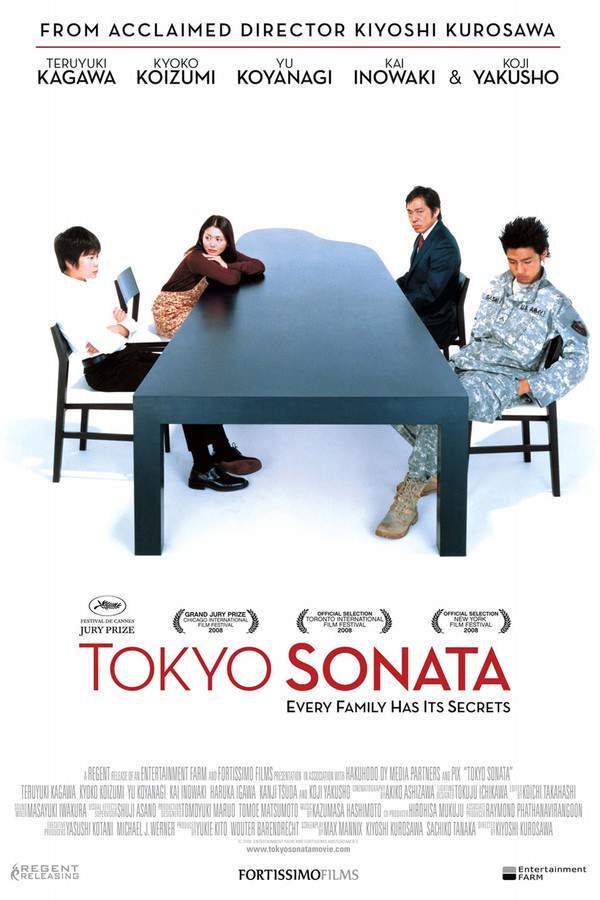
A Japanese family struggles to maintain appearances as personal hardships emerge. The father unexpectedly loses his job, while the eldest son is preoccupied with college, creating distance between them. The youngest son harbors a secret passion for playing the piano, further complicating family dynamics. As the mother grapples with these challenges, the carefully constructed facade of their lives begins to crumble, revealing hidden tensions and threatening their relationships.
Warning: spoilers below!
Haven’t seen Tokyo Sonata yet? This summary contains major spoilers. Bookmark the page, watch the movie, and come back for the full breakdown. If you're ready, scroll on and relive the story!
Read the complete plot breakdown of Tokyo Sonata (2009), including all key story events, major twists, and the ending explained in detail. Discover what really happened—and what it all means.
Tokyo Sonata tells the poignant story of the Sasaki family, consisting of Ryūhei, his wife Megumi, a dedicated housewife, and their two sons, the late-teen Takashi and the middle-schooler Kenji. Within their household, emotional connections are scarce, and genuine communication is a rare occurrence.
After losing his stable office job due to his company’s decision to hire cheaper labor from China, Ryūhei finds himself in a state of growing desperation as he struggles to secure new employment. He reconnects with an old classmate, Kurosu, who has faced a similar fate. Both men conceal the harsh truths of their circumstances from their families, bonding over shared woes. However, tragedy strikes when Ryūhei discovers that Kurosu and his wife have tragically taken their own lives, presumably due to Kurosu’s overwhelming despair.
Meanwhile, driven by noble intentions, Takashi decides to enlist in the United States military, a choice that deeply angers Ryūhei and saddens Megumi. On the other hand, Kenji grapples with guilt after inadvertently causing his classmates to insult their teacher. Eager to learn the piano despite his father’s adamant disapproval, Kenji secretly starts taking lessons from a kind-hearted teacher, Miss Kaneko, using his lunch money to pay for them and practicing on a damaged keyboard he salvaged from the trash. As he hones his skills, he and Miss Kaneko grow close, with her recognizing his exceptional talent and encouraging him to follow his musical dreams. When his parents uncover his secret lessons, a furious Ryūhei lashes out in anger, physically hurting Kenji and sending him tumbling down the stairs, leading to a minor concussion.
In a bizarre turn of events, Megumi, who feels increasingly isolated and worries about Takashi, becomes a hostage to a desperate burglar in their own home. The robber forces her to drive a car he has stolen, but during a stop at a mall, she has a moment to escape. However, upon unexpectedly encountering a distraught Ryūhei, now working as a low-paid janitor, she chooses to return to her captor, and they slowly develop a connection as they continue to journey without a clear destination.
That evening, all three family members confront their personal crises away from home. Kenji, after trying to assist a friend fleeing from an abusive father, is caught by the police and held in an adult cell overnight but is soon released. Megumi continues her travels with the burglar, spending the night in a shed by the sea. Despite the robber’s initial advances, he is unable to proceed, and they find solace in each other’s company. However, when Megumi sees a distant light on the horizon, the robber’s despair deepens as he cannot perceive the hope it represents. The next day, the robber drives the stolen vehicle into the ocean, leading Megumi back home.
Simultaneously, Ryūhei stumbles upon a stash of cash at his janitorial job but is then struck by a speeding vehicle, left unconscious but waking up surprisingly intact to abandon the money the following day.
Eventually, Kenji, Megumi, and Ryūhei find themselves back together at home, engaging in a mundane meal that lacks any acknowledgment of their individual journeys. Four months later sees the family adjusting to the new status quo—Ryūhei continuing his janitorial role, Takashi opting to remain in the Middle East despite Japan’s withdrawal orders. The film culminates with Kenji flawlessly performing Claude Debussy’s “Clair de Lune” at an audition, evoking tears from his parents as the entranced audience watches their family share this tender moment together.
Last Updated: November 16, 2024 at 15:30
Discover curated groups of movies connected by mood, themes, and story style. Browse collections built around emotion, atmosphere, and narrative focus to easily find films that match what you feel like watching right now.
Stories where a family's carefully constructed life slowly falls apart.If you appreciated the domestic tension and emotional unraveling in Tokyo Sonata, this thread collects similar drama films. These movies explore family secrets, generational conflict, and the struggle to maintain appearances, offering stories for viewers who like emotionally heavy, character-driven narratives.
These narratives typically follow multiple family members, each grappling with their own private crisis—often related to failure, secret ambitions, or emotional isolation. The plot unfolds through slow-burn revelations that expose the cracks in their shared life, leading to a climax where the family structure is fundamentally challenged, if not permanently altered.
Movies are grouped here because they share a core focus on the dynamics of a family unit under stress. They possess a melancholic tone, heavy emotional weight, and a deliberate pacing that allows the audience to feel the gradual accumulation of domestic pressure and alienation.
Emotionally heavy journeys that find fragile moments of transcendence.For viewers who liked the blend of heavy emotion and transcendent beauty in Tokyo Sonata, this thread finds similar movies. These films balance somber themes like economic hardship or family strife with moments of hope, creating a bittersweet and deeply reflective viewing experience for fans of slow-paced, meaningful drama.
The narrative pattern involves characters enduring significant emotional or physical hardship, often feeling isolated or desperate. The journey is characterized by a slow accumulation of weight, but it is punctuated by key scenes of unexpected beauty, artistry, or human connection that provide a glimmer of light, leading to an ending that acknowledges the pain while affirming a fragile, bittersweet hope.
These films are grouped by their unique emotional blend: a foundation of heavy, realistic struggle topped with a climax or resolution that offers a moment of transcendent beauty or connection. They share a melancholic tone, slow pacing, and a bittersweet ending feel that leaves the viewer emotionally moved but not completely devastated.
Don't stop at just watching — explore Tokyo Sonata in full detail. From the complete plot summary and scene-by-scene timeline to character breakdowns, thematic analysis, and a deep dive into the ending — every page helps you truly understand what Tokyo Sonata is all about. Plus, discover what's next after the movie.
Track the full timeline of Tokyo Sonata with every major event arranged chronologically. Perfect for decoding non-linear storytelling, flashbacks, or parallel narratives with a clear scene-by-scene breakdown.
Discover the characters, locations, and core themes that shape Tokyo Sonata. Get insights into symbolic elements, setting significance, and deeper narrative meaning — ideal for thematic analysis and movie breakdowns.
Get a quick, spoiler-free overview of Tokyo Sonata that covers the main plot points and key details without revealing any major twists or spoilers. Perfect for those who want to know what to expect before diving in.
Visit What's After the Movie to explore more about Tokyo Sonata: box office results, cast and crew info, production details, post-credit scenes, and external links — all in one place for movie fans and researchers.
Discover movies like Tokyo Sonata that share similar genres, themes, and storytelling elements. Whether you’re drawn to the atmosphere, character arcs, or plot structure, these curated recommendations will help you explore more films you’ll love.
Tokyo Sonata (2009) Scene-by-Scene Movie Timeline
Tokyo Sonata (2009) Movie Characters, Themes & Settings
Tokyo Sonata (2009) Spoiler-Free Summary & Key Flow
Movies Like Tokyo Sonata – Similar Titles You’ll Enjoy
Shoplifters (2018) Complete Plot Breakdown
Children of Tokyo (2010) Ending Explained & Film Insights
Tokyo! (2009) Plot Summary & Ending Explained
Tokyo Project (2017) Full Summary & Key Details
Tokyo Towers: Mom and Me, and Sometimes Dad (2007) Spoiler-Packed Plot Recap
Tokyo Story (1953) Plot Summary & Ending Explained
The Daughter of the Samurai (1937) Story Summary & Characters
An Inn in Tokyo (1935) Complete Plot Breakdown
Tokyo Chorus (1931) Complete Plot Breakdown
The Tokyo Siblings (1995) Detailed Story Recap
Tokyo Twilight (1957) Plot Summary & Ending Explained
A Japanese Tragedy (1953) Detailed Story Recap
Tokyo Lullaby (1997) Ending Explained & Film Insights
Tokyo Tower (1000) Full Movie Breakdown
The Only Son (1936) Movie Recap & Themes