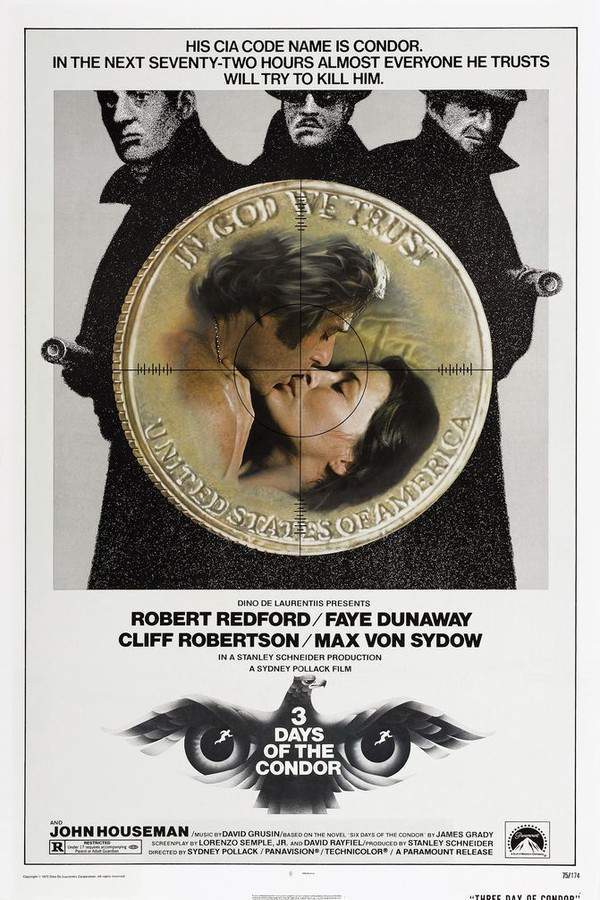
A quiet CIA codebreaker, Joe Turner, finds his day turned deadly when he discovers a horrific massacre at his office. Now a hunted man, he must evade ruthless operatives and a skilled assassin while trying to understand why his own agency is after him. With no one to trust, Joe races against time to expose the dark forces involved and fight for his survival during a perilous three-day ordeal.
Find where to stream, rent, or buy Three Days of the Condor (1975) in the US with current JustWatch availability, up-to-date pricing, and platform listings for subscription, rental, and digital purchase options.
Warning: spoilers below!
Haven’t seen Three Days of the Condor yet? This summary contains major spoilers. Bookmark the page, watch the movie, and come back for the full breakdown. If you're ready, scroll on and relive the story!
Read the complete plot breakdown of Three Days of the Condor (1975), including all key story events, major twists, and the ending explained in detail. Discover what really happened, and what it all means.
Joe Turner, played by Robert Redford, is a CIA employee working at the American Literary Historical Society, where his role involves reading and cataloguing various texts into a database for later cross-checking with actual CIA operations. This routine day suddenly takes a dark turn when, on a rainy December morning, a quiet man in a sedan outside begins marking off the names of Joe and his colleagues as they arrive for work.
As Turner grapples with unanswered questions regarding connections he’s found between international operations in Venezuela and Saudi Arabia, he heads out for lunch after a morning of waiting in vain for a response from the CIA headquarters in Langley. He discreetly exits through a basement door against protocol, and, upon his return, discovers a horrifying scene—his coworkers have all been brutally murdered. Overwhelmed with shock and urgency, Joe grabs a pistol from the receptionist’s desk before bolting from the building.
Navigating a world now filled with potential threats, Joe realizes that he may be the next target. In a moment of desperation, he finds a payphone and calls the CIA, identified only by his code name, “Condor.” > “The section’s been hit. Everyone’s dead,” he struggles to convey. The agency assures him that help is on the way. However, when Joe attempts to make sense of his looming danger, he becomes increasingly paranoid and suspicious of those around him. His anxiety peaks upon returning to his apartment, only to find a co-worker murdered in bed, escalating his fear that he can trust no one.
In a twist of fate, he kidnaps Kathy, played by Faye Dunaway, whom he encounters while escaping. Initially terrified, Kathy soon senses Joe’s predicament is genuine and gradually learns to connect with him, despite her own disbelief. As evening falls, Joe discovers troubling updates on the news, which misrepresent the day’s events. After a tense night spent together, the following day brings new danger when the man who previously knocked on his apartment door, a mailman, returns—intent on killing Joe.
A fierce struggle ensues, during which Joe employs quick thinking and railed items in Kathy’s apartment, leading to a climactic confrontation that results in the mailman’s demise. With crucial evidence gained from the hitman, Joe devises a reckless plan that entails utilizing Kathy’s unsuspecting desire for a CIA job as a cover for acquiring information from his superiors.
After a series of intense and life-threatening events, including a startling revelation about the assassin Joubert](/actor/max-von-sydow), played by Max von Sydow, Joe learns that this scandal runs deep, implicating high-level CIA officials in a conspiracy to control global oil markets. Ultimately, he tracks down Atwood, the head of the operation, discovering that his findings had made him a grave threat to a significant scheme.
In a shocking yet liberating encounter, Joubert reveals that Atwood’s life is forfeited as collateral damage in this deadly game of secrecy—a clean break that allows Joe to walk away with his life but a heavy heart. Back in New York, Joe confronts Director Higgins, unsettling the balance of power and agency ethics as he comes to know the consequences of the CIA’s shadowy dealings.
As Joe fades into the throng of New Yorkers, Abigail cries out after him, the final exchange with Higgins reverberating in his mind, “How do you know they’ll publish? How do you know??” It’s a poignant reminder of the risks inherent in uncovering the truth, leaving him to grapple with the loneliness of his newfound awareness amidst a chaotic world.
Last updated: November 03, 2024 at 21:38
Explore frequently asked questions about Three Days of the Condor (1975) with spoiler-rich answers covering the full plot summary, major story beats, character motivations, hidden details, and ending meaning. This movie summary FAQ helps explain confusing scenes, plot twists, and narrative decisions in clear, searchable detail.
Joe Turner was targeted because his research at the American Literary Historical Society uncovered connections between CIA operations in Venezuela and Saudi Arabia that exposed a high-level conspiracy involving oil market manipulation. His innocent-sounding job cataloguing texts was actually a cover for analyzing intelligence that inadvertently revealed the illegal operation, making him a liability to the conspirators.
Earlier in the film, Joe mentions frustrating attempts to reach Langley about connections he found between international operations, hinting at the dangerous information he possessed.
The conspiracy involved high-level CIA officials orchestrating a scheme to control global oil markets. This wasn't just an intelligence operation, it was a profit-driven conspiracy that required eliminating anyone who discovered the connection between CIA activities in Venezuela and Saudi Arabia.
The CIA didn't kill their own employees, the conspirators within the CIA ordered the hit to silence everyone at the front organization who might have access to the dangerous documents. Since Joe was the only one who discovered the specific connections between operations, killing the entire office ensured no trail led back to the conspiracy.
The silent man in the sedan was systematically marking off names of employees, showing this was a pre-planned elimination of everyone at the location.
Joubert let Joe live because Atwood's life had become 'collateral damage', the conspiracy had already been exposed through Joe's actions, and Atwood was essentially a sacrificial piece. Joe was no longer a threat; he was a loose end they were willing to leave alive rather than create more bodies that would attract attention.
The mailman was actually a professional assassin hired by the CIA conspirators to finish the job started at the office. After Joe escaped the initial massacre, the conspirators sent additional hitmen, including the mailman who had previously scouted Joe's apartment, to locate and eliminate him before he could expose the truth.
The same mailman had knocked on Joe's apartment door earlier, ostensibly delivering mail but actually surveying the location.
Joe left through the basement door against protocol because he was frustrated after waiting all morning for a response from Langley about his findings. This small act of breaking protocol saved his life, the assassins were waiting at the front entrance, marking people off as they arrived, and didn't notice him leaving through a different exit.
Kathy helped Joe because after the initial shock of being kidnapped, she realized he was genuinely terrified and in life-threatening danger. His desperation seemed authentic, and as they spent time together, she developed empathy for his impossible situation, being hunted by the same government he worked for.
The news portrayed the mass murder as a robbery because the CIA controlled the narrative and fed false information to media outlets. This cover story protected the conspiracy by making the killings appear criminal rather than political, preventing investigation into the real motives.
During the confrontation, Joe gained evidence from the mailman that helped him understand who was behind the conspiracy and how deeply it reached into the CIA. This information allowed him to formulate his reckless plan to infiltrate the agency using Kathy's job aspirations as cover.
Joe confronted Director Higgins to expose the agency's corruption and force accountability, though he knew the truth might never be published. His final act was about confronting the institutional betrayal he experienced, not for revenge, but to force the darkness into the open, even at the cost of his own anonymity and peace.
At the end, Joe survives but is psychologically scarred and fundamentally alone. He exposes the truth to Higgins but knows the public may never believe or publish it. He walks away into the crowds of New York City, having sacrificed his innocence and trust in institutions but unable to achieve real justice or closure.
Joe took the pistol because, upon discovering the massacre, he realized he was the next target and needed a weapon to defend himself. This moment marks his transformation from passive analyst to active survivor, forced into violence to stay alive.
Discover curated groups of movies connected by mood, themes, and story style. Browse collections built around emotion, atmosphere, and narrative focus to easily find films that match what you feel like watching right now.
Ordinary individuals hunted by the powerful organizations they once trusted.Discover movies like Three Days of the Condor where an ordinary person discovers a deadly conspiracy within their own organization. These tense, fast-paced stories feature protagonists on the run, fighting for survival against the very system they trusted.
The narrative typically begins with a shocking event that reveals a hidden conspiracy, forcing an unsuspecting protagonist into immediate danger. The journey is one of isolation and paranoia, as the character navigates a complex web of deception, learning to trust no one while piecing together the puzzle to survive.
Movies are grouped here by their core premise of institutional betrayal and the protagonist's subsequent fight for survival. They share a high-stakes tone, a fast-paced narrative of pursuit, and a heavy emotional focus on the psychological toll of being hunted by one's own allies.
Relentless chase narratives where trust is a liability and nowhere is safe.If you liked the non-stop tension and feeling of being hunted in Three Days of the Condor, explore these similar thrillers. They feature fast-paced plots, high intensity, and protagonists who can trust no one as they race against time to survive.
Stories in this thread are defined by a continuous state of pursuit from an unseen or omnipresent threat. The plot unfolds through a series of escalating encounters and close calls, forcing the protagonist to remain in constant motion. The narrative complexity often comes from unraveling the 'why' behind the chase while simultaneously trying to stay alive.
These movies are united by their primary focus on creating a visceral experience of paranoia and urgency. They share a fast pace, high intensity, and a tense tone that keeps the audience on edge, mirroring the protagonist's hunted心理状态.
Don't stop at just watching - explore Three Days of the Condor in full detail. From the complete plot summary and scene-by-scene timeline to character breakdowns, thematic analysis, and a deep dive into the ending - every page helps you truly understand what Three Days of the Condor is all about. Plus, discover what's next after the movie.
Track the full timeline of Three Days of the Condor with every major event arranged chronologically. Perfect for decoding non-linear storytelling, flashbacks, or parallel narratives with a clear scene-by-scene breakdown.
Discover the characters, locations, and core themes that shape Three Days of the Condor. Get insights into symbolic elements, setting significance, and deeper narrative meaning - ideal for thematic analysis and movie breakdowns.
Discover movies like Three Days of the Condor that share similar genres, themes, and storytelling elements. Whether you’re drawn to the atmosphere, character arcs, or plot structure, these curated recommendations will help you explore more films you’ll love.
Three Days of the Condor (1975) Scene-by-Scene Movie Timeline
Three Days of the Condor (1975) Movie Characters, Themes & Settings
Three Days of the Condor (1975) Spoiler-Free Summary & Key Flow
Movies Like Three Days of the Condor – Similar Titles You’ll Enjoy
The Day of the Jackal (1973) Story Summary & Characters
Three (2016) Movie Recap & Themes
3 Days to Kill (2014) Full Summary & Key Details
The Cold Light of Day (2012) Story Summary & Characters
Chief of Station (2024) Full Summary & Key Details
Cover-Up (1991) Detailed Story Recap
After the Condor (1991) Detailed Story Recap
Three Men to Destroy (1980) Ending Explained & Film Insights
Last Three Days (2020) Detailed Story Recap
Condor (1986) Detailed Story Recap
Three Men on Fire (1986) Detailed Story Recap
Thirteen Days to Die (1965) Complete Plot Breakdown
Three Days to a Kill (1992) Spoiler-Packed Plot Recap
Three Days to Live (1957) Full Summary & Key Details
The Day of the Jackal (1000) Detailed Story Recap