Plot Explained Spoilers guaranteed!
Plot Explained

Browse by genre

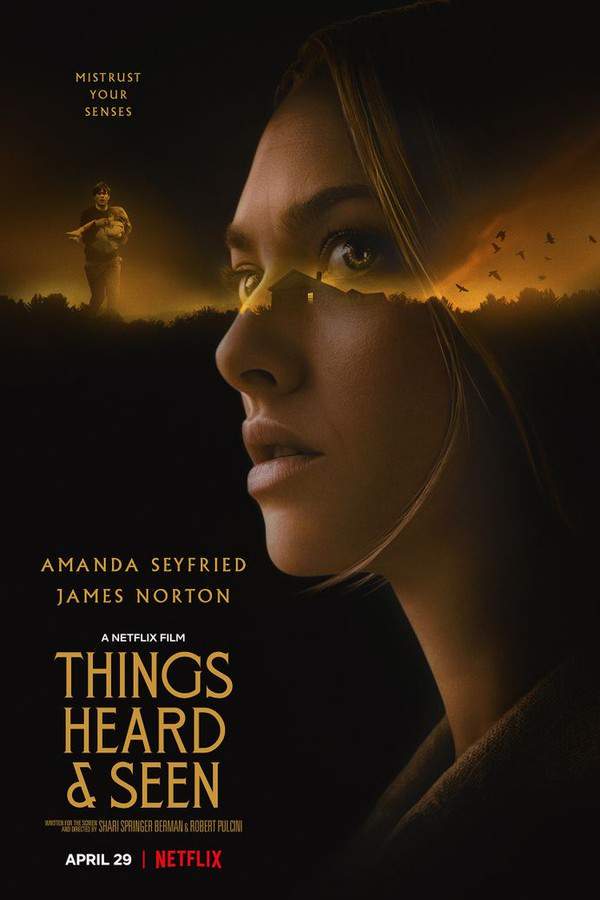
Things Heard & Seen (2021) movie poster

Ending Explained

Things Heard & Seen (2021) Ending Explained – Final Scene & Meaning

Release, runtime and language
2021 · 119 min · English
Echo score 56
Loading streaming availability…
Directed by
Robert Pulcini, Shari Springer Berman
Starring
F. Murray Abraham, Karen Allen, Amanda Seyfried, Alex Neustaedter, Jack Gore, James Norton

Seeking a fresh start, Catherine Clare leaves 1980s Manhattan with her husband George and young daughter Franny, relocating to a historic farmhouse in the Hudson Valley. Hoping for a tranquil life, Catherine soon finds herself increasingly disturbed by unsettling events and the house's mysterious past. As she grapples with the isolation of rural living and hidden truths about her marriage, Catherine’s growing sense of dread leads her to question everything she thought she knew.

On this page (7)
  1. 1 Where to watch
  2. 2 What happens at the end
  3. 3 Final events in order
  4. 4 Ending questions answered
  5. 5 Movie threads
  6. 6 Movies like Things Heard & Seen
  7. 7 Every angle
Loading streaming availability…

Ending explained · contains spoilers

What Happens at the End of Things Heard & Seen?

How Things Heard & Seen (2021) ends, what the final scene means, which earlier moments set it up and how to read the ending if the film leaves it open. The full ending explained, with every spoiler.

The ending of Things Heard & Seen reveals a haunting intertwining of the supernatural and moral consequences of the characters’ choices. Throughout the film, Catherine’s suspicion that their house is haunted and her belief in spirits—supported by Floyd—stand in contrast to the film’s deeper philosophical undertones. According to Swedenborg’s ideas, spirits exist in an intermediate realm, reflecting our true selves rather than being inherently evil or good. This philosophical thread suggests that the supernatural elements are more about revealing inner truths than actual malevolent spirits.

In the climax, George’s moral downfall becomes undeniable. We see him alone on a boat called Lost Horizon, which symbolizes his complete mental disconnection and moral decay. The inscription hints at George’s lost state of mind—he is sinking into a metaphorical hell he has chosen through his actions. His killing of Floyd, who denied his affair and stood in moral opposition, aligns with the idea that George’s evil acts are self-inflicted, not caused by spirits. His row closer to the "gates of hell" signifies that he is willingly marching toward his moral and spiritual destruction, accepting the consequences of his own choices.

The film’s key message, reinforced by Swedenborg’s philosophy, is that evil is a consequence of personal decisions rather than external malevolence. George’s destruction is entirely his own, and the supernatural elements merely serve as a backdrop to his moral decline. In the end, Things Heard & Seen leaves us contemplating the nature of evil—how it manifests from within, shaped by our actions, and how individuals are responsible for their own damnation. George’s fate is a stark reminder that only those about to enter hell can truly see its gates, underscoring that our destiny is ultimately shaped by what we choose to be.

Last updated: June 25, 2025 at 08:58

Was this helpful?

The last 4 events

How Things Heard & Seen Ends: The Final Events in Order

The last events of Things Heard & Seen (2021) in chronological order, the run-up to the ending explained above. The complete timeline has all 15 events, scene by scene.

Open the full timeline
  1. Discovery of George's Infidelity

    Amidst the chaos, Catherine uncovers George's infidelity with Willis, shattering her trust completely. This revelation deepens her turmoil and sets the stage for her subsequent actions, pushing her toward reckless choices.

    Where
    Farmhouse
  2. Catherine’s Affair with Eddie

    In an act of retaliation against George's betrayal, Catherine begins an affair with Eddie. This decision spirals her deeper into conflict, aligning her with the very spirit world that haunted her and complicating her already fragile state.

    Where
    Farmhouse
  3. Catherine's Tragic Fate

    In a desperate attempt to maintain control, George murders Catherine in cold blood, subsequently disguising it as a tragic accident. The shocking turn of events leaves Franny to grapple with the aftermath as suspicions loom over George’s behavior.

    Where
    Farmhouse
  4. George’s Desperate Escape

    In a frantic bid to evade arrest, George attempts to flee on his cousin’s boat as a storm arises. The vessel encounters disaster, mirroring the tragic artwork that had been projected in his class, symbolizing George's ultimate fate for his heinous actions.

    Where
    Water

Ending questions answered

Things Heard & Seen Ending: Your Questions Answered

The questions people ask most about the ending of Things Heard & Seen (2021): what the final scene means, how the twist works, what happens to each character and how to read the ending. Each answer contains spoilers.

Q1

What happens to George at the end of Things Heard & Seen?

George meets his demise on a boat called Lost Horizon. After killing Floyd, George isolates himself on the boat which serves as a symbol of his complete mental disconnection and moral decay. The inscription on the boat hints at his lost state of mind as he sinks into a metaphorical hell of his own making, willingly marching toward his moral and spiritual destruction.

Foreshadowing: Earlier scenes show George's increasing moral deterioration and his growing his facade obsession with maintaining, setting the stage for his ultimate breakdown.

  • george fate
  • boat lost horizon
  • george death
  • final scene
Q2

Why does George kill Floyd?

George kills Floyd because Floyd denied George's affair with his student Maitland and represented moral opposition to George's deceptive lifestyle. The murder represents George's final rejection of accountability and his desperate attempt to eliminate anyone who threatens to expose his true nature. This act solidifies George's descent into self-inflicted evil rather than being caused by any external supernatural force.

Foreshadowing: Throughout the film, George's anger and frustration build as Catherine investigates the house and Floyd challenges his moral authority.

  • floyd murder
  • why george kills
  • affair revelation
  • george violence
Q3

What does the Lost Horizon boat symbolize in the ending?

The Lost Horizon represents George's complete mental disconnection and his journey toward self-destruction. The boat's name directly reflects George's lost state of mind, he has become morally lost and is sinking into a metaphorical hell. His positioning on the boat, rowing closer to the 'gates of hell,' signifies his willing acceptance of the consequences of his own evil choices.

Foreshadowing: The film's earlier references to spiritual philosophy and the idea that evil comes from within foreshadow the boat as a visual representation of George's spiritual isolation.

  • lost horizon meaning
  • boat symbolism
  • george isolation
  • spiritual decay
Q4

Is the house actually haunted or is everything psychological in Things Heard & Seen?

The film suggests the supernatural elements are more about revealing inner truths than actual malevolent spirits. According to Swedenborg's philosophy presented in the film, spirits exist in an intermediate realm reflecting our true selves rather than being inherently evil or good. The unsettling events Catherine experiences ultimately serve to expose the moral corruption already present within her husband George, rather than proving the house is literally haunted.

Foreshadowing: Catherine's suspicions about the house being haunted are contrasted throughout with the deeper philosophical revelations about the nature of evil.

  • house haunted
  • supernatural vs psychological
  • swedenborg philosophy
  • spiritual truth
Q5

What does Swedenborg's philosophy mean for the ending of Things Heard & Seen?

Swedenborg's philosophy provides the framework for understanding that evil stems from personal decisions rather than external malevolence. The supernatural elements in the film serve as a backdrop revealing inner truths about the characters. George's destruction is entirely self-inflicted, the spirits and eerie events merely reflect the moral corruption he has chosen. The key message is that individuals are responsible for their own damnation, and only those about to enter hell can truly see its gates.

Foreshadowing: The film weaves Swedenborg's ideas throughout, with Floyd's explanations establishing the philosophical context that the ending fulfills.

  • swedenborg
  • philosophy evil
  • personal responsibility
  • spiritual meaning
Q6

What happens to Catherine in the ending of Things Heard & Seen?

Catherine survives the film's events but faces the aftermath of discovering her husband's true nature. She has witnessed George's moral collapse and his violent act against Floyd. The ending leaves her in a position of having to confront the reality of her marriage and the man she truly married, though the film focuses more on George's fate than Catherine's specific outcome.

Foreshadowing: Catherine's growing awareness and investigation throughout the film lead her to question everything she thought she knew about her husband.

  • catherine fate
  • george wife
  • survival
  • marriage ending
Q7

Is George possessed by evil spirits or is he just a bad person?

The film clearly indicates George is not possessed, he is simply a bad person making evil choices. Swedenborg's philosophy establishes that spirits reflect our true selves rather than controlling us. George's moral downfall results entirely from his own decisions: his infidelity, his lies, and ultimately his murder of Floyd. The supernatural elements merely mirror the evil already present within him, serving as a visual representation of his internal corruption rather than as an external force controlling his actions.

Foreshadowing: From early in the film, George's lies and infidelity demonstrate his moral character without any suggestion of supernatural possession.

  • george evil
  • possession vs choice
  • moral corruption
  • free will
Q8

What does the ending line about seeing the gates of hell mean?

The ending line 'only those about to enter hell can truly see its gates' means that George has become so morally corrupted that he can no longer hide from his own evil. His choices have brought him to the point where he visibly embodies the spiritual destruction he has chosen. The gates represent his own damnation, which he has earned through his actions and now cannot avoid or deny.

Foreshadowing: This concept connects to the film's broader theme that evil manifests from within and that individuals shape their own spiritual destiny.

  • gates of hell
  • spiritual destruction
  • damnation
  • moral consequence
Q9

Why is Floyd killed and what was his importance in the story?

Floyd is killed because he represents moral opposition to George and threatens to expose George's affair with his student. Throughout the film, Floyd serves as Catherine's ally in understanding the house's history and as a moral voice who believes in spiritual truth rather than supernatural evil. His death at George's hands demonstrates how George eliminates anyone who stands in the way of his deception, ultimately sealing his own moral fate.

Foreshadowing: Floyd's conflicts with George and his support of Catherine establish him as a moral figure whose death would have significant impact.

  • floyd death
  • george affair
  • moral opposition
  • character purpose
Q10

What is the main message of Things Heard & Seen about the nature of evil?

The film's key message is that evil manifests from within and is a consequence of personal decisions rather than external malevolence. George's fate demonstrates that individuals are responsible for their own damnation, the supernatural elements merely serve as a backdrop revealing inner truths. The horror comes not from haunted spirits but from the evil people choose to embody, making the real terror psychological and moral rather than supernatural.

Foreshadowing: The entire narrative builds toward revealing that the true horror lies in human moral corruption, not in ghostly manifestations.

  • evil nature
  • personal responsibility
  • moral choice
  • theme meaning

Movie threads

More Movies Like Things Heard & Seen, by Mood & Story

Curated lists built around what makes Things Heard & Seen tick: the same mood, the same kind of story or the same emotional payoff. Each list explains why these movies belong together.

Atmospheric horror movies like Things Heard & Seen

Stories where the setting itself becomes a source of growing supernatural terror. If you liked the slow-burn dread and supernatural presence in Things Heard & Seen, you'll find more movies here with a similar vibe. These films focus on atmospheric horror where the setting itself is haunted, creating a sense of unease and uncovering sinister secrets.

  • atmospheric
  • dreadful
  • sinister
  • suspenseful
  • supernatural
  • uneasy
  • Tone: dark, sinister
  • Pacing: steady, slow burn
Why these movies?

The story pattern: Narratives in this thread often follow characters who move into or discover a location with a troubled past. The story unfolds as they perceive increasingly disturbing phenomena, leading them to investigate and confront the source of the haunting, which is often tied to a historical tragedy or unresolved injustice.

Why they belong together: Movies are grouped here for their shared emphasis on mood and setting over visceral scares. They prioritize a creeping, pervasive sense of dread, using the environment to generate psychological tension and explore themes of history's lingering echo on the present.
Psychological thrillers about betrayal like Things Heard & Seen

Thrillers where personal dread is magnified by the treachery of a intimate partner. For viewers who enjoyed the themes of marital betrayal and psychological unraveling in Things Heard & Seen, this section recommends similar movies. These stories focus on the horror of discovering a partner's secrets, leading to a heavy emotional weight and a tense, distrustful atmosphere.

  • paranoid
  • isolated
  • suspenseful
  • dreadful
  • psychological
  • tense
  • Tone: dark, paranoid
  • Pacing: steady
Why these movies?

The story pattern: The narrative pattern involves a protagonist, frequently isolated in a new environment, who begins to suspect their partner is not who they seem. The tension escalates as small lies compound into major betrayals, forcing the protagonist to investigate alone, often leading to a confrontation that reveals the full extent of the deception and danger.

Why they belong together: These films are connected by their exploration of intimate betrayal as a source of horror. They share a heavy emotional weight, a dark tone, and a focus on the psychological deterioration of a character who realizes the person closest to them is their greatest threat.

If you liked this

Movies Like Things Heard & Seen

Similar movies to Things Heard & Seen: the same genre, themes or kind of story. Each one comes with its own plot summary, timeline and ending explained.

Browse all movie summaries

Every angle

Things Heard & Seen (2021) Explained: Plot, Ending, Timeline & Characters

Everything about Things Heard & Seen in one place: what happens in the plot summary, the timeline in chronological order, the characters and meaning, the ending explained and a spoiler-free summary. What's After the Movie adds the cast, box office and post-credit scenes.

Coming soon on iOS and Android

The Plot Explained Movie Summary App

Plot summaries, endings explained and timelines on your phone. Catch up on any movie in minutes, save your favorites and never miss a twist again.

Be the first to know when we launch. Your email stays private, always.

Learn more about the app