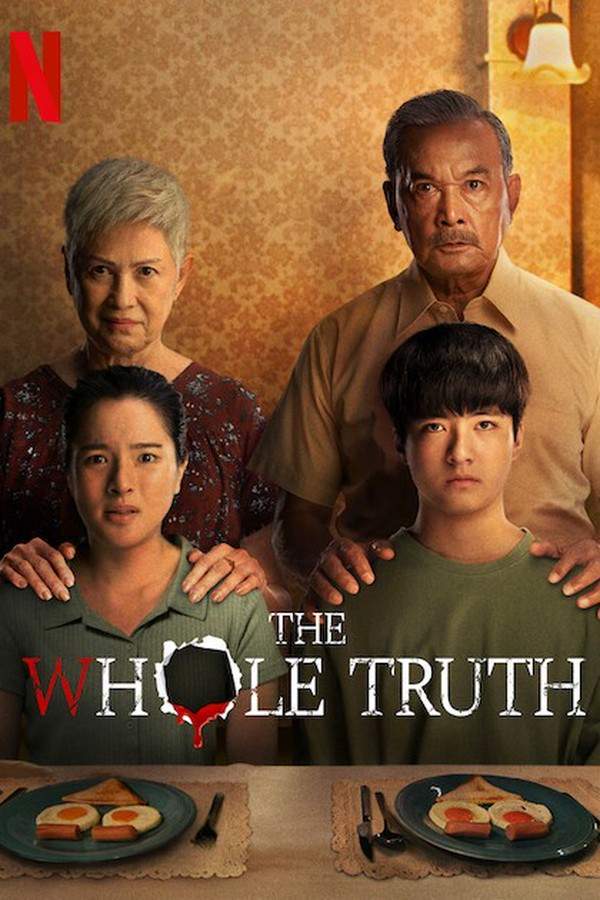
Pim and Putt are teenage siblings trying to navigate school, family secrets, and a house that seems to bend time. Pim is a popular cheerleader who lights up her world with school pride and social visibility, while Putt moves through days with a quiet intensity and a leg brace that keeps him grounded, both emotionally and physically. Their mother, Mai, is a working single mom who has just landed a higher-paying job, which leaves the siblings temporarily in the care of their aging grandparents, Wan and Phong, whose presence hints at a family history that has quietly cracked the surface.
The day Pim comes home from school, she finds Putt and his friend Fame playing video games. Fame, who already carries a reputation for trouble, follows Pim upstairs and tries to force his way into her room while she’s changing. Putt can’t assist—his leg keeps him from climbing the stairs in time. Fame toys with the situation, reminding Putt that he has something important—a mysterious video—that could be used to blackmail him. Pim phones Mai to warn her about Fame, but Mai’s reply is blunt: she must stay late for a meeting. The night grows heavy with rain, and Mai’s drive ends in a car accident, a catastrophe that binds the siblings to their grandparents’ house longer than planned.
At the hospital, Mai lies in a coma in the ICU, and Pim and Putt meet Wan, their grandmother, who seems both caring and unsettling. Wan insists the teens stay in their mother’s old room and hints they once lived there as children, though the memories feel foggy to Pim and Putt. Wan’s demeanor turns eerie and elusive, and she cautions the teens not to upset their grandfather, even as a sense of unease quietly takes root. The family’s dynamics darken when an unassuming hole appears in the wall between the grandparents’ house and the one next door. Putt discovers the hole first, peering through to a house that looks decayed and abandoned, with a dark-haired figure lurking inside. He shares the find with Pim, who dismisses it as a trick of the mind—until the hole reappears with a renewed hunger for attention.
As the days pass, Fame’s threats surface again. He wants to expose the video, and Pim’s intuition about Fame’s bad faith grows stronger. The hole becomes a fulcrum for fear: a wet scraping sound behind the wall, a glimpse of a girl with a deeply swollen, dark face, and a smeared trail of dark liquid that oozes from her mouth. Pim witnesses the girl through the hole, while Putt insists the vision is real, even as Fame himself is physically unable to perceive it. The tension erupts when Fame grabs for his phone, only to be met with a bloody nose after he attempts to peek through the hole. Pim confirms that Fame had been blackmailing Putt for access to the video of Pim in the gym shower, and she severs the blackmail contact.
Over time, the adults’ secrets start to spill. A newspaper headline confirms a grim turn of events: Chaiyut, the son of a wealthy real estate magnate named Apiwat, has “walked free” after his friend confessed to driving during a fatal hit-and-run. Phong, the grandfather, grapples with this news, advocating that justice be pursued by any means, even if it means taking matters into his own hands. The siblings uncover more about the house next door and the clockless wall that has become a corridor to another time. An important figure in the backstory, Pinya, enters the narrative as Wan and Phong’s daughter, whose face bears a heavy, swollen look that hints at a tragedy tied to poison and a closet—a tragedy that Wan refuses to fully reveal.
The plot thickens as Pim is chosen to be head cheerleader again, shattering the tension about the video, while Paew, another pupil, is exposed as the one who circulated it in her relentless pursuit of social standing. Pim’s victory is tempered by Putt’s worsening health; he coughs blood and grows sicker with each passing night. The hole’s whispers intensify, revealing more about the house across the hall than any of them suspected. Putt theorizes that the wall acts as a wormhole into a different time or dimension, while Phong tries to shield his family from the truth that lies beyond the wall’s gaping mouth.
As Phong investigates his old police case, he confronts the idea that the truth behind Chaiyut’s hit-and-run may have been buried by a powerful network. The siblings observe their grandparents’ strange behavior—Wan’s sudden calmness, Pim’s sudden reappearances of the cat Latte, and the renewed energy of the claim that a dark, ghostly girl wants to speak. A pivotal moment arrives when Wan confronts the limits of her own memory, admitting she has kept her pills to remain compliant under someone’s coercion. The twins realize that the wall does not just connect two houses; it connects the past to the present in a way that may decide who lives and who dies.
The revelations converge in a crescendo of memory and guilt. Mai reveals that Pinya, Wan’s daughter, and Krit, Mai’s partner, died in a sequence of tragic events that escalated after Pinya’s own mysterious illness and the family’s fragile ability to tell the truth. Pinya’s death is tied to a dangerous secret involving poison, a closet, and the possibility that Krit’s life spiraled into a web of denial and self-preservation. The narrative cuts between present-day struggle and a feverish montage of flashbacks: Mai’s act of shooting Krit in a moment of rage, Phong’s reluctant complicity in covering up the suicide, and Wan’s long moral compromise that kept Pinya and the truth hidden.
In the present, Wan’s hold on the past shatters. Phong’s attempt to confront Chaiyut’s fate reveals that the case was not as clean as it seemed, and the evidence points to a murder that was more about who held the power than who actually drove the car. As the family battles illness—the siblings’ bodies weakening under the strain of the haunting and the truth—the final act unfolds with an irreversible act of violence. Wan dies amid a storm of memories and a gunshot, while Phong, overwhelmed by guilt and fear, takes his own life in a moment of fatal release, creating the very hole in the wall that he never could truly see. The film’s last images pull us back to Mai, who appears composed and confident, preparing herself for what comes next.
In the end, Pim and Putt return to their home with Mai, the hole still visible as a doorway to the past. Pinya’s ghost appears as a quiet, sorrowful presence beside Pim, and the family’s history, once hidden in plain sight, remains a living testament to the ways memory, love, and fear can collide. Mai’s lipstick glints in a pale reflection as Pim holds the hand of Pinya’s specter, suggesting that the living and the dead are never truly separated here. The story leaves a lingering question about what truths have finally been faced, what lies were kept, and how a house can remember the sins of those who tried to forget.