Plot Explained Spoilers guaranteed!
Plot Explained

Browse by genre

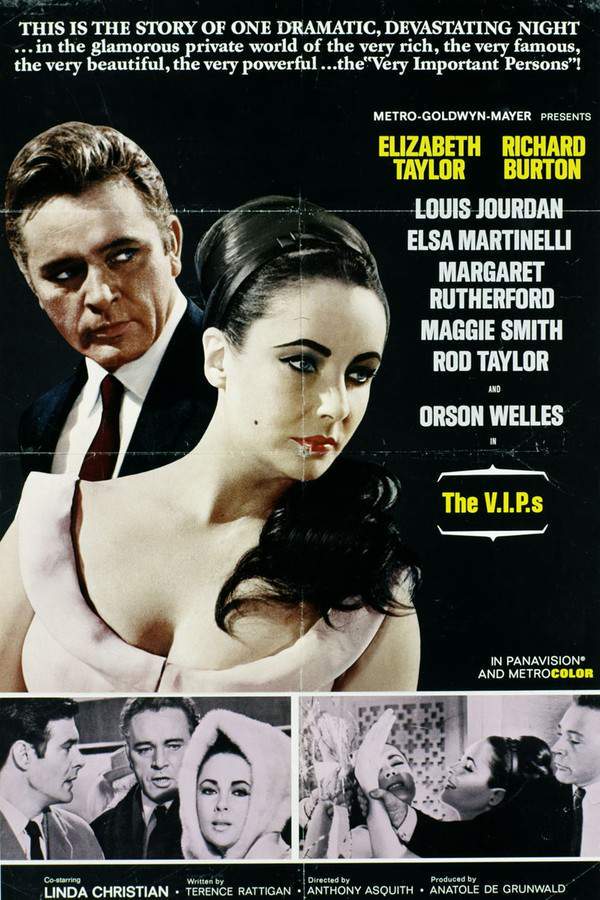
The V.I.P.s (1963) movie poster

Plot Summary

The V.I.P.s (1963) Plot Summary Explained

Release, runtime and language
1963 · 119 min · English
Loading streaming availability…
Directed by
Anthony Asquith
Starring
Rod Taylor, Margaret Rutherford, Orson Welles, Maggie Smith, Elizabeth Taylor, Richard Burton

A sudden storm grounds a flight from London to New York, forcing a group of wealthy passengers to confront personal struggles. Frances, a stylish socialite, grapples with a failing marriage and seeks a fresh start. A duchess battles to uphold her image and status, while an ambitious actress tries to break into the competitive world of acting. The unexpected delay reveals hidden tensions and vulnerabilities within this privileged group.

On this page (6)
  1. 1 Where to watch
  2. 2 What happens: full plot
  3. 3 Plot questions answered
  4. 4 Movie threads
  5. 5 Movies like The V.I.P.s
  6. 6 Every angle
Loading streaming availability…

Full plot summary · contains spoilers

What Happens in The V.I.P.s: Full Plot Summary

The whole story of The V.I.P.s (1963) explained, from the opening scene to the final frame: every key event, every twist and what it all adds up to. Read it as a quick recap before the sequel, to check a scene you missed, or to finally understand what really happened.

Fog shrouds Terminal 3 at Heathrow, turning a routine layover into a tangled crossroads where a group of VIPs confronts the drama in their own lives. Elizabeth Taylor stars as Frances Andros, a celebrated actress who is trying to leave her husband, Richard Burton as Paul Andros, for her lover Louis Jourdan in a plot fueled as much by desire as by fear of the consequences. The tension between loyalty and longing plays out against the hum of the terminal, where announcements are drowned by the murmur of private schemes, each character weighing how far they’re willing to go when time is slipping away.

In this web of near-misses and near-confessions, the central couple’s fate trembles on a knife-edge. Paul Andros, a man of wealth and influence, is not simply facing a straightforward heartbreak; he must reckon with the very real possibility of losing the woman he believes he deserves, not to a casual affair but to a decision that would redefine their entire lives. The atmosphere is charged with what-ifs, and the fog outside mirrors the uncertainty inside, making every exchange feel like a high-stakes negotiation where a single sentence might derail futures.

The airport’s other dramas unfold with equal gravity. The Duchess of Brighton, an aristocrat whose life has long been shaped by status and expectation, is portrayed by Margaret Rutherford. She is on a journey toward Florida that promises money enough to save a cherished home, and her presence adds a layer of old-world elegance and hidden anxieties to the scene. Her itinerary intersects, however briefly, with the fortunes and misfortunes swirling around the other VIPs, reminding viewers that social rank does not inoculate anyone from crisis or compromise.

Across the corridors, the arrival of a bold film project collides with the need for swift departures. Orson Welles embodies Max Buda, a forceful film producer who must leave London and escort his newest protégée, Elsa Martinelli as Gloria Gritti, before midnight to escape a looming tax bill. The pressure cooker of deadlines heightens the stakes, as money and career pressures push characters toward choices that expose their vulnerabilities and test their loyalties. Gloria Gritti is young and ambitious, yet caught between professional ambition and the mores of a world that prizes appearances as much as outcomes.

Meanwhile, in a quieter, more personal orbit, Rod Taylor plays Les Mangrum, an Australian businessman who must reach New York City to protect his enterprise from being sold out from under him. His sense of urgency is sharpened by the quiet devotion of his secretary, Miss Mead, a character portrayed with sharp edges and genuine feeling by Maggie Smith. Miss Mead is quietly in love with Mangrum, a truth she private-carries even as she contends with the practical demands of her job and the reckless vagaries of the business world. The romance grounds the broader drama in something intimate and human, giving the terminal’s fretful atmosphere a human scale.

The morning’s delays set off a chain reaction of negotiations, where characters seek each other out for help, money, or a second chance. Max Buda’s need to depart casts a pall over the possibilities offered by the location poster he spots—the Duchess’s home—an image that hints at a film deal that could become the very thing that sustains or destabilizes a life. The idea of using a real home as a film location serves as a tangible emblem of how art, commerce, and personal history are all threaded together in this microcosm of society under pressure.

As the day wears on and the fog thickens, alliances shift in small, telling ways. The various strands of the narrative—marital strain, financial peril, professional ambition, and unrequited longing—interweave to reveal how fragile stability can be when so many desires collide in a single place. The VIPs’ stories do not collide in loud melodrama; they collide in quiet moments of decision, in looks passed across crowded rooms, in the unspoken questions that hover just beyond the reach of polite conversation.

In the end, the film returns to the core tension that began the tale: Frances Andros’s possible departure from Paul Andros. The near-suicide that haunts Paul is avoided not by a grand gesture, but by a reconciliation born from a moment of honesty and a willingness to choose something lasting over something alluring but uncertain. The moment is small, almost incidental, but it satisfies a fundamental human need for connection even as the world outside remains a blur of rain and runway lights. The fog lifts not with fireworks, but with a quiet, earned sense of resolution that acknowledges how fragile happiness can be and how fragile wealth and status can be when tested by real emotion.

Beyond the plot’s surface, the film offers a meditation on time and restraint. The Heathrow terminal becomes a crucible where characters confront the limits of their plans and the unpredictable nature of fate. The interconnected stories emphasize that even when lives run along parallel lines—two people in a strained marriage, a producer chasing a profit, a secretary willing to risk everything for love, an aristocrat juggling duty and desire—their outcomes are not predetermined. They are shaped by choices made in the margins, in conversations held in crowded lounges, and in the quiet moments when someone chooses not to press a button, not to take a chance, not to walk away.

The performances anchor the narrative with a measured elegance that suits the film’s premise. Elizabeth Taylor and Richard Burton bring a charged authenticity to Frances Andros and Paul Andros, their dynamic a study in passion tempered by history. Orson Welles infuses Max Buda with the gruff confidence and improvisational energy that makes him feel simultaneously larger-than-life and intimately real. Maggie Smith’s Miss Mead offers a blend of vulnerability and steel, a testament to love’s stubborn persistence even in precarious circumstances. Margaret Rutherford’s Duchess of Brighton embodies a grace under pressure, while Louis Jourdan’s Marc Champselle represents the allure and risk of a path not taken. Rod Taylor’s Mangrum grounds the story in a practical, urgent world, and Elsa Martinelli’s Gloria Gritti adds a touch of modern appetite and ambition to the ensemble. Linda Christian's presence adds another layer to the tapestry of faces who inhabit this fog-bound aerodrome, reminding us that every life has its own unspoken history.

Overall, the film uses a single setting—a terminal caught between delays and destinies—to explore how people navigate love, money, duty, and opportunity when time itself feels suspended. It maintains a tone that is thoughtful and restrained rather than sensational, allowing the emotional weather to unfold with quiet intensity. The result is a portrait of a moment when extraordinary people confront ordinary truths: that life can hinge on one conversation, one decision, one willingness to stay, and that sometimes reconciliation—not escape—offers the most meaningful form of escape from an uncertain world.
Last updated: March 05, 2026 at 18:41

Was this helpful?

Plot questions answered

The V.I.P.s Plot Explained: Your Questions Answered

The questions people ask most about The V.I.P.s (1963): what happens in the confusing scenes, why the characters do what they do, the twists, hidden details and what the ending means. Each answer contains spoilers.

Q1

Why does Frances Andros want to leave her husband for Marc Champselle?

Frances Andros wants to leave her husband Paul because their marriage has become strained and she has developed feelings for Marc Champselle. Her decision is driven by a desire for a fresh start and genuine emotional connection, though she fears the consequences of abandoning her established life. The fog-bound delay forces her to confront whether she's willing to truly commit to this dramatic change.

  • frances andros
  • marc champselle
  • paul andros
  • marriage
  • affair
  • leaving husband
Q2

Why does Paul Andros nearly commit suicide at the airport?

Paul Andros nearly commits suicide because he's devastated by Frances's decision to leave him for another man. The combination of being publicly humiliated, losing the woman he believes he deserves, and the claustrophobic pressure of the airport delay pushes him to the edge. His near-suicide represents the emotional breaking point of a wealthy but emotionally vulnerable man confronting rejection.

  • paul andros
  • suicide
  • emotional breakdown
  • rejection
  • desperation
Q3

What is the Duchess of Brighton's financial dilemma?

The Duchess of Brighton faces financial ruin and risks losing her historic home unless she can secure a substantial amount of money. She travels to Florida for a job that promises to provide the funds needed to keep her cherished property. Her situation represents how even aristocracy is not immune to financial pressures and the desperate measures required to maintain status.

  • duchess of brighton
  • florida
  • financial trouble
  • home
  • money
  • aristocrat
Q4

Why must Max Buda leave London by midnight?

Max Buda must leave London by midnight with his young protégée Gloria Gritti to escape a looming tax bill that would otherwise cripple his finances. The midnight deadline creates urgent pressure, forcing him to make quick decisions about his film project and future. This deadline drives much of his interaction with the Duchess regarding her home as a potential film location.

  • max buda
  • midnight
  • tax bill
  • london
  • gloria gritti
  • film producer
  • deadline
Q5

How does Miss Mead feel about Les Mangrum?

Miss Mead is quietly in love with her employer Les Mangrum, though she keeps her feelings hidden throughout the film. Despite her professional demeanor and sharp edges, she acts selflessly on his behalf, approaching Paul Andros to request financial help that could save Mangrum's company. Her unrequited love represents the film's quieter, more intimate emotional undercurrent.

  • miss mead
  • les mangrum
  • secretary
  • love
  • unrequited
  • devotion
Q6

What deal does Max Buda make with the Duchess of Brighton?

Max Buda discovers a poster featuring the Duchess's historic home and proposes using it as a film location. In exchange for allowing her property to be filmed, the Duchess receives a cash payment substantial enough to save her home from financial ruin. The deal provides Buda with a valuable production location while solving her immediate financial crisis.

  • max buda
  • duchess
  • home
  • film location
  • deal
  • money
  • payment
Q7

How do Frances and Paul reconcile at the end?

Frances and Paul reconcile at the last moment when Frances realizes she doesn't want to lose her husband after all. Rather than a grand gesture, their reconciliation comes through a moment of honesty and vulnerability, Frances chooses lasting connection over uncertain allure. The fog lifting mirrors their emotional clarity, as they find their way back to each other despite the chaos around them.

  • frances andros
  • paul andros
  • reconciliation
  • marriage
  • fog
  • resolution
Q8

Why are all the flights grounded at Heathrow Airport?

Heavy fog shrouding Terminal 3 at Heathrow forces flight cancellations and severe delays, trapping the wealthy passengers in the terminal. The fog creates the literal circumstances that bring all these VIPs together and prevents anyone from leaving, the storm becomes both a plot mechanism and a metaphor for the characters' emotional uncertainty and confusion.

  • heathrow
  • fog
  • flight delay
  • airport
  • storm
  • grounded flights
Q9

Why does Les Mangrum need to reach New York urgently?

Les Mangrum must reach New York City quickly because his business is at risk of being sold out from under him by competitors. His secretary Miss Mead's efforts to secure financial help directly relate to preventing this corporate takeover. The New York deadline adds urgent stakes to his storyline and motivates his presence at the airport during the fog delay.

  • les mangrum
  • new york
  • business
  • company
  • sale
  • urgency
  • deadline
Q10

What role does Gloria Gritti play in Max Buda's plans?

Gloria Gritti is Max Buda's young and ambitious protégée whom he must escort out of London before midnight to avoid the tax consequences. She represents professional ambition in the film industry and is caught between her career aspirations and the expectations of the entertainment world's power structures. Her presence adds a modern, hungry energy to the ensemble.

  • gloria gritti
  • max buda
  • protégée
  • actress
  • ambition
  • film career
Q11

Why does the film take place entirely at an airport terminal?

The airport terminal serves as both a literal setting and a symbolic crucible where characters confront their lives suspended between destinations. The confined space forces interactions between people who might otherwise never meet, while the delays create the pressure cooker environment where secrets are revealed and decisions are made. The terminal becomes a microcosm of society under stress.

  • airport terminal
  • setting
  • confined space
  • delays
  • heahtrow
  • suspense

Movie threads

More Movies Like The V.I.P.s, by Mood & Story

Curated lists built around what makes The V.I.P.s tick: the same mood, the same kind of story or the same emotional payoff. Each list explains why these movies belong together.

Confined crisis dramas like The V.I.P.s

Personal crises intensify when characters are trapped together in a single setting. Movies like The V.I.P.s where characters are forced together in a single location, leading to intense personal and emotional confrontations. This collection features similar dramas where a confined setting amplifies the stakes and accelerates the narrative.

  • tense
  • claustrophobic
  • dramatic
  • anxious
  • melancholic
  • hopeful
  • Tone: tense, dramatic, bittersweet
  • Pacing: steady, deliberate
Why these movies?

The story pattern: Stories in this thread often begin with a disruptive event that traps a group of diverse characters together. As they cannot escape the situation or each other, their personal struggles and conflicts become the central focus, leading to dramatic confrontations and emotional resolutions.

Why they belong together: These films are grouped by their shared premise of a confined setting that catalyzes the drama. They create a claustrophobic, tense mood by focusing on character interactions under pressure, resulting in a steady-paced, emotionally charged viewing experience.

Bittersweet interconnected dramas like The V.I.P.s

Multiple storylines converge, revealing the poignant connections between strangers. If you liked the multiple storylines in The V.I.P.s, explore these films featuring interconnected lives facing personal crises. These dramas share a bittersweet tone and a focus on how chance encounters reveal our shared vulnerabilities.

  • dramatic
  • melancholic
  • hopeful
  • thoughtful
  • interconnected
  • character-driven
  • Tone: bittersweet, dramatic, melancholic
  • Pacing: steady, character-driven
Why these movies?

The story pattern: The narrative pattern follows a diverse group of characters, each with their own urgent personal arc, whose paths cross due to a shared event or location. Their stories unfold in parallel, sometimes briefly connecting, and resolve with a mix of hopeful and melancholic outcomes that feel true to life.

Why they belong together: These movies are connected by their multi-strand narrative structure and a consistently bittersweet emotional tone. They offer a moderate level of complexity by balancing several character arcs, creating a rich, dramatic tapestry that explores universal human experiences.

If you liked this

Movies Like The V.I.P.s

Similar movies to The V.I.P.s: the same genre, themes or kind of story. Each one comes with its own plot summary, timeline and ending explained.

Browse all movie summaries

Every angle

The V.I.P.s (1963) Explained: Plot, Timeline & Characters

Everything about The V.I.P.s in one place: what happens in the plot summary, the timeline in chronological order, the characters and meaning and a spoiler-free summary. What's After the Movie adds the cast, box office and post-credit scenes.

Coming soon on iOS and Android

The Plot Explained Movie Summary App

Plot summaries, endings explained and timelines on your phone. Catch up on any movie in minutes, save your favorites and never miss a twist again.

Be the first to know when we launch. Your email stays private, always.

Learn more about the app