Plot Explained Spoilers guaranteed!
Plot Explained

Browse by genre

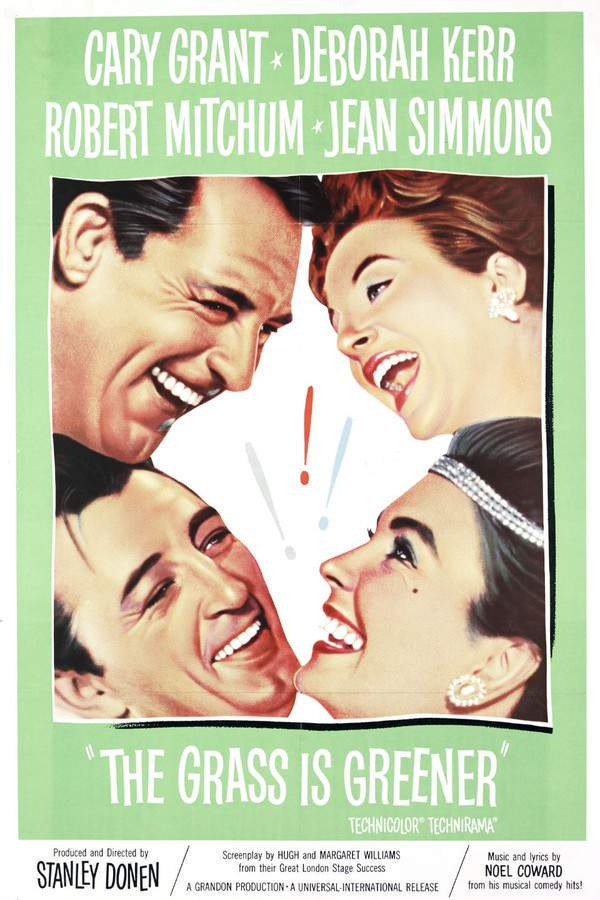
The Grass Is Greener (1960) movie poster

Plot Summary

The Grass Is Greener (1960) Plot Summary Explained

Release, runtime and language
1960 · 104 min · English
JustWatch #34,309
Directed by
Stanley Donen
Starring
Jean Simmons, Robert Mitchum, Deborah Kerr, Cary Grant, Aileen Lewis, Elisabeth Orion

An aristocratic British couple, Lord and Lady D'Arcy, decide to open their stately home to the public. Their intentions are noble, but they soon encounter a series of misunderstandings and humorous situations as they navigate cultural differences and the unexpected arrival of an American oil tycoon, leading to surprising romantic developments.

On this page (6)
  1. 1 Where to watch
  2. 2 What happens: full plot
  3. 3 Plot questions answered
  4. 4 Movie threads
  5. 5 Movies like The Grass Is Greener
  6. 6 Every angle

Where to watch

Where to Watch The Grass Is Greener (1960)

Where can you watch The Grass Is Greener? Stream, rent or buy it in the US, including on Kanopy, Amazon Video and Apple TV Store: current JustWatch availability with up-to-date prices.

Streaming availability powered by JustWatch

Full plot summary · contains spoilers

What Happens in The Grass Is Greener: Full Plot Summary

The whole story of The Grass Is Greener (1960) explained, from the opening scene to the final frame: every key event, every twist and what it all adds up to. Read it as a quick recap before the sequel, to check a scene you missed, or to finally understand what really happened.

Victor and Hilary, the Earl and Countess of Rhyall, are struggling to manage their lavish English country estate amidst the twentieth-century inheritance tax turmoil that has hit Britain. To alleviate their financial woes, they have resorted to charging curious visitors a small fee of two shillings and sixpence to explore their grand home. Surprisingly, this unorthodox strategy has become quite profitable, and they also delve into mushroom cultivation for sale while engaging in various entrepreneurial activities related to their estate.

However, their peaceful existence is disrupted by the unexpected arrival of Charles Delacro, a bold American oil magnate who breeches their private space, stripping a "Private" sign off the door. Initially taken aback, Hilary is captivated by Charles' immense wealth and his brazen demeanor, transforming her initial shock into intrigue. Despite being married to Victor, his confident charm sparks a whirlwind of emotions within her. Their conversation flows easily, leading Hilary to invite Charles for a drink, during which he invites her to join him at the luxurious Savoy hotel in London, his intentions clear but veiled in charm.

When Victor suddenly appears, the dynamic shifts. Observant and knowing, he interacts with Charles in a cordial yet loaded manner. The evening ends with Hilary planning a hair appointment in London, claiming she’ll be spending the night with their single friend, Hattie Durant. Victor, while pretending to be oblivious, offers guidance on train schedules, simmering with jealousy beneath his calm exterior.

The next day, Charles, determined to make his presence known, locates Hilary's hairdresser and lies in wait outside the salon. The two proceed to his hotel room, crossing further into forbidden territory as they head to the bedroom. Victor, meanwhile, grows increasingly uneasy as Hattie, still pining for him, implores her concerns regarding Hilary's loyalty. Ignoring Hilary's wishes, Victor invites Charles to their home under the pretext of rekindling an acquaintance. Charles graciously offers to drive Victor back from London, planting the seeds for future chaos.

As dawn arrives, Victor resolves to maintain a façade of control. Initially, he feigns ignorance about the affair, opting for a fishing trip with Charles instead. In a moment of candor, he reveals that he is fully aware of the betrayal and the threat to his honor weighs heavily on him. Victor challenges Charles, igniting a sense of obligation within the arrogant tycoon to respond. In the dimly lit hallways of their estate, they meet for a duel, firing their weapons once with an eerie silence enveloping them. Victor is left nursing a wound to his arm, while Charles remains unscathed.

Yet, the aftermath reveals a calculated act: both men deliberately aimed to miss, trusting that neither truly wished for the duel to escalate fatally. Unknown to them, the family's mysterious butler, Sellers, an adept marksman from his past military experience, watched the encounter unfold from the shadows, ensuring that Victor’s hit was not accidental.

This duel's revelation sends shockwaves among the women in their lives. Hilary wrestles with her feelings, torn between her duty to Victor and her attraction to Delacro. Ultimately, she chooses loyalty to her husband, though her heart remains conflicted. In the interim, Hattie departs with Charles, leaving in her wake an air of uncertainty as this drama of love, loyalty, and rivalry continues to unfold.
Last updated: November 17, 2024 at 20:08

Was this helpful?

Plot questions answered

The Grass Is Greener Plot Explained: Your Questions Answered

The questions people ask most about The Grass Is Greener (1960): what happens in the confusing scenes, why the characters do what they do, the twists, hidden details and what the ending means. Each answer contains spoilers.

Q1

Why does Victor challenge Charles to a duel?

Victor challenges Charles to a duel after discovering that Hilary is having an affair with him. Although Victor had been feigning ignorance about the relationship, he finally confronts Charles directly during their fishing trip, revealing that he is fully aware of the betrayal. The duel is prompted by Victor's wounded honor and the social code of the era, which demanded a response to such marital infidelity. However, neither man truly wishes to kill the other, setting up the deliberate miss that follows.

Foreshadowing: Victor's jealousy was already evident earlier when he offered Hilary train schedule advice while quietly simmering with resentment.

  • victor
  • charles
  • duel
  • honor
  • challenge
  • affair
Q2

Why do both Victor and Charles miss their shots during the duel?

Both men deliberately aim to miss because neither truly wants to kill the other. Victor, despite his anger, recognizes that Charles has not actually forced Hilary into the affair, she went willingly. Charles, meanwhile, feels a residual respect for Victor as Hilary's husband and does not want to commit murder over the situation. Their mutual decision to miss represents an unspoken understanding between men of honor, choosing to preserve their lives and dignity rather than escalate the conflict to tragedy.

Foreshadowing: The fishing trip conversation revealed both men's reluctance to let the situation become fatal.

  • duel
  • miss
  • intentional
  • shot
  • victor
  • charles
Q3

Why does Hilary choose to stay with Victor instead of leaving with Charles?

Hilary ultimately chooses loyalty to her husband Victor despite her genuine attraction to Charles and his immense wealth. The decision reflects her sense of duty and the social expectations of her position as Countess. Though her heart remains conflicted between her attraction to Charles's boldness and her commitment to Victor, she prioritizes her marriage. Her choice is complicated by the fact that she entered into the affair voluntarily, Charles did not coerce her, making her guilt and sense of responsibility factor into her decision.

Foreshadowing: Earlier in the story, Hilary's initial reaction to Charles was one of intrigue rather than resistance, showing her internal conflict from the start.

  • hilary
  • victor
  • loyalty
  • marriage
  • choice
  • charles
Q4

Who is Sellers and why is he watching the duel?

Sellers is the family's butler, described as mysterious, who has a hidden past as a skilled marksman from his military service. He covertly monitors the duel from the shadows, ensuring that Victor's wound is not accidental, meaning he was watching to protect Victor or possibly intervene if the situation turned truly dangerous. His presence adds an element of hidden competence and loyalty, suggesting he serves the family with discreet capabilities beyond typical household duties.

Foreshadowing: Sellers is introduced as the family's mysterious butler from the beginning, with his military background hinted at in the narrative.

  • sellers
  • butler
  • marksman
  • duel
  • military
  • watching
Q5

Why does Hattie leave with Charles at the end of the movie?

Hattie leaves with Charles as a surprising turn in the story's aftermath. Throughout the film, Hattie had been infatuated with Victor and had even warned him about Hilary's fidelity, making her departure with Charles somewhat unexpected. This development suggests that Hattie may have been seeking her own romantic escape or perhaps moved opportunistically after seeing the chaos in Victor and Hilary's marriage. The departure leaves relationships in an unresolved, uncertain state, emphasizing the film's mixed ending.

Foreshadowing: Hattie's infatuation with Victor was visible throughout, but her disappointment when he remained focused on Hilary may have driven her to seek alternative companionship.

  • hattie
  • charles
  • leaves
  • departure
  • romance
Q6

Why are Victor and Hilary charging visitors to see their estate?

Victor and Hilary opened their estate to the public because they are struggling financially due to twentieth-century inheritance tax turmoil affecting Britain's aristocratic families. The steep taxes threaten their ability to maintain the grand Rhyall estate. Their solution, charging visitors two shillings and sixpence to tour the property, proves surprisingly profitable. They also start mushroom cultivation as an additional revenue stream. This financial pressure is the backdrop that makes their lives vulnerable to outside disruption, such as Charles's arrival.

Foreshadowing: The opening context establishes their financial desperation as the reason they become receptive to unexpected visitors.

  • estate
  • financial
  • tax
  • visitors
  • money
  • struggle
Q7

Why does Charles Delacro come to the estate?

Charles Delacro arrives at the Rhyall estate as an audacious American oil magnate who simply takes what he wants. He breezes past the "Private" signs and enters the estate uninvited, demonstrating his bold, confident, and somewhat entitled demeanor typical of a wealthy American businessman. His initial intrusion seems motivated by curiosity about British aristocracy and perhaps a desire to acquire prestigious connections. His immediate captivation with Hilary drives much of the subsequent plot.

Foreshadowing: Charles's character is established from the start as someone who ignores boundaries and takes what attracts him.

  • charles
  • delacro
  • oil
  • tycoon
  • arrival
  • estate
Q8

Why does Victor invite Charles to return to the estate after discovering the affair?

Victor invites Charles back to the estate under the pretense of rekindling an acquaintance, but his true motivation is jealousy and a desire to confront the situation directly. Although Hilary had asked him not to contact Charles, Victor acts against her wishes, using the invitation as a trap of sorts. This decision leads directly to the fishing trip confrontation and the subsequent duel. Victor's choice to bring his rival into his home reflects his attempt to maintain control and face the threat head-on.

Foreshadowing: Victor's jealousy was evident when he pretended not to notice Hilary's lies about her London trip.

  • victor
  • invitation
  • charles
  • estate
  • jealousy
  • confrontation

Movie threads

More Movies Like The Grass Is Greener, by Mood & Story

Curated lists built around what makes The Grass Is Greener tick: the same mood, the same kind of story or the same emotional payoff. Each list explains why these movies belong together.

Sophisticated Comedies of Manners like The Grass Is Greener

Witty, urbane stories where social graces mask romantic tensions and class conflicts. Discover movies like 'The Grass Is Greener' that master the art of the comedy of manners. These films are perfect for viewers who enjoy witty banter, romantic tension, and stories set in elegant worlds where social decorum is both a shield and a weapon.

  • witty
  • sophisticated
  • romantic tension
  • urbane
  • deceptive
  • calm
  • Tone: witty, urbane, with romantic tension
  • Pacing: steady, dialogue-driven
Why these movies?

The story pattern: These narratives typically unfold in affluent or aristocratic settings, where characters navigate a web of social expectations, romantic rivalries, and subtle power plays. The plot often revolves around a disruption to the status quo—a new suitor, a financial threat, or a secret—that tests the characters' loyalties and composure, leading to a resolution that is rarely entirely happy or sad.

Why they belong together: Movies are grouped here for their shared commitment to wit, sophistication, and the exploration of human relationships through the lens of social custom. They balance humor with genuine emotional stakes, creating a unique blend of light entertainment and insightful drama.

Marital Dramedies with Mixed Endings like The Grass Is Greener

Stories of marriage tested by infidelity and societal pressure, ending on a nuanced note. If you liked the nuanced portrayal of marriage in 'The Grass Is Greener', explore these similar stories. These movies blend comedy and drama to show relationships tested by infidelity and pressure, often concluding with bittersweet or mixed resolutions that feel authentic.

  • romantic tension
  • deceptive
  • melancholic undertones
  • urbane
  • witty
  • sophisticated
  • Tone: neutral, with serious undertones
  • Pacing: steady, character-focused
Why these movies?

The story pattern: The narrative follows a married couple whose relationship is put under a microscope. An external force—often a charming outsider or a financial crisis—creates romantic rivalry and forces characters to confront their commitments. The journey involves deception, introspection, and a climax that challenges their bond, leading to an ending that acknowledges the difficulties of reconciliation without providing a perfectly tidy solution.

Why they belong together: These films are united by their central focus on marital strife presented with a blend of humor and heartfelt drama. They share a similar emotional weight and a thoughtful, non-judgmental approach to infidelity and loyalty, resulting in conclusions that are realistically complex rather than simplistically happy or tragic.

If you liked this

Movies Like The Grass Is Greener

Similar movies to The Grass Is Greener: the same genre, themes or kind of story. Each one comes with its own plot summary, timeline and ending explained.

Browse all movie summaries

Every angle

The Grass Is Greener (1960) Explained: Plot, Timeline & Characters

Everything about The Grass Is Greener in one place: what happens in the plot summary, the timeline in chronological order, the characters and meaning and a spoiler-free summary. What's After the Movie adds the cast, box office and post-credit scenes.

Coming soon on iOS and Android

The Plot Explained Movie Summary App

Plot summaries, endings explained and timelines on your phone. Catch up on any movie in minutes, save your favorites and never miss a twist again.

Be the first to know when we launch. Your email stays private, always.

Learn more about the app