










Plot Explained Spoilers guaranteed!
Plot Explained

Browse by genre

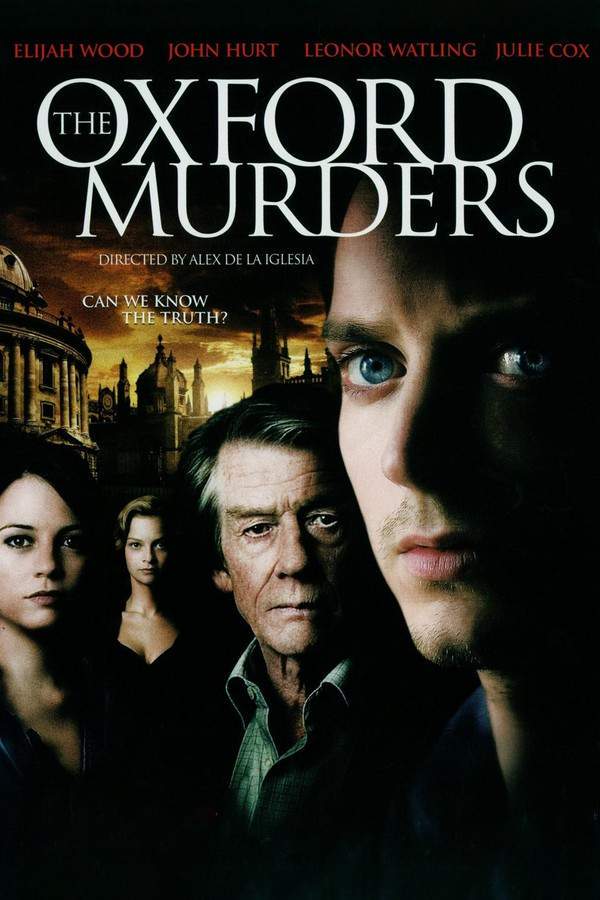
The Oxford Murders (2008) movie poster

Timeline

The Oxford Murders (2008) Timeline Explained – Every Event in Order

Release, runtime and language
2008 · 107 mins · English
JustWatch #3,636 27
Directed by
Álex de la Iglesia
Starring
John Hurt, Anna Massey, Alex Cox, Dominique Pinon, Burn Gorman, Elijah Wood

At Oxford University, a mathematics professor teams up with his graduate student to investigate a string of brutal killings whose clues appear as enigmatic mathematical symbols. As the duo races against time, they must decipher the equations, confront hidden motives, and grapple with the unsettling notion that absolute truth may be unattainable.

On this page (7)
  1. 1 Where to watch
  2. 2 Events in order (13)
  3. 3 Timeline questions answered
  4. 4 Movie threads
  5. 5 Movies like The Oxford Murders
  6. 6 Categories
  7. 7 Every angle

Where to watch

Where to Watch The Oxford Murders (2008)

Where can you watch The Oxford Murders? Stream, rent or buy it in the US, including on fuboTV, Hoopla and Kanopy: current JustWatch availability with up-to-date prices.

Streaming availability powered by JustWatch

13 events in order · contains spoilers

The Oxford Murders Timeline: Events in Chronological Order

Every key event of The Oxford Murders (2008) in order, scene by scene, with when and where it takes place. Use it to untangle flashbacks, time jumps and parallel storylines, to refresh your memory before the sequel or to find the exact scene you are thinking of.

  1. Martin arrives in Oxford and moves into Mrs. Eagleton's house

    Martin, a US student, travels to Oxford to study under Arthur Seldom and idolizes him. He lodges with Mrs. Eagleton, where her daughter Beth resents her caregiver duties. The stage is set for a tense mentor-student dynamic that will soon be tested by a series of dark events.

    When
    1993
    Where
    Oxford, Mrs. Eagleton's house
  2. Seldom's public lecture challenges certainty

    In a public lecture, Seldom quotes Wittgenstein to deny absolute truth. Martin challenges him, declaring his belief in the absolute truth of mathematics, saying he believes in pi. Seldom humiliates Martin, undercutting his confidence and exposing the fragility of his position before the audience.

    When
    1993
    Where
    University lecture hall, Oxford
  3. Martin abandons his studies; encounter with Podorov

    Disillusioned, Martin decides to abandon his studies and collects his belongings from his office. There he encounters Podorov, a bitter mathematician who also failed to join Seldom's circle. The exchange underscores Martin's sense of exclusion from Seldom's world.

    When
    1993
    Where
    University office, Oxford
  4. Landlady is found murdered; 'first of a series' hint

    Back at Mrs. Eagleton's house, Martin and Seldom discover the landlady murdered. Seldom tells the police that he received a note with his friend's address marked as the first of a series, hinting at a serial killer testing his intellect.

    When
    Evening 1993
    Where
    Mrs. Eagleton's house, Oxford
  5. Imperceptible murders and the killer's strategy

    Martin and Seldom discuss the idea of imperceptible murders — victims who are dying anyway, making foul play easy to miss. They speculate that such murders might escape routine police suspicion and frame Seldom's theory as a dangerous intellectual game.

    When
    1993
    Where
    Oxford
  6. Hospital visit; Kalman and the mystery symbol

    Martin visits the hospital to see his girlfriend Lorna, who works there. He encounters Seldom visiting Kalman, a former student with cancer. A patient sharing Kalman's room dies from a suspicious injection, and the authorities receive a second symbol: two interlocking arcs.

    When
    1993
    Where
    Hospital, Oxford
  7. Lorna and Seldom; love, loyalty, and secrets

    Martin's relationship with Lorna strains as his obsession with Seldom and the murders grows. He learns that Lorna was once Seldom's lover, a revelation that complicates loyalties and trust.

    When
    1993
    Where
    Hospital, Oxford
  8. Guy Fawkes Night concert; mystery symbols intensify

    During a Guy Fawkes Night concert, Podorov acts suspiciously and is chased by police, though his intent is merely to hang an insulting banner. A musician collapses and dies from respiratory failure, and a triangle is drawn on his music stand, reinforcing the killing pattern’s symbolism.

    When
    Guy Fawkes Night 1993
    Where
    Oxford, concert hall
  9. Seldom's diary story and the perfect crime

    Seldom recounts a nineteenth-century tale about a diary listing ways to kill his wife, and a later twist reveals the diary's forged origin. He uses the tale to argue that the perfect crime is not one that remains unsolved, but one solved incorrectly, foreshadowing how misdirection can shape events.

    When
    1993
    Where
    Seldom's office/house
  10. Fermat's Last Theorem hype; bus to conference

    The Oxford mathematics community buzzes when a local researcher claims to have solved Fermat's Last Theorem. Martin, Seldom, and other mathematicians board a bus to attend the conference, drawn by intellectual excitement and prestige. Martin hesitates to leave Lorna behind but eventually reconciles with her on the street.

    When
    1993
    Where
    Oxford, bus to conference
  11. Reconciliation and the tetractys insight

    Martin reconciles with Lorna and, after making love, realizes that the killer's sequence consists of Pythagorean symbols with the tetractys (ten points) as the next target. The couple decide to take a long holiday away from Oxford, mathematics, and Seldom.

    When
    post-conference
    Where
    Oxford, then away
  12. Bus bombing; the bomber's true motive revealed

    In a dramatic twist, the bus is bombed by a bus driver for a school for developmentally challenged children who wants organ donors for his daughter, killing the children and himself. The police later infer that the bomber staged other murders to deflect blame from himself.

    When
    bus journey day
    Where
    On the bus to the conference, Oxford
  13. Beth's murder revealed; Seldom's cover-up unmasked

    With the bus tragedy behind them, Martin confronts Seldom and reveals his conclusions. Beth had murdered the landlady to escape caregiver duties, and Seldom aided the cover-up by fabricating the first-of-a-series note and misdirection. The hospital death and other events were similarly manipulated.

    When
    aftermath
    Where
    Mrs. Eagleton's house / Seldom's circle

Last updated: October 07, 2025 at 09:49

Was this helpful?

Timeline questions answered

The Oxford Murders Timeline Explained: Your Questions Answered

When does it happen, and why in that order? The questions people ask about the chronology of The Oxford Murders (2008): time jumps, flashbacks, cause and effect between scenes and the correct order of events, each answered with spoilers.

Q1

Why did Beth kill Mrs. Eagleton in the movie?

Beth killed the landlady to escape the burden of caregiving. As Mrs. Eagleton's caregiver, she resented the endless responsibility and attention her mother received, leading her to commit murder hoping to finally be free from the role.

Foreshadowing: Earlier scenes show Beth's visible restlessness and resentment toward her caregiving duties, hinting at her growing desperation.

  • beth
  • mrs eagleton
  • landlady murder
  • caregiver
  • killing motive
Q2

Why did Arthur Seldom cover up Beth's crime?

Seldom arrived at the house too late to prevent the murder and chose to protect Beth instead of turning her in. He fabricated the 'first of a series' note to create a false serial killer theory that would redirect police investigation away from the actual culprit.

Foreshadowing: Seldom's philosophical debate about truth and the 'perfect crime' earlier in the film foreshadows his willingness to manipulate reality.

  • arthur seldom
  • cover up
  • beth
  • murder investigation
  • lie
Q3

What are imperceptible murders in The Oxford Murders?

Imperceptible murders are killings of victims who are already dying from natural causes, making foul play difficult to detect. Seldom proposes this theory to explain how the killer could commit crimes that escape routine police suspicion, though in reality many apparent murders turned out to be natural deaths or accidents that Seldom exploited.

  • imperceptible murders
  • killing method
  • serial killer theory
  • murder concept
Q4

Why did the bus driver bomb the school bus?

The bus driver bombed the school bus to kill developmentally challenged children whose organs could be donated to his daughter, who needed a lung transplant. He staged other murders to divert suspicion from himself, using the mathematical symbols as a deliberate distraction.

Foreshadowing: The religious fanatic at the hospital whose daughter needed a transplant earlier establishes the organ donor subplot that connects to the driver's motive.

  • bus driver
  • bombing
  • school bus
  • organ donation
  • daughter
  • motive
Q5

Why did Martin say he believes in the number pi?

During Seldom's lecture on Wittgenstein's Tractatus arguing against absolute truth, Martin challenged him by asserting his belief in the absolute truth of mathematics. Pi represents an irrational, infinite number, seemingly absolute-yet-undefinable, making it a provocative philosophical statement about whether mathematical truths are truly absolute or whether truth itself is unattainable.

Foreshadowing: This moment establishes the mentor-student conflict and sets up the film's exploration of truth versus perception.

  • martin
  • pi
  • absolute truth
  • mathematics
  • seldom lecture
  • philosophy
Q6

What was Lorna's past relationship with Arthur Seldom?

Lorna had a romantic relationship with Seldom before meeting Martin. This past connection creates tension in Martin's relationship with Lorna and adds complexity to his obsession with Seldom, as he discovers his mentor once occupied the emotional space he now fills.

  • lorna
  • arthur seldom
  • romance
  • past relationship
  • love triangle
Q7

Why did the killer use mathematical symbols?

The bus driver deliberately left mathematical symbols at crime scenes to frame the killings as an intellectual game and direct suspicion toward Oxford's mathematical community. The symbols, leading to the tetractys, were a deliberate misdirection, though some symbols also appeared at genuine accidents or natural deaths that Seldom exploited for his theory.

Foreshadowing: The symbols begin appearing after the initial murder, creating the false impression of a serial killer testing Seldom's intellect.

  • mathematical symbols
  • serial killer
  • tetractys
  • pyramid
  • misdirection
Q8

What is the tetractys in The Oxford Murders?

The tetractys is a ten-point triangular symbol from Pythagorean mathematics. Martin realizes the sequence of killer symbols, line, two arcs, triangle, points to the tetractys as the next target, representing the culmination of the Pythagorean mathematical sequence the killer used as his false trail.

Foreshadowing: The sequence of symbols throughout the film builds toward this Pythagorean revelation.

  • tetractys
  • ten points
  • pythagorean
  • mathematical sequence
  • symbol
Q9

What did Seldom mean by the perfect crime?

Seldom told Martin that the perfect crime is not one that remains unsolved, but one solved under the wrong assumption. He illustrated this with a nineteenth-century diary tale, later revealed as forged, where a husband killed his wife and framed someone else, demonstrating how justice can be perverted through misdirection.

Foreshadowing: This story directly parallels Seldom's own cover-up of Beth's murder and the false serial killer narrative he constructed.

  • perfect crime
  • misdirection
  • justice
  • wrong assumption
  • diary story
Q10

Did Arthur Seldom know Beth killed the landlady?

Seldom did not witness the murder but arrived afterward and discovered what Beth had done. Rather than report her, he chose to protect her and constructed the elaborate 'first of a series' narrative to misdirect police investigation, though he claims his lies harmed no one directly.

  • seldom
  • beth
  • killer truth
  • cover up
  • knowledge
Q11

What does the ending of The Oxford Murders mean?

The ending leaves guilt and moral responsibility deliberately ambiguous. Seldom argues that all actions carry consequences whether intended or not, even suggesting Martin's casual remark to Beth may have influenced her decision to kill. The film refuses to resolve whether Seldom's protective lies were justified or merely another form of manipulation, leaving viewers to weigh truth against mercy.

Foreshadowing: The entire film builds toward this moral complexity, from Seldom's philosophical debates about truth to his deliberate cover-up.

  • ending
  • ambiguity
  • guilt
  • moral responsibility
  • consequences
  • truth

Movie threads

More Movies Like The Oxford Murders, by Mood & Story

Curated lists built around what makes The Oxford Murders tick: the same mood, the same kind of story or the same emotional payoff. Each list explains why these movies belong together.

Academic thrillers with moral complexity like in The Oxford Murders

Stories where brilliant minds are drawn into dark worlds of crime. If you liked the cerebral puzzles and ethical dilemmas of The Oxford Murders, explore other movies like it. These similar mystery and crime films feature brilliant protagonists in academic settings, grappling with intellectual challenges that force difficult moral choices and lead to unsettling truths.

  • cerebral
  • intellectual
  • methodical
  • morally ambiguous
  • unsettling
  • suspenseful
  • Tone: dark, cerebral, morally ambiguous
  • Pacing: steady, methodical
Why these movies?

The story pattern: These narratives typically follow a knowledgeable protagonist—a professor, student, or expert—who becomes entangled in a high-stakes investigation. The plot is driven by intellectual deduction and puzzle-solving, but the central conflict arises from the clash between objective analysis and subjective morality, often resulting in an ending that questions the very nature of truth and guilt.

Why they belong together: Movies in this thread are grouped by their shared setting in the world of academia or high intellect, their focus on a puzzle-based mystery, and their exploration of the dark side of knowledge. They share a tone of cerebral suspense and often leave the audience with weighty philosophical questions.

Mind-bending mystery movies with unreliable narratives like The Oxford Murders

Thrillers where the investigation itself is a facade hiding a deeper truth. Fans of The Oxford Murders who enjoyed its twist on the detective genre will find similar movies here. These complex thrillers feature investigations that are not what they seem, leading to shocking revelations that deconstruct the entire narrative and challenge the viewer's perception.

  • mind-bending
  • unreliable narration
  • complex
  • psychological
  • deconstructive
  • suspenseful
  • Tone: dark, unsettling, psychologically complex
  • Pacing: steady, layered
Why these movies?

The story pattern: The narrative pattern begins with a seemingly straightforward crime that initiates a logical investigation. However, the central twist reveals that the mystery was an elaborate construct—a red herring or a game—designed to conceal a more personal, mundane, or shocking truth. The journey is less about solving the case and more about uncovering the manipulator's motive.

Why they belong together: These films are connected by their shared narrative structure that dismantles the traditional whodunit. They prioritize psychological manipulation and thematic depth over a neat resolution, creating a complex and often ambiguous viewing experience that lingers long after the film ends.

If you liked this

Movies Like The Oxford Murders

Similar movies to The Oxford Murders: the same genre, themes or kind of story. Each one comes with its own plot summary, timeline and ending explained.

Browse all movie summaries

Categories

Movie Lists Featuring The Oxford Murders

The Oxford Murders appears in these hand-built movie categories. Each one groups movies by a specific mood, theme or story type, with their plot summaries and endings explained.

View all movie categories

Every angle

The Oxford Murders (2008) Explained: Plot, Timeline & Characters

Everything about The Oxford Murders in one place: what happens in the plot summary, the timeline in chronological order, the characters and meaning and a spoiler-free summary. What's After the Movie adds the cast, box office and post-credit scenes.

Coming soon on iOS and Android

The Plot Explained Movie Summary App

Plot summaries, endings explained and timelines on your phone. Catch up on any movie in minutes, save your favorites and never miss a twist again.

Be the first to know when we launch. Your email stays private, always.

Learn more about the app