Plot Explained Spoilers guaranteed!
Plot Explained

Browse by genre

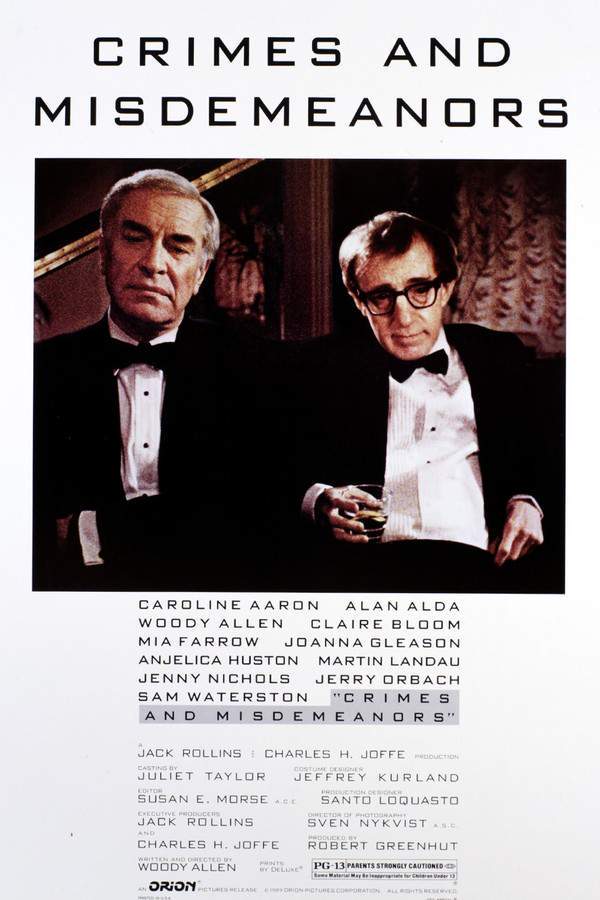
Crimes and Misdemeanors (1989) movie poster

Plot Summary

Crimes and Misdemeanors (1989) Plot Summary Explained

Release, runtime and language
1989 · 104 min · English
Loading streaming availability…
Starring
Woody Allen, Martin Landau

A respected but adulterous eye doctor, Judah, desperately tries to salvage his marriage and reputation, leading him to a risky scheme with the involvement of his resourceful brother. Interwoven with his story is the experience of Cliff Stern, a documentary filmmaker grappling with professional and personal struggles as he explores the complexities of love and artistic expression. The film presents a darkly humorous look at morality, guilt, and the consequences of one's actions.

On this page (6)
  1. 1 Where to watch
  2. 2 What happens: full plot
  3. 3 Plot questions answered
  4. 4 Movie threads
  5. 5 Movies like Crimes and Misdemeanors
  6. 6 Every angle
Loading streaming availability…

Full plot summary · contains spoilers

What Happens in Crimes and Misdemeanors: Full Plot Summary

The whole story of Crimes and Misdemeanors (1989) explained, from the opening scene to the final frame: every key event, every twist and what it all adds up to. Read it as a quick recap before the sequel, to check a scene you missed, or to finally understand what really happened.

As the story progresses, we are introduced to two contrasting protagonists: Judah Rosenthal, a well-respected ophthalmologist leading what seems to be a perfect family life, and Clifford Stern, a struggling documentary filmmaker grappling with his artistic identity. Although their lives appear to diverge significantly, both men are ensnared in a web of secrets and lies that threaten to dismantle their meticulously maintained facades.

Judah's seemingly charmed existence is disrupted by his clandestine affair with flight attendant Dolores Paley. Her insistence on honesty drives her to threaten revealing their relationship to his wife, Miriam. As fear and tension mount in Judah's life, he seeks counsel from a patient, Rabbi Ben, who implores him to face his truths and pursue redemption. However, in a desperate attempt to safeguard his marriage and public image, Judah turns to his brother Jack—a ruthless gangster who finds a hitman to silence Dolores. In a harrowing act to cover his misdeeds, Judah invades Dolores' apartment, only to be consumed by guilt and plagued with questions regarding his faith.

Concurrently, Clifford Stern is enlisted by his arrogant brother-in-law, Lester, a prominent television producer, to forge a documentary that glorifies Lester's achievements. Initially excited about the project, Clifford soon realizes he is disheartened by Lester's egotism and lack of empathy. During his work, he finds himself enamored with Halley Reed, Lester's associate producer, who mirrors his passion for art and philosophy. Trapped in an unfulfilling marriage to Wendy, Clifford shares his feelings with Halley, expressing admiration for Professor Louis Levy, a philosopher whose teachings resonate deeply with him.

Tragedy strikes when Clifford learns of Professor Levy’s unexpected death, leaving behind only a cryptic message: > "I've gone out the window." As he processes this loss, Clifford attempts to pursue Halley again, only to face her gentle rejection. Devastated by this setback and the collapse of his documentary aspirations, his resentment towards Lester swells, prompting him to craft a film that lays bare Lester's flaws. During the premiere of the documentary, Clifford's harsh editing contrasts Lester with archival footage of Benito Mussolini, drawing a stark parallel between their exploitative natures. Lester reacts with fury, dismissing Clifford immediately.

As Halley departs for London, Clifford is burdened by the uncertainty of her return. When he learns that Halley is set to produce Lester's latest project, it deepens his sense of loss. Upon her return, Halley’s engagement to Lester inflicts a deep wound on Clifford's heart, exacerbated by the knowledge that Lester has been showering her with extravagant gifts, such as white roses. This only compounds Cliff’s despair as he grapples with the reality of Halley's affections now directed elsewhere.

The lives of Judah and Clifford intersect at a lively family wedding, serving as a backdrop for both men to confront their turbulent histories. During a conversation, Judah offers an optimistic perspective that starkly contrasts with Clifford's gloom. While Judah has begun to find comfort in time's passage, Cliff remains entrenched in his overwhelming guilt.

As the wedding festivities continue, the tender moment of Rabbi Ben dancing with his daughter poignantly underscores the beauty that persists in life despite hardship. The echoes of Professor Levy's wisdom resonate through the evening, encouraging Cliff to shift his focus from despair to the love that fills the void, fostering hope that future generations may grasp life’s deeper meanings.
Last updated: November 22, 2024 at 14:14

Was this helpful?

Plot questions answered

Crimes and Misdemeanors Plot Explained: Your Questions Answered

The questions people ask most about Crimes and Misdemeanors (1989): what happens in the confusing scenes, why the characters do what they do, the twists, hidden details and what the ending means. Each answer contains spoilers.

Q1

Why does Judah decide to have Dolores killed instead of confessing to his wife?

Judah hires a hitman because Dolores threatens to reveal their affair to his wife Miriam, which would destroy his reputation and marriage. Although Rabbi Ben urges him to confess and seek redemption, Judah chooses the cowardly path of silencing Dolores. His fear of losing his perfect life and professional standing outweighs his moral compass, leading him to turn to his gangster brother Jack for help.

Foreshadowing: Earlier, Rabbi Ben warns Judah that avoiding the truth will lead to ruin, foreshadowing Judah's descent into murder.

  • judah rosenthal
  • dolores paley
  • affair
  • hitman
  • murder cover-up
Q2

What does Professor Levy's message 'I've gone out the window' mean?

Professor Levy commits suicide by jumping out a window, leaving the cryptic message as his final statement. This tragic event deeply affects Clifford, who admired Levy's philosophical teachings. The message suggests Levy saw death as an escape, though the film leaves whether it was intentional or accidental open to interpretation. It represents the ultimate expression of despair from a man who taught about meaning and purpose but couldn't find his own.

  • professor louis levy
  • suicide
  • window
  • philosophical death
Q3

Why does Halley choose Lester over Clifford?

Halley chooses Lester because of his success and stability, which contrast sharply with Clifford's struggling career and uncertain future. Despite Clifford's artistic passion and intellectual depth, Lester offers security and the ability to provide extravagant gifts like white roses. The film suggests Halley, like many characters, prioritizes practical concerns over romantic ideals, though Clifford views this as a betrayal of their shared artistic values.

Foreshadowing: Clifford's attraction to Halley is established early through their shared love of art and philosophy, making her eventual choice of Lester more painful.

  • halley reed
  • lester
  • clifford stern
  • relationship choice
  • white roses
Q4

Why does Clifford compare Lester to Mussolini in his documentary?

Clifford edits the documentary to draw stark parallels between Lester and Benito Mussolini, highlighting their shared exploitative nature and ego. By juxtaposing Lester's arrogant interviews with archival footage of Mussolini's fascist rallies, Clifford exposes Lester's moral emptiness and manipulative personality. This aggressive artistic statement costs Clifford the job but represents his attempt to expose truth through his art, matching his philosophical hero Levy's ideals.

  • clifford stern
  • lester
  • mussolini
  • documentary
  • artistic expression
Q5

Why does Judah seem at peace at the wedding while Clifford remains despairing?

Judah finds a cold comfort by accepting time's passage and rationalizing his crimes. He tells Clifford that the pain of guilt diminishes with time, suggesting he has mentally buried his conscience. This differs from Clifford, who cannot escape his emotional turmoil over lost love and professional failure. Judah's peace is morally ambiguous, he hasn't sought true forgiveness but has simply learned to live with his guilt, reflecting the film's exploration of whether justice exists.

  • judah rosenthal
  • wedding
  • guilt
  • redemption
  • peace
Q6

What is the significance of Rabbi Ben dancing with his daughter at the wedding?

Rabbi Ben dancing with his daughter represents hope and beauty persisting despite life's darkness. This tender moment underscores the film's theme that meaning and joy exist even amid moral failure and despair. For both Judah and Clifford, who grapple with guilt, lost love, and artistic failure, this scene offers a glimpse of redemptive beauty. It balances the film's dark themes with human warmth, suggesting life continues with moments of grace.

  • rabbi ben
  • wedding dance
  • daughter
  • hope
  • beauty
Q7

Does Judah actually kill Dolores himself or just hire someone?

According to the summary, Judah invades Dolores' apartment, but the hitman hired by his brother Jack ultimately silences her. The film leaves the exact details somewhat ambiguous, but Judah's direct involvement in breaking into her apartment shows he crossed from complicity into active participation in the cover-up. His guilt and religious questioning follow, suggesting he sees himself as responsible for her death regardless of who physically committed the act.

  • judah rosenthal
  • dolores paley
  • murder
  • apartment invasion
Q8

What is the connection between Judah's story and Clifford's story?

Both Judah and Clifford face moral crises and lie to protect themselves. Judah commits murder and gets away with it; Clifford creates a vengeful documentary that destroys his career. Both lose romantic interests, Judah through death, Clifford through rejection. The parallel structure explores whether consequences matter: Judah escapes justice while Clifford faces it, yet both remain trapped in guilt and regret. The film asks whether moral choices truly matter in an indifferent universe.

  • parallel narratives
  • judah
  • clifford
  • morality
  • consequences
Q9

What does the title 'Crimes and Misdemeanors' mean in the film?

The title refers to the spectrum of moral transgressions in the film, from Judah's murder (a crime) to Clifford's petty resentments and manipulations (misdemeanors). It suggests all characters commit wrongs, from murder to lying to artistic revenge. The film refuses to separate good and evil cleanly, instead showing how ordinary people rationalize increasingly serious transgressions. The title invites viewers to consider their own moral compass and whether they'd choose differently in Judah's position.

  • title meaning
  • crimes
  • misdemeanors
  • morality
  • moral spectrum
Q10

Does Judah feel genuine remorse for killing Dolores?

Judah experiences intense guilt and questions his faith after Dolores' death, plagued by religious doubts about divine justice. However, his remorse appears more centered on self-punishment than genuine sorrow for taking a life. He seeks counsel from Rabbi Ben about faith, suggesting spiritual crisis, yet chooses rationalization over confession. His eventual peace comes from time healing wounds rather than true atonement, making his redemption ambiguous.

  • judah rosenthal
  • remorse
  • guilt
  • faith
  • religion
  • dolores

Movie threads

More Movies Like Crimes and Misdemeanors, by Mood & Story

Curated lists built around what makes Crimes and Misdemeanors tick: the same mood, the same kind of story or the same emotional payoff. Each list explains why these movies belong together.

Philosophical Moral Dramas like Crimes and Misdemeanors

Stories where characters confront the consequences of their ethical failures. If you liked the ethical quandaries in Crimes and Misdemeanors, you'll appreciate these movies. They feature complex characters facing moral dilemmas, exploring themes of guilt, consequence, and existential doubt in a serious, dramatic context. Find other films that challenge your perspective on right and wrong.

  • philosophical
  • guilty
  • introspective
  • somber
  • anxious
  • moral dilemma
  • Tone: dark, philosophical, somber
  • Pacing: steady, character-driven
Why these movies?

The story pattern: These narratives often follow a character's descent into an ethical gray area, driven by desire or desperation. The central conflict is internal, a battle with guilt and self-justification, frequently set against a backdrop that questions larger systems of faith or justice. The plot is driven by dialogue and character decisions rather than external action.

Why they belong together: They are grouped by their shared focus on weighty moral questions, a dark and introspective tone, and a narrative structure that prioritizes philosophical exploration over conventional plotting. The emotional experience is heavy and intellectually engaging.

Movies with Interwoven Bittersweet Stories like Crimes and Misdemeanors

Films that connect separate narratives into a poignant, unified theme. If you enjoyed the parallel narratives of Crimes and Misdemeanors, this collection features other films that weave separate character stories into a cohesive whole. These dramas often have a bittersweet tone, blending melancholy with dark humor and philosophical depth, exploring complex themes through interconnected lives.

  • bittersweet
  • melancholic
  • introspective
  • somber
  • hopeful
  • parallel lives
  • Tone: bittersweet, melancholic, darkly humorous
  • Pacing: steady, methodical
Why these movies?

The story pattern: The narrative pattern involves two or more distinct storylines that run parallel, sometimes intersecting tangentially, but primarily serving to contrast or complement each other. This structure allows for a richer exploration of a central theme from different angles. The ending typically doesn't resolve neatly for everyone, leaving a mix of hope and despair that feels true to life.

Why they belong together: They share a specific structural approach (parallel narratives) combined with a distinct emotional tone (bittersweet). The pacing is steady, allowing each storyline to develop fully, and the overall effect is one of contemplative complexity, where the sum of the parts is greater than the whole.

If you liked this

Movies Like Crimes and Misdemeanors

Similar movies to Crimes and Misdemeanors: the same genre, themes or kind of story. Each one comes with its own plot summary, timeline and ending explained.

Browse all movie summaries

Every angle

Crimes and Misdemeanors (1989) Explained: Plot, Timeline & Characters

Everything about Crimes and Misdemeanors in one place: what happens in the plot summary, the timeline in chronological order, the characters and meaning and a spoiler-free summary. What's After the Movie adds the cast, box office and post-credit scenes.

Coming soon on iOS and Android

The Plot Explained Movie Summary App

Plot summaries, endings explained and timelines on your phone. Catch up on any movie in minutes, save your favorites and never miss a twist again.

Be the first to know when we launch. Your email stays private, always.

Learn more about the app