Plot Explained Spoilers guaranteed!
Plot Explained

Browse by genre

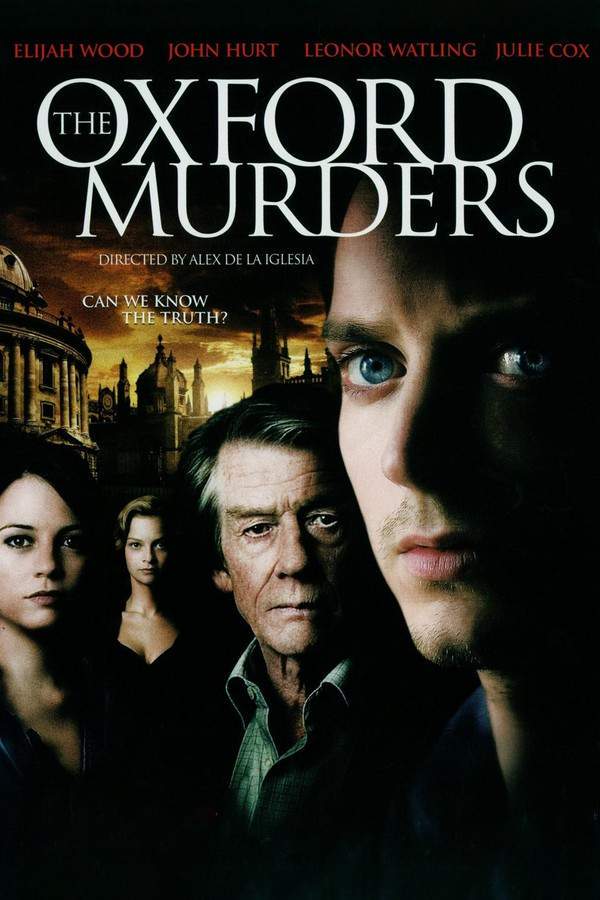
The Oxford Murders (2010) movie poster

Plot Summary

The Oxford Murders (2010) Plot Summary Explained

Release, runtime and language
2010 · 108 min · English
JustWatch #4,075 31
Directed by
Álex de la Iglesia
Starring
John Hurt, Elijah Wood, Leonor Watling, Jim Carter

A promising American mathematics student, Martin, seeks mentorship from a renowned philosophy professor, Arthur Seldom, at Oxford University. Their academic pursuits are shattered when a series of disturbing murders occur, disrupting the peaceful atmosphere. Martin and Arthur find themselves drawn into a dangerous investigation, compelled to decipher puzzling crime scenes and an elaborate mathematical enigma that may reveal the killer's motive and identity.

On this page (6)
  1. 1 Where to watch
  2. 2 What happens: full plot
  3. 3 Plot questions answered
  4. 4 Movie threads
  5. 5 Movies like The Oxford Murders
  6. 6 Every angle

Where to watch

Where to Watch The Oxford Murders (2010)

Where can you watch The Oxford Murders? Stream, rent or buy it in the US, including on fuboTV, Hoopla and Kanopy: current JustWatch availability with up-to-date prices.

Streaming availability powered by JustWatch

Full plot summary · contains spoilers

What Happens in The Oxford Murders: Full Plot Summary

The whole story of The Oxford Murders (2010) explained, from the opening scene to the final frame: every key event, every twist and what it all adds up to. Read it as a quick recap before the sequel, to check a scene you missed, or to finally understand what really happened.

Martin, portrayed by Elijah Wood, is an American student at the prestigious University of Oxford who aspires to have the enigmatic Arthur Seldom, played by John Hurt, as his thesis supervisor. Upon settling into accommodations arranged by Mrs. Eagleton, a longtime friend of Seldom, Martin learns that the elderly landlady's daughter, Beth, a bitter caregiver and musician herself, is resentful of her circumstances.

During a public lecture, Seldom provocatively quotes Wittgenstein's Tractatus, asserting that absolute truth is unattainable. Eager to impress his idol, Martin counters, stating, > "I believe in the number pi," only to be met with ridicule and humiliation from Seldom, leaving him feeling disillusioned and questioning his path.

As Martin contemplates abandoning his studies, he runs into Podorov, portrayed by Burn Gorman, a bitter mathematician who shares in his frustration of not being accepted as a student under Seldom's guidance. However, fate takes a dark turn when Martin returns home to find Seldom visiting Mrs. Eagleton, only to discover that she has been tragically murdered. Seldom shares that he received a chilling note suggesting that this is the first of many murders designed to challenge his intellectual prowess.

Seldom theorizes about a possible serial killer, claiming, > "The only perfect crime that exists is not the one that remains unsolved, but the one which is solved with the wrong culprit." As the investigation unfolds, Martin and Seldom delve into the complexities of the case, discussing the ease with which Mrs. Eagleton's murder might have been overlooked, especially considering her terminal illness.

In this tense situation, Beth confesses to Martin her underlying desire to break free from the burden of caring for her dying mother. Together with Lorna, a Spanish nurse played by Leonor Watling who has caught Martin's affection, they find themselves embroiled in a web of mathematical clues, desperate to unravel the mystery while navigating rising tensions and police scrutiny.

Each character becomes a potential suspect, and dark secrets emerge, including an ominous history between Seldom and others. As they continue to connect the dots, the stakes escalate when a second murder occurs, entwining the lives of Martin, Beth, and Lorna in a deadly game of intellect where everyone has something to lose.

Amidst an atmosphere charged with suspicion, revelations about Seldom’s past start to surface, leading to shocking conclusions that suggest a deeper connection between the murders and the characters’ intertwined lives. As the narrative reaches its climax, Martin uncovers an unsettling truth: the real puppeteer behind this twisted scenario isn't merely a serial killer, but rather Beth herself, seeking liberation under Seldom's misguided influence.

With Martin’s insightful deductions and an eventual confrontation, the tale winds down to reveal how obsession, ambition, and the pursuit of absolute truth can lead to devastating consequences for all involved.
Last updated: November 03, 2024 at 23:32

Was this helpful?

Plot questions answered

The Oxford Murders Plot Explained: Your Questions Answered

The questions people ask most about The Oxford Murders (2010): what happens in the confusing scenes, why the characters do what they do, the twists, hidden details and what the ending means. Each answer contains spoilers.

Q1

Why did Beth kill her mother Mrs. Eagleton?

Beth killed her mother because she was desperate to escape the burden of caring for her terminally ill parent. Living with and tending to her dying mother had filled her with resentment and a suffocating sense of being trapped. The murder was her way of gaining freedom from this oppressive situation, though she framed it within the mathematical murder game orchestrated to challenge Seldom's intellect.

Foreshadowing: Earlier, Beth explicitly confesses to Martin about her desire to break free from caring for her dying mother, revealing her volatile emotional state.

  • beth
  • mrs eagleton
  • murder
  • caregiver
  • freedom
Q2

Why did Seldom receive the first murder note?

Seldom received the note because the killer was specifically targeting him and his intellectual abilities. The note stated that Mrs. Eagleton's murder was the first of many designed to challenge his intellect. The killer wanted Seldom to apply his philosophical and logical reasoning to solve the puzzles, essentially using the murders as a twisted intellectual game meant for Seldom's entertainment and scrutiny.

Foreshadowing: Seldom's lecture on Wittgenstein and his assertion that 'the perfect crime is one solved with the wrong culprit' establishes his as a target for such a challenge.

  • seldom
  • murder note
  • challenge
  • intellectual game
Q3

Who was behind the murders in the story?

Beth was the actual mastermind behind the murders, not the serial killer Seldom initially suspected. She orchestrated the entire murder game, using mathematical clues and philosophical challenges to draw Seldom into her trap. Her goal was to kill her mother and frame the situation as part of a larger intellectual puzzle, while also manipulating Martin and Seldom into solving her twisted game.
Foreshadowing: Beth's confession about wanting freedom from her mother, combined with her resentment toward Seldom (who was her mother's friend), plants the seeds of her involvement.

  • beth
  • killer
  • serial killer
  • mastermind
  • orchestrator
Q4

Why did Martin say he believes in the number pi during the lecture?

Martin said 'I believe in the number pi' as an attempt to impress Seldom after the professor provocatively stated that absolute truth is unattainable. Martin sought to demonstrate faith in something concrete and mathematical as a counterpoint to Wittgenstein's philosophical relativism. However, Seldom ridiculed him in front of the audience, causing humiliation and making Martin question his place at Oxford.

Foreshadowing: This moment establishes Martin's desperation to gain acceptance from Seldom, which later makes him vulnerable to the investigation.

  • martin
  • pi
  • lecture
  • humiliation
  • wittgenstein
Q5

What did Seldom mean by 'the only perfect crime is the one solved with the wrong culprit'?

Seldom meant that the most dangerous crimes are those where evidence points to an innocent person, leading investigators to convict the wrong individual. This philosophy becomes central to the case as the murders are designed specifically to mislead and test whether Seldom will identify the actual perpetrator or be fooled by clever manipulation. The statement foreshadows the twist that Beth orchestrated everything while making others appear guilty.

Foreshadowing: This quote appears early in the investigation and directly sets up the thematic core of the story's mystery.

  • seldom
  • perfect crime
  • quote
  • philosophy
  • wrong culprit
Q6

What was revealed about Seldom's dark past?

The film reveals disturbing connections between Seldom and other characters that add layers to his character. Specifically, his long friendship with Mrs. Eagleton and his influence over the academic community at Oxford are explored. The revelations suggest Seldom may have been more entangled in the lives of the victims than initially apparent, though the exact nature of his past is revealed through the investigation's progress.

Foreshadowing: The ominous history between Seldom and others hinted at throughout the investigation builds toward these revelations.

  • seldom
  • past
  • history
  • revelation
  • secret
Q7

Why was Podorov relevant to the murder investigation?

Podorov served as a red herring and mirror to Martin's own situation. Like Martin, Podorov was a bitter mathematician who had been rejected by Seldom and harbored resentment toward him. This made Podorov an obvious suspect in the murder investigation, diverting attention from the actual culprit. His presence in the story highlights the theme of rejected academics and adds complexity to the web of potential suspects.

Foreshadowing: Martin's meeting with Podorov early in the film establishes him as a character with motive and opportunity.

  • podorov
  • suspect
  • red herring
  • bitter mathematician
Q8

What mathematical puzzle or clues were left at the murder scenes?

The murder scenes contained mathematical clues designed to challenge Seldom's intellectual prowess. These puzzles were part of the killer's game to test whether Seldom could solve the mystery or be fooled by the elaborate setup. The clues were meant to be decoded using mathematical logic and philosophical reasoning, reflecting the film's central theme of applying academic rigor to criminal investigation.

Foreshadowing: The investigation centers on connecting mathematical clues to the identity of the killer, with Seldom's expertise being the key asset.

  • mathematical clues
  • puzzle
  • murder scenes
  • enigma
  • logic
Q9

How did Martin deduce that Beth was the killer?

Martin pieced together the evidence by connecting Beth's confession about wanting freedom from her dying mother with the timing and nature of the murders. He recognized that Beth had both motive and opportunity, and that her emotional state aligned with the pattern of killings. Through careful deduction and analyzing the mathematical clues in context of the characters' relationships, Martin arrived at the unsettling truth about Beth's orchestration of the entire murder game.

Foreshadowing: Beth's earlier confession about her desire to escape her caregiving role provides the psychological foundation for Martin's realization.

  • martin
  • deduction
  • beth
  • killer
  • evidence
Q10

What was Lorna's role in the investigation?

Lorna, a Spanish nurse, became romantically involved with Martin while also being drawn into the investigation. Her medical background and position within the household gave her access to information about Mrs. Eagleton's condition and care. She assisted Martin and Seldom in their pursuit of the truth, though her primary function was as a romantic interest and additional support character in navigating the dangerous academic environment.

Foreshadowing: Lorna's introduction as a nurse caring for Mrs. Eagleton establishes her proximity to the central mystery.

  • lorna
  • nurse
  • romance
  • investigation
  • support
Q11

What connected all the murders in the story?

All the murders were connected by Beth's single-minded goal of eliminating her mother and creating an elaborate intellectual game to distract from her crime. Each murder was staged with mathematical clues intended to challenge Seldom, making them appear as part of a larger serial killer pattern rather than a personal act of filicide. The connection was ultimately artificial, designed to manipulate Seldom and Martin into solving a puzzle rather than seeking a conventional motive.

Foreshadowing: The note Seldom received established that the murders were intentionally linked through the mathematical challenges.

  • murders
  • connection
  • beth
  • pattern
  • game
Q12

What does the ending of the film mean thematically?

The ending illustrates how obsession with intellectual pursuits and the pursuit of absolute truth can lead to devastating consequences. Beth's manipulation of the murder game, Seldom's philosophical arrogance, and Martin's desperate quest for validation all contribute to a tragic outcome. The bittersweet conclusion shows that solving the intellectual puzzle brought no true victory, only loss and the revelation that intellectual games can destroy lives when they become detached from moral consequences.

Foreshadowing: The entire narrative builds toward this exploration of how academic obsession and philosophical gamesmanship lead to tragedy.

  • ending
  • theme
  • obsession
  • truth
  • consequences
  • bittersweet

Movie threads

More Movies Like The Oxford Murders, by Mood & Story

Curated lists built around what makes The Oxford Murders tick: the same mood, the same kind of story or the same emotional payoff. Each list explains why these movies belong together.

Academic thrillers like The Oxford Murders

Cerebral mysteries where elite institutions become crime scenes. Explore movies like The Oxford Murders where prestigious universities or research centers become the backdrop for complex crimes. If you enjoyed the intellectual puzzles and tense atmosphere of academia under threat, these similar mystery and crime stories will appeal.

  • intellectual
  • suspenseful
  • academic
  • sinister
  • cerebral
  • claustrophobic
  • Tone: dark, sinister
  • Pacing: steady, methodical
Why these movies?

The story pattern: Stories in this thread typically involve a murder or conspiracy that disrupts a scholarly environment, forcing intellectually gifted protagonists to apply their specific expertise to solve the puzzle. The narrative often revolves around deciphering codes, unraveling philosophical debates, or exposing dark secrets hidden beneath a veneer of respectability.

Why they belong together: These movies are grouped by their shared setting of academic elitism combined with a dark, intellectual thriller plot. They feature a steady pacing driven by clue-solving, a complex narrative structure, and a tone that is both suspenseful and cerebral.

Dark crime puzzles with bittersweet endings like The Oxford Murders

Mysteries where solving the case brings tragic enlightenment. If you liked the heavy emotional weight and complex puzzle of The Oxford Murders, this list features similar crime thrillers with bitter-sweet endings. These movies deliver intellectual satisfaction but leave a lasting emotional impact.

  • complex
  • bittersweet
  • heavy
  • tragic
  • intellectual
  • suspenseful
  • Tone: dark, bittersweet
  • Pacing: steady, deliberate
Why these movies?

The story pattern: The narrative pattern involves a protagonist drawn into a meticulously constructed mystery, often with mathematical or philosophical layers. The pursuit of truth is relentless, but the final reveal exposes a tragic motive or a deeply personal betrayal, leaving the characters—and the audience—with a sense of hollow victory and irrevocable loss.

Why they belong together: Movies in this thread share a high-intensity, complex plot structure focused on solving an elaborate puzzle, coupled with a dark tone and a conclusively bittersweet ending. The emotional journey is heavy, prioritizing intellectual challenge and tragic revelations over tidy, happy resolutions.

If you liked this

Movies Like The Oxford Murders

Similar movies to The Oxford Murders: the same genre, themes or kind of story. Each one comes with its own plot summary, timeline and ending explained.

Browse all movie summaries

Every angle

The Oxford Murders (2010) Explained: Plot, Timeline & Characters

Everything about The Oxford Murders in one place: what happens in the plot summary, the timeline in chronological order, the characters and meaning and a spoiler-free summary. What's After the Movie adds the cast, box office and post-credit scenes.

Coming soon on iOS and Android

The Plot Explained Movie Summary App

Plot summaries, endings explained and timelines on your phone. Catch up on any movie in minutes, save your favorites and never miss a twist again.

Be the first to know when we launch. Your email stays private, always.

Learn more about the app