Plot Explained Spoilers guaranteed!
Plot Explained

Browse by genre

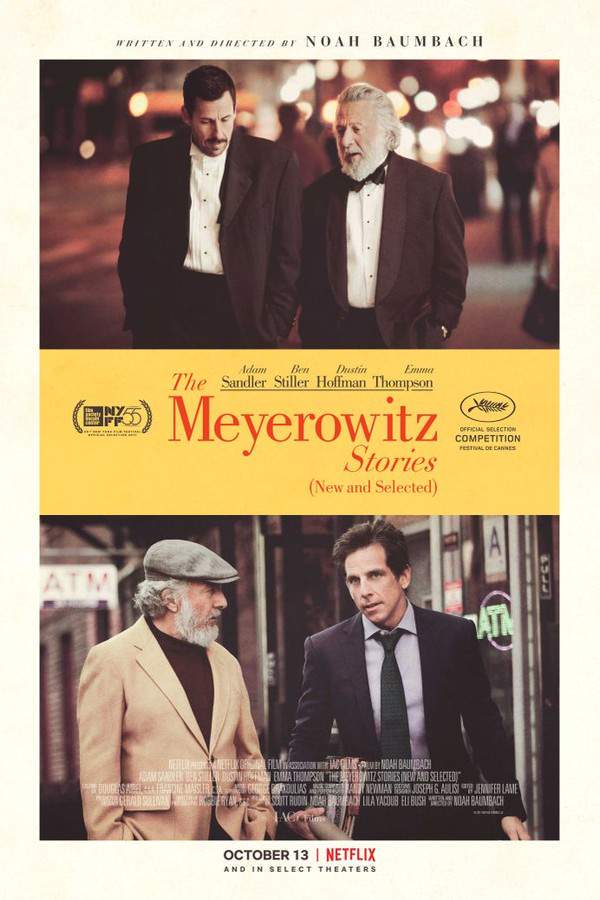
The Meyerowitz Stories (New and Selected) (2017) movie poster

Timeline

The Meyerowitz Stories (New and Selected) (2017) Timeline Explained – Every Event in Order

Release, runtime and language
2017 · 112 min · English
Echo score 72
Loading streaming availability…
Directed by
Noah Baumbach
Starring
Adam Sandler, Emma Thompson, Judd Hirsch, Dustin Hoffman, Grace Van Patten, Adam David Thompson
Budget
$11.4M

When the adult Meyerowitz children return to New York City for a celebration of their father Harold’s artistic legacy, long-simmering tensions and resentments surface. The event forces them to confront their individual struggles and examine their complicated relationships with each other and their accomplished, self-absorbed father. The gathering reveals the challenges of adulthood and the enduring power of family ties.

On this page (7)
  1. 1 Where to watch
  2. 2 Events in order (15)
  3. 3 Timeline questions answered
  4. 4 Movie threads
  5. 5 Movies like The Meyerowitz Stories (New and Selected)
  6. 6 Categories
  7. 7 Every angle
Loading streaming availability…

15 events in order · contains spoilers

The Meyerowitz Stories (New and Selected) Timeline: Events in Chronological Order

Every key event of The Meyerowitz Stories (New and Selected) (2017) in order, scene by scene, with when and where it takes place. Use it to untangle flashbacks, time jumps and parallel storylines, to refresh your memory before the sequel or to find the exact scene you are thinking of.

  1. Danny Moves In

    After separating from his wife, Danny Meyerowitz moves in with his father, Harold, who is a retired art professor. This marks the beginning of their complicated relationship as they navigate their family dynamics.

    Where
    Harold's residence
  2. Eliza's Provocative Film

    Danny's daughter, Eliza, showcases one of her sexually provocative films to the family. Despite their shock, the family attempts to compliment her work, highlighting the generational differences in their perspectives on art.

    Where
    Harold's residence
  3. Harold's Art Show Refusal

    Despite having his work selected for a faculty group show at Bard, Harold refuses to participate. This refusal is indicative of his struggle with accepting his place in the art community.

    Where
    Bard College
  4. Visit to MoMA

    Danny and Harold attend a retrospective at MoMA for Harold's successful contemporary, L.J. Shapiro. Both feel out of place, with Harold choosing to run away due to feelings of being forgotten by the art world.

    Where
    MoMA, New York
  5. Lunch Meeting with Matthew

    Harold meets with his successful son, Matthew, who attempts to convince him to sell their Manhattan home. The tension arises as Harold insists that any decision regarding the house should remain within the family.

    Where
    Restaurant in New York
  6. Confrontation with a Patron

    During lunch, Harold feels insulted by another patron's arrogance, leading him to claim that the patron swapped jackets with him. This moment leads to a brief bonding experience between Harold and Matthew.

    Where
    Restaurant
  7. Visit to Julia

    Harold and Matthew pay a visit to Julia, Harold's second wife. The discomfort rises as Julia reflects on her past as a mother, causing tension between the family members.

    Where
    Julia’s residence
  8. Harold's Diagnosis

    Harold is diagnosed with a chronic subdural hematoma and is admitted to the hospital. Both Danny and Matthew learn to manage Harold's care while grappling with their complicated feelings towards him.

    Where
    Hospital
  9. Jean's Revelation

    In an emotional moment, Jean reveals to her brothers that a family friend had exposed himself to her during childhood. This shocking revelation leads to tension between the siblings and influences their subsequent actions.

    Where
    Hospital
  10. Vandalizing the Friend's Car

    Angered by what Jean shared, Danny and Matthew initially seek retribution but instead end up vandalizing the elderly friend's car. Jean feels betrayed, wishing her brothers had simply listened to her instead.

    Where
    Outside the friend's residence
  11. Fight at Bard

    While representing Harold at the faculty group show, Danny and Matthew get into a fight, revealing their deep-seated emotional struggles. This confrontation is pivotal, leading Matthew to break down emotionally.

    Where
    Bard College
  12. The Sale of the Townhouse

    Despite Matthew's initial resistance, the family ultimately decides to sell Harold's townhouse. This decision marks a significant shift in Harold's life and forces him to confront his failures as an artist.

    Where
    Harold's townhouse
  13. Revelation of 'Matthew' Sculpture

    As Harold recuperates, both he and Matthew realize that Harold's favorite sculpture, titled 'Matthew,' signifies deeper personal feelings for Danny. This realization sheds light on the complex dynamics within the family.

    Where
    Maureen's residence
  14. Danny's Trip to California

    Danny, feeling overwhelmed by family responsibilities, accepts Matthew's offer to travel to California. This trip symbolizes a tentative step towards reconciling with his past and forgiving Matthew.

    Where
    Airport
  15. Eliza Discovers the Sculpture

    In a poignant moment, Eliza uncovers her grandfather's sculpture at The Whitney, which was long thought lost. This discovery represents a reconnection to her family's artistic legacy and its tumultuous history.

    Where
    The Whitney, New York

Last updated: December 24, 2024 at 10:01

Was this helpful?

Timeline questions answered

The Meyerowitz Stories (New and Selected) Timeline Explained: Your Questions Answered

When does it happen, and why in that order? The questions people ask about the chronology of The Meyerowitz Stories (New and Selected) (2017): time jumps, flashbacks, cause and effect between scenes and the correct order of events, each answered with spoilers.

Q1

Why does Harold refuse to participate in the Bard College faculty exhibition?

Harold refuses because he views the faculty group show as beneath his status as a former professor. After decades of teaching and creating art, he considers participating in a lesser showcase to be a demotion that reflects poorly on his legacy. His pride prevents him from accepting what he perceives as an insult to his artistic career.

Foreshadowing: This refusal foreshadows Harold's later emotional breakdown at the MoMA retrospective, where he confronts his feelings of being overshadowed by more successful artists.

  • harold
  • bard college
  • art exhibition
  • pride
  • artistic legacy
Q2

Why does Harold run away from the L.J. Shapiro retrospective at MoMA?

Harold flees because seeing Shapiro's successful retrospective triggers a painful realization about his own forgotten status in the art world. Shapiro, once his contemporary, now enjoys major acclaim while Harold feels invisible. The overwhelming atmosphere of celebration becomes too much for him to bear, causing him to escape emotionally.

Foreshadowing: Harold's reaction at MoMA directly connects to his earlier refusal to participate in the Bard show, both stem from his struggle to accept his place in the art community.

  • harold
  • l.j. shapiro
  • moma
  • art world
  • retrospective
  • jealousy
Q3

Why does Matthew want Harold to sell the Manhattan townhouse?

Matthewpushes for the sale because the property has become a financial burden. As a financial consultant, he recognizes that maintaining the large Manhattan townhouse is costly, especially given Harold's limited income and increasing medical needs. Matthew believes selling it would provide financial relief, though Harold insists the decision should remain within the family.

Foreshadowing: The conflict over the house represents the larger tension between Matthew's practical approach to life and Harold's emotional attachment to family legacy and artistic identity.

  • matthew
  • harold
  • townhouse
  • manhattan
  • house sale
  • financial burden
Q4

Why does Julia apologize to the family for being a bad mother?

Julia apologizes because she regrets how her focus on her own life and career affected her role as a mother to Danny and Jean. During Harold and Matthew's visit, she candidly acknowledges her past shortcomings, expressing genuine remorse for not being more present or nurturing. This confession creates discomfort because it forces the family to confront painful memories they'd rather leave unspoken.

Foreshadowing: Julia's apology highlights the generational pattern of parental failure that runs through the family, echoing Harold's own failures as a father.

  • julia
  • harold
  • apology
  • mother
  • regret
  • family dysfunction
Q5

Why does Jean reveal the childhood trauma about the family friend at the hospital?

Jean reveals the traumatic memory because Harold's health crisis creates a moment of emotional vulnerability that lowers her defenses. The gravity of potentially losing her father without him knowing this painful part of her past compels her to share it with her brothers. She hopes that by speaking the truth, she might finally receive the understanding and support she never got as a child.

Foreshadowing: This revelation explains Jean's distant relationship with the family and her ongoing emotional struggles throughout the film.

  • jean
  • childhood trauma
  • family friend
  • hospital
  • revelation
  • abuse
Q6

Why do Danny and Matthew vandalize the friend's car instead of hurting him?

Danny and Matthew choose to vandalize the car because their initial rage at learning about Jean's trauma naturally leads them to seek revenge. However, when they arrive at the man's home and see him as a helpless elderly person, their desire for violence dissipates. They settle on property damage as a compromise between their protective instincts and their inability to actually harm a vulnerable old man.

Foreshadowing: Their choice reflects the film's theme of failed protective actions, Jean wanted emotional support, not destructive revenge, which leads to her feeling betrayed by her brothers.

  • danny
  • matthew
  • jean
  • vandalism
  • revenge
  • car
  • elderly man
Q7

What does Harold's sculpture titled 'Matthew' actually represent?

The sculpture titled 'Matthew' is not actually about Matthew, Harold's son. During Harold's recovery at Maureen's residence, both he and Matthew realize the sculpture represents Harold's complicated feelings toward Danny. The piece embodies Harold's mix of love and resentment toward his eldest son, his favorite work is named after a different child than the one inspired it, symbolizing how Harold's emotional life often misfires or connects to the wrong person.

Foreshadowing: This revelation exposes the deep misalignment in Harold's emotional attachments and explains his difficult relationships with his children.

  • harold
  • matthew
  • sculpture
  • danny
  • art
  • emotional meaning
  • misunderstanding
Q8

Why does Danny decide to forgive Harold and join Matthew's trip to California?

Danny's forgiveness develops gradually through the film. Initially bitter about Harold's neglect during his divorce and childhood, Danny reaches a turning point when he realizes that holding onto resentment only continues his own suffering. Matthew's invitation to California, combined with seeing Harold's vulnerability through his illness and the sculpture revelation, helps Danny understand that forgiveness is necessary for his own healing rather than for Harold's sake.

Foreshadowing: Danny's forgiveness arc parallels the film's broader theme of adult children reconciling with their father's imperfect legacy.

  • danny
  • harold
  • forgiveness
  • california
  • reconciliation
  • healing
Q9

What is the significance of Eliza discovering Harold's sculpture at The Whitney?

Eliza's discovery of the believed-lost sculpture beneath The Whitney's foundation represents a literal and symbolic reconnection with family legacy. The sculpture, thought to be destroyed or lost, resurfaces just as the family is reconciling its complicated relationship with Harold's artistic career. This moment bridges the fragmented family history, showing that Harold's work, despite his perceived failures, has been part of the art world all along.

Foreshadowing: The discovery occurs at the climax, symbolizing how the younger generation (Eliva) can reclaim and reconnect with artistic heritage that older generations nearly lost.

  • eliza
  • harold
  • sculpture
  • whitney
  • discovery
  • legacy
  • art
Q10

What does the title 'New and Selected' mean in relation to the family's story?

The title 'New and Selected' mirrors the format of a poetry collection, it suggests the family is presenting certain stories from their history while introducing new developments. Just as Harold's art career includes both new and selected works, the family gathering serves as an opportunity to revisit old wounds ('selected') while creating new moments ('new') that might redefine their future together.

Foreshadowing: The title sets up the film's structure, which moves between past family history and present confrontations, ultimately pointing toward potential renewal.

  • title
  • new and selected
  • meaning
  • family stories
  • poetry collection
  • narrative structure

Movie threads

More Movies Like The Meyerowitz Stories (New and Selected), by Mood & Story

Curated lists built around what makes The Meyerowitz Stories (New and Selected) tick: the same mood, the same kind of story or the same emotional payoff. Each list explains why these movies belong together.

Movies about dysfunctional family reunions like The Meyerowitz Stories (New and Selected)

Stories about awkward family gatherings that force a reckoning with the past. If you enjoyed the awkward and heartfelt dynamics of The Meyerowitz Stories, you'll appreciate these other movies about family reunions. This section features similar stories where adult children return home, confronting their parents' legacies and their own personal struggles with a blend of wit and melancholy.

  • dysfunctional
  • awkward
  • melancholic
  • witty
  • strained
  • tender
  • Tone: bittersweet, witty, melancholic
  • Pacing: steady, character-driven
Why these movies?

The story pattern: A family event, often a celebration or crisis, brings estranged relatives together. This triggers the resurfacing of long-held tensions and unresolved issues. The narrative unfolds through a series of awkward encounters, heated confrontations, and quiet reflections, as characters grapple with their shared history and individual identities, leading to an ambiguous or bittersweet resolution.

Why they belong together: These films are grouped together because they share a focus on the complex dynamics of family gatherings. They blend comedy and drama to explore themes of forgiveness, legacy, and the enduring, complicated nature of family bonds, all with a steady, character-driven pace and medium emotional intensity.


Movies about parental legacies like The Meyerowitz Stories (New and Selected)

Character studies of adults defined by their famous or difficult parents. Fans of The Meyerowitz Stories will find similar themes in these movies about adult children wrestling with their parents' artistic or personal legacies. These stories explore the emotional weight of living in a parent's shadow, featuring complex characters and bittersweet conclusions about family and self-worth.

  • reflective
  • melancholic
  • strained
  • tender
  • dysfunctional
  • witty
  • Tone: reflective, bittersweet, melancholic
  • Pacing: steady, reflective
Why these movies?

The story pattern: The story revolves around one or more adult children who are deeply affected by the legacy—artistic, professional, or personal—of a dominant parent. The central conflict involves their struggle for recognition and self-definition. The plot often involves a pivotal event that forces a re-examination of this relationship, leading to a climax of confrontation and a resolution that acknowledges the pain but may offer a path toward individuation.

Why they belong together: These movies are united by their thematic exploration of filial relationships and the burden of legacy. They share a reflective, often melancholic mood, a steady narrative pace that allows for deep character study, and a tendency toward bittersweet endings that acknowledge complexity without providing easy answers.

If you liked this

Movies Like The Meyerowitz Stories (New and Selected)

Similar movies to The Meyerowitz Stories (New and Selected): the same genre, themes or kind of story. Each one comes with its own plot summary, timeline and ending explained.

Browse all movie summaries

Categories

Movie Lists Featuring The Meyerowitz Stories (New and Selected)

The Meyerowitz Stories (New and Selected) appears in these hand-built movie categories. Each one groups movies by a specific mood, theme or story type, with their plot summaries and endings explained.

View all movie categories

Every angle

The Meyerowitz Stories (New and Selected) (2017) Explained: Plot, Timeline & Characters

Everything about The Meyerowitz Stories (New and Selected) in one place: what happens in the plot summary, the timeline in chronological order, the characters and meaning and a spoiler-free summary. What's After the Movie adds the cast, box office and post-credit scenes.

Coming soon on iOS and Android

The Plot Explained Movie Summary App

Plot summaries, endings explained and timelines on your phone. Catch up on any movie in minutes, save your favorites and never miss a twist again.

Be the first to know when we launch. Your email stays private, always.

Learn more about the app