Plot Explained Spoilers guaranteed!
Plot Explained

Browse by genre

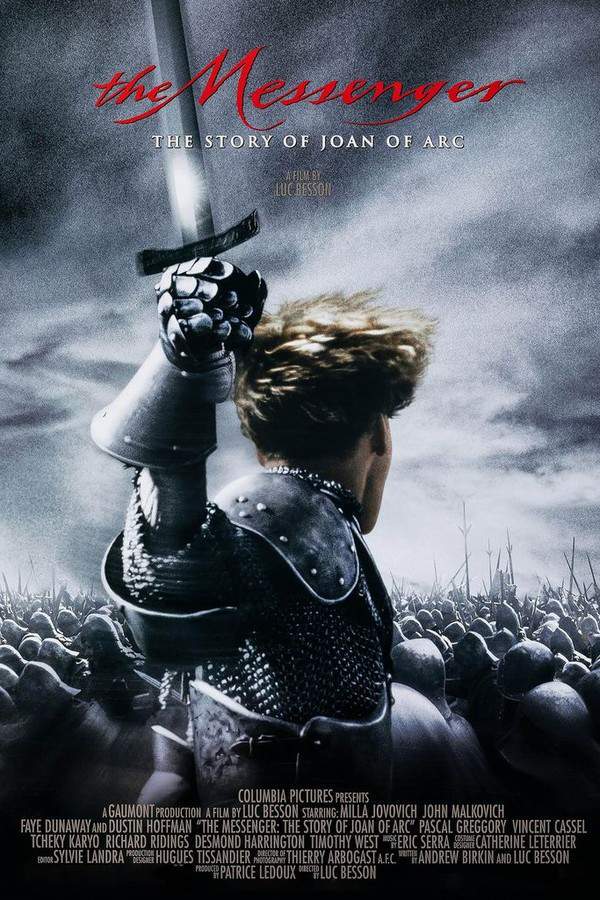
The Messenger: The Story of Joan of Arc (1999) movie poster

Timeline

The Messenger: The Story of Joan of Arc (1999) Timeline Explained – Every Event in Order

Release, runtime and language
1999 · 148 min · English
Loading streaming availability…
Directed by
Luc Besson
Budget
$85M

A teenage peasant girl claims divine guidance to lead the French army against the English occupation, sparking a remarkable series of events. This biography explores the rise of Joan of Arc, detailing her miraculous experiences, prophetic visions, and pivotal battles. Defying societal norms, she inspires unwavering devotion and leaves a lasting impact on France before her tragic death at the young age of nineteen.

On this page (6)
  1. 1 Where to watch
  2. 2 Events in order (15)
  3. 3 Timeline questions answered
  4. 4 Movie threads
  5. 5 Movies like The Messenger: The Story of Joan of Arc
  6. 6 Every angle
Loading streaming availability…

15 events in order · contains spoilers

The Messenger: The Story of Joan of Arc Timeline: Events in Chronological Order

Every key event of The Messenger: The Story of Joan of Arc (1999) in order, scene by scene, with when and where it takes place. Use it to untangle flashbacks, time jumps and parallel storylines, to refresh your memory before the sequel or to find the exact scene you are thinking of.

  1. Childhood Trauma

    Young Joan of Arc experiences a traumatic event as her childhood village is consumed by flames. The chaos leaves her with emotional scars, compounded by relentless visions that plague her since early childhood.

    Where
    Joan's Village
  2. Death of Catherine

    During the turmoil, Joan is comforted by her older sister, Catherine, but fate turns cruel as Joan witnesses Catherine's brutal murder at the hands of English soldiers. This heart-wrenching experience shatters Joan's innocence, intensifying her feelings of loss and despair.

    Where
    Joan's Village
  3. Seeking Refuge

    After the tragedy, Joan is forced to seek refuge with distant relatives, carrying the heavy burden of her loss. This time of displacement shapes her into a resilient individual determined to reclaim her homeland.

    Where
    Relatives' Home
  4. Message to Charles VII

    Years later, Joan, now a teenager, sends an urgent message to Charles VII, the Dauphin of France. She implores him to gather an army to combat the English forces occupying their lands, believing in her divine mission.

    Where
    Chinon
  5. Recognition by Charles VII

    Upon receiving Joan, Charles VII is captivated by her passionate recounting of divine visions. With the encouragement of his mother-in-law, Yolande of Aragon, he welcomes her and believes in her potential to lead them to victory.

    Where
    Chinon
  6. Leading the French Forces

    Joan dons armor and takes charge of the French armies as they march toward Orléans, aiming to lift the siege. She faces initial skepticism from military commanders but begins to earn their respect and loyalty through her unwavering resolve.

    Where
    Orléans
  7. Battle at St. Loup

    Joan's strategic prowess is highlighted during key battles, particularly the successful capture of the stockade at St. Loup. Her daring charge inspires the troops, turning doubt into confidence and leading to a significant French victory.

    Where
    St. Loup
  8. Assault on Tourelles

    Despite injuries from enemy fire, Joan leads a fierce second assault on the English stronghold of Tourelles. Her determination and leadership culminate in the successful seizure of the fortress, further boosting the morale of the French forces.

    Where
    Tourelles
  9. Coronation of Charles VII

    After a series of victories, Joan returns triumphantly to Reims for the coronation of Charles VII. This moment symbolizes not only a pivotal point for France but also Joan's role in shaping the destiny of her country.

    Where
    Reims
  10. Betrayal at Compiègne

    Despite her earlier successes, Joan's significance begins to diminish in Charles's eyes. This shift leads to her betrayal and capture by the pro-English Burgundians at Compiègne, marking a tragic turn in her fortunes.

    Where
    Compiègne
  11. Imprisonment in Rouen

    Joan finds herself shackled and imprisoned in Rouen, awaiting a grim fate as tension mounts among her captors. Her once-mighty presence is a shadow of its former self, as she contemplates her uncertain future.

    Where
    Rouen
  12. Trial for Heresy

    As her trial for heresy begins, the English forces move quickly to condemn Joan, fearing her influence over their troops. Under immense pressure, Bishop Cauchon ultimately succumbs and drives the proceedings toward a conviction.

    Where
    Rouen
  13. Renouncing Divine Guidance

    In a desperate attempt to save her life, Joan reluctantly agrees to recant her claims of divine guidance. This act, meant to protect her, is twisted against her, sealing her tragic fate rather than granting her freedom.

    Where
    Rouen
  14. Final Days and Execution

    Confined and stripped of her dignity, Joan faces execution with courage as she is burned alive in the public square of Rouen. Her anguished cries resonate through the crowd, marking a sorrowful end to her remarkable life.

    Where
    Rouen
  15. Legacy as a Saint

    In a poignant turn of events, Joan of Arc is later canonized as a saint in the 20th century. Her story becomes a symbol of enduring strength and faith, inspiring generations to come with her remarkable tenacity against overwhelming odds.

Last updated: November 21, 2024 at 11:12

Was this helpful?

Timeline questions answered

The Messenger: The Story of Joan of Arc Timeline Explained: Your Questions Answered

When does it happen, and why in that order? The questions people ask about the chronology of The Messenger: The Story of Joan of Arc (1999): time jumps, flashbacks, cause and effect between scenes and the correct order of events, each answered with spoilers.

Q1

Why does Charles VII believe in Joan's claims of divine guidance?

Charles VII is convinced by Joan's passionate recounting of her visions and the circumstances surrounding her arrival. His mother-in-law Yolande of Aragon encourages him to see Joan as a gift from God, and Charles is desperate for any advantage against the English. He sees her as a potential asset who could unite the French people and turn the tide of the war, which is why he welcomes her and grants her command of the armies.

  • charles vii
  • Yolande of Aragon
  • divine visions
  • chinon
  • belief
Q2

How does Joan gain the French army's trust despite being a peasant girl?

Joan earns the army's loyalty through a combination of strategic victories and unwavering resolve. She initially faces skepticism from commanders who doubt her authority, but her success at the Battle of St. Loup and her daring charge inspire the troops. Her willingness to fight alongside them and her refusal to back down despite injuries demonstrate her commitment, transforming doubt into devotion.

Foreshadowing: The timeline shows Joan was already marked by trauma and visions from childhood, giving her an unshakeable conviction that radiates outward.

  • french army
  • military leadership
  • st loup
  • battle
  • trust
  • commanders
Q3

Why does Charles VII withdraw support from Joan after her victories?

After Joan's military successes at Orléans and the coronation, Charles VII becomes less dependent on her politically. He grows concerned about the financial strain of her campaigns and the growing power of her influence over the military. Rather than viewing her as essential, he sees her as an increasingly expensive asset whose purpose has been largely fulfilled.

  • charles vii
  • betrayal
  • support
  • finances
  • paris campaign
Q4

Why does Joan agree to renounce her divine visions?

Joan signs the recantation under extreme duress while imprisoned in Rouen. Bishop Cauchon pressures her to renounce her claims as a desperate attempt to save her life from execution. She hopes that by denying her visions, she will be spared. However, this act is immediately twisted against her by the English, who use it as proof of her earlier deception rather than granting her freedom.

  • recantation
  • heresy trial
  • bishop cauchon
  • visions
  • rouen prison
Q5

Why is Joan executed even after she recants her claims?

The English have already decided they want Joan dead regardless of her cooperation. Her recantation is leveraged against her, they argue that if she truly believed in her visions, she would not have renounced them, making her initial claims fraudulent. This gives them justification to proceed with execution while appearing to have given her a chance at mercy. Additionally, they orchestrate the scandal of stripping her clothing and forcing men's attire on her, creating grounds to accuse her of sorcery and burn her alive.

  • execution
  • recantation
  • sorcery
  • burning
  • rouen
  • english
Q6

How is Joan captured at Compiègne?

Joan is betrayed and captured by the pro-English Burgundians at Compiègne. Charles VII has already withdrawn his support, leaving her without royal protection or reinforcements. The Burgundians seize this opportunity to capture her and sell her to the English, who see her as a significant threat to their military and political standing in France.

  • compiègne
  • burgundians
  • capture
  • betrayal
  • english
Q7

What is Bishop Cauchon's role in Joan's trial and execution?

Bishop Cauchon serves as the judge in Joan's heresy trial, presiding over the proceedings in Rouen under intense pressure from the English. Though he shows initial hesitation, he ultimately succumbs to the English demand for conviction. He insists that Joan renounce her visions to save herself, but then allows the English to twist this recantation against her. He also abandons her when the English strip her clothing and dress her in men's attire, refusing to intervene as they use this as evidence of sorcery.

  • bishop cauchon
  • trial
  • heresy
  • rouen
  • judge
  • church
Q8

Why are the English so desperate to execute Joan?

The English fear Joan's influence over their own soldiers as much as over the French. Her presence bolsters French morale while demoralizing English troops who have heard stories of her divine mission. They worry she could turn the tide of the war further against them, so they rush to eliminate her before she can escape or regain her influence. The trial is expedited precisely because they fear what might happen if she remains alive.

  • english soldiers
  • influence
  • fear
  • military threat
  • trial urgency
Q9

What happens to Joan in her final days in prison?

In her final days, Joan is confined in isolation and subjected to psychological torment. The English devise a scheme to destroy her reputation by stripping her of her clothing and forcing her into men's attire, then accusing her of sorcery. When she suspects this is a trap to incriminate her, Bishop Cauchon refuses to help her. This ordeal breaks her spirit and sets the stage for her execution as a sorceress and heretic.

  • prison
  • mens clothing
  • sorcery
  • strip
  • humiliation
  • rouen
Q10

Where do Joan's divine visions come from?

Joan's visions have plagued her since early childhood, beginning after she witnesses her village being burned and later watches her sister Catherine brutalized and murdered by English soldiers. These traumatic experiences, combined with the chaos and violence of war, manifest as religious visions that Joan interprets as divine guidance from God, saints, and angels. These visions become the foundation of her mission to save France.

  • visions
  • childhood trauma
  • catherine
  • english soldiers
  • divine mission
Q11

Why does Joan's campaign to take Paris fail?

After her coronation of Charles VII, Joan launches an assault on Paris but faces repeated rejections when she requests reinforcements. Without adequate support, the campaign stalls. Charles VII, who has already begun to distance himself from Joan, refuses to commit additional forces. The lack of reinforcement dooms the assault to failure, marking the beginning of Joan's decline in importance at the French court.

  • paris
  • campaign
  • reinforcements
  • failure
  • charles vii

Movie threads

More Movies Like The Messenger: The Story of Joan of Arc, by Mood & Story

Curated lists built around what makes The Messenger: The Story of Joan of Arc tick: the same mood, the same kind of story or the same emotional payoff. Each list explains why these movies belong together.

Movies about tragic historical martyrs like The Messenger: The Story of Joan of Arc

Intense stories of visionary figures who rise and fall through faith and fire. Discover more movies like The Messenger: The Story of Joan of Arc that explore the rise and tragic fall of historical figures. These similar biography dramas often feature themes of faith, female empowerment, and historical tragedy, leading to a sad and emotionally heavy conclusion.

  • tragic
  • devout
  • somber
  • inspiring
  • harrowing
  • oppressive
  • Tone: dark, tragic, devout
  • Pacing: steady, biographical
Why these movies?

The story pattern: The narrative follows a clear arc: a protagonist, often young and divinely inspired, rises to a position of immense influence against overwhelming odds. Their initial success and fervent hope are slowly eroded by political betrayal, public doubt, and eventual persecution, leading to a climactic, somber execution that cements their legacy as a martyr.

Why they belong together: These films are grouped by their shared focus on a real-life martyr's journey, blending high-intensity historical drama with a dark, oppressive tone. They feature a steady pacing that builds inexorably towards a known, tragic endpoint, creating a harrowing and devout viewing experience centered on sacrifice.

Intense psychological war dramas with a dark tone like The Messenger: The Story of Joan of Arc

War stories where the battlefield is both external and inside the mind. If you liked the psychological depth and brutal war violence in The Messenger: The Story of Joan of Arc, explore these similar movies. These dark war dramas often feature heavy emotional weight, complex characters, and a steady pacing that builds towards a bleak or sad ending.

  • intense
  • brutal
  • desperate
  • oppressive
  • somber
  • psychological
  • Tone: dark, brutal, desperate
  • Pacing: steady, immersive
Why these movies?

The story pattern: These narratives unfold in a wartime setting but prioritize the internal conflict of a central leader or soldier. The plot intertwines military strategy with the protagonist's psychological unraveling or spiritual crises. The steady pacing allows for a deep exploration of this mental anguish, which often becomes as destructive as the physical war, leading to a desperate or tragic conclusion.

Why they belong together: Movies in this thread share a high-intensity, dark tone derived from the fusion of graphic war violence and profound psychological torment. They are connected by a heavy emotional weight, a focus on the cost of leadership and conviction, and a relentlessly somber mood that leaves a lasting impact.

If you liked this

Movies Like The Messenger: The Story of Joan of Arc

Similar movies to The Messenger: The Story of Joan of Arc: the same genre, themes or kind of story. Each one comes with its own plot summary, timeline and ending explained.

Browse all movie summaries

Every angle

The Messenger: The Story of Joan of Arc (1999) Explained: Plot, Timeline & Characters

Everything about The Messenger: The Story of Joan of Arc in one place: what happens in the plot summary, the timeline in chronological order, the characters and meaning and a spoiler-free summary. What's After the Movie adds the cast, box office and post-credit scenes.

Coming soon on iOS and Android

The Plot Explained Movie Summary App

Plot summaries, endings explained and timelines on your phone. Catch up on any movie in minutes, save your favorites and never miss a twist again.

Be the first to know when we launch. Your email stays private, always.

Learn more about the app