










Plot Explained Spoilers guaranteed!
Plot Explained

Browse by genre

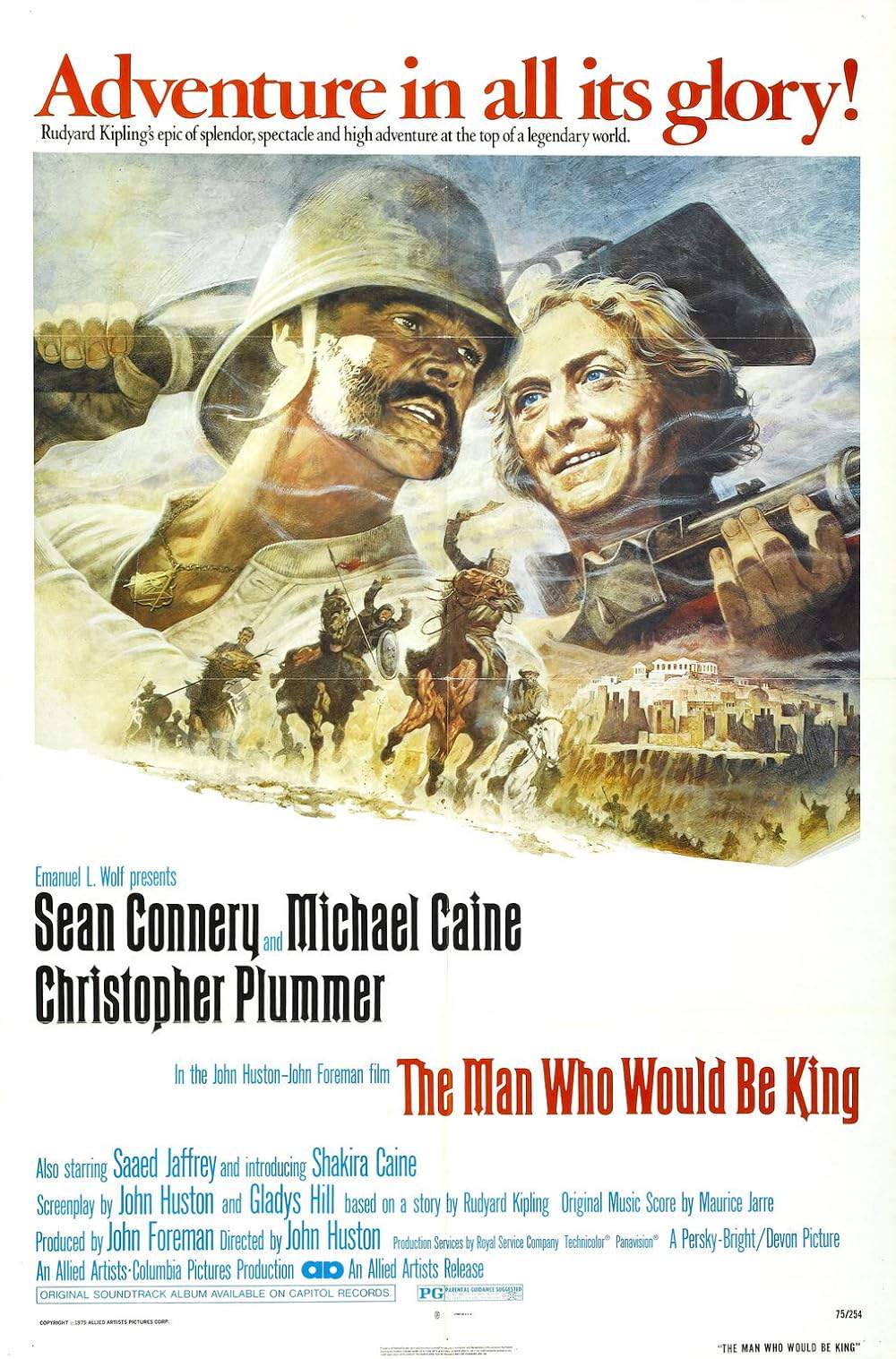
The Man Who Would Be King (1975) movie poster

Timeline

The Man Who Would Be King (1975) Timeline Explained – Every Event in Order

Release, runtime and language
1975 · 129 min · English
Starring
Sean Connery, Michael Caine, Christopher Plummer, Albert Moses, Doghmi Larbi, Jack May

Two former British Army sergeants, Daniel Dravot and Peachy Carnehan, find their current lives lacking adventure and hatch a daring, audacious plan. Seeking fortune and glory, they journey to a remote region of Kafiristan. Through a series of events, Daniel is proclaimed king, and the pair find themselves embroiled in a complex situation, facing challenges and moral dilemmas as they navigate their unexpected rise to power and the consequences of their ambition.

On this page (7)
  1. 1 Where to watch
  2. 2 Events in order (15)
  3. 3 Timeline questions answered
  4. 4 The book behind the movie
  5. 5 Movie threads
  6. 6 Movies like The Man Who Would Be King
  7. 7 Every angle

Where to watch

Where to Watch The Man Who Would Be King (1975)

Where can you watch The Man Who Would Be King? Stream, rent or buy it in the US, including on Hoopla, Plex and Tubi TV: current JustWatch availability with up-to-date prices.

Streaming availability powered by JustWatch

15 events in order · contains spoilers

The Man Who Would Be King Timeline: Events in Chronological Order

Every key event of The Man Who Would Be King (1975) in order, scene by scene, with when and where it takes place. Use it to untangle flashbacks, time jumps and parallel storylines, to refresh your memory before the sequel or to find the exact scene you are thinking of.

  1. Meeting in 1885 India

    In the year 1885, journalist Rudyard Kipling encounters a scruffy derelict who turns out to be his old friend, Peachy Carnehan. Carnehan begins to recount their adventurous past, setting the stage for the tales of ambition and betrayal that follow.

    When
    1885
    Where
    India
  2. The Pocket-Watch Incident

    Three years prior, Carnehan and his comrade Danny Dravot stole Kipling's pocket-watch. Upon discovering a masonic tag, Carnehan felt a strong obligation to return it, revealing a connection that would intertwine their fates.

    When
    1882
  3. The Blackmail Scheme

    After their first encounter with Kipling, Carnehan and Dravot attempt to blackmail a local raja. Their plans are thwarted when Kipling calls upon the British district commissioner to intervene, demonstrating the thin line between integrity and manipulation.

  4. Reversal of Fortune

    In a twist, Carnehan successfully blackmails the commissioner, allowing him to evade deportation. This act sets the tone for their further unscrupulous ambitions in India, revealing the lengths they will go for freedom and profit.

  5. Dreaming of Kafiristan

    Faced with the monotony of life in civilized India, Carnehan and Dravot decide to embark on a bold journey to Kafiristan. Armed with rifles and ammunition, their goal is to conquer and exploit the region that has remained largely untouched by Europeans.

    Where
    Kafiristan
  6. Journey Beyond the Khyber Pass

    The duo sets off on a treacherous journey through the Khyber Pass, braving bandits and blizzard conditions. Their determination to carve out a destiny for themselves deepens as they navigate the perilous terrains of Afghanistan.

    Where
    Khyber Pass
  7. Encounter with Billy Fish

    Upon reaching Kafiristan, Carnehan and Dravot meet Billy Fish, a Gurkha soldier who becomes their ally. He helps them bridge cultural gaps and provides vital connections that assist them in their rise to power among local leaders.

  8. Military Conquests

    With their newfound military might, Carnehan and Dravot join forces with a local chief in a plundered village. They lead successful raids against rival factions, gaining respect and followers through their cunning strategies.

    Where
    Kafiristan
  9. Dravot's Divine Revelation

    After a fierce battle, an arrow strikes Dravot's jacket, reinforcing the belief among locals that he is a divine figure. This moment marks a turning point in their conquests, as Dravot's persona starts to take on a godlike status among the villagers.

  10. The Sacred Test of Godhood

    The high priest of Sikandergul summons Dravot and Carnehan to validate Dravot's supposed divinity through a dramatic reenactment. When a sacred symbol is discovered around Dravot’s neck, he is hailed as both king and god, sealing his fate with the locals.

    Where
    Sikandergul
  11. Discovering the Royal Treasury

    As Dravot's influence grows, he discovers a royal treasury filled with gold and jewels. Despite Carnehan's warnings to flee while they can, Dravot is intoxicated by his newfound power and decides to cement his position among the people.

  12. The Forbidden Desire

    Dravot's affection for the local beauty Roxane leads him to violate his oath with Carnehan. He chooses to marry her, hoping to establish a dynasty, demonstrating how ambition can cloud judgment and lead to downfall.

  13. The Revelation of Mortality

    When Roxane is brought to Dravot, fear overcomes her, leading to a violent confrontation. In a shocking turn of events, her resistance unveils Dravot's humanity, provoking the villagers who had revered him.

  14. Dravot's Downfall

    As villagers rage against Dravot's betrayal, he is captured and placed on a rope bridge. In a moment of defiance, he sings a hymn, but the bridge gives way, leading to his tragic fall and the collapse of their empire.

  15. Carnehan's Return as a Beggar

    After surviving a night of brutal imprisonment, Carnehan returns to India, now broken and homeless. The saga of ambition and betrayal concludes as he leaves Kipling with a grim reminder of their disastrous adventure: Dravot's skull adorned with a golden crown.

    Where
    India

Last updated: November 16, 2024 at 12:10

Was this helpful?

Timeline questions answered

The Man Who Would Be King Timeline Explained: Your Questions Answered

When does it happen, and why in that order? The questions people ask about the chronology of The Man Who Would Be King (1975): time jumps, flashbacks, cause and effect between scenes and the correct order of events, each answered with spoilers.

Q1

Why did the local people in Kafiristan believe Dravot was a god?

The belief in Dravot's divinity stemmed from a battle where an arrow struck his jacket but failed to penetrate, leaving him unscathed. This apparent miracle convinced both the villagers and their enemies that he possessed supernatural protection. The high priest of Sikandergul later reinforced this belief by using Dravot's masonic tag, inscribed with sacred symbols, as proof that he was Sikander (Alexander the Great) returned to claim his kingdom.

Foreshadowing: Earlier, the Gurkha Billy Fish warns Dravot that the locals believe in signs and miracles, foreshadowing how a single lucky incident would be interpreted as divine intervention.

  • dravot godhood
  • kafiristan
  • divine king
  • arrow incident
  • sikander
Q2

Why did Dravot break his oath and decide to marry Roxane?

Dravot's decision to marry Roxane was driven by his growing attachment to power and his desire to establish a lasting legacy. Having been proclaimed king and god, he wanted to cement his rule by producing an heir, someone to inherit his kingdom and maintain his divine lineage among the locals. His ambition to be treated as an equal by Queen Victoria also fueled this desire, as he dreamed of building a dynasty that would endure beyond his own reign.

Foreshadowing: Carnehan had warned Dravot that taking women would destroy their scheme, and earlier the two swore oaths to avoid both women and drink, oaths that Dravot ultimately abandoned as his ego swelled.

  • rooxane
  • dravot marriage
  • ambition
  • dynasty
  • betrayal
Q3

How did Dravot's masonic tag become proof of his godhood?

The high priest of Sikandergul orchestrated a dramatic test to confirm Dravot's divinity. During the reenactment, the priest 'discovered' the masonic tag around Dravot's neck and declared its symbols to be sacred markers left by Sikander (Alexander the Great). Since the locals believed Alexander had visited their land centuries ago, the tag was interpreted as proof that Dravot was the returning king and god they had been awaiting.

Foreshadowing: Kipling gave Dravot his masonic tag as a symbol of brotherhood before their journey, not knowing it would be reinterpreted as religious evidence.

  • masonic tag
  • alexander great
  • sikandergul
  • high priest
  • divine proof
Q4

Why did Roxane bite Dravot when she was brought to him?

Roxane bit Dravot out of fear and resistance. As a local beauty given to the 'god-king' against her will, she panicked when Dravot attempted to kiss her. Her bite broke the skin and drew blood, physically demonstrating that Dravot was mortal, not the divine being the villagers had proclaimed. This moment shattered the illusion of his godhood and triggered the villagers' violent reaction against him.

Foreshadowing: The text notes that fear overtook Roxane when she was brought to Dravot, indicating she was a unwilling participant in this arrangement.

  • roxane bite
  • dravot mortality
  • revelation
  • village anger
Q5

What happened to Dravot on the rope bridge and why did he sing?

After being exposed as mortal, Dravot was captured and forced onto a rope bridge by the enraged villagers. As the bridge was cut, he defiantly sang 'The Son of God Goes Forth to War', a hymn that references Christ's sacrifice, even though he had abandoned his earlier moral compass. His singing represented a final moment of either religious conviction or bitter irony, as he faced death having betrayed both his companion and his stated principles.

Foreshadowing: This hymn echoes the earlier religious themes, as Dravot had allowed himself to be worshipped as a god despite being a mere mortal.

  • rope bridge
  • dravot death
  • hymn
  • son of god goes forth to war
Q6

Why didn't Carnehan leave with the treasure when he had the chance?

Carnehan did urge Dravot to flee with the treasure before things escalated, but Dravot refused. Dravot had become intoxicated by the locals' reverence and his new role as king and judge. He rejected the plan to abandon the kingdom, dreaming instead of corresponding with Queen Victoria as an equal ruler. His ambition and ego overrode Carnehan's caution, leading to their eventual downfall.

Foreshadowing: Carnehan suggests taking as much treasure as they could carry early on, but Dravot dismisses this in favor of remaining to enjoy his newfound power.

  • treasure
  • dravot greed
  • carnehan warning
  • gold jewels
Q7

What happened to Billy Fish after Dravot's downfall?

The summary does not detail Billy Fish's specific fate after Dravot's death. He was the Gurkha survivor of an earlier British expedition who helped bridge the cultural gap between the newcomers and local leaders, and he aided their rise to power. However, when the villagers turned against Dravot, there is no record of Billy Fish's ultimate outcome.

Foreshadowing: Billy Fish had warned Dravot about local beliefs in signs and miracles, showing he understood the cultural dynamics better than the two ex-sergeants.

  • billy fish
  • gurkha
  • kafiristan
  • ally
Q8

How did Carnehan survive being crucified between two trees?

Carnehan was crucified between two trees and spent a night in this brutal position, but he somehow survived until morning when he was eventually freed. The experience left him mentally and physically shattered, transforming him from a confident adventurer into a broken beggar who returned to India. The film leaves the exact mechanism of his survival ambiguous, emphasizing instead the severe physical and psychological damage he endured.

Foreshadowing: The text notes that he was imprisoned but 'survives the night', a survival that seems almost miraculous given the brutal treatment he received.

  • carnehan crucifixion
  • survival
  • imprisonment
  • shattered
Q9

What is the significance of Dravot's skull with the golden crown?

When Carnehan leaves Kipling's office at the end, he leaves behind a bundle containing Dravot's skull adorned with a golden crown. This grim token serves as the ultimate symbol of their failed ambition, the crown they sought through deception became the literal ornament of Dravot's death. It represents the tragic irony of their journey: they went to Kafiristan seeking fortune and power, but ended with one friend dead and the other destroyed, leaving only this macabre souvenir as proof of their adventure.

Foreshadowing: Earlier, Dravot dreams of being treated as an equal by Queen Victoria while wearing a golden crown, a stark contrast to how he actually dies and is remembered.

  • dravot skull
  • golden crown
  • ending
  • symbol
  • irony
Q10

Why was the journey through the Khyber Pass significant to the story?

The Khyber Pass represented the threshold between the civilized British world and the wild, uncharted territory of Kafiristan. Crossing it marked the point of no return for Dravot and Carnehan, their old lives as minor criminals in India were officially over. The harsh conditions they faced (bandits, blizzards, avalanches) during this journey also established their determination and resilience, qualities that initially helped them succeed in Kafiristan but ultimately could not save them from the consequences of their hubris.

Foreshadowing: The journey beyond the Khyber Pass begins their transformation from ex-sergeants into conquerors, setting the stage for everything that follows.

  • khyber pass
  • afghanistan
  • journey
  • crossing
  • threshold
Q11

Why did Dravot want to be treated as equal to Queen Victoria?

Dravot's aspiration to be treated as an equal by Queen Victoria represented the ultimate expression of his inflated ego. As a former British Army sergeant who had emigrated to India to escape dull, underpaid work, he had always felt beneath the British social order. Becoming king in Kafiristan gave him a taste of real power, and he began to believe he had ascended to a level where he could negotiate with the British Empire as a peer rather than a subject. This delusion contributed to his decision to stay and marry Roxane, as he thought a dynasty would legitimize his position.

Foreshadowing: His desire to match Queen Victoria directly contrasts with his original plan to simply exploit the region and return wealthy, a plan that required no such grand ambitions.

  • queen victoria
  • equal
  • ambition
  • british empire
  • delusion

Movie threads

More Movies Like The Man Who Would Be King, by Mood & Story

Curated lists built around what makes The Man Who Would Be King tick: the same mood, the same kind of story or the same emotional payoff. Each list explains why these movies belong together.

Hubristic Journeys Into The Unknown like The Man Who Would Be King

Ambitious quests where pride leads to a catastrophic and tragic fall. If you like The Man Who Would Be King, explore other movies about ambitious characters whose pride leads to a tragic fall. These films share a dark tone and heavy emotional weight, focusing on the dangerous consequences of overreaching ambition in unfamiliar and treacherous worlds.

  • hubristic
  • tragic
  • fatalistic
  • ambitious
  • epic
  • brooding
  • Tone: dark, tragic, fatalistic
  • Pacing: steady, epic
Why these movies?

The story pattern: Narratives in this thread typically follow a clear arc: ambition sparks a daring venture, initial success fuels dangerous arrogance, and a fatal miscalculation triggers a swift and complete collapse. The journey is less about external conquest and more about the internal corruption that power and pride bring.

Why they belong together: Movies are grouped here for their shared focus on the fatal flaw of hubris. They create a specific, tragic tension where the audience watches characters they may even admire walk willingly into their own destruction, resulting in a bleak and morally complex viewing experience.
Friendship Tested By Power And Greed like The Man Who Would Be King

Stories of deep bonds shattered by the corrosive lure of power and fortune. Find movies like The Man Who Would Be King where a powerful friendship is shattered by ambition. These similar stories explore how loyalty cracks under the pressure of greed and power, often set against epic backdrops and leading to emotionally heavy, tragic conclusions.

  • tragic
  • brooding
  • betrayal
  • friendship
  • greed
  • moral dilemma
  • Tone: dark, tragic, brooding
  • Pacing: steady, character-driven
Why these movies?

The story pattern: The narrative pattern revolves around a central, seemingly unbreakable friendship. A shared goal or windfall initially strengthens the bond, but as power accumulates, one friend's ambition corrupts them, leading to a pivotal act of betrayal. The story then chronicles the agonizing dissolution of the relationship, often with fatal consequences.

Why they belong together: These films are grouped by their powerful exploration of a specific emotional conflict: the destruction of camaraderie by ambition. They resonate because they pit deep personal connection against the impersonal forces of greed and power, creating high-stakes drama and profound sadness.

If you liked this

Movies Like The Man Who Would Be King

Similar movies to The Man Who Would Be King: the same genre, themes or kind of story. Each one comes with its own plot summary, timeline and ending explained.

Browse all movie summaries

Every angle

The Man Who Would Be King (1975) Explained: Plot, Timeline & Characters

Everything about The Man Who Would Be King in one place: what happens in the plot summary, the timeline in chronological order, the characters and meaning and a spoiler-free summary. What's After the Movie adds the cast, box office and post-credit scenes.

Coming soon on iOS and Android

The Plot Explained Movie Summary App

Plot summaries, endings explained and timelines on your phone. Catch up on any movie in minutes, save your favorites and never miss a twist again.

Be the first to know when we launch. Your email stays private, always.

Learn more about the app