Plot Explained Spoilers guaranteed!
Plot Explained

Browse by genre

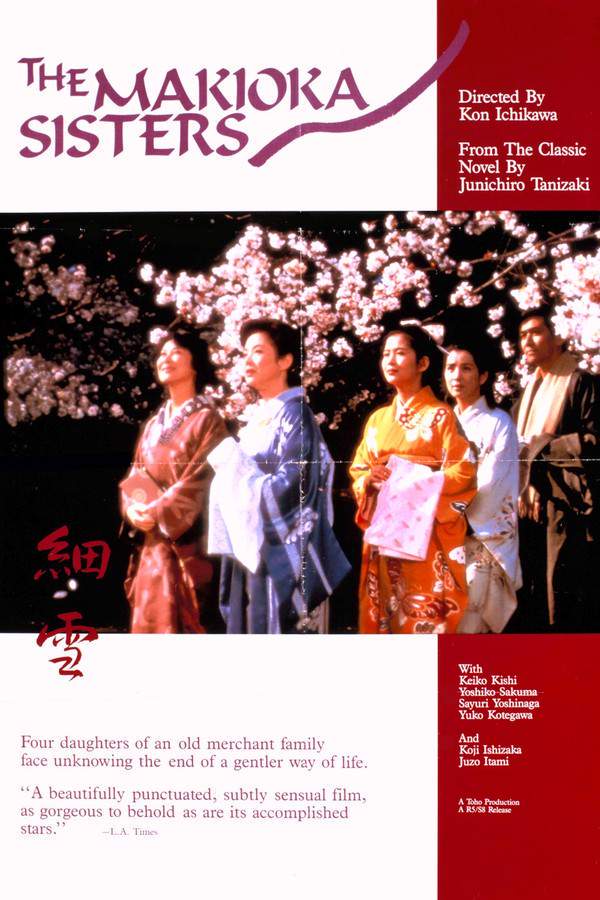
The Makioka Sisters (1983) movie poster

Timeline

The Makioka Sisters (1983) Timeline Explained – Every Event in Order

Release, runtime and language
1983 · 140 mins · Japanese
Directed by
Kon Ichikawa
Starring
Jûzô Itami, Akemi Negishi, Kuniko Miyake, Keiko Kishi, Yoshiko Sakuma, Koji Ishizaka

The film follows four Makioka sisters who reunite each spring in Kyoto to admire the cherry blossoms, using their ceremonies and daily rituals to illuminate the refined, pre‑war world of an affluent Osaka family. Their gatherings are interwoven with Japan’s changing seasons, reflecting the impermanence and beauty of both nature and tradition.

On this page (5)
  1. 1 Events in order (13)
  2. 2 Timeline questions answered
  3. 3 Movie threads
  4. 4 Movies like The Makioka Sisters
  5. 5 Every angle

13 events in order · contains spoilers

The Makioka Sisters Timeline: Events in Chronological Order

Every key event of The Makioka Sisters (1983) in order, scene by scene, with when and where it takes place. Use it to untangle flashbacks, time jumps and parallel storylines, to refresh your memory before the sequel or to find the exact scene you are thinking of.

  1. Sisters' Kyoto cherry blossom visit

    In spring 1938, the four Makioka sisters travel to Kyoto with Teinosuke and Sachiko's husband to admire the cherry blossoms. The visit brings family tensions to the surface as expectations around Yukiko, Taeko, and Tsuruko come into play. The trip foreshadows ongoing conflicts within the clan's main line.

    When
    Spring 1938
    Where
    Kyoto
  2. Tsuruko confronts the Yukiko marriage issue

    Tsuruko, heiress of the Makioka main house, upsets Yukiko by challenging the matter of Yukiko's engagement because of a feared flaw in the groom's clan. The family debates the responsibilities of maintaining the main house and its lineage. The dispute signals the fragile balance of tradition within the clan.

    When
    Spring 1938
    Where
    Kyoto
  3. Taeko's past elopement and newspaper error

    Five years earlier, Taeko runs away with Okuhata's third son, triggering a scandal that a newspaper mistakenly reports as Yukiko's elopement. The correction inflames the situation rather than appeasing it, forcing the clan to respond publicly. Tatsuo pushes for a formal refutation, but the misnaming escalates the embarrassment.

    When
    Circa 1933
    Where
    Osaka (Semba)
  4. Move from main house to Sachiko's branch

    Dissatisfied with the scandal, Yukiko and Taeko refuse to continue living in the main house and relocate to the Sachiko residence, a lateral branch of the Makioka clan. The shift deepens the family rift and signals the erosion of traditional control over marriages. The sisters adapt to life outside the main line's expectations.

    When
    Circa 1933-1934
    Where
    Sachiko's house
  5. Taeko starts making dolls and grows closer to Itakura

    Taeko begins making dolls and gradually loses interest in Okuhata as she grows closer to Itakura, who has left the jewelry business and become a photographer. This change marks Taeko's search for independence and emotional direction outside of the arranged marriage system. The evolving relationship influences her future choices.

    When
    1930s
    Where
    Semba, Osaka
  6. Yukiko's arranged brides fail to materialize

    Several groom candidates—including a bank broker, a prefectural council employee, and a pharmaceutical company executive—are arranged for Yukiko, but none lead to marriage as she rejects them. Her independence contrasts with the traditional expectations placed on her. The episode reveals the different ways the sisters resist the clan's control.

    When
    1930s
    Where
    Osaka
  7. Itakura's ear infection and death

    Itakura contracts an ear infection that leads to his sudden death, leaving Taeko shocked and bereft. The loss intensifies Taeko's grief and pushes her toward new directions rather than returning to old loyalties. The event reshapes the sisters' perceptions of duty and happiness.

    When
    1930s
    Where
    Osaka
  8. Tatsuo announces a Tokyo transfer; Tsuruko's disorientation

    Tatsuo informs the family that he will be transferred to Tokyo for work, prompting Tsuruko to confront a future without the stability of the main house. The impending move deepens the sense of distance within the clan. The prospect of a Tokyo life begins to redefine familial roles.

    When
    Circa 1938-1939
    Where
    Tokyo
  9. Higashidani proposal for Yukiko

    A new suitor emerges for Yukiko: the grandson of Viscount Higashidani, a representative of the former aristocracy, offers a return to a more prestigious line. The sisters weigh tradition against Yukiko's own wishes as they observe how she handles the proposal. Yukiko's choice becomes a quiet test of independence within the clan.

    When
    Late 1930s
    Where
    Osaka
  10. Taeko's bar life and new love

    Taeko, still grieving Itakura, begins visiting bars to drown her sorrow and meets Miyoshi, a diligent and honest bartender. She decides to leave her family home and move in with him, starting a new life away from the main house's expectations. This partnership gives her a sense of security and autonomy.

    When
    Late 1930s
    Where
    Osaka
  11. Tsuruko leaves for Tokyo with her husband

    After much hesitation, Tsuruko finally decides to uproot and move to Tokyo with her husband. The departure marks a major shift in the clan's leadership and social direction as the main house's influence wanes. The move also signals new possibilities for the sisters beyond Osaka.

    When
    Late 1930s
    Where
    Tokyo
  12. Yukiko and Higashidani plan marriage

    Yukiko and Mr. Higashidani decide to marry, providing stability for Yukiko's future and a quiet consolidation of an aristocratic alliance. The decision reflects a shift toward personal choice within the constraints of tradition. The choice also contrasts with Taeko's pursuit of independence.

    When
    Late 1930s
    Where
    Osaka
  13. Winter farewell at Osaka Station

    In a wintry Osaka scene, Yukiko, Teinosuke, and the others bid farewell to Tsuruko and her family as they depart for Tokyo. Sachiko declines to see them off, preferring restraint, while she visits Taeko at her new home. The two share tea and watch the falling snow, a quiet moment of sisterhood amid change.

    When
    Winter
    Where
    Osaka Station

Last updated: October 09, 2025 at 14:49

Was this helpful?

Timeline questions answered

The Makioka Sisters Timeline Explained: Your Questions Answered

When does it happen, and why in that order? The questions people ask about the chronology of The Makioka Sisters (1983): time jumps, flashbacks, cause and effect between scenes and the correct order of events, each answered with spoilers.

Q1

Why does Yukiko keep rejecting her arranged marriage candidates?

Yukiko rejects several suitors, including a bank broker, a prefectural council employee, and a pharmaceutical company executive, because she values personal choice over the family's traditional expectations. Her resistance reflects a broader theme in the film: the tension between maintaining family honor and pursuing individual happiness. Yukiko's independence contrasts sharply with the clan's insistence on strategic marriages to preserve their social standing.

Foreshadowing: The sisters' early discussion in Kyoto foreshadows the ongoing conflict between personal desire and family duty.

  • yukiko
  • arranged marriage
  • suitors
  • rejection
  • tradition
Q2

Why did Taeko run away with Okuhata's third son?

Taeko elopes with Okuhata's third son approximately five years before the main timeline, seeking to escape the constraints of the arranged marriage system. The act represents a bold assertion of personal freedom, though it brings shame to the Makioka family. The scandal is further compounded when a newspaper mistakenly reports the elopement as Yukiko's rather than Taeko's, forcing the clan to issue a public correction that only amplifies the embarrassment.

Foreshadowing: Taeko's early rebellion sets the pattern for her later unconventional choices.

  • taeko
  • elopement
  • okuhata
  • scandal
  • newspaper
Q3

Why do Yukiko and Taeko leave the main house to live with Sachiko?

After the elopement scandal damages the main house's reputation, both Yukiko and Taeko refuse to continue living there and relocate to Sachiko's residence, a branch of the Makioka clan in Semba, Osaka. This move signifies the erosion of traditional family control over the sisters' lives and deepens the rift within the family. The sisters adapt to life outside the main line's expectations, establishing greater personal autonomy.

Foreshadowing: The departure from the main house foreshadows the gradual dissolution of family unity.

  • main house
  • sachiko
  • branch family
  • yukiko
  • taeko
Q4

Why does Taeko start making dolls and grow closer to Itakura?

Taeko begins making dolls during the 1930s as she gradually loses interest in her engagement to Okuhata. She grows emotionally closer to Itakura, who leaves the jewelry business to become a photographer. This shift marks Taeko's search for independence and creative expression outside the arranged marriage system. Her evolving relationship with Itakura represents a genuine connection based on shared interests rather than family obligation.

Foreshadowing: The doll-making foreshadows Taeko's eventual departure from traditional roles.

  • taeko
  • dolls
  • itakura
  • photographer
  • independence
Q5

What causes Itakura's death and how does it affect Taeko?

Itakura contracts an ear infection that leads to his sudden death, leaving Taeko shocked and deeply grieving. The loss intensifies her sorrow and propels her toward new directions in life rather than returning to old loyalties. This tragedy reshapes the sisters' perceptions of duty and happiness, pushing Taeko further away from conventional expectations and toward seeking her own path.

Foreshadowing: Itakura's declining health is hinted at through Taeko's increasing melancholy.

  • itakura
  • death
  • ear infection
  • taeko
  • grief
Q6

Why does Tsuruko decide to move to Tokyo with her husband?

Tsuruko finally decides to uproot and move to Tokyo with her husband after much hesitation, prompted by her husband Tatsuo's work transfer. The departure marks a major shift in the clan's leadership and social direction as the main house's influence wanes. This decision represents both the disintegration of the traditional family structure and new possibilities for the sisters beyond Osaka.

Foreshadowing: Tatsuo's announcement of the transfer earlier signals the inevitable change.

  • tsuruko
  • tokyo
  • transfer
  • main house
  • departure
Q7

Why does Yukiko eventually accept the Higashidani marriage proposal?

Yukiko accepts the proposal from the grandson of Viscount Higashidani, a representative of the former aristocracy, because it offers her stability and a return to a prestigious social line. This choice represents a quiet compromise between personal wishes and family tradition. Unlike Taeko's rebellious path, Yukiko's decision reflects a more measured form of independence, choosing within the constraints of her society rather than defying it entirely.

Foreshadowing: The Higashidani proposal emerges after multiple rejected suitors, suggesting Yukiko's eventual acceptance of societal expectations.

  • yukiko
  • higashidani
  • marriage
  • aristocracy
  • proposal
Q8

Why does Taeko leave her family to be with Miyoshi the bartender?

After Itakura's death, Taeko begins visiting bars to drown her grief and meets Miyoshi, a diligent and honest bartender. She decides to leave her family home and move in with him, starting a new life away from the main house's expectations. This partnership gives her a sense of security and autonomy, representing her continued rejection of traditional marriage arrangements in favor of genuine emotional connection.

Foreshadowing: Taeko's bar visits following Itakura's death hint at her search for new meaning.

  • taeko
  • miyoshi
  • bartender
  • independence
  • new life
Q9

What is the significance of the sisters' annual Kyoto cherry blossom visits?

The four Makioka sisters travel to Kyoto each spring to admire the cherry blossoms, using these gatherings to maintain family bonds and observe traditional rituals. The visits bring family tensions to the surface, particularly regarding marriage expectations and lineage responsibilities. The cherry blossom season serves as a metaphor for the impermanence of tradition and the beauty found in cyclical change, reflecting the film's melancholic meditation on a world in transition.

Foreshadowing: The opening Kyoto trip establishes the pattern of reunion and conflict that defines the sisters' relationships.

  • kyoto
  • cherry blossoms
  • sisters
  • tradition
  • ritual
Q10

Why does the newspaper mistakenly report Yukiko's name instead of Taeko's for the elopement?

When Taeko elopes with Okuhata's third son, a newspaper mistakenly reports the scandal as Yukiko's elopement rather than Taeko's. This error likely occurs due to the family's prominence and Yukiko's status as the elder unmarried sister, making her a more newsworthy subject. The misnaming escalates the family's embarrassment, as Tatsuo pushes for a formal refutation that only draws more attention to the scandal.

Foreshadowing: The newspaper error compounds the family's public shame from the original elopement.

  • newspaper
  • error
  • yukiko
  • taeko
  • elopement
  • scandal
Q11

What is the conflict between the Makioka main house and branch families?

The Makioka family operates under a hierarchical system where the main house (headed by Tsuruko as heiress) holds authority over branch families like Sachiko's household. The main house is responsible for maintaining lineage and social standing through strategic marriages. The tension arises when branch family members assert independence, such as Yukiko and Taeko moving out, challenging the main house's control over marriage decisions and family reputation.

Foreshadowing: Tsuruko's confrontation with Yukiko about marriage in Kyoto exposes these underlying tensions.

  • main house
  • branch family
  • clan
  • tradition
  • hierarchy
Q12

What happens at the final winter farewell at Osaka Station?

In a wintry scene at Osaka Station, Yukiko, Teinosuke, and others bid farewell to Tsuruko and her family as they depart for Tokyo. Sachiko chooses not to see them off, preferring restraint, but instead visits Taeko at her new home. The two sisters share tea and watch the falling snow, a quiet moment of connection amid change. This scene symbolizes the end of an era for the family and the bittersweet nature of transformation.

Foreshadowing: The farewell crystallizes the themes of departure and impermanence that run throughout the film.

  • osaka station
  • farewell
  • tsuruko
  • sachiko
  • taeko
  • winter

Movie threads

More Movies Like The Makioka Sisters, by Mood & Story

Curated lists built around what makes The Makioka Sisters tick: the same mood, the same kind of story or the same emotional payoff. Each list explains why these movies belong together.

Movies about fading traditions like The Makioka Sisters

Beautiful, slow-paced stories about the quiet loss of old-world grace. If you enjoyed the elegant and melancholic mood of The Makioka Sisters, this collection showcases similar films that explore beautiful worlds in transition. Find movies like this that capture fading traditions, changing societies, and the bittersweet feeling of impermanence through graceful, character-driven stories.

  • elegant
  • melancholic
  • nostalgic
  • serene
  • contemplative
  • observational
  • Tone: melancholic, contemplative, elegant
  • Pacing: slow, deliberate, atmospheric
Why these movies?

The story pattern: Narratives in this thread are often observational and character-centric, unfolding through rituals, seasons, or daily life rather than high-stakes plots. The central conflict typically arises from the subtle tension between personal desires and societal duty, or the inexorable passage of time eroding cherished customs.

Why they belong together: Movies are grouped here for their shared serene yet melancholic tone, their focus on the aesthetics of a specific time and place, and their exploration of how individuals navigate the gentle, inevitable collapse of the worlds they know.

Movies about sisterhood and family duty like The Makioka Sisters

Intimate dramas where family bonds are tested by custom and expectation. For viewers who liked the family dynamics in The Makioka Sisters, this list features movies with similar themes of sisterhood, marriage customs, and societal pressure. Discover character-driven dramas where the bonds between siblings are central to the narrative and shaped by their cultural context.

  • family drama
  • sisterhood
  • societal pressure
  • marriage customs
  • character-driven
  • interwoven lives
  • Tone: observational, dramatic, bittersweet
  • Pacing: steady, character-driven
Why these movies?

The story pattern: These stories follow the interconnected lives of sisters, often using their relationships as a microcosm for larger societal shifts. The plot revolves around pivotal events like marriages, reunions, or conflicts that force the characters to negotiate their individual identities within the strictures of their family and culture.

Why they belong together: This thread connects films through their shared focus on the intricate dynamics of sisterhood, the thematic exploration of marriage and custom as social forces, and a moderate narrative complexity derived from multiple character perspectives within a single family unit.

If you liked this

Movies Like The Makioka Sisters

Similar movies to The Makioka Sisters: the same genre, themes or kind of story. Each one comes with its own plot summary, timeline and ending explained.

Browse all movie summaries

Every angle

The Makioka Sisters (1983) Explained: Plot, Timeline & Characters

Everything about The Makioka Sisters in one place: what happens in the plot summary, the timeline in chronological order, the characters and meaning. What's After the Movie adds the cast, box office and post-credit scenes.

Coming soon on iOS and Android

The Plot Explained Movie Summary App

Plot summaries, endings explained and timelines on your phone. Catch up on any movie in minutes, save your favorites and never miss a twist again.

Be the first to know when we launch. Your email stays private, always.

Learn more about the app